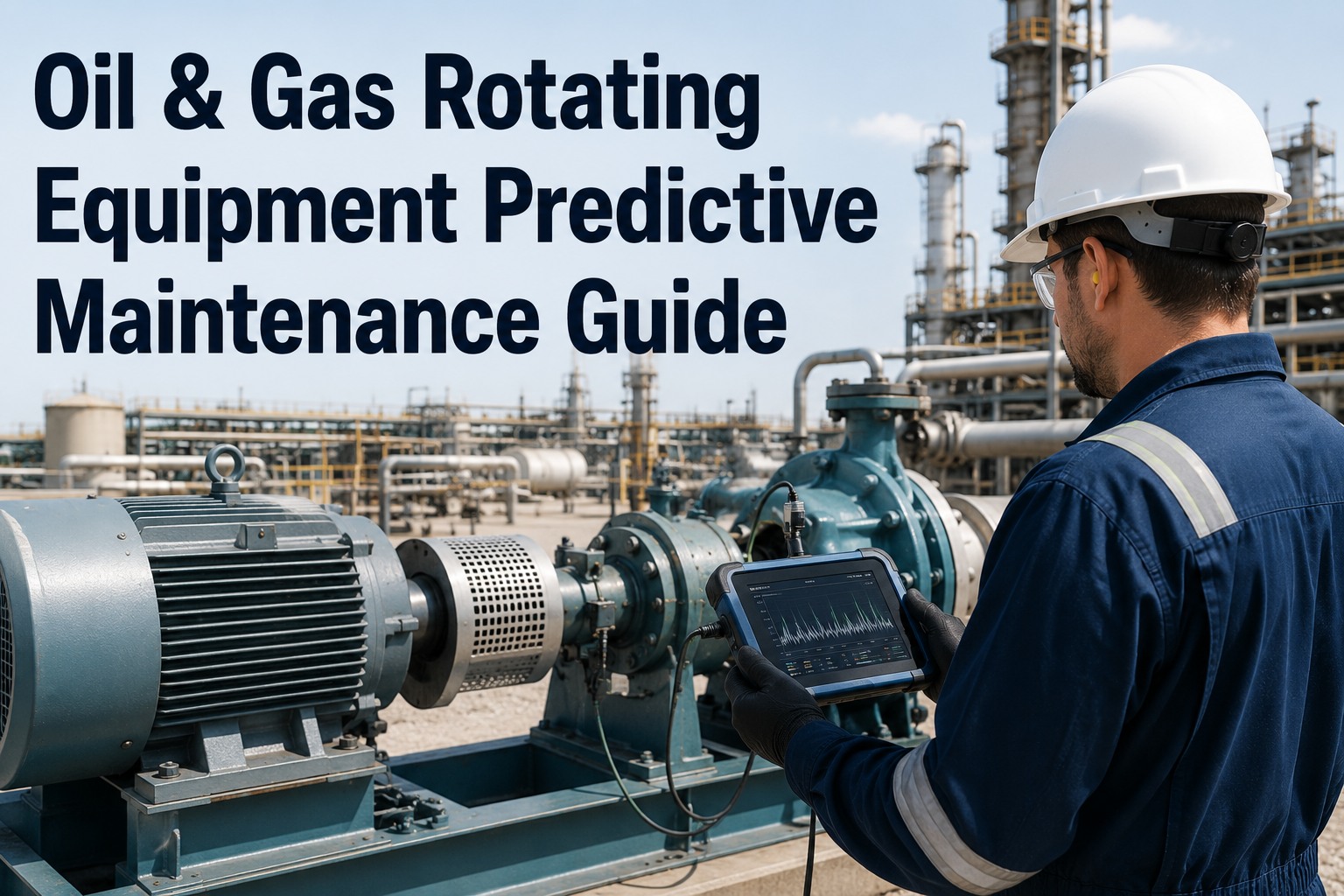
Oil and gas rotating equipment — pumps, compressors, turbines and motors — accounts for the majority of unplanned downtime events in upstream and midstream operations, yet most teams still manage these critical assets with time-based PMs and spreadsheet logs. A mature oil and gas predictive maintenance program shifts the model from calendar-based interventions to condition-based triggers, using vibration analysis, oil diagnostics and real-time sensor data to flag bearing wear, misalignment and cavitation weeks before failure. OxMaint gives reliability engineers the CMMS backbone to deploy rotating equipment PdM effectively — connecting condition-monitoring alerts to automated work orders, mechanical-integrity workflows and audit-ready documentation under PSM Element 5. You can Start Free Trial today or book a guided demo to see the platform on your asset hierarchy.
What if your pumps, compressors and turbines told you they were failing — 30 days before they did?
Rotating equipment drives 60–70% of unplanned downtime cost in oil and gas. A condition-based PdM program built on OxMaint catches bearing degradation, seal leaks and rotor imbalance early — turning surprise outages into planned weekend fixes.
Why oil & gas rotating equipment maintenance is a high-stakes reliability problem
A single failed centrifugal pump on a midstream pipeline can halt throughput for 6–18 hours, with deferred production, emergency repair crews and environmental reporting costs compounding quickly. The stakes are higher in upstream, where multi-stage gas compressors and gas turbines operate under PSM mechanical-intensity obligations.
The reliability gap isn't a lack of data — most facilities already have portable vibration collectors, oil labs and DCS alarms. The gap is orchestration: turning a trending sensor value into an approved, scheduled, parts-ready work order before the asset trips. That orchestration layer is exactly what a rotating equipment CMMS like OxMaint provides, closing the loop between condition monitoring and execution.
How to build an oil & gas reliability program for rotating equipment
A defensible oil and gas reliability program follows a phased progression — from asset criticality ranking through condition-monitoring technology selection, trigger-to-work-order automation, and KPI feedback. Skipping the CMMS foundation is the #1 reason PdM pilots stall.
Asset criticality & hierarchy
Rank every pump, compressor and turbine by production impact, safety risk and environmental consequence. Load the full asset hierarchy — parent child relationships, OEM data, design specs — into OxMaint so every work order and sensor reading ties to a specific component.
Baseline condition data
Collect baseline vibration spectra, oil analysis reports and performance curves. OxMaint stores unlimited condition-monitoring readings per asset, so reliability engineers can trend RMS velocity, peak acceleration and bearing defect frequencies over time on a single asset dashboard.
Set condition-based triggers
Define ISO 10816 alarm thresholds and custom PdM rules — e.g., "if vibration RMS exceeds 7.1 mm/s on Pump P-204, auto-generate a corrective work order and reserve spare bearings." OxMaint converts threshold breaches into prioritised work orders without manual data entry.
Close the execution loop
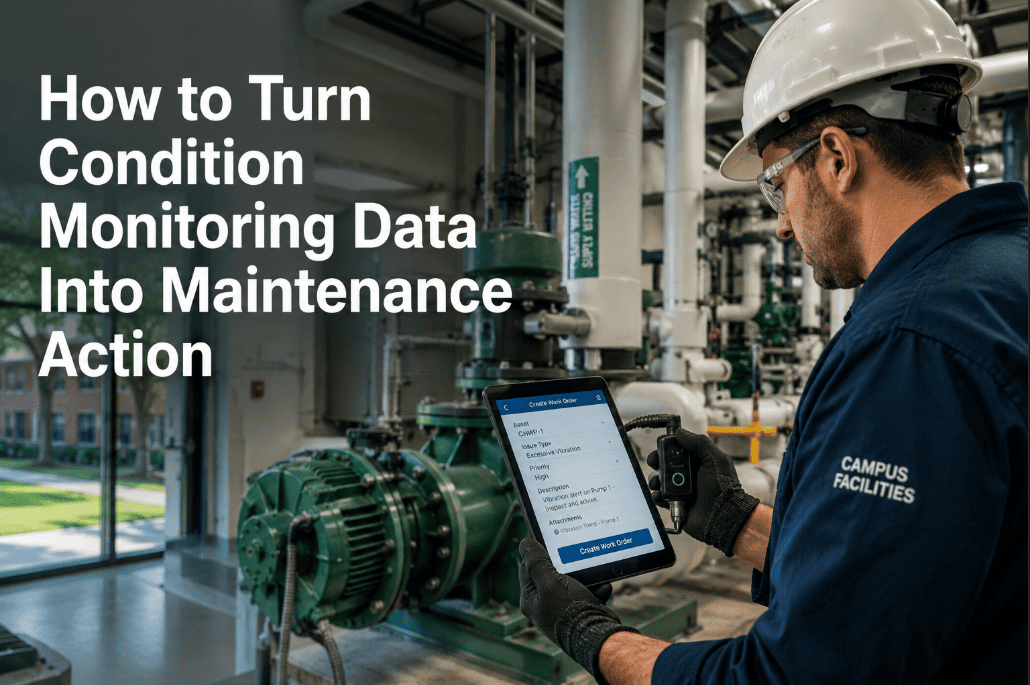
Technicians receive work orders on mobile devices with the vibration trend chart, fault diagnosis and recommended corrective action attached. Parts are auto-reserved from inventory. Completed work feeds back into the asset history, refining future predictions.
Pump vibration analysis, compressor condition monitoring & turbine health tracking
Each class of rotating equipment demands a different condition-monitoring lens. The table below maps the dominant failure modes, recommended PdM technology and the data each technique feeds into OxMaint for automated decision-making.
| Equipment | Top failure modes | PdM technique | OxMaint automation |
|---|---|---|---|
| Centrifugal pumps | Bearing wear, seal leakage, cavitation, misalignment | Vibration analysis (velocity & acceleration), flow/pressure performance curves | Auto work order on ISO 10816 threshold breach; spares reservation |
| Reciprocating & screw compressors | Valve failure, rod loading, gear tooth pitting, lube-oil degradation | Vibration + oil analysis + temperature mapping | Trend dashboard; multi-sensor alert fusion into single priority ticket |
| Gas turbines | Combustor can degradation, blade fouling, bearing vibration | High-frequency vibration, exhaust temp spread, borescope inspection | Inspection scheduling aligned to OEM firing-hour counts and PSM MI |
| Electric motors | Winding insulation breakdown, bearing current discharge, rotor bar cracks | Motor current signature analysis (MCSA), thermography, vibration | PdM rule engine triggers work order on combined electrical + vibration anomaly |
What does an oil & gas PdM program cost — and what does it save?
Reliability teams need to justify PdM investment with defensible numbers. The formula below is the baseline ROI model OxMaint helps customers build during onboarding. A typical 180-asset midstream facility spending $42K/month on reactive repairs can reach payback in under 5 months.
| Cost / saving category | Reactive baseline | With OxMaint PdM | Annual delta |
|---|---|---|---|
| Unplanned downtime (180-asset facility) | $504K/yr | $292K/yr | −$212K |
| Emergency callout & overtime labour | $86K/yr | $31K/yr | −$55K |
| Spare-parts inventory carrying cost | $120K/yr | $78K/yr | −$42K |
| OxMaint software + implementation | — | $24K/yr | +$24K |
| Net annual benefit | +$285K |
Worked example: a Gulf Coast midstream operator with 23 multi-stage gas compressors deployed OxMaint's condition-based trigger engine and reduced unplanned compressor trips by 38% in year one — recovering $1.2M in deferred throughput. The payback period was 4.3 months.
How OxMaint powers oil & gas rotating equipment PdM
OxMaint is the AI-powered CMMS + EAM platform that connects condition-monitoring data to work-order execution, mechanical-integrity compliance and maintenance analytics — purpose-built for maintenance and reliability teams in oil and gas.
Condition-based work-order automation
Vibration, oil and temperature thresholds from any monitoring system trigger auto-generated work orders in OxMaint — with fault diagnosis, recommended action and parts pre-reserved. Outcome: cut unplanned downtime 30–50% by catching failures 2–6 weeks earlier.
PSM Element 5 mechanical-integrity workflow
Built-in inspection templates, ITPs and audit trails align rotating-equipment PdM to OSHA PSM mechanical-intensity and ISO 55000 expectations. Outcome: pass audits without scrambling — every inspection, thickness reading and repair is time-stamped and traceable.
Spare-parts inventory optimisation
OxMaint links BOMs to asset records and auto-reserves critical spares (bearings, seals, valve kits) when a PdM work order is generated. Outcome: reduce inventory carrying cost 15–25% while eliminating "part not available" delays on critical repairs.
Maintenance analytics & MTBF tracking
Real-time dashboards track MTBF, MTTR, OEE and bad-actor rankings across every pump, compressor and turbine. Outcome: identify the 10% of assets driving 60% of downtime and focus PdM investment where it moves the needle most.
See OxMaint on your rotating equipment — book a 30-minute demo
Bring your asset list and a top bad-actor pump or compressor. We'll show you how condition-based triggers, automated work orders and PSM-ready documentation work on your hierarchy in real time.
Oil & gas rotating equipment predictive maintenance — your questions answered
What is predictive maintenance for oil and gas rotating equipment?
Predictive maintenance (PdM) for oil and gas rotating equipment uses condition-monitoring data — vibration spectra, oil analysis, temperature trends and performance curves — to detect early-stage degradation in pumps, compressors and turbines and trigger corrective work orders before failure occurs. Unlike time-based PMs, PdM interventions happen only when the asset's condition warrants it, reducing unnecessary maintenance and downtime.
How does pump vibration analysis work in an oil & gas reliability program?
Pump vibration analysis measures RMS velocity, peak acceleration and bearing defect frequencies against ISO 10816 thresholds. A trended rise in specific frequencies points to bearing wear, misalignment, imbalance or cavitation. OxMaint stores every reading, trends it on the asset dashboard and auto-generates a work order when a threshold is breached — you can Start Free Trial to test the trigger engine on your pump population.
What CMMS features does an oil & gas rotating equipment maintenance program need?
The CMMS must support condition-based work-order triggers, a full parent-child asset hierarchy, BOM-linked spare-parts reservation, mobile work execution, mechanical-integrity inspection templates and audit-ready reporting aligned to PSM Element 5. OxMaint delivers all of these plus AI-driven failure prediction and maintenance analytics dashboards for MTBF, MTTR and bad-actor analysis.
How long does it take to deploy a rotating equipment PdM program?
A focused PdM pilot on 20–50 critical rotating assets typically takes 4–8 weeks: asset hierarchy loading (Week 1–2), baseline condition data collection (Week 2–4), threshold and trigger configuration in OxMaint (Week 4–6), and execution-loop validation (Week 6–8). Full facility rollout to 200+ assets generally follows over 3–6 months. Most teams see measurable downtime reduction within the first quarter.
What is the ROI of predictive maintenance for compressors and turbines in oil & gas?
Industry benchmarks show PdM programs for oil and gas rotating equipment deliver 3–10x ROI within 12–18 months, driven by a 30–50% reduction in unplanned downtime, 15–25% lower spare-parts carrying cost and 20–40% fewer emergency callouts. A typical 180-asset midstream facility invests $20–30K/yr in software and sensors and recovers $200–400K/yr in avoided downtime and repair costs. To model your specific payback, Book a Demo and we'll run the numbers on your asset base.
Stop reacting to rotating-equipment failures. Start predicting them.
Join the oil and gas reliability teams using OxMaint to cut unplanned downtime, pass PSM audits and extend the life of every pump, compressor and turbine in their fleet.
Free 14-day trial · No credit card