Mining gives you no buffer. When a haul truck, conveyor, or crusher stops, extraction or processing halts in the same instant — high-production assets can bleed around $130,000 an hour, and a single failure incident averages roughly $180,000. Two forces make this worse right now: equipment is run 24/7 in punishing conditions, and the skilled technicians who keep it running are increasingly hard to find. When a lean crew is stuck firefighting breakdowns, preventive work slips, and the cycle feeds itself. PM scheduling breaks it — converting reactive chaos into planned, meter-triggered work that a scarce team can actually cover. This guide lays out the ROI of getting PM scheduling right in mining, and shows how OxMaint's preventive maintenance scheduling delivers it — or book a demo to model the return on your fleet.
Maintenance KPI / Preventive Maintenance Scheduling
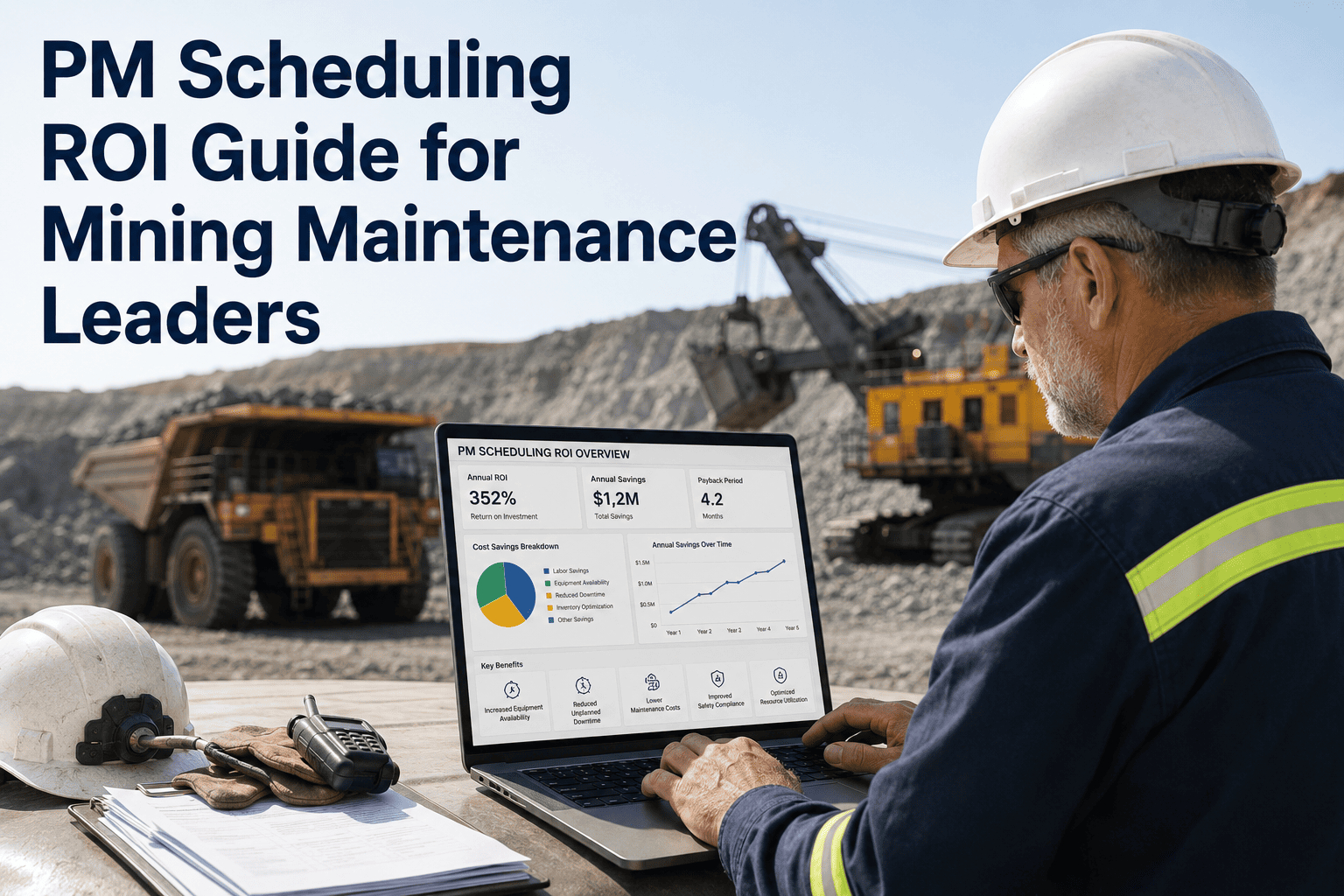
PM Scheduling ROI Guide for Mining Maintenance Leaders
Turn reactive breakdowns into planned, meter-triggered maintenance — protecting availability on million-dollar assets and stretching a scarce maintenance crew further.
When a mine asset stops
There's no inventory to absorb a stoppage in mining — the failure hits the production rate directly. Here's what's at stake the moment a critical asset goes down.
| Asset | When it stops | Downtime cost |
|---|
| Haul truck | Hauling capacity lost across the cycle | $5K–$10K / hr |
| Conveyor | The entire value chain stalls behind it | Severe / hr |
| Crusher | Processing halts; ore backs up | High / hr |
| Shovel / excavator | Extraction stops at the face | High / hr |
High-production assets can lose around $130,000 per hour, and the average equipment-failure incident runs roughly $180,000 — which is why mining operations spend 35–50% of their budgets on maintenance.
Two roads from a failing component
The same worn bearing leads to two completely different days, depending on whether you saw it coming. PM scheduling is what puts you on the right road.
Reactive
Component fails mid-shift
↓
Emergency breakdown halts production
↓
Premium labor and expedited parts
↓
Catastrophic damage — a $400K rebuild
Planned
Meter or condition signal flags it weeks out
↓
Repair scheduled into a planned window
↓
Parts pre-positioned, right tech assigned
↓
Failure averted at a fraction of the cost
Get on the planned road
OxMaint triggers PM on hours, meters, and condition signals — so the failing component becomes a scheduled job, not a halted shift.
The technician-shortage multiplier
Skilled mining technicians are scarce and getting scarcer, and a small crew can't out-firefight a 24/7 fleet. PM scheduling is how a lean team covers more — by changing the kind of work, not just the amount.
Fewer, predictable jobs
Planned work replaces chaotic reactive call-outs, so a small crew covers far more assets reliably.
Right-sized windows
Schedule into shift changes and production lulls, and batch jobs across assets to optimize crew time.
Captured knowledge
Bake a retiring expert's method into a standard PM task so anyone on the team can execute it.
The ROI value drivers
PM scheduling returns value through five reinforcing streams — each one pulling work out of the expensive reactive column and into the planned one.
Unplanned downtime ↓ 30–50%
Preventive plus predictive maintenance on critical assets removes most surprise failures.
Asset life ↑ ~40%
Targeted, interval-based PM extends the working life of high-value machines.
Planned ratio ↑
Reactive firefighting becomes scheduled, lower-cost, safer work.
Parts delays ↓ ~40%
Smart spares and pre-positioning beat long lead times at remote sites.
Labor leverage ↑
A scarce, expensive crew covers more of the fleet with predictable planning.
The numbers
The case is straightforward when downtime is this expensive and maintenance is this large a share of the budget.
30–50%
Less unplanned downtime with PM + predictive
~40%
Longer asset life from targeted PM
$400K
Rebuild avoided by a 2-week-early signal
Every dollar in preventive work saves roughly five in reactive repair — and against $130,000-an-hour downtime, a single averted failure can pay for the program outright.
Expert Review
"People think mining reliability is a technology problem. It's a scheduling-and-people problem that technology helps you solve. We were losing our best technicians to retirement faster than we could hire, and the ones left were buried in breakdowns — which meant the PM that would have prevented those breakdowns kept slipping. Flipping to meter-triggered scheduling did two things at once: it pulled work into planned windows where a smaller crew could actually keep up, and it forced us to write down how our veterans did the job, so the knowledge didn't walk out the gate with them. The downtime numbers followed. You don't beat a labor shortage by working people harder — you beat it by making sure they never touch a job that didn't have to happen."
Reviewed by a mine maintenance superintendent, 22+ years in heavy mobile equipment reliability.
See the PM scheduling ROI on your fleet
Walk through meter-triggered PM, planned windows, and a board-ready savings model built from your own equipment data.
Frequently asked questions
Why is PM scheduling so valuable in mining specifically?
Because in mining there's no buffer — when a haul truck, conveyor, or crusher stops, extraction or processing halts immediately, and high-production assets can lose around $130,000 an hour. The average failure incident runs about $180,000. Scheduling maintenance into planned windows instead of reacting to breakdowns is the single biggest lever on availability. See PM scheduling in
OxMaint.
How does PM scheduling help with the technician shortage?
Skilled mining technicians are increasingly scarce, and a lean crew can't firefight its way through a 24/7 fleet. PM scheduling converts chaotic reactive work into fewer, predictable, planned jobs a small team can cover, lets you coordinate windows across assets to optimize crew use, and bakes a retiring expert's method into a repeatable task. Do more with fewer hands in
a quick demo.
What's the cost of unplanned downtime on mining equipment?
It's among the highest in any industry. Haul truck downtime commonly runs $5,000 to $10,000 an hour, high-production assets around $130,000 an hour, and a single failure incident averages roughly $180,000 — before the value-chain ripple when a conveyor stalls everything behind it. Emergency repairs also carry premium labor and expedited-parts costs. Quantify yours in
OxMaint.
How much downtime can PM scheduling actually remove?
Preventive and predictive maintenance together typically cut unplanned downtime by 30 to 50%, and targeted, interval-based PM has been shown to reduce downtime around 35% while extending asset life roughly 40%. The gains come from catching degradation early and scheduling the repair before it becomes a breakdown.
Book a demo to model your reduction.
When should major maintenance be scheduled?
Into planned windows — shift changes, production-cycle lulls, and seasonal slowdowns — so the work lands when the impact is lowest. Coordinating overhauls across multiple assets in the same window also optimizes a scarce crew's time. The goal is to make every major job a scheduled event, never an emergency. Schedule windows in
OxMaint.
How does meter or usage-based scheduling work for mining assets?
Mining equipment wears by use, not the calendar, so PM should trigger on operating hours, meter readings, or condition signals rather than fixed dates. A modern haul truck carries hundreds of sensors; tying PM to runtime and fault data generates a service exactly when the machine has earned it. That precision avoids both over- and under-maintaining. See trigger setup in
a demo.
What's the ROI and payback?
The math is favorable because downtime is so costly and mining already spends 35 to 50% of its budget on maintenance. Every dollar in preventive work saves roughly five in reactive repair, and a single early signal can avert a catastrophic rebuild — one operation avoided a $400,000 engine failure from a two-week-early warning.
Book a demo to project your return.
How does OxMaint handle PM scheduling for mining fleets?
OxMaint triggers PM on hours, meters, or condition, schedules the work into planned windows, routes it to the right technician with parts pre-checked, and rolls availability and cost-per-asset across every pit and site. It runs on mobile for remote crews and documents everything for compliance reporting. Run it on your fleet with a
free trial.
Schedule the failure out of your fleet
Trigger PM on real usage, push work into planned windows, and let a scarce crew cover more — turning availability into a number your operation can bank.