In a hotel, maintenance labor is both the largest controllable cost in engineering and one of the biggest levers on the guest experience — and technician scheduling is where both are decided. Send the nearest radio instead of the qualified technician and you get a temporary fix that fails in days; let work pile into reactive bursts and overtime balloons; leave a room out of order an extra night and you lose a sellable room-night at full rate. Good scheduling flips all of that: the right tech arrives first, planned work crowds out emergencies, and rooms come back online faster. This guide breaks down the return on getting technician scheduling right in hospitality, and shows how OxMaint's technician scheduling delivers it — or book a demo to model the numbers on your property.
Maintenance KPI / Technician Scheduling
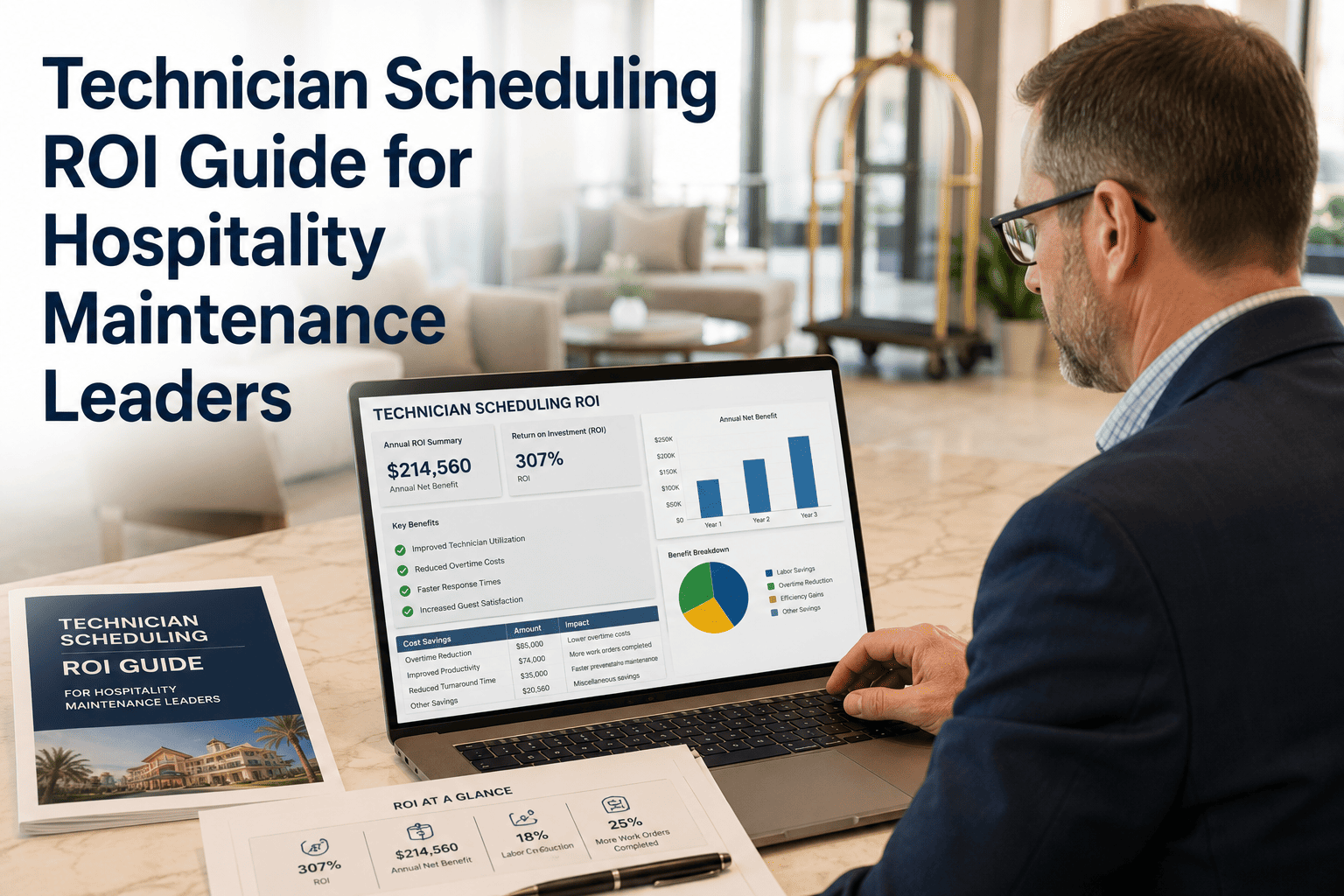
Technician Scheduling ROI Guide for Hospitality Maintenance Leaders
Turn scheduling into return — higher first-time fix, lower overtime, more rooms in service, and faster confirmed repairs that protect reviews and revenue.
The hospitality maintenance scoreboard
Scheduling either moves these numbers or it doesn't. These are the targets leading hotel engineering teams manage against.
Work orders / tech / day
12–18
Urgent response time
<30 min
Where a technician's day actually goes
The cheapest capacity you have is the productive time you're already paying for. Scheduling reclaims the hours lost to travel, searching for parts, and waiting — illustrative, but the shape is real.
Before
ProductiveTravel / searchingWaiting
After
ProductiveTravelWaiting
ProductiveTravel / searchingWaiting
The dispatch that pays for itself
Routing by skill instead of proximity is the single highest-leverage scheduling decision — it's the difference between one visit and three.
Nearest available tech
An HVAC fault goes to a general technician. The temporary fix fails within days, generating a second work order and double the labor.
Right qualified tech
The certified technician arrives with the right parts and fixes it once. First-time fix rises, the callback never happens, and labor is recovered.
Put the right tech on every job
OxMaint routes work orders by skill, priority, and availability — and tracks the utilization that turns scheduling into savings.
The ROI value drivers
Technician scheduling returns value through five reinforcing streams. None of them require hiring — they come from using the hours you already pay for, better.
First-time fix ↑
Skill-based dispatch ends the repeat-visit cycle and the duplicate work orders it spawns.
Overtime ↓
Demand-aligned shifts make overtime a controlled buffer instead of the default.
PM completion ↑
Planned work crowds out emergencies; emergency-repair cost falls 15–25%.
Resolution time ↓
Faster confirmed repairs lift guest-satisfaction scores, a top controllable driver.
Room uptime ↑
Fewer out-of-order rooms protect sellable room-nights at full rate.
Response time isn't resolution time
Hotels measure how fast an engineer arrives. Guests feel how fast the problem is actually fixed — and that gap is where reviews are won or lost.
Fast arrival, slow fix
Engineer arrives in 12 minutes, then spends an hour hunting for a part and chasing room access. The metric looked fine; the guest didn't.
Both compressed
Skill match, parts on hand, and live status updates resolve the fault fast — and the guest knows it's handled.
>70%
of faults left 60+ minutes, or handled with no status update, turn into a negative review — while those resolved within ~20 minutes trend positive. Acknowledged and fast beats fast and silent.
A worked example: 200-room hotel
Illustrative first-year impact for a 200-room property moving from paper and radios to structured scheduling.
$35K–$50K
typical maintenance savings in the first 12 months
Emergency repair cost↓ 15–25%
Guest-related maintenance complaints↓ 30–40%
Asset uptime↑ 10–15%
Hotels commonly reach payback in 12 to 18 months, with a cumulative 200–400% return over 18 to 24 months. Adoption is the variable that decides which end of that range you land on.
Expert Review
"In hospitality, the maintenance budget hides in plain sight — it's the second truck roll. A guest reports a thermostat, a general tech bandages it, it fails two nights later, and now you've paid twice and earned a one-star review for the trouble. The fix isn't more headcount; it's scheduling discipline. Route by skill so the job is done once, balance planned work so overtime stops being your release valve, and measure resolution time, not arrival time, because that's the number the guest actually experiences. Do that and you'll find you had the capacity all along — you were just spending it on travel, part-hunting, and rework."
Reviewed by a hotel director of engineering, 16+ years in multi-property hospitality maintenance and labor planning.
See the scheduling ROI on your property
Walk through skill-based dispatch, utilization tracking, and a board-ready savings model built from your own work-order data.
Frequently asked questions
How does technician scheduling drive maintenance ROI in a hotel?
Scheduling is where hospitality maintenance ROI is won or lost, because labor is the biggest controllable cost and a major lever on guest experience. Skill-based dispatch raises first-time fix, demand-aligned shifts cut overtime, and planned work crowds out expensive emergencies. The result is more work orders completed per technician per day and fewer rooms out of order. See it modeled in
OxMaint.
What's the difference between response time and resolution time?
Response time is how long until a technician arrives; resolution time is how long until the repair is confirmed done — and guests feel the second one. An engineer can arrive in twelve minutes and still spend an hour hunting for a part and chasing room access. Good scheduling compresses every stage, not just arrival.
Book a demo to see resolution tracking.
Why does dispatching the right technician matter more than the nearest?
Because the nearest available technician isn't always qualified, and an HVAC fault sent to a general tech often gets a temporary fix that fails within days — generating a second work order and double the cost. Skill-based dispatch sends the certified person the first time, lifting first-time-fix rate and ending the repeat-visit cycle. That's pure recovered labor. See routing in
OxMaint.
How does better scheduling reduce overtime?
Most maintenance overtime comes from poor planning, not genuine understaffing — work piles into reactive bursts because PM wasn't scheduled and requests weren't balanced across the team. Aligning shifts to actual demand and spreading planned work turns overtime into a controlled buffer rather than a default expense. Leading operators cut hours while protecting service.
Book a demo to model the savings.
What maintenance KPIs should a hotel track?
The core set: work orders completed per technician per day (often targeted at 12 to 18), equipment uptime (above 95%), preventive-maintenance completion rate (above 90%), urgent response time (under 30 minutes), and maintenance cost per available room. Together they show whether scheduling is converting labor into uptime and guest satisfaction. Track them live in
OxMaint.
How fast does a hospitality CMMS pay back?
Hotels commonly report payback within 12 to 18 months and a 200-to-400% return over 18 to 24 months. A 200-room property often sees $35,000 to $50,000 in savings inside the first year, driven by 15-to-25% lower emergency-repair cost and 10-to-15% better uptime. Adoption is the variable that makes or breaks it.
Book a demo to project your numbers.
How does maintenance scheduling affect guest reviews and revenue?
Maintenance response is one of the top controllable drivers of guest satisfaction. A fault resolved within about 20 minutes tends to produce a neutral or positive review, while one left 60-plus minutes or handled with no status update turns negative over 70% of the time. Faster, communicated repairs protect reviews, loyalty, and the room revenue an out-of-order room would lose. See it in
OxMaint.
How does OxMaint schedule and dispatch technicians?
OxMaint routes each work order to a qualified, available technician by skill and priority, balances planned and reactive work across the team, and pushes the full job to their mobile device with asset history and parts. Supervisors see live status and utilization, and the system documents every close for reporting. Run it on your property with a
free trial.
Schedule smarter, not harder
Recover the productive hours you already pay for, send the right tech every time, and turn technician scheduling into a number your owners will notice.