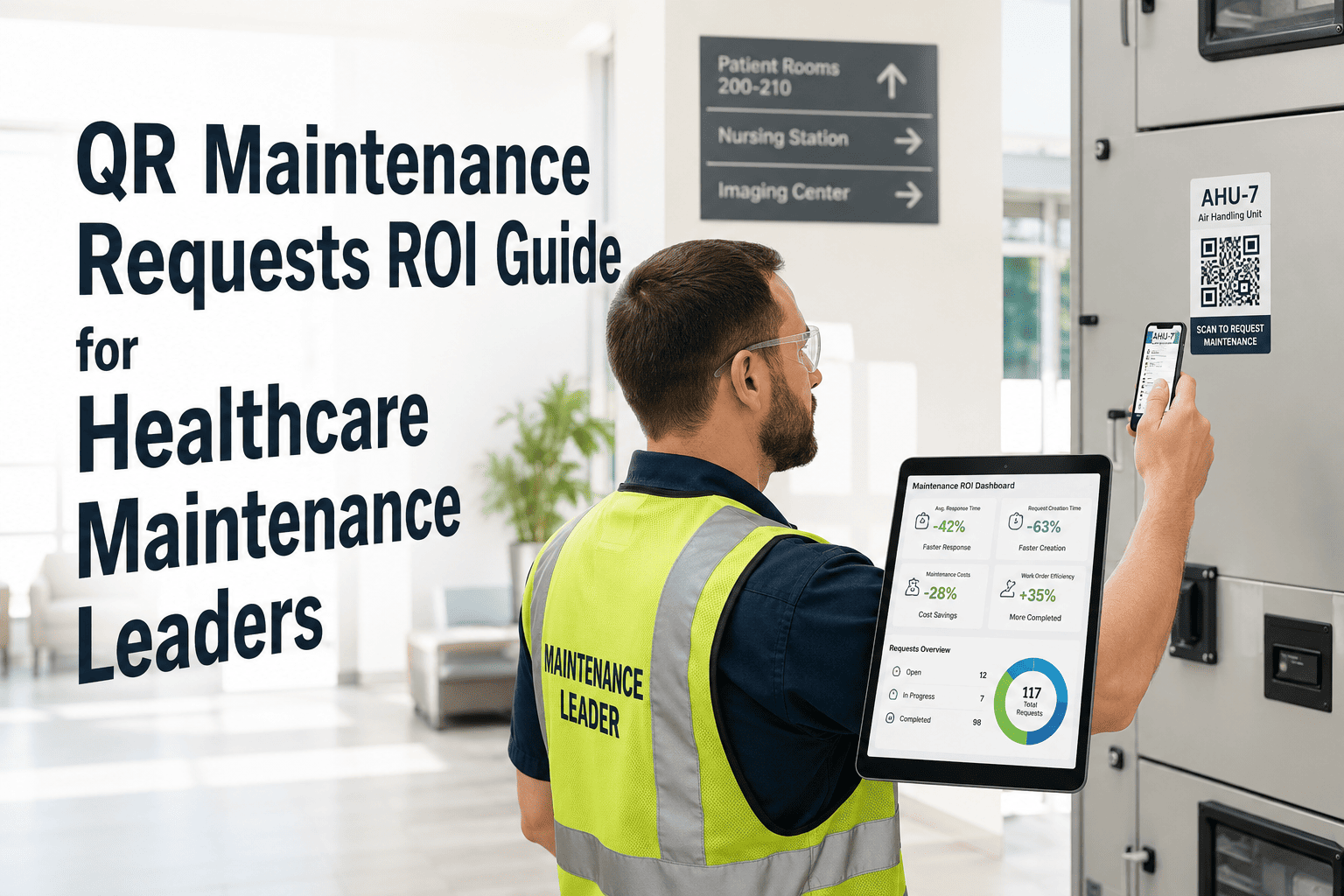
Missed inspections in healthcare facilities are not just an operational inconvenience — they are a patient safety event and a regulatory liability. The Joint Commission cites inadequate preventive maintenance as a contributing factor in 23% of healthcare equipment-related adverse events, and OSHA estimates that missed medical equipment inspections cost U.S. healthcare facilities $180 million annually in regulatory penalties alone. The inspection tracking problem in hospitals is fundamentally a request capture problem: when a nurse notices an infusion pump anomaly, a housekeeping staff member spots a ceiling tile crack, or a patient reports a bed mechanism failure, there is no immediate, frictionless way to route that observation into the maintenance workflow — so it waits, and gets missed. OxMaint QR Code Maintenance Requests put a maintenance request trigger on every bed, every piece of equipment, and every room — scannable by any staff member with a phone, with zero app download or login required. This ROI guide quantifies what that change means for healthcare maintenance compliance and patient safety outcomes.
How QR Code Maintenance Requests Work in Healthcare
See QR Maintenance Requests in a Live Healthcare Environment Demo
OxMaint's healthcare demo shows the complete workflow — from QR scan to work order to compliance record — in the context of your specific facility type. Book 30 minutes.
QR Request System vs. Traditional Request Methods: Healthcare Comparison
| Metric | Phone / Verbal Request | Paper Work Order | OxMaint QR Request |
|---|---|---|---|
| Request Creation Time | 0 min (verbal) — not logged | 8–15 minutes | Under 60 seconds |
| Asset Auto-Identified | No | No (manual entry) | Yes — by QR scan |
| Request Capture Rate | ~40% (verbal issues forgotten) | 65–75% | 95%+ |
| Time to Technician Assignment | 2–6 hours (supervisor relay) | 1–4 hours | Under 5 minutes |
| Compliance Audit Record | None | Paper only (loss risk) | Digital — instant export |
| Staff Training Required | None (informal) | Moderate | Zero — scan with phone camera |
Healthcare-Specific Compliance Impact
Expert Review
The compliance risk in healthcare maintenance is not that inspections are not happening — it is that they are not being documented in a way that survives a Joint Commission survey. I have seen facilities fail surveys not because equipment was in poor condition, but because the maintenance team could not produce documented evidence of the inspection program from the prior 12 months. QR-based maintenance request systems like OxMaint solve both problems simultaneously. They increase the rate at which issues are actually captured by clinical staff — because any nurse can scan a code rather than hunting for a phone extension — and they create an automatic, audit-ready documentation trail for every single interaction. In my experience, facilities that implement QR-based request systems reduce their Joint Commission finding rates in the environment of care category by 40–60% within the first survey cycle after deployment.
ROI Summary: QR Maintenance Requests in a 200-Bed Hospital
Every Missed Inspection Is a Compliance Risk You Can Prevent
OxMaint QR Maintenance Requests capture issues the moment clinical staff notice them — building a Joint Commission-compliant audit trail automatically, with zero extra work for your maintenance team.
Frequently Asked Questions
How do QR code maintenance requests reduce missed inspections in healthcare facilities?
Missed inspections in healthcare most commonly occur not because technicians fail to perform the work, but because the issue is never formally logged in the first place — it stays as a verbal observation that gets forgotten in a busy clinical environment. OxMaint QR codes on every asset and room give clinical staff a zero-friction way to create a maintenance record the moment they observe an issue — no phone call, no app, no login. Facilities using QR maintenance requests report 95%+ request capture rates compared to 40–65% for phone or paper-based systems, and that capture rate improvement directly reduces the proportion of issues that progress to compliance failures or emergency repairs before they are addressed.
Do clinical staff need to download an app or create an account to use OxMaint QR requests?
No. OxMaint QR maintenance requests are designed for zero-barrier adoption in clinical environments. Any staff member scans the QR code with their phone's native camera — no app download, no account creation, no login. A browser-based request form opens automatically, pre-populated with the asset ID and location from the QR code. The staff member adds a description, optionally attaches a photo, and submits — creating a fully logged work order in OxMaint in under 60 seconds. The maintenance team manages all workflows through the OxMaint CMMS; clinical staff simply scan. This frictionless design is the primary driver of the 95%+ request capture rates healthcare facilities achieve with the system.
How does OxMaint QR request documentation satisfy Joint Commission environment of care requirements?
The Joint Commission's EC.02.06.01 standard requires healthcare facilities to demonstrate a documented inspection and maintenance program for clinical equipment. OxMaint QR requests create a time-stamped, asset-linked record for every request, assignment, and completion — automatically building the inspection history trail the standard requires. At survey time, the facilities director can export a complete maintenance record for any asset, room, or equipment category in minutes, rather than assembling paper records over days. Book a demo to see how OxMaint structures healthcare compliance records specifically for Joint Commission survey readiness.
Can OxMaint QR codes handle both clinical equipment requests and facility infrastructure issues?
Yes. OxMaint QR codes are asset-class agnostic — the same system covers clinical equipment (beds, infusion pumps, imaging devices), facility infrastructure (HVAC, plumbing, electrical, elevators), and room-level issues (lighting, flooring, ceiling, door hardware). Each QR code type routes requests to the appropriate maintenance team automatically based on asset category and issue type. This unified request system eliminates the multiple phone numbers, email addresses, and paper systems that most hospitals maintain separately for biomedical, facility, and housekeeping maintenance — replacing them with a single OxMaint workflow that captures all maintenance issues in one auditable record system.