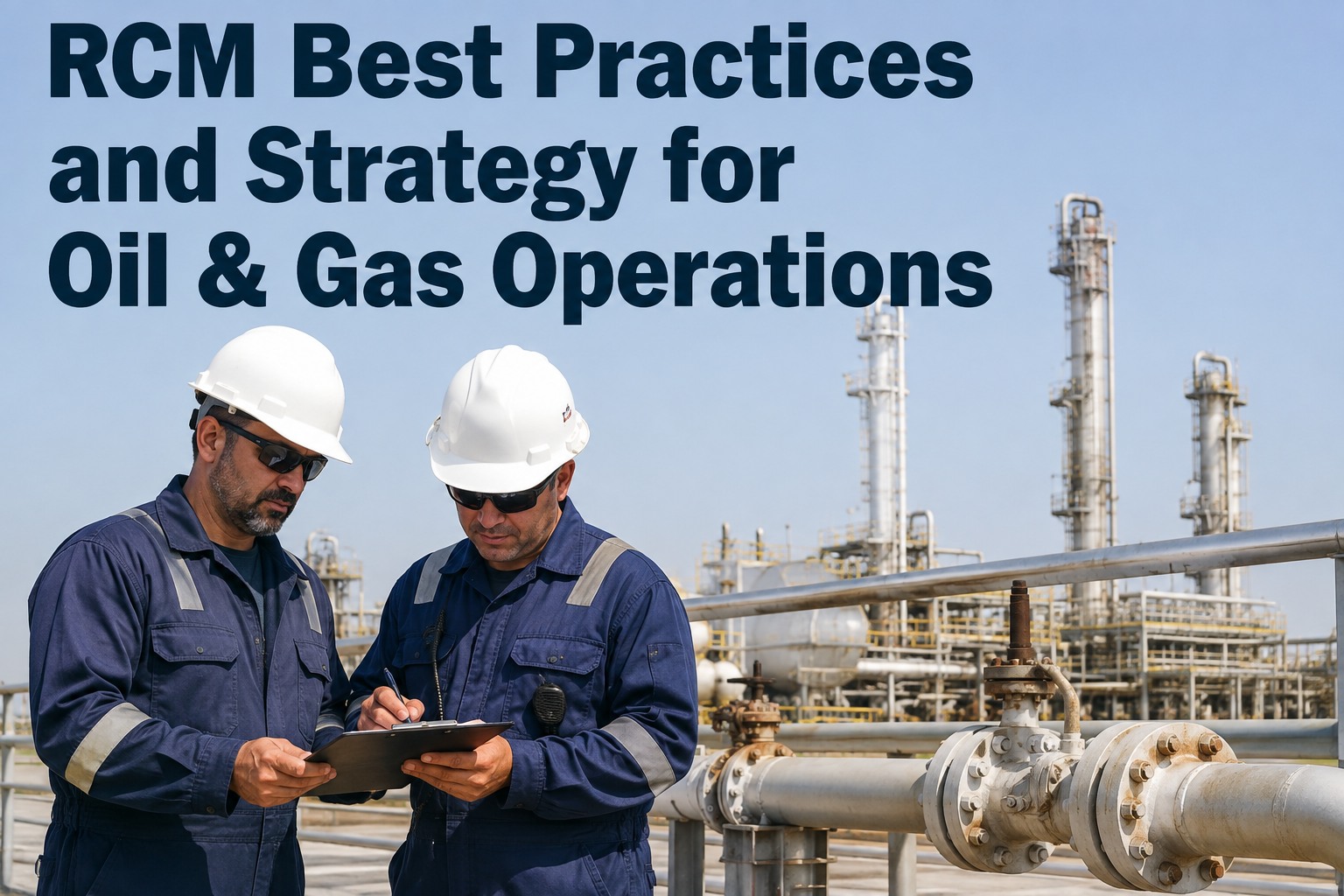
Reliability centered maintenance in oil & gas is the systematic process of identifying how critical assets fail, selecting the right maintenance strategy for each failure mode, and executing that strategy consistently across every facility — from offshore platforms to refineries and pipeline networks. For an industry where a single unplanned compressor shutdown can cost $500K per day in lost production, RCM shifts maintenance teams from reactive firefighting to engineered failure prevention. This guide walks through the seven RCM questions, shows you how to identify top failure modes on critical equipment, and explains how to launch an RCM pilot that delivers measurable downtime reduction in weeks. OxMaint's AI-powered CMMS is built for teams putting RCM into practice — you can Start Free Trial today or book a 30-minute demo to see it mapped to your asset hierarchy.
Is your maintenance strategy actually preventing failures — or just reacting to them?
70% of oil & gas unplanned downtime is preventable with the right RCM strategy. The average facility loses $38M annually to equipment failures that reliability-centered maintenance would have caught weeks earlier. Stop firefighting. Start engineering failures out of your operation.
How to build an oil and gas reliability program using the seven RCM questions
Every effective RCM implementation starts with seven structured questions defined in SAE JA1011. Answering them for each critical asset — pumps, compressors, valves, heat exchangers — determines which maintenance strategy actually reduces failure risk and cost.
What are the asset's functions?
Document what the asset does and its required performance standards — flow rate, pressure tolerance, temperature range. A gas turbine isn't just "running"; it must deliver 45MW at 99.2% availability.
In what ways can it fail?
List every functional failure. A centrifugal pump can fail to start, fail to reach rated flow, or fail to hold pressure. Each failure mode needs its own strategy.
What causes each failure?
Identify failure modes — bearing wear, seal degradation, impeller erosion, cavitation. OxMaint links each failure mode to a coded library tied directly to work order history.
What happens when it fails?
Define the failure effect: production loss, safety incident, environmental release, secondary equipment damage. This drives the criticality ranking that prioritizes your RCM effort.
How does the failure matter?
Classify consequences: safety, environmental, operational, or non-operational. A seal failure on a sour gas line has far different consequences than one on a water injection pump.
What can predict or prevent it?
Determine if condition monitoring (vibration, oil analysis, thermography) or time-based PMs can detect or prevent deterioration before functional failure occurs.
What if no proactive task works?
If no PM or predictive task is technically feasible or cost-effective, the default strategy is run-to-failure — or a redesign to eliminate the failure mode entirely.
OxMaint ties it together
Every RCM decision flows into OxMaint as a scheduled PM, condition-based trigger, or RTF flag — so strategy becomes execution automatically, not a binder on a shelf.
Choosing the right oil and gas maintenance strategy for each failure mode
RCM doesn't mean "do PMs on everything." A mature oil and gas maintenance optimization program assigns one of four strategies to each failure mode based on consequence, failure pattern, and detection window.
| Strategy | When to Use | Example Asset | Typical Cost Impact |
|---|---|---|---|
| Run-to-Failure | Low consequence, non-critical, cheap to replace | Lighting, small filters, non-hazardous instrumentation | Minimal — only repair labor + parts |
| Time-Based PM | Age-related failure pattern, known wear-out point | Lubrication changes, filter swaps, valve overhauls | Low — scheduled labor, no downtime |
| Condition Monitoring | Random failure pattern, detectable degradation window | Centrifugal compressors, turbines, large pumps | Medium — sensors + analytics, prevents $500K+ outages |
| Redesign / Modification | Recurring failure with no viable proactive task | Frequent seal failures, chronic vibration issues | High upfront — eliminates repeat cost permanently |
The average offshore platform maintains 40-60% of assets with PMs that don't actually prevent the failure mode they target. RCM analysis typically eliminates 30% of unnecessary PMs while adding condition monitoring where it matters — cutting total maintenance cost 15-25% within the first year.
How to launch an RCM pilot project for oil and gas in 8 weeks
An RCM pilot project in oil and gas doesn't require a plant-wide rollout. Start with one critical system — a gas compression train, a separation unit, or a pumping station — prove the value, then scale.
Select the pilot system & build asset hierarchy
Choose 15–30 assets with high criticality and good failure history. Map the asset hierarchy in OxMaint — mirror your P&ID from plant down to component level. Pull 2 years of work order history to establish the baseline.
Run FMEA with cross-functional team
Conduct Failure Mode and Effects Analysis with operators, maintenance technicians, and reliability engineers. Document functions, functional failures, failure modes, and effects for each asset. OxMaint's failure-mode library accelerates this by 40%.
Assign maintenance strategies
Apply the RCM decision logic to each failure mode. Convert decisions into OxMaint PM schedules, condition-based triggers, or RTF designations. Eliminate PMs that don't map to a real failure mode — typically 25-35% of existing tasks.
Execute, measure & report
Run the new strategy for 60 days. Track unplanned downtime, PM compliance, mean time between failures (MTBF), and maintenance cost per unit of output. OxMaint dashboards show the before/after automatically — no spreadsheets required.
What an RCM pilot delivers: a worked example from a mid-size gas plant
A gas processing plant in the Permian Basin ran an RCM pilot on their inlet compression train — 24 assets, $42K/year in maintenance spend, averaging 6 unplanned shutdowns annually. Here's what changed in 90 days.
ROI Formula: ($220K saved production + $42K reduced maintenance) ÷ $18K OxMaint annual license + $12K RCM analysis labor = 8.7x return in Year 1. Payback period: 6 weeks after pilot completion.
How OxMaint operationalizes your RCM program end-to-end
RCM analysis that lives in spreadsheets and binders fails within 18 months. OxMaint turns your RCM decisions into automated workflows — so the strategy you engineered actually gets executed on the floor, every shift, every day.
Asset hierarchies that mirror your plant
Build ISO 14224-compliant asset trees from process unit down to component. Every work order, failure code, and PM is tied to the exact asset and failure mode — giving you the data foundation RCM demands.
PM triggers based on runtime or sensor data
Schedule PMs by calendar, runtime hours, cycles, or condition thresholds. When vibration on a compressor crosses 4.5 mm/s, OxMaint auto-generates a work order — condition-based maintenance without manual monitoring.
Failure-mode libraries linked to every work order
Standardized failure codes mean every repair feeds your reliability database. Technicians tag what failed, how, and why — so your MTBF and failure-mode trends are accurate, not guessed.
Analytics that prove your RCM program works
Live dashboards track MTBF, MTTR, PM compliance, downtime cost, and asset availability. Show leadership exactly how much downtime and cost your RCM strategy has eliminated — in dollars, not guesswork.
See OxMaint on your assets — book a 30-minute demo
We'll map your top 5 critical assets to an RCM strategy live, show you how automated PM triggers replace spreadsheets, and project your downtime reduction in the first call.
Frequently asked questions about RCM in oil and gas
What is reliability centered maintenance in oil & gas?
RCM is a structured methodology that identifies the failure modes of critical assets and selects the most effective maintenance strategy for each one — run-to-failure, time-based PM, condition monitoring, or redesign. In oil and gas, RCM focuses on assets where failure consequences include safety incidents, environmental releases, or production losses exceeding hundreds of thousands of dollars per day.
How long does RCM implementation take in oil and gas operations?
A focused RCM pilot project on 15-30 critical assets typically takes 6-8 weeks from system selection to strategy execution. Full plant-wide rollout depends on asset count but generally scales at 3-5 systems per quarter. OxMaint accelerates the process by providing pre-built failure-mode libraries and asset hierarchy templates — see how in a Book a Demo session.
What are the main benefits of RCM in oil and gas?
Facilities that implement RCM typically see 15-25% reduction in total maintenance cost, 30-50% reduction in unplanned downtime, 20-40% increase in MTBF, and 10-15% extension in asset useful life. RCM also improves safety by reducing emergency repairs and strengthens regulatory compliance under OSHA PSM, API RP 583, and ISO 55000.
Which assets should I prioritize for my RCM pilot project?
Start with assets that have high failure consequence and good historical failure data — typically rotating equipment like compressors, pumps, and turbines in a continuous process unit. Avoid assets with sparse failure history or low criticality. The ideal pilot covers 15-30 assets where a 30% downtime reduction will produce measurable financial impact within 60-90 days.
How does OxMaint support RCM compared to spreadsheets or legacy CMMS?
Spreadsheets can't trigger work orders, legacy CMMS platforms lack failure-mode tracking, and neither provides real-time analytics. OxMaint closes the loop: RCM decisions become automated PM schedules and condition-based triggers, every work order feeds failure data back to the asset record, and dashboards prove the ROI. You can Start Free Trial in minutes with no credit card required.
Stop reacting to failures. Start engineering them out.
Join oil & gas reliability teams using OxMaint to turn RCM strategy into measurable downtime reduction, lower maintenance cost, and audit-ready compliance — all in one AI-powered platform.
Free 14-day trial · No credit card
-optimizing-your-maintenance-strategy.png)
