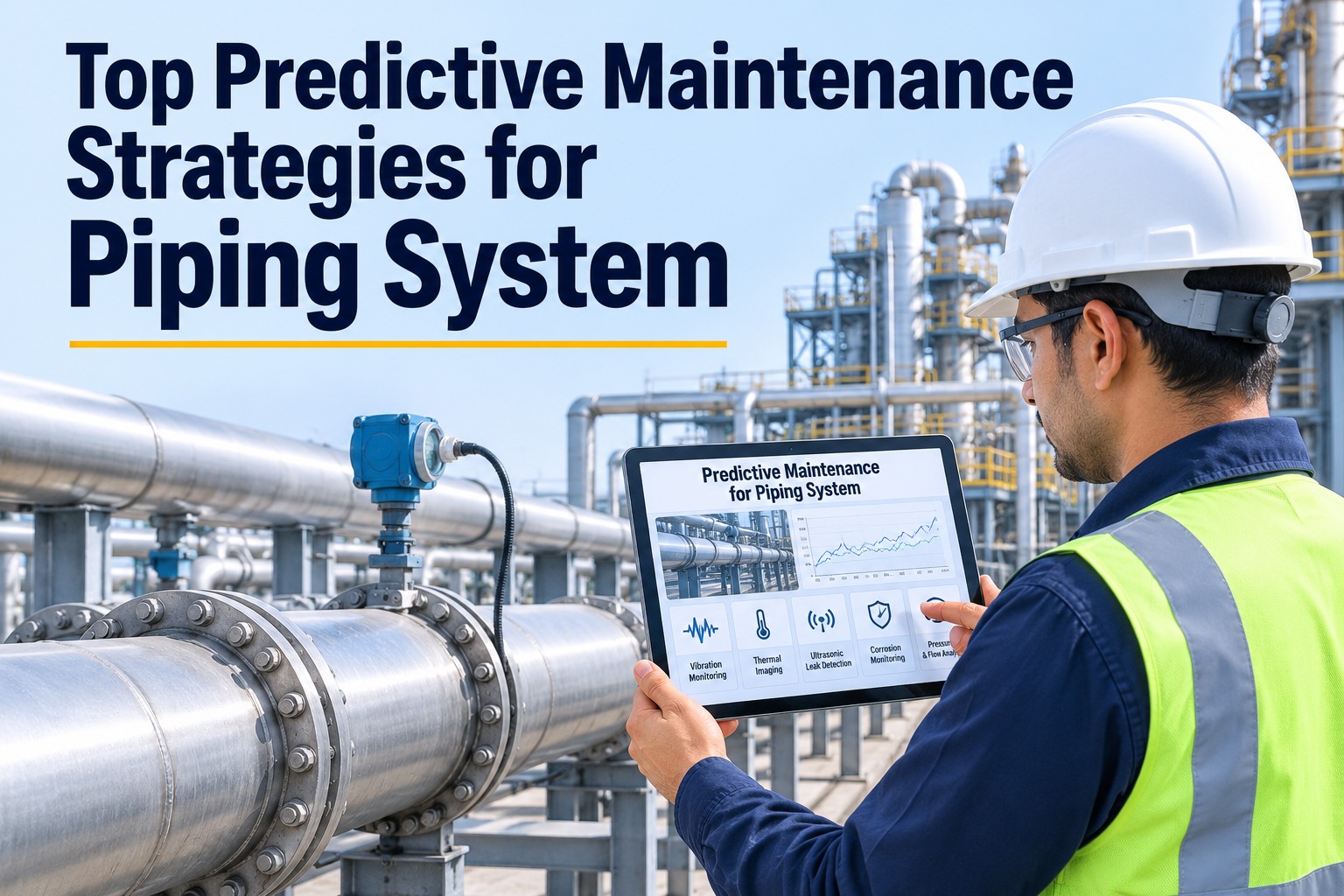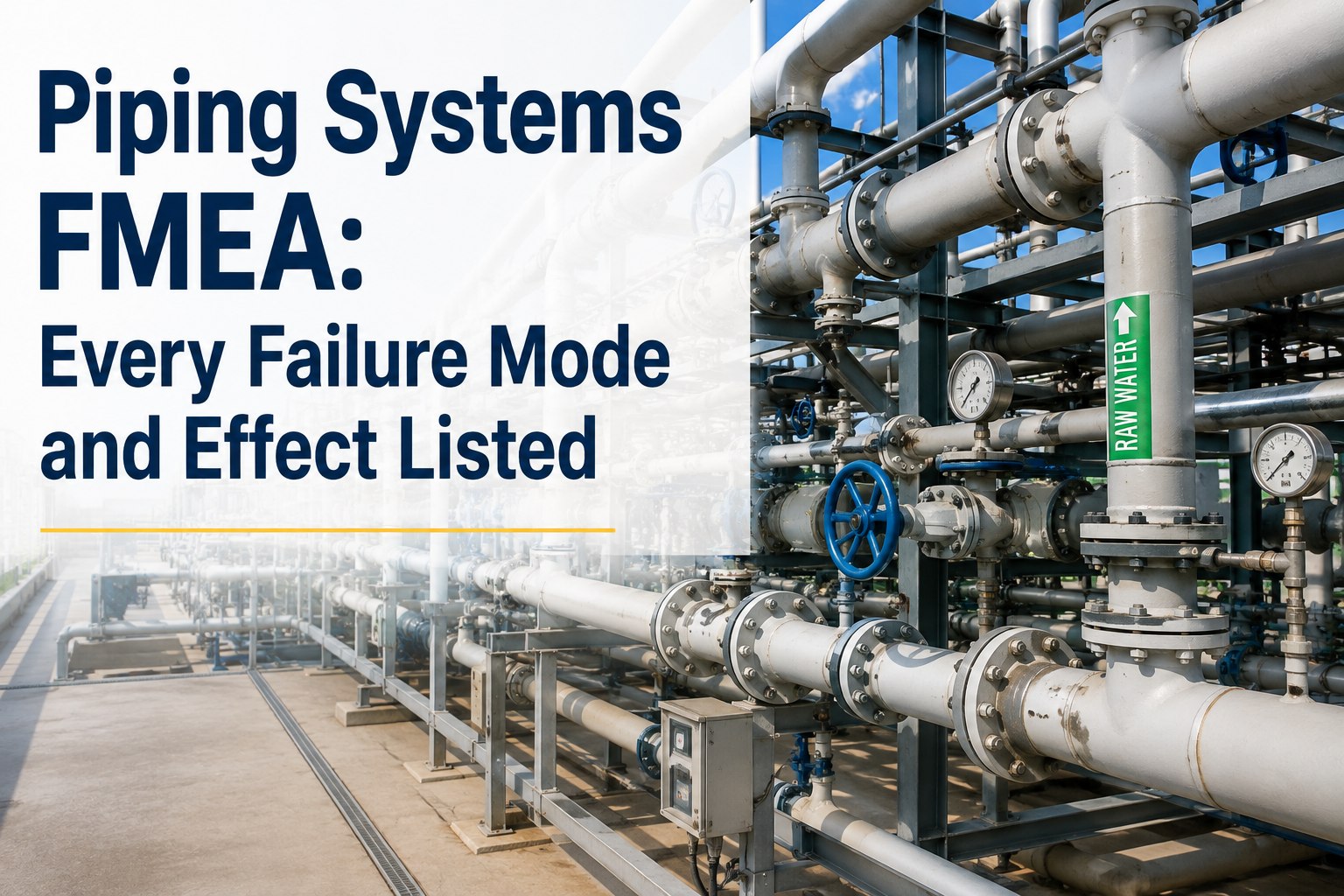
Failure modes and effects for piping systems follow predictable patterns — corrosion under insulation, flow-accelerated corrosion, fatigue at welded joints, and flange leakage account for the majority of unplanned piping failures across process plants. A structured piping systems FMEA catalogs each failure mode, its root cause, its severity rating, and the recommended RCM maintenance task so reliability teams can shift from reactive firefighting to planned, condition-based interventions. This reference covers the most common piping systems failure modes your team encounters on the floor, maps each to its downstream effect on production and safety, and shows how OxMaint turns this FMEA library into daily action inside a CMMS. Download the free worksheet, log every failure mode against each asset, and Start Free Trial to apply it inside OxMaint today.
COMPLETE FMEA REFERENCE
Every Piping Failure Has a Mode. Most Plants Miss the Warning Signs.
Industry data shows that 60–80% of piping failures are preventable with the right inspection cadence and failure-mode tracking. Yet most teams still rely on spreadsheets and reactive work orders — and absorb the $50K–$500K cost of each unplanned shutdown.
PIPING SYSTEMS FAILURE MODE LIBRARY
Piping Systems Common Failures: Mode, Cause, Effect, Severity
Below is the core piping systems FMEA template — the failure modes reliability engineers encounter most frequently in chemical, oil and gas, power, and water treatment plants. Each row maps the failure mode to its most likely root cause, the downstream effect on production and safety, and a severity rating on a 1–10 scale where 10 is catastrophic loss of containment with injury risk.
| Failure Mode | Root Cause | Effect | Severity | Recommended RCM Task |
|---|---|---|---|---|
| External Corrosion Under Insulation (CUI) | Water ingress under thermal insulation, cycling temperatures 10–175°C | Wall thinning, pinhole leak, potential fire if flammable service | 9 | Time-based inspection per API 583; thermographic survey; remove insulation for visual UT at high-risk zones |
| Flow-Accelerated Corrosion (FAC) | High-velocity water/steam flow, pH imbalance, oxygen content | Rapid wall loss at elbows and reducers; sudden rupture | 10 | Condition-based UT monitoring at susceptible fittings; chemistry control; implement per EPRI guidelines |
| Erosion / Erosion-Corrosion | Particulate-laden flow, cavitation, high-velocity droplet impingement | Localized wall thinning at bends, tee junctions; reduced pressure rating | 7 | IRIS or PEC inspection at 18-month intervals; flow modeling; hardness testing |
| Fatigue Cracking at Welds | Vibration, thermal cycling, pressure pulsation, poor weld geometry | Through-wall crack, sudden release of hazardous inventory | 9 | Vibration analysis; phased-array UT on welds; design modification to reduce stress concentration |
| Flange / Gasket Leakage | Bolt load relaxation, gasket degradation, misalignment, thermal shock | Process leak, fugitive emissions, EPA violation risk | 6 | Torque verification at PM interval; LDAR monitoring; gasket replacement on condition |
| Valve Stem Packing Leak | Packing wear, gland nut loosening, thermal cycling | Fugitive emissions, loss of containment, regulatory penalty | 5 | Condition-based packing adjustment; quarterly LDAR sniff; repack on failure |
| Support Failure / Sagging | Corrosion of supports, design deficiency, foundation settlement | Excess stress on pipe, weld cracking, misalignment of rotating equipment | 6 | Visual inspection of supports annually; load calculation review; corrective engineering |
| Hydrogen-Induced Cracking (HIC) | Wet H₂S service, hydrogen permeation into steel | Internal blistering, stepwise cracking, sudden brittle failure | 8 | Wet fluorescent MPI; advanced UT; material upgrade to HIC-resistant steel |
| Creep Damage (High-Temp) | Long-term operation above material creep threshold, typically >400°C for carbon steel | Pipe expansion, wall thinning, eventual rupture at stress points | 8 | Replica metallography; creep monitoring per API 579; scheduled replacement at design life |
| Freeze Damage | Inadequate heat tracing, failed steam trap, low ambient exposure | Ice expansion, pipe burst, water damage to adjacent equipment | 7 | Pre-winter heat-trace circuit testing; low-temperature alarms; drain dead legs |
Severity scale: 1–3 negligible / 4–6 marginal / 7–8 critical / 9–10 catastrophic. Ratings should be adjusted based on service fluid, operating pressure, and proximity to occupied areas.
RISK PRIORITIZATION
How to Calculate Risk Priority Number for Piping Systems
A piping systems FMEA is only useful if it drives prioritization. The Risk Priority Number (RPN) multiplies three ratings — Severity, Occurrence, and Detectability — to rank which failure modes deserve attention first. An RPN of 200+ typically warrants immediate corrective action or a redesign.
ROOT CAUSE ANALYSIS
Piping Systems Root Cause Analysis: From Failure Mode to Fix
When a piping failure occurs, the goal is not just to repair the leak — it is to identify the root cause so the failure mode never recurs. A structured RCA process typically reduces repeat piping failures by 40–60% within the first year of implementation.
Log the failure mode, location, operating conditions, service fluid, and time-to-failure inside the CMMS asset record. Include photos, inspection history, and last-known wall thickness readings.
Trace the symptom back through mechanical, chemical, operational, and human-factor causes. Example: a flange leak may trace to bolt relaxation, which traces to thermal cycling, which traces to a missing spring washer.
Match the confirmed root cause to the failure mode in your piping systems FMEA template. If the mode was already cataloged, verify the RPN and adjust the occurrence rating upward if warranted.
Modify the RCM task — shorten the inspection interval, switch from time-based to condition-based monitoring, upgrade the material specification, or add a predictive sensor. Document the change inside OxMaint.
Track MTBF on the affected asset class for the next 6–12 months. If repeat failures drop, lock the new strategy into the PM schedule. If they do not, loop back to step 2 and re-examine the root cause.
WORKED EXAMPLE
Real-World Piping Failure: A 180-Asset Plant That Cut Unplanned Leaks 45%
A mid-sized chemical processing plant with 180 tagged piping assets was spending $42K annually on emergency leak repairs and had experienced two recordable environmental incidents from flange failures in a single year. Their maintenance program ran on spreadsheets and a paper-based work-order system with no failure-mode tracking.
The reliability team built a piping systems FMEA inside OxMaint, mapped every asset to its failure modes, and set condition-based inspection triggers. Within 12 months, unplanned leaks dropped from 14 to 8 per year, emergency repair spend fell to $23K, and both environmental incidents were eliminated. The FMEA history now feeds every new work order — so the team always knows which failure mode they are preventing and why.
HOW OXMAINT HELPS
Turn This FMEA Template Into Daily Maintenance Action
A piping systems FMEA on paper is a static document. Inside OxMaint, it becomes a living system — every failure mode logged against the asset record, every RCM task triggered automatically, and every failure feeding back into a searchable history that sharpens future decisions.
Link Every Failure Mode to an Asset
Tag each pipe segment, valve, and flange with its cataloged failure modes and RPN scores. When a technician opens a work order, the relevant failure modes and recommended inspection points surface automatically — cutting diagnostic time by up to 50%.
Auto-Trigger Condition-Based PMs
Set time-based and condition-based maintenance triggers for every failure mode — UT inspection every 18 months for FAC, torque check every 6 months for flange leaks. OxMaint generates the work order automatically, so nothing falls through the cracks.
Track MTBF and Failure Trends
Every completed work order feeds OxMaint's analytics engine — giving you MTBF, MTTR, and failure-mode frequency by asset class. Spot trends like rising flange failures on a specific process line before they become incidents.
Audit-Ready FMEA History
Every failure mode, RCA, RPN update, and corrective action is timestamped and searchable. When OSHA, EPA, or API auditors ask for your mechanical integrity program, export the full asset history in two clicks — no binder, no scramble.
See OxMaint on Your Piping Assets — Book a 30-Minute Demo
Walk through a live piping FMEA inside OxMaint. We will map your top five failure modes to assets, set up condition-based PM triggers, and show you the analytics dashboard your reliability team has been missing.
FREQUENTLY ASKED QUESTIONS
Piping Systems FMEA: What Reliability Teams Ask Most
What are the most common failure modes in piping systems?
The most common piping systems failure modes are external corrosion under insulation (CUI), flow-accelerated corrosion (FAC), erosion at bends and tees, fatigue cracking at welded joints, and flange or gasket leakage. Together these five modes account for an estimated 60–70% of unplanned piping failures in process plants. A complete FMEA should also catalog less frequent but high-severity modes like hydrogen-induced cracking, creep damage, and freeze damage.
How do you assign a severity rating in a piping systems FMEA?
Severity is rated on a 1–10 scale based on the consequence of the failure effect. A rating of 1–3 means negligible impact (minor leak, no production loss), 4–6 means marginal (limited downtime, environmental reportable), 7–8 means critical (significant downtime, injury risk), and 9–10 means catastrophic (loss of containment with flammable or toxic service, potential fatality). Adjust the rating based on service fluid, operating pressure, pipe location, and proximity to personnel. You can build and track these severity ratings inside OxMaint — Start Free Trial to set up your first asset FMEA.
What is the difference between FMEA and RCM for piping systems?
FMEA (Failure Modes and Effects Analysis) is the structured process of identifying failure modes, their causes, and their effects — it produces the data. RCM (Reliability-Centered Maintenance) uses that FMEA data to determine the optimal maintenance strategy for each failure mode: run-to-failure, time-based PM, condition-based monitoring, or redesign. FMEA is the foundation; RCM is the decision framework built on top of it. OxMaint supports both by linking failure modes to assets and auto-triggering the RCM task at the right interval.
How often should a piping systems FMEA be reviewed and updated?
A piping systems FMEA should be reviewed at least annually and updated whenever a significant failure occurs, a new asset is commissioned, or operating conditions change (new fluid service, pressure change, temperature modification). After any root cause analysis, the failure mode's occurrence rating and RCM task should be re-evaluated. Plants that review their FMEA quarterly typically see 20–30% fewer repeat failures than those that treat it as a one-time document.
Can I use a piping systems FMEA template inside a CMMS?
Yes — and you should. A piping systems FMEA template becomes far more valuable when it lives inside a CMMS like OxMaint, where each failure mode can be linked to a specific asset, assigned an RPN score, and tied to an automatically generated preventive or predictive maintenance task. Instead of a static spreadsheet, your team gets a searchable failure-mode database that feeds every work order and improves with every completed inspection. Book a 30-minute demo to see it on your assets.
Stop Reacting to Piping Failures. Start Preventing Them.
Build your piping systems FMEA inside OxMaint, trigger condition-based PMs automatically, and give your reliability team the data they need to prevent failures before they happen. Free 14-day trial, no credit card required.
Free 14-day trial · No credit card