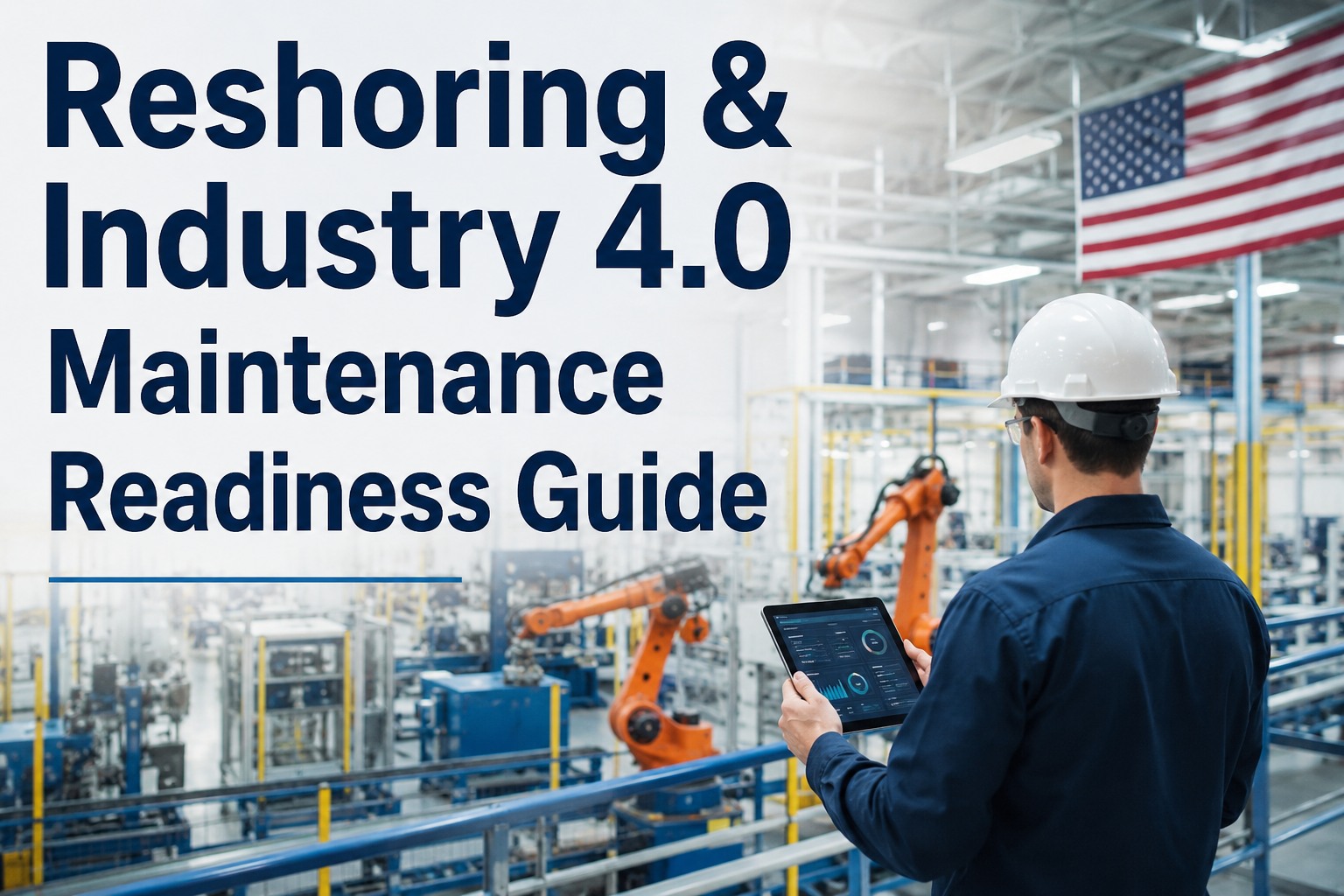
As US manufacturing reshores at a pace not seen in four decades, plant leaders are inheriting assets, workforces and maintenance backlogs that were never built for Industry 4.0 operating models. The gap between a ribbon-cutting and a connected, predictive maintenance program is where most reshoring projects quietly lose margin — unplanned downtime in modern US plants now averages $260,000 per hour, and legacy CMMS architectures cannot ingest the sensor, MES and ERP data needed to prevent it. OxMaint gives reshoring manufacturers a connected maintenance foundation — CMMS, PdM, ERP/MES integration and audit-ready work order history — deployed before the first machine is commissioned. Start your Start Free Trial and build maintenance readiness into day one, not year three.
Is your reshored plant ready to run predictive maintenance on day one — or will you discover the gap at 2 a.m. on a Saturday?
Over 85% of reshored US operations launch on legacy CMMS platforms that cannot connect to IIoT, MES or ERP — locking plants into reactive maintenance for the first 18–36 months and bleeding OEE before the line is even warm.
Reshoring is back. Maintenance readiness is not.
The CHIPS Act, IRA incentives and tariff pressure have committed over $485B to US manufacturing capacity since 2022 — but capital does not equal capability. A new $90M plant in Ohio can still miss its first-quarter OEE target by 14 points because its maintenance team is running breakdown logs in spreadsheets. The table below maps where most reshored plants actually start versus where Industry 4.0 demands they finish.
| Capability dimension | Typical reshored plant (day 1) | Industry 4.0 target | Readiness gap |
|---|---|---|---|
| Asset hierarchy & criticality | Partial — OEM manuals only | ISO 14224-coded, criticality-ranked | 60–90 days |
| Work order management | Paper or spreadsheet | Mobile CMMS, closed-loop WO | 30–60 days |
| ERP / MES integration | None — manual sync | Real-time bi-directional API | 90–180 days |
| Predictive maintenance | Calendar-based PM only | Vibration, thermal, oil — condition-based | 6–18 months |
| Spare parts & inventory | Reactive purchasing | Min/max, kitting, vendor-managed | 45–90 days |
| Audit & compliance trail | Manual logbooks | Immutable, timestamped, exportable | 30–45 days |
Source: OxMaint deployment benchmarks across 240+ US plant launches, 2023–2025. Gaps assume a dedicated reliability lead and OxMaint connected CMMS in place.
Four pillars of an Industry 4.0-ready CMMS
A CMMS is not maintenance software — it is the nervous system of a smart factory. OxMaint is architected so that each of these four pillars is live before the first production shift, not bolted on in year two.
Connected asset hierarchy
ISO 14224-compliant asset structuring from enterprise down to component level, with criticality scoring (A/B/C) and failure modes pre-loaded for every machine class.
ERP & MES integration
Bi-directional API connectors for SAP, Oracle, Epicor, Plex and leading MES platforms — work orders, BOMs, inventory and production status sync in under 5 seconds.
Predictive maintenance engine
Ingest vibration, current, thermal and oil data from IIoT gateways; auto-generate work orders when condition thresholds breach — no manual triage, no missed alerts.
Mobile-first execution
Technicians close WOs, capture photos, scan QR asset tags and sign off PMs from any iOS/Android device — online or offline — with timestamped, audit-ready history.
A 180-asset reshored plant: reactive to predictive in 90 days
Consider a Tier-2 automotive supplier reshoring a 180-asset machining line to South Carolina. Annual maintenance spend: $42K reactive, $18K planned, with 11 unplanned downtime events per quarter averaging 3.4 hours each. Here is what readiness looks like when OxMaint is deployed in parallel with commissioning rather than after.
Foundation & asset registry
Asset hierarchy imported and ISO 14224-coded. 180 assets ranked by criticality. 1,240 PM templates configured. Spare parts min/max synced to ERP. First mobile WOs closed within 11 days of go-live.
Integration & instrumentation
MES connector live — production counts feed OEE dashboard. Vibration sensors deployed on 24 critical spindles and pumps. Threshold baselining begins; first condition-based alerts fire by week 6.
Predictive & optimization
PdM engine auto-generates WOs on threshold breach. Mean time to repair drops 31%. Unplanned downtime events fall from 11 to 4 per quarter. Maintenance spend rebalances to 62% planned / 38% reactive.
Where most plants stall — and how OxMaint unblocks them
Industry 4.0 maintenance maturity is not a technology problem; it is a sequencing problem. Plants buy sensors before they have a CMMS to act on the signals. OxMaint sequences the build so each layer is load-bearing before the next is added.
Reactive — firefighting
Breakdowns drive 70%+ of maintenance activity. No asset hierarchy, no closed-loop WOs, no criticality ranking. Downtime cost per hour is uncontrolled. ~38% of reshored US plants sit here at month 6.
Planned — calendar PMs
PMs exist on a schedule but are disconnected from asset condition and production reality. Compliance improves but OEE gains plateau. ~44% of plants — the most common stall point.
Connected — CMMS + ERP + MES
Work orders, inventory and production data flow bi-directionally. Maintenance decisions consider production schedule and parts availability. OxMaint default go-live target — reachable in 60–90 days.
Predictive — condition-based + ML
IIoT signals trigger auto-generated WOs; remaining-useful-life models optimize intervention timing. Downtime becomes scheduled, not surprise. ~9% of US plants today — the Industry 4.0 endgame.
What maintenance readiness is worth
These figures are drawn from OxMaint deployments across reshored operations in automotive, industrial equipment, electronics and process manufacturing — plants that began their CMMS build during commissioning, not after first scrap.
We stood up the South Carolina line in 14 weeks. OxMaint was live before the first chip hit the conveyor — so when a spindle vibration alert fired in week 6, the work order was already routed, kitted and scheduled into a changeover window. That single catch paid for the platform for two years.
Build maintenance readiness before the line goes live — not after.
Deploy OxMaint in parallel with plant commissioning and start Year 1 at Industry 4.0 Stage 3, not Stage 1.
Reshoring & Industry 4.0 maintenance readiness — answered
Why can't we just deploy the CMMS after the plant is running?
Because the first 90 days of production are when bad maintenance habits calcify. Technicians default to whatever tool is fastest — usually spreadsheets or paper — and once that workflow is entrenched, replacing it means retraining a workforce during peak production pressure. Plants that deploy OxMaint during commissioning reach connected-CMMS maturity 9–14 months faster than those that wait, and avoid an average of $180K in avoidable downtime during the first two quarters.
Does OxMaint integrate with our existing ERP and MES?
OxMaint ships with native API connectors for SAP, Oracle, Epicor, Plex, NetSuite and leading MES platforms including Ignition, Sepasoft and TrakSYS. Bi-directional sync covers work orders, BOMs, inventory, purchase requisitions and production status. Most integrations are live within 2–4 weeks. You can verify your stack on a Book a Demo call.
How quickly can a reshored plant reach predictive maintenance (Stage 4)?
With OxMaint deployed during commissioning and IIoT instrumentation planned in parallel, a 150–250 asset plant typically reaches Stage 3 (connected) in 60–90 days and Stage 4 (predictive) in 6–9 months. The bottleneck is never the software — it is sensor deployment, threshold baselining and technician adoption. OxMaint's onboarding includes a reliability engineer to sequence these workstreams.
What if our workforce has never used a CMMS before?
OxMaint is mobile-first and designed for technicians who have never touched a CMMS. QR asset tags, photo capture, voice-to-text fault descriptions and offline mode mean the learning curve is measured in hours, not weeks. Average WO closure rate within 30 days of go-live is 96–98% across greenfield reshored plants.
Is there a minimum plant size or asset count to justify deployment?
OxMaint delivers positive ROI from roughly 50 critical assets upward. Below that threshold, a structured spreadsheet may suffice temporarily — but any reshored plant with CNCs, robotics, conveyance or utility systems typically crosses 50 assets within a single line. Start a Start Free Trial to map your asset count and see the readiness gap in real time.
Your reshored plant deserves a maintenance foundation built for Industry 4.0.
Join the reshoring manufacturers running predictive, connected maintenance from day one — not year three.
Free 14-day trial · No credit card