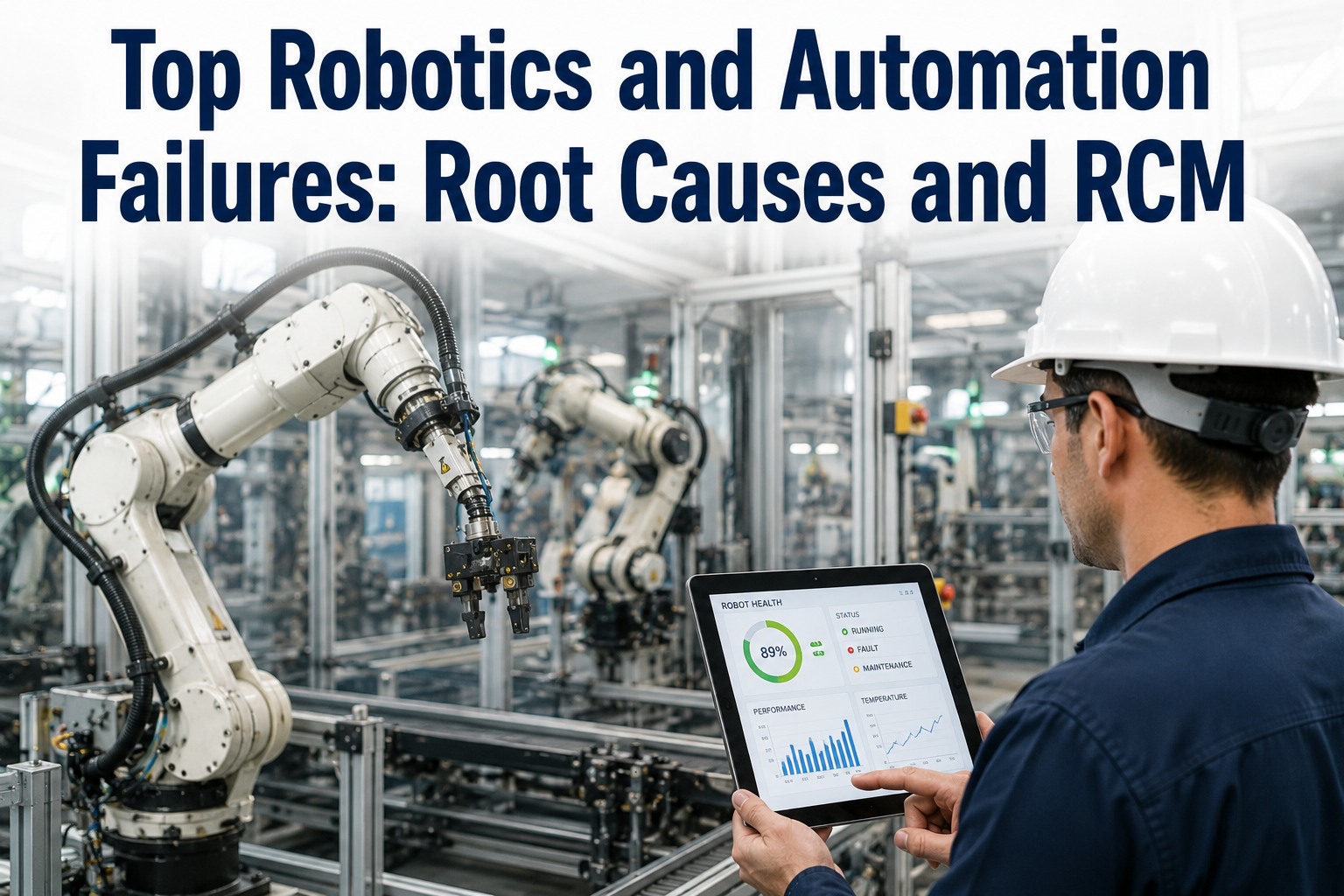
Understanding failure modes and effects for robotics & automation equipment is the single most effective way to reduce unplanned downtime, extend asset life, and protect production throughput. This guide breaks down every critical failure mode—from actuator & encoder wear to control system faults—alongside severity ratings and root cause analysis (RCA) methods so your team can build a defensible RCM strategy. By shifting from reactive fixes to predictive prevention, maintenance leaders typically cut robotics downtime by 30–50% and recover thousands of hours in lost OEE. If you want to turn these FMEA findings into automated, scheduled preventive actions, you can Start Free Trial with OxMaint today.
ROBOTICS & AUTOMATION FMEA
Is one failed actuator shutting down your entire production line?
Unplanned robotics failures cost manufacturers an average of $260,000 per hour in lost output. When actuator wear, encoder drift, or end-effector jams go undetected, a single $200 component failure cascades into a $50,000 downtime event. Build a data-driven FMEA and RCM strategy that catches these failures before they start.
FAILURE MODE BREAKDOWN
Robotics & automation failure modes, causes, and severity ratings
A structured Failure Mode and Effects Analysis (FMEA) is the backbone of robotics & automation reliability. Below is a comprehensive failure mode list mapping the most common failures to their root causes, operational effects, and severity ratings on a 1–10 scale.
| Failure Mode | Root Cause | Failure Effect | Severity (1-10) | Recommended RCM Task |
|---|---|---|---|---|
| Actuator & Encoder Wear | Lubrication breakdown, mechanical fatigue, seal degradation | Position drift, inaccurate tooling movements, micro-stops | 7 | Vibration analysis & condition-based lubrication |
| End-Effector Jams | Debris accumulation, gripper misalignment, pneumatic pressure drops | Dropped parts, cycle time spikes, line stoppage | 8 | Visual inspection & pressure monitoring |
| Servo Motor Overheating | Overload, cooling fan failure, ambient temperature spikes | Thermal shutdown, motor burnout, cascading cell downtime | 9 | Thermal imaging & load balancing alerts |
| Control System Faults | EMI interference, firmware bugs, power supply fluctuations | Erratic movements, safety e-stops, communication loss | 8 | PLC backup verification & UPS integration |
| Cable & Connector Fatigue | Repeated flexing, torsional stress, environmental exposure | Intermittent signals, complete signal loss, safety hazards | 6 | Scheduled cable replacement (time-based) |
| Pneumatic Leakage | O-ring wear, fitting loosening, tube abrasion | Reduced gripping force, slower cycle times, energy waste | 5 | Ultrasonic leak detection & flow monitoring |
ROOT CAUSE ANALYSIS
How to run robotics & automation root cause analysis that actually sticks
Skipped RCAs are why the same breakdown shows up quarter after quarter. Applying the right RCA technique to the right failure type ensures your team fixes the actual problem, not just the symptom.
5-Whys Analysis
Best for quick, single-factor incidents.
When a robotic welder suddenly drops out of position, ask "why" five times to drill past the symptom (e.g., "encoder drift") to the true root cause (e.g., "maintenance skipped lubrication due to an unapproved PM schedule change"). OxMaint lets you embed 5-Whys templates directly into high-impact work orders so the analysis happens before the ticket closes.
Fishbone (Ishikawa) Diagram
Best for multi-factor failures.
When a packaging line experiences intermittent jams, the cause is rarely singular. Categorize potential causes by Machine, Method, Material, Manpower, Measurement, and Environment. OxMaint's asset history feeds real downtime data and part-replacement logs directly into your fishbone sessions, eliminating guesswork.
Fault Tree Analysis (FTA)
Best for complex or safety-critical events.
For high-severity failures like servo motor burnouts or safety e-stop triggers, FTA maps out logical combinations of faults using AND/OR gates. OxMaint tracks the boolean logic of these failures against your asset hierarchy, helping reliability engineers predict and prevent compound failure scenarios.
WORKED EXAMPLE
The cost of skipped RCA: A 180-asset automation plant scenario
Consider a mid-sized automotive component manufacturer running 180 robotic cells. By failing to formalize their RCA process, they accepted recurring actuator failures as "normal wear." Here is what that complacency actually cost them—and how RCM changed the math.
Annual Downtime Cost Formula
Unplanned Hours × Production Rate × Profit Margin + Emergency Parts & Labor = Total Annual Loss
REACTIVE MAINTENANCE
The Cost of Inaction
- 320 hours of unplanned downtime per year from repeat actuator and encoder failures.
- 1,200 units/hr lost production rate during outages.
- $42,000/yr in expedited spare parts and overtime labor costs.
- 72-hour average MTTR (Mean Time To Repair) due to poor spare parts inventory tracking.
RCM + OXMAINT
The RCM Payback
- 110 hours of downtime after implementing condition-based monitoring and FMEA-driven PMs.
- 34% reduction in MTTR due to automated work order triggers and organized inventory.
- $28,500/yr recovered in eliminated expedited parts and overtime.
- $180K+ saved in recovered production throughput over 12 months.
SOFTWARE SOLUTION
How OxMaint drives robotics & automation failure prevention
OxMaint makes RCA a habit, not a forgotten project. By integrating FMEA data, condition monitoring, and automated work orders, OxMaint ensures every root cause is transformed into a preventive action that actually gets scheduled and closed.
Automated RCA Workflows
Trigger a mandatory 5-Whys or Fishbone workflow on any high-impact work order. Capture findings directly against the specific robotic asset so history is never lost.
Predictive Maintenance Triggers
Connect IoT sensors for vibration and temperature monitoring. OxMaint's AI analyzes the data to predict actuator & encoder wear before precision drifts, cutting unplanned downtime by 30–50%.
Closed-Loop Preventive Actions
Turn every identified root cause into an automated PM schedule. Ensure tasks are assigned, completed, and verified—eliminating the "fix it and forget it" cycle.
Reliability Analytics & FMEA Tracking
Track MTBF, MTTR, and OEE in real-time dashboards. Visually map severity ratings and failure effects against actual downtime to continuously refine your FMEA worksheet.
Stop paying for the same robotics failure twice.
See how OxMaint maps your FMEA findings to automated, preventive work orders. Book a 30-minute demo with our reliability engineers today.
FAQ
Robotics & automation failure modes and RCM FAQs
What is a failure mode and effects analysis (FMEA) for robotics?
An FMEA for robotics is a structured method used to identify every potential way a robotic system or automated asset can fail (failure modes), the root causes behind those failures, and the impact those failures have on production and safety. By assigning severity, occurrence, and detection ratings, maintenance teams can prioritize which failure modes require immediate preventive action.
How often should robotics FMEA worksheets be updated?
FMEA worksheets should be reviewed annually at minimum, or whenever a significant design change, new asset installation, or recurring failure occurs. Using a CMMS like OxMaint keeps your FMEA data dynamically linked to actual work order history, so your worksheets update in real-time as new failure patterns emerge. You can Start Free Trial to see this live.
What is the difference between RCM and preventive maintenance for automation?
Preventive maintenance (PM) is time-based or usage-based scheduling (e.g., lubricating an actuator every 90 days). Reliability-Centered Maintenance (RCM) is a broader strategy that uses FMEA data and condition monitoring to apply the right maintenance task—whether predictive, preventive, or run-to-failure—based on the specific failure mode's impact on safety and operations.
What are the most common root causes of automation line stoppages?
The most common root causes include undetected mechanical wear (like actuator and encoder fatigue), environmental contamination causing sensor drift, pneumatic leakage, and control system faults from power fluctuations. Skipping root cause analysis after an event ensures these issues will repeat and cause secondary downtime events.
How does maintenance software improve robotics reliability?
Maintenance software improves reliability by centralizing asset data, automating preventive work order triggers based on condition monitoring, and enforcing RCA workflows before failure tickets are closed. To see how OxMaint maps your specific failure modes to scheduled actions, Book a Demo with our team.
Turn your next breakdown into your last.
Build a data-driven FMEA, automate your RCM strategy, and eliminate repeat failures with OxMaint's AI-powered CMMS.
Free 14-day trial · No credit card required