root-cause-analysis-software-repeat-equipment-failures

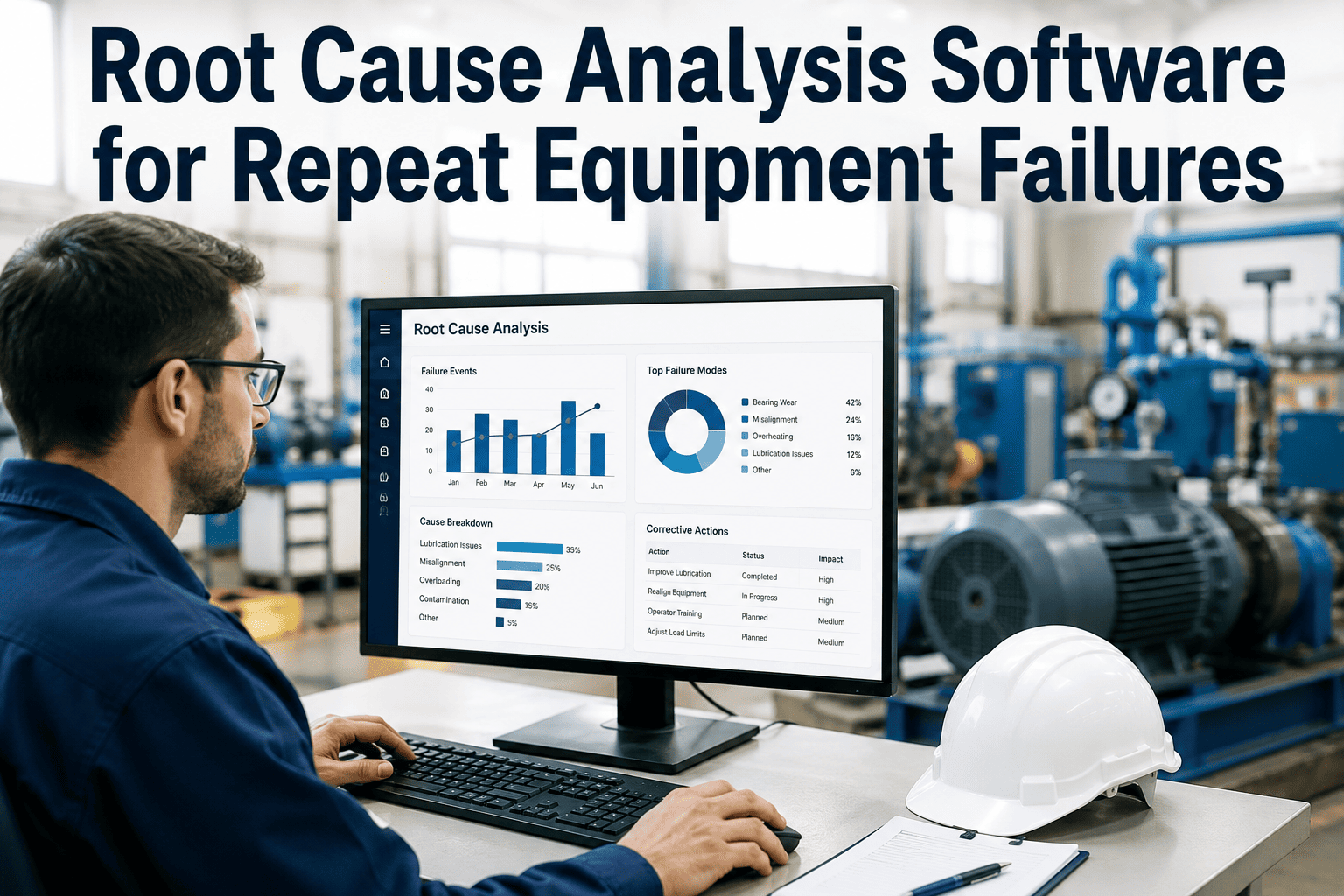
Root Cause Analysis Software for Repeat Equipment Failures


The same pump fails for the fourth time this year. The technician replaces the same bearing, logs the same work order note, and everyone moves on until it happens again in eight weeks. Across industrial maintenance teams, roughly 40% of all equipment failures are repeat occurrences of a cause that was never actually identified — only ever patched. Sign in to OxMaint to scan your own work order history for repeat failure patterns hiding in plain sight. Book a demo to see structured root cause analysis running against your worst-offending assets.

OxMaint · Root Cause Analysis Software
A repair that does not stop the failure from coming back is not a fix. It is a very expensive way of buying eight more weeks.

The 80/20 Pattern Hiding in Your Failure Data

Most maintenance budgets are not spread evenly across the fleet. A small group of repeat offenders quietly absorbs the majority of every year's unplanned spend.


80%
of downtime traced back to just 20% of assets or failure modes

40%
of all recorded failures are repeat occurrences of an uncorrected cause

40–72%
typical drop in repeat incident rate once the real root cause is corrected

Why the First Answer Is Never the Root Cause

A structured drill-down — the same 5-Whys logic OxMaint applies automatically to every logged failure — usually needs three to five layers before it reaches something you can actually fix for good.

1
Why did the pump fail?
The bearing seized.

2
Why did the bearing seize?
It was running without adequate lubrication.

3
Why was lubrication inadequate?
The PM interval for greasing was too long for this duty cycle.

4
Why was the interval wrong?
It was copied from a generic OEM manual, not this asset's actual run-time.

5
Root cause
No process exists to adjust PM intervals against real usage data — this will keep happening on every similar asset until that process exists.
Fixing the bearing again does not touch the process gap in step five. That is why the same failure keeps coming back — and why structured RCA has to be built into the workflow, not treated as an occasional deep-dive.

Six Cause Domains Every Repeat Failure Falls Into

Structured RCA categorizes every failure into one of six domains so patterns across assets — not just within one machine — become visible.

01
Machine
Design limitation, wear, or a component operating outside its rated tolerance.
02
Method
Procedure gaps, missing steps, or a task performed differently by every technician.
03
Material
Wrong part specification, substandard supply batch, or incorrect lubricant grade.
04
Manpower
Training gaps, unverified competency, or inconsistent handover between shifts.
05
Measurement
Inaccurate sensor calibration, missed readings, or thresholds set too wide to catch drift.
06
Environment
Temperature, vibration, humidity, or contamination conditions the asset was never designed for.

Symptom Fix vs Root Cause Fix

The two approaches look identical on the work order. They produce very different totals by the end of the year.

DimensionSymptom FixRoot Cause Fix
What gets repairedThe failed part onlyThe part, plus the condition that caused it to fail
Likelihood of recurrenceHigh — same failure returns on a similar timelineReduced 40–70% within two PM cycles
Knowledge capturedA closed work order with a parts listA documented cause, linked corrective action, and owner
Impact across the fleetLimited to the one asset repairedPattern applied across every similar asset in the portfolio
Time to identifyMinutes — replace and move onHours with AI-assisted pattern matching, not weeks
Scroll right to view full comparison on mobile
Expert Review
This framework was reviewed by OxMaint's reliability engineering team against structured RCA programs running across manufacturing and industrial accounts with high repeat-failure rates. The six-domain classification and staged Why drill-down consistently surfaced systemic causes — training gaps, PM interval errors, sourcing issues — that single-asset troubleshooting missed entirely.

Frequently Asked Questions — Root Cause Analysis for Repeat Failures

Match failures by asset, failure mode, and root cause category rather than just by symptom description — two bearing failures on the same pump with different causes are not the same repeat. Sign in to OxMaint to run automatic pattern matching across your work order history.
It helps for complex multi-factor failures, but a technician or planner can run a 5-Whys drill-down on most repeat issues using the work order history already in the CMMS. Book a demo to see the guided drill-down workflow your team can run without an engineering degree.
Start with the 20% of assets or failure modes driving most of your downtime — that Pareto slice returns the fastest payoff before expanding RCA further. Sign in to OxMaint to rank your assets by repeat failure cost automatically.
Most programs see a measurable drop within two full PM cycles of correcting the identified root cause, with some reporting reductions of up to 72% within six months. Book a demo to see a repeat-failure dashboard tracking your own trend line.
Yes. Environmental and specification-related causes often affect several similar assets across different locations, and pattern matching can surface that connection in hours rather than months of separate investigations. Sign in to OxMaint to scan for portfolio-wide failure signatures.
OxMaint · Root Cause Analysis · Reliability Engineering

Every repeat failure your team fixes without finding the cause is a bill you have already agreed to pay again. Structured RCA is how that cycle actually ends.

Automatic repeat pattern detection. Guided 5-Whys and fishbone workflows. Corrective action tracking to verified completion. Fleet-wide signature matching — built into the work order, not a separate spreadsheet.



Share This Story, Choose Your Platform!