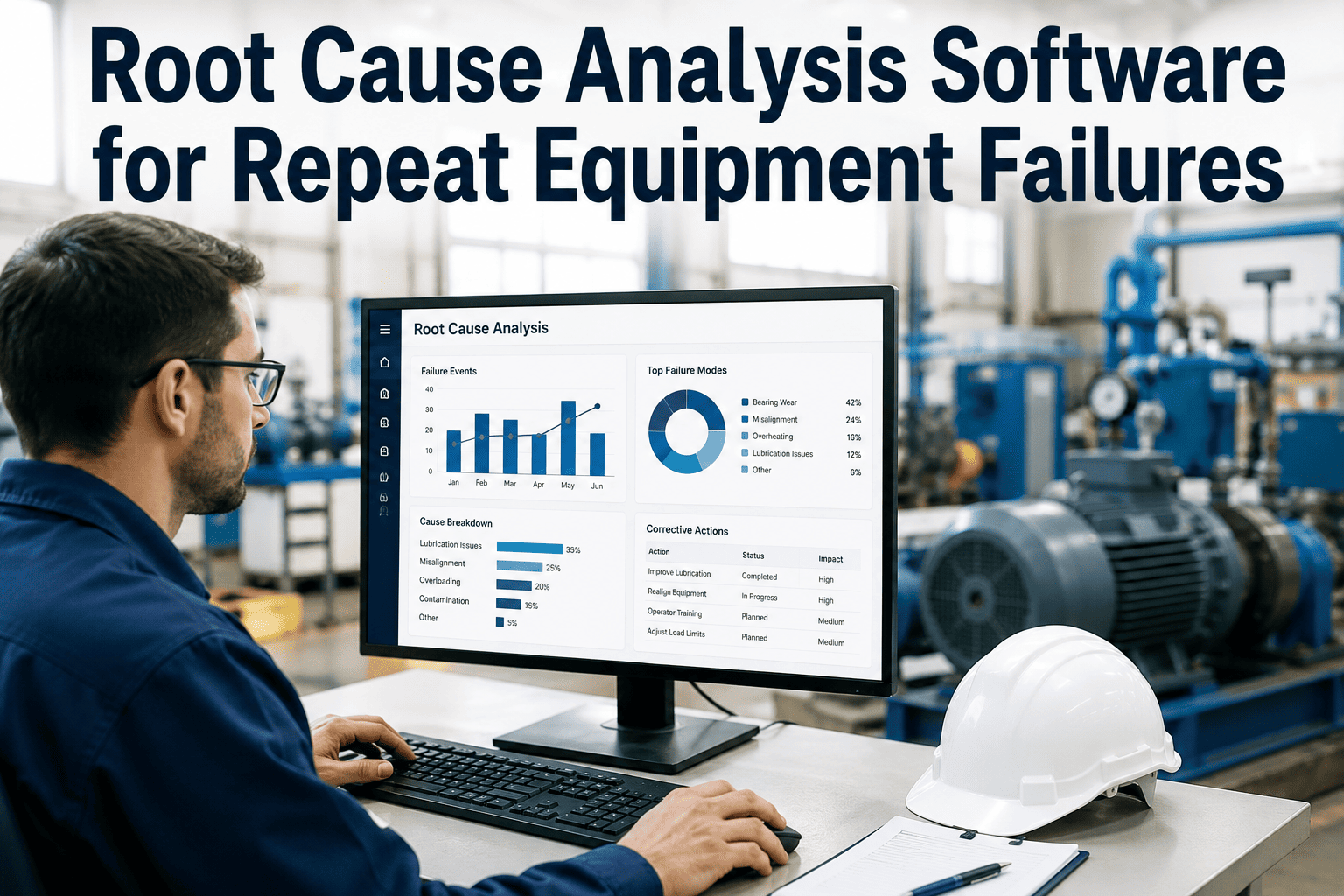
Repeat failures are the most expensive problem in maintenance — not because individual repairs cost more, but because the same asset breaks down again and again, consuming labor, parts, and production time while the root cause goes unidentified. Industry data shows that 40% of equipment failures are repeat occurrences, and most maintenance teams lack the analytical capacity to identify why. OxMaint's AI analytics scans your entire work order history to surface hidden failure patterns, identify systemic root causes, and recommend reliability improvements that eliminate recurring failures at their source.
AI ROOT CAUSE ANALYSIS
Stop Fixing the Same Failure Twice
OxMaint's AI mines your work order history to find why equipment keeps failing — and gives your reliability team the evidence to fix it permanently.
40%
Of all equipment failures are repeat occurrences
3.2x
Higher repair cost for repeat failures vs first-occurrence repairs
60%
Of repeat failures eliminated after AI-driven RCA implementation
THE REPEAT FAILURE TRAP: WHY IT PERSISTS
01
Data Exists But Goes Unread
Most CMMS platforms store years of work order history, but maintenance managers rarely have time to analyze hundreds of records manually. Failure patterns hide in plain sight.
02
Fixes Address Symptoms, Not Causes
Under time pressure, technicians fix what broke — the burnt motor, the failed bearing — without investigating why it failed. The underlying cause persists and triggers the next failure.
03
No Formal RCA Process
Formal root cause analysis tools like FMEA and 5-Why require reliability engineers and structured time — resources most maintenance teams don't have for every repeat failure event.
04
Knowledge Leaves With People
Senior technicians who remember the last three times a pump failed carry that institutional knowledge in their heads. When they leave, the next team repeats the same diagnostic loop from scratch.
HOW OXMAINT AI IDENTIFIES ROOT CAUSES
1
Pattern Mining Across Work History
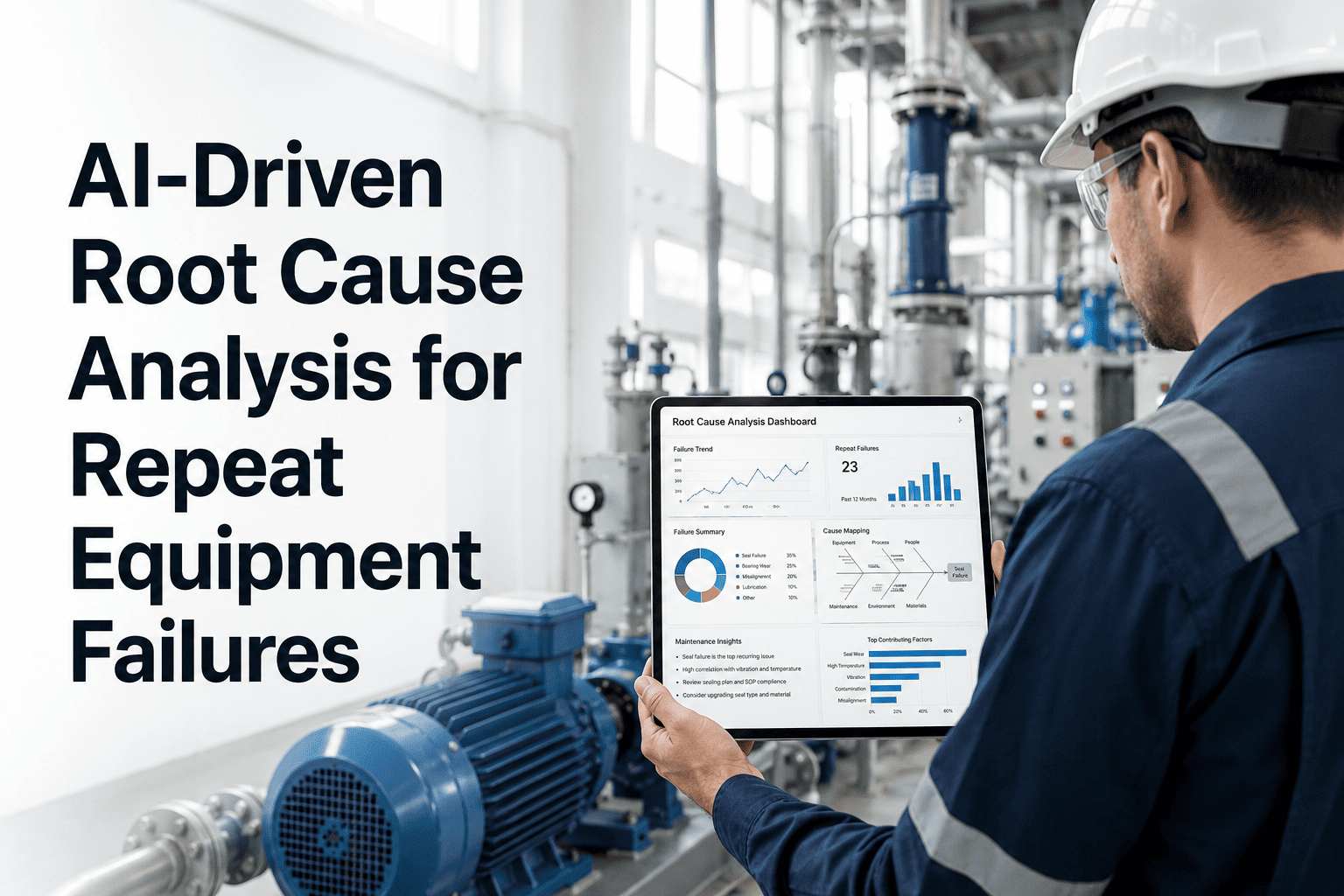
OxMaint's AI scans all historical work orders for the same asset, asset class, or shared component — identifying failure frequency, time-between-failures, common fault codes, and repair outcomes over configurable time windows.
2
Correlation with Operating Conditions
Failure events are correlated against operating data — load cycles, temperature patterns, runtime hours, and production volumes at the time of failure — to identify whether failures cluster around specific operating conditions.
3
Contributing Factor Ranking
The AI ranks the most statistically probable root causes for the failure pattern — maintenance interval too long, wrong lubricant specification, design overload — and assigns a confidence score to each contributing factor.
4
Recommended Corrective Actions
OxMaint generates specific, actionable recommendations — reduce PM interval from 90 to 45 days, upgrade bearing grade from ABEC-3 to ABEC-7, install shaft alignment jig — that address the identified root cause directly.
| Failure Type | Pattern AI Identifies | Root Cause Found | Corrective Action | Repeat Rate After Fix |
|---|---|---|---|---|
| Pump Seal Failures | Failures cluster at 60–65 day intervals | PM interval 90 days — too long for duty cycle | Shorten PM to 45 days, upgrade seal grade | Reduced 78% |
| Motor Overheating | Failures peak on summer afternoons | Ventilation blocked by seasonal dust accumulation | Add filter cleaning to summer PM checklist | Eliminated completely |
| Conveyor Belt Slippage | Failures follow production schedule changes | Tension not adjusted for new product weight | Add tension check to changeover procedure | Reduced 91% |
| Bearing Failures | Same bearing fails every 3rd replacement | Wrong supplier part — incorrect tolerance spec | Qualify single approved-supplier bearing stock | Reduced 85% |
KA
Root cause analysis has always been the step maintenance programs skip because it requires time and engineering expertise that most facilities don't have available after fighting the day's fires. The result is a maintenance program that perpetually treats the same symptoms on the same machines at the same intervals — spending money to stay in place rather than improving. OxMaint changes that by automating the pattern recognition step. I've used it to identify root causes in 48 hours that would have taken weeks of manual data analysis — and the corrective actions it recommends are specific enough to implement without additional engineering study. The repeat failure elimination results we've seen across industrial clients have consistently delivered 40–70% reductions in repeat incident rates within two PM cycles.
Find Out Why Your Equipment Keeps Failing
Book a demo and see OxMaint's AI RCA analyze your worst repeat-failure assets in real time.
FREQUENTLY ASKED QUESTIONS
How much historical work order data does OxMaint need to generate meaningful root cause analysis?
OxMaint can begin pattern detection with as few as 5–8 failure events on the same asset or asset class, but the analysis becomes statistically meaningful at 12 or more events within the analysis window. Most facilities migrating from paper or spreadsheet systems can import historical work order data through OxMaint's CSV import tool, allowing the AI to analyze multi-year failure histories immediately rather than waiting for new data to accumulate. For assets with sparse failure histories, OxMaint aggregates patterns across similar asset models in the same equipment class to provide statistically valid root cause hypotheses. Sign up free to test your historical data with the RCA engine.
Can OxMaint's AI RCA distinguish between failures caused by maintenance practices versus equipment design or operating conditions?
Yes. OxMaint's root cause classification model separates contributing factors into four categories: maintenance-induced causes (wrong PM interval, improper procedure, incorrect parts), operating condition causes (overload, environmental exposure, production process changes), design causes (undersized component, wrong material specification), and age or wear-out causes (end of useful life, cumulative fatigue). Each failure pattern analysis generates a ranked breakdown of contributing factors by category, allowing reliability engineers to direct corrective actions at the appropriate layer — whether that means changing a PM procedure, adjusting operating parameters, or specifying a design upgrade. Book a demo to see the category breakdown interface.
How does OxMaint track whether recommended corrective actions actually reduced repeat failure rates?
OxMaint's RCA module includes an outcomes tracking dashboard that measures time-between-failures on each asset before and after a corrective action is implemented. When a recommended action is marked as implemented in the system, OxMaint begins tracking the post-correction failure rate and calculates whether the intervention is statistically reducing recurrence at the expected rate. If failures resume at a similar rate after the initial improvement, the system re-triggers pattern analysis and escalates to the next probable root cause layer. This creates a closed-loop reliability improvement process rather than a one-time analysis exercise.
Can OxMaint identify root causes that span multiple assets — a systemic issue affecting an entire equipment class?
Yes, and this is one of the most valuable capabilities of AI-driven RCA versus single-asset analysis. OxMaint's fleet-level pattern analysis identifies when the same failure mode is occurring across multiple assets of the same model, manufacturer, or component supplier — flagging systemic issues that would never surface from single-asset analysis. Common examples include a bad batch of replacement parts from a supplier, a shared PM procedure error affecting all assets of one type, or a process condition change affecting all equipment in a specific production zone. Fleet-level RCA findings are flagged with a "systemic" tag and routed to the reliability manager for organization-wide corrective action. Start free to run your first fleet-level pattern analysis.