The same pump fails every six weeks. The same conveyor belt trips every third Monday. The same compressor throws the same fault code that maintenance cleared eight months ago. Repeat equipment failures are not bad luck — they are a data problem. When failure history is scattered across paper logs, technician memory, and disconnected spreadsheets, root causes stay hidden and the same fixes get applied to the same symptoms forever. This page shows how asset failure history tracking inside a CMMS breaks that cycle permanently. Start tracking your asset failures in OxMaint — free for 14 days.
Asset Reliability · Failure History · Root Cause Analysis · CMMS
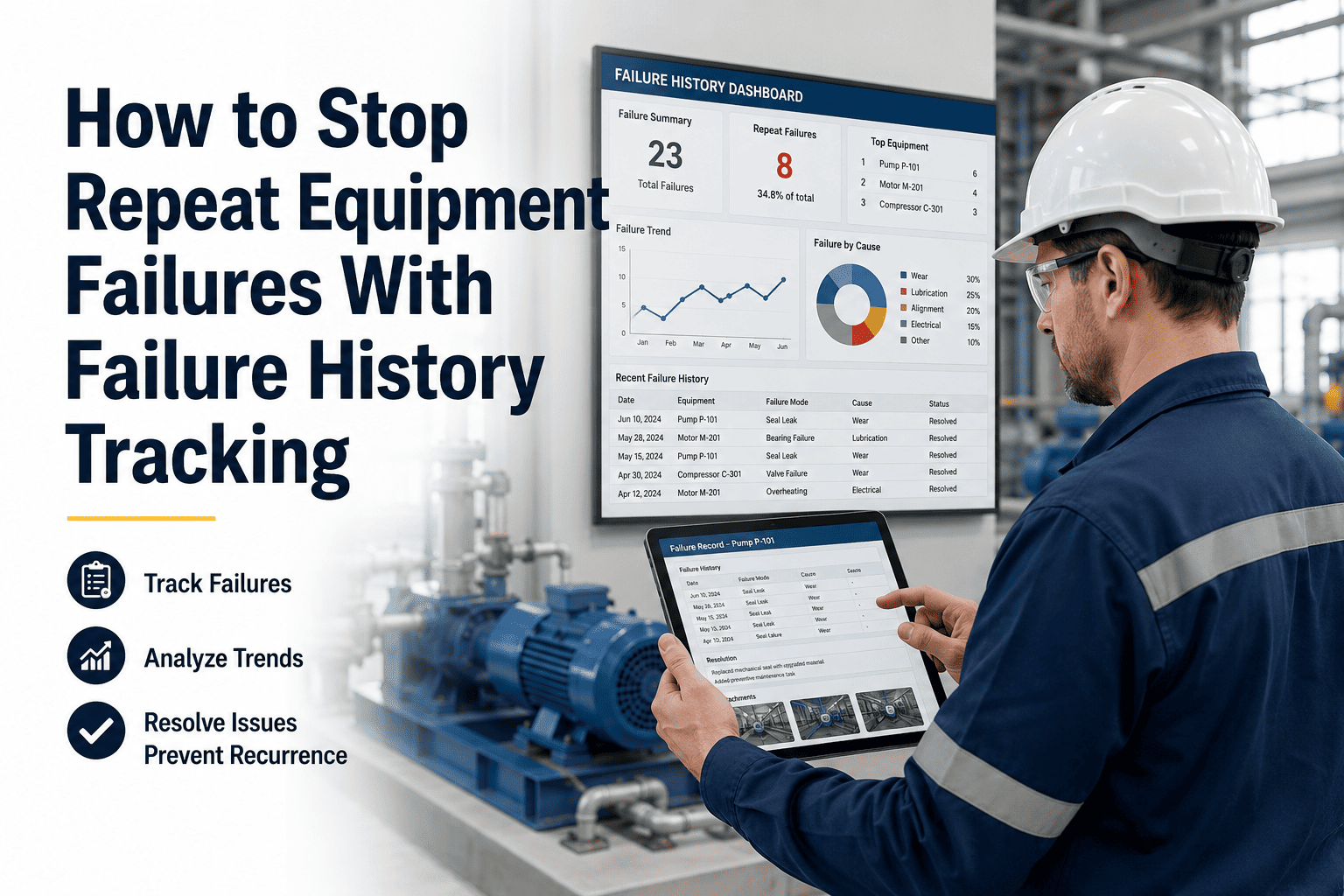
How to Stop Repeat Equipment Failures With Failure History Tracking
Repeat failures are the most preventable category of maintenance cost. They account for up to 25% of all corrective work orders but often represent 60–70% of total maintenance spend on high-value assets — because each recurrence happens without the urgency to find the real cause.
25%
of all corrective WOs are repeat failures on known assets
4×
higher MTTR on repeat failures vs first-occurrence repairs
70%
of repeat failures have a documented root cause — never acted on
Why It Keeps Happening
Why the Same Equipment Fails Over and Over
A
The Fix Was Symptomatic, Not Causal
A bearing overheats and seizes. The team replaces the bearing and restarts the machine. Six weeks later, it fails again — because the real cause was inadequate lubrication intervals, which nobody documented or changed.
B
No Access to Previous Failure Data at the Job Site
The technician fixing the pump today has no idea it failed for the same reason three months ago — because that work order is in a paper file nobody reads. History without accessibility is worthless.
C
Root Cause Analysis Is Skipped Under Pressure
When production is waiting and the maintenance team is under pressure to restart fast, the RCA step — the one that would prevent recurrence — gets skipped in favour of getting back online. The next failure is booked in advance.
D
No System Flags That This Is a Repeat
Without a CMMS tracking failure patterns, nobody knows this is the fourth time this asset has failed in 12 months until someone manually compares spreadsheets — which rarely happens.
The Solution
How Failure History Tracking Stops the Repeat Cycle
Every Failure Gets a Failure Code, Not Just a Description
Structured failure codes (e.g. mechanical-bearing-overheating vs electrical-motor-insulation) turn work order notes into searchable, analysable data. Free-text descriptions like "pump broken — fixed" are useless for pattern detection. Failure codes are the raw material of all RCA work.
Asset History Is Visible at the Point of Repair
When a technician opens a work order on a mobile CMMS, the last 5 failures for that asset appear automatically — including what was done, who did it, and what parts were used. This context changes how the repair is approached before a single bolt is turned.
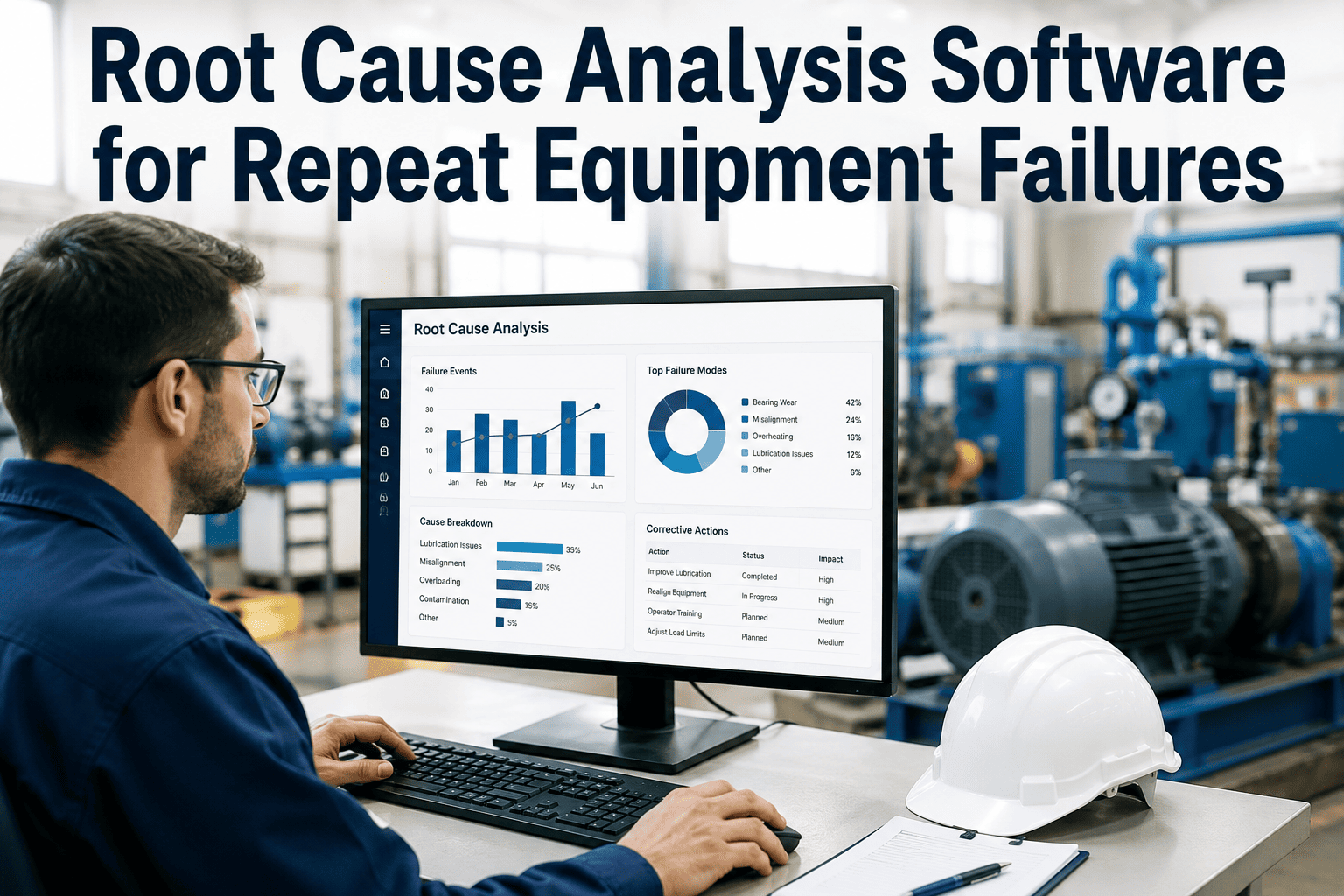
CMMS Analytics Identify Your Top Repeat-Failure Assets Monthly
A CMMS can rank every asset by failure frequency, total downtime contribution, and repair cost in seconds. Your top 5 repeat-failure assets are almost always visible in this report — and they are where your reliability investment will have the highest return.
Root Cause Actions Are Linked to Work Orders — Not Forgotten
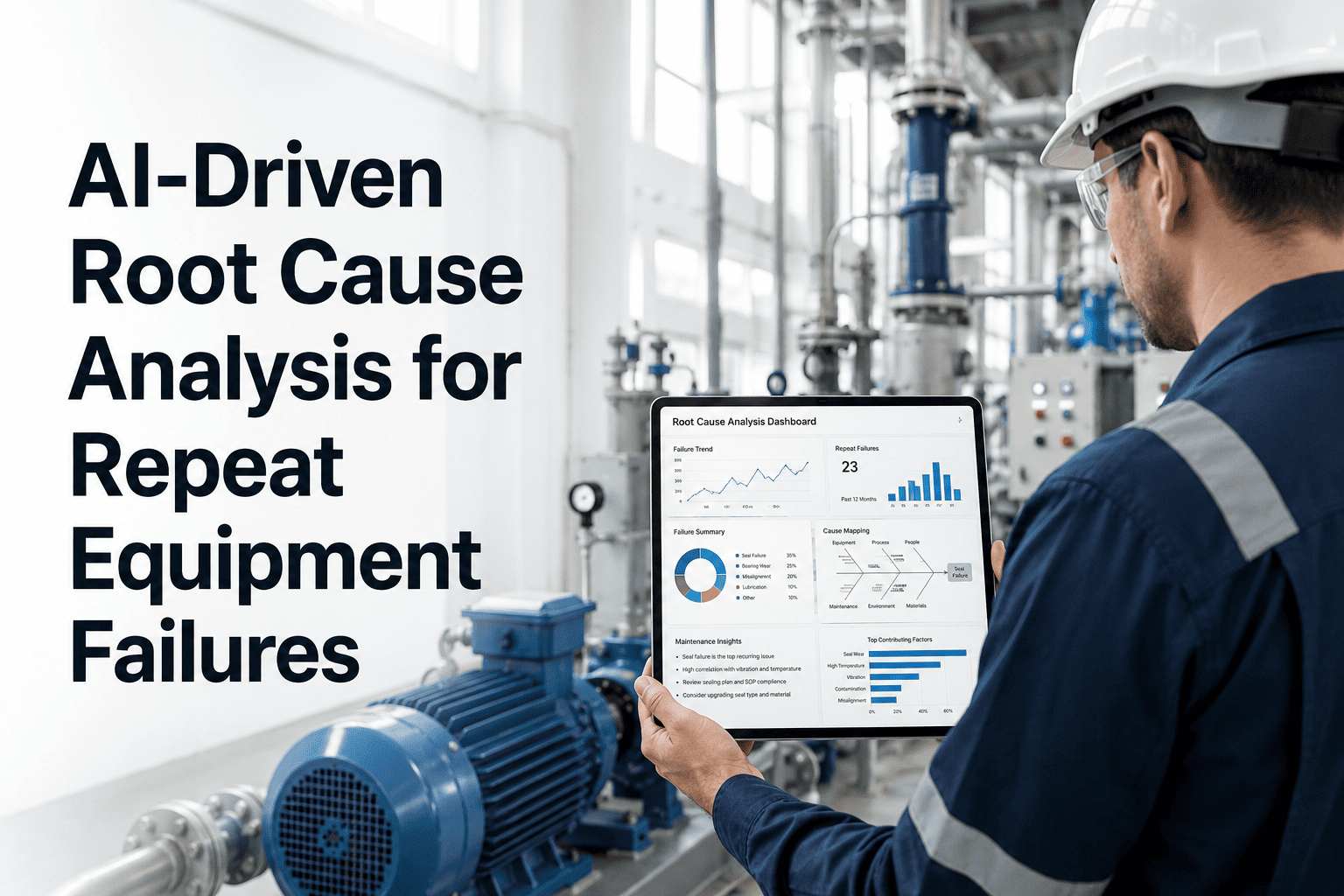
When RCA identifies a solution (e.g. change lubrication interval from 30 days to 14 days), that action is converted into a PM task in the CMMS — not a meeting note. It gets scheduled, assigned, and verified. The loop closes.
Failure Analysis Framework
Failure Classification Table — What Your CMMS Should Track
| Failure Category |
Example Failure Code |
Common Root Cause |
Corrective PM Action |
| Mechanical – Wear |
MECH-BEARING-WEAR |
Inadequate lubrication frequency |
Reduce lubrication interval; check alignment |
| Electrical – Insulation |
ELEC-MOTOR-INSULATION |
Moisture ingress; overloading |
Add IP enclosure; review load profile |
| Mechanical – Fatigue |
MECH-SHAFT-FATIGUE |
Misalignment; vibration not monitored |
Laser alignment PM; add vibration sensor |
| Hydraulic – Seal |
HYD-SEAL-LEAK |
Temperature cycling beyond spec |
Upgrade seal material; add temperature alarm |
| Instrumentation – Calibration |
INST-SENSOR-DRIFT |
Calibration schedule not followed |
Enforce calibration PM at manufacturer interval |
Asset Reliability with OxMaint
Know Which Assets Are About to Fail — Before They Do It Again
OxMaint tracks every failure with structured codes, shows full asset history at the point of repair, and generates repeat-failure reports automatically. Your team stops guessing and starts fixing the real cause.
Expert Review
Reliability Engineers on Failure History Tracking
★★★★★
"Failure codes transformed our maintenance data from a pile of notes into something we could actually analyse. Within two months of standardising our failure taxonomy in the CMMS, we identified three assets driving 40% of our corrective backlog. Fixing those three assets was the highest-ROI project our team had done in five years."
FC
F. Chen
Reliability Engineer, Pharmaceutical Manufacturing
★★★★★
"The shift from free-text work order descriptions to structured failure codes was resisted initially. Technicians thought it was extra admin. Six months later, when we showed them that the system had automatically flagged their repeat-failure assets and reduced their emergency callouts, they became the biggest advocates for the process."
MB
M. Bergström
Maintenance Manager, Pulp and Paper Plant
Frequently Asked
Repeat Equipment Failures — Common Questions
How many failures on the same asset before it qualifies as a "repeat failure" problem?
Industry standard defines a repeat failure as the same failure mode occurring more than twice in a 12-month period. However, for high-criticality assets, even a second failure of the same mode warrants a formal root cause analysis before the third can occur. A
CMMS like OxMaint can automatically flag assets that exceed a configurable failure threshold, so your team doesn't need to manually review history to identify where the problem pattern exists. Even one failure on a safety-critical asset should trigger a structured RCA process.
What is the best root cause analysis method for maintenance teams?
For maintenance teams, the 5-Why method is the most practical entry point — it requires no specialist training, takes 15–30 minutes, and can be completed at the job site immediately after repair. For complex, high-consequence failures involving multiple systems, a Fishbone (Ishikawa) diagram or Failure Mode and Effects Analysis (FMEA) provides more rigorous structure. The key is that the root cause finding must be converted into a CMMS work order or PM task — not just documented and forgotten. Most repeat failures persist because the RCA finding never gets actioned.
See how OxMaint links RCA actions to PM schedules.
Does OxMaint provide failure code libraries or do teams build their own?
OxMaint provides a standard failure code framework aligned to ISO 14224 and common industry taxonomies, which teams can use out-of-the-box or customise for their specific equipment and terminology. The important principle is that every plant uses a consistent, agreed set of codes — not individual free-text descriptions that differ by technician and shift. Consistency is what makes the failure data searchable, reportable, and actionable over time. Teams that start with a simple 20–30 code library and expand it based on what they actually encounter get the best long-term data quality.
How long does it take to see measurable improvement after implementing failure history tracking?
Most teams see a measurable reduction in repeat failures within 3–6 months of consistent failure code recording in a CMMS. The first 90 days are typically spent building the dataset — standardising codes, training technicians, and letting failure patterns accumulate. By month 4–6, the CMMS analytics begin showing clear repeat-failure assets, and focused root cause interventions on the top 3–5 assets typically produce a 20–30% reduction in total corrective work order volume within the following quarter. The compounding effect means results improve every 6 months as more failure data is captured.
Stop the Repeat Failure Cycle
Every Repeat Failure Is a Failure You Already Paid for Once.
OxMaint's asset failure history tracking, structured failure codes, and repeat-failure analytics give your team the data to fix root causes — not just symptoms. Stop paying for the same failure twice.


.png)

