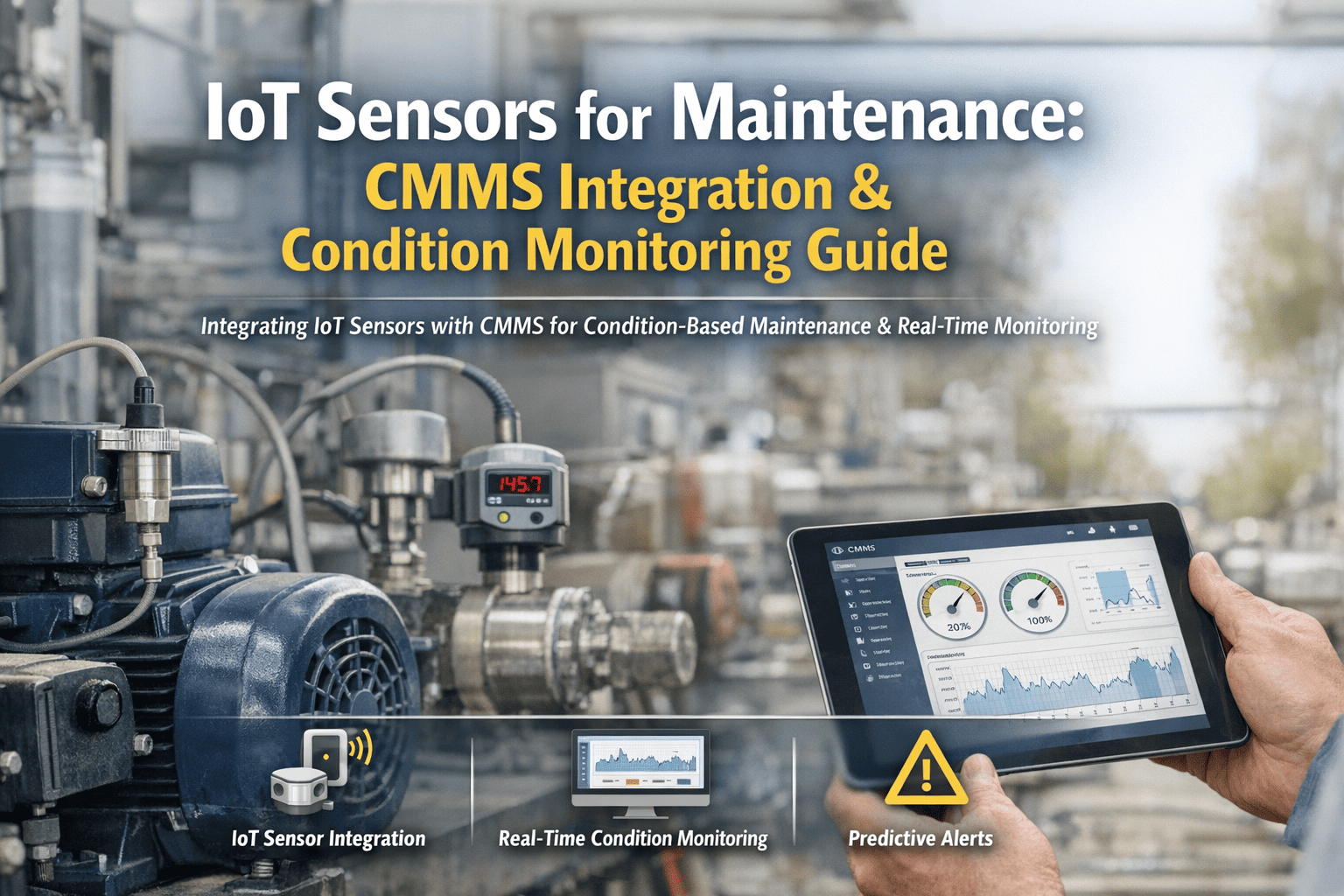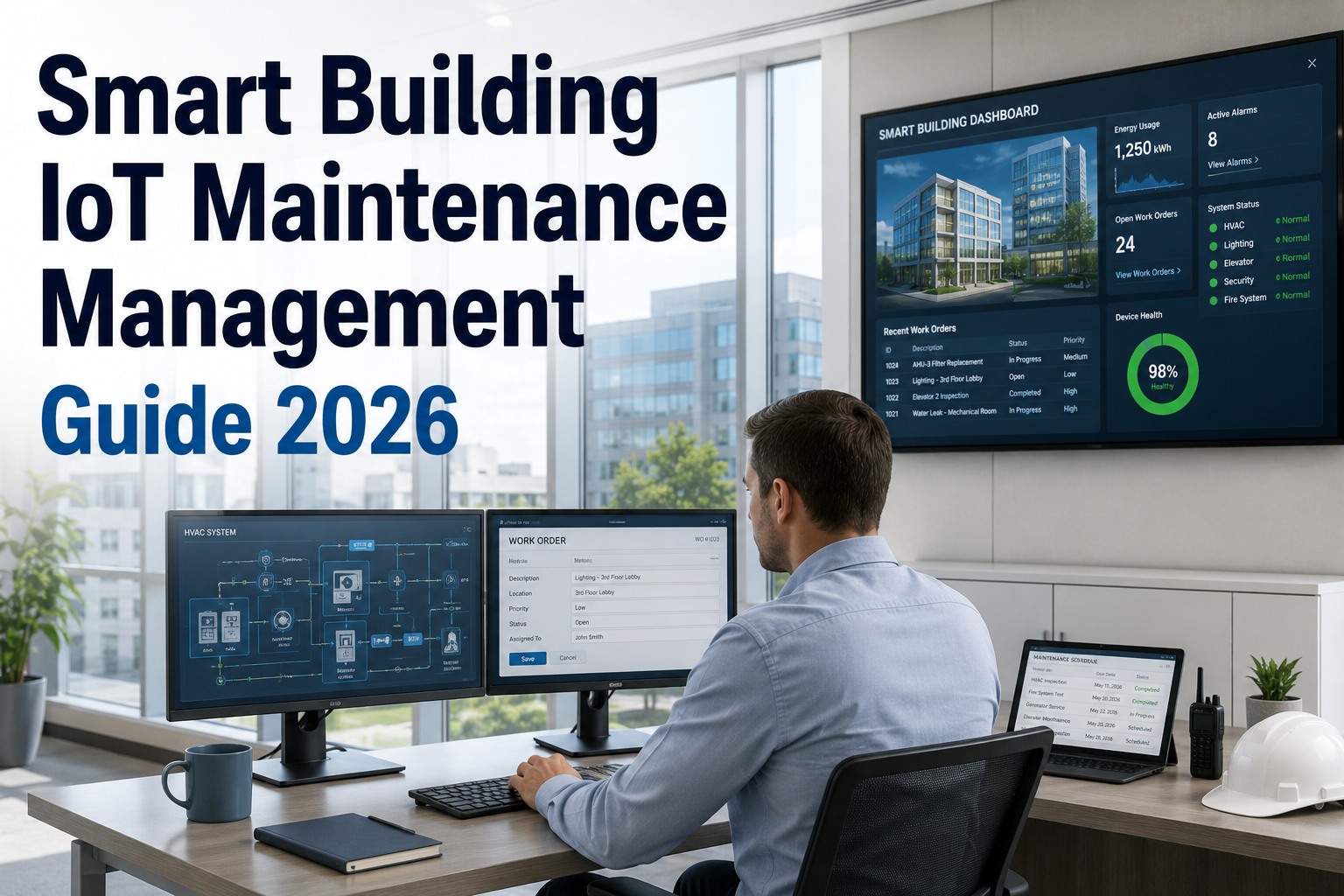
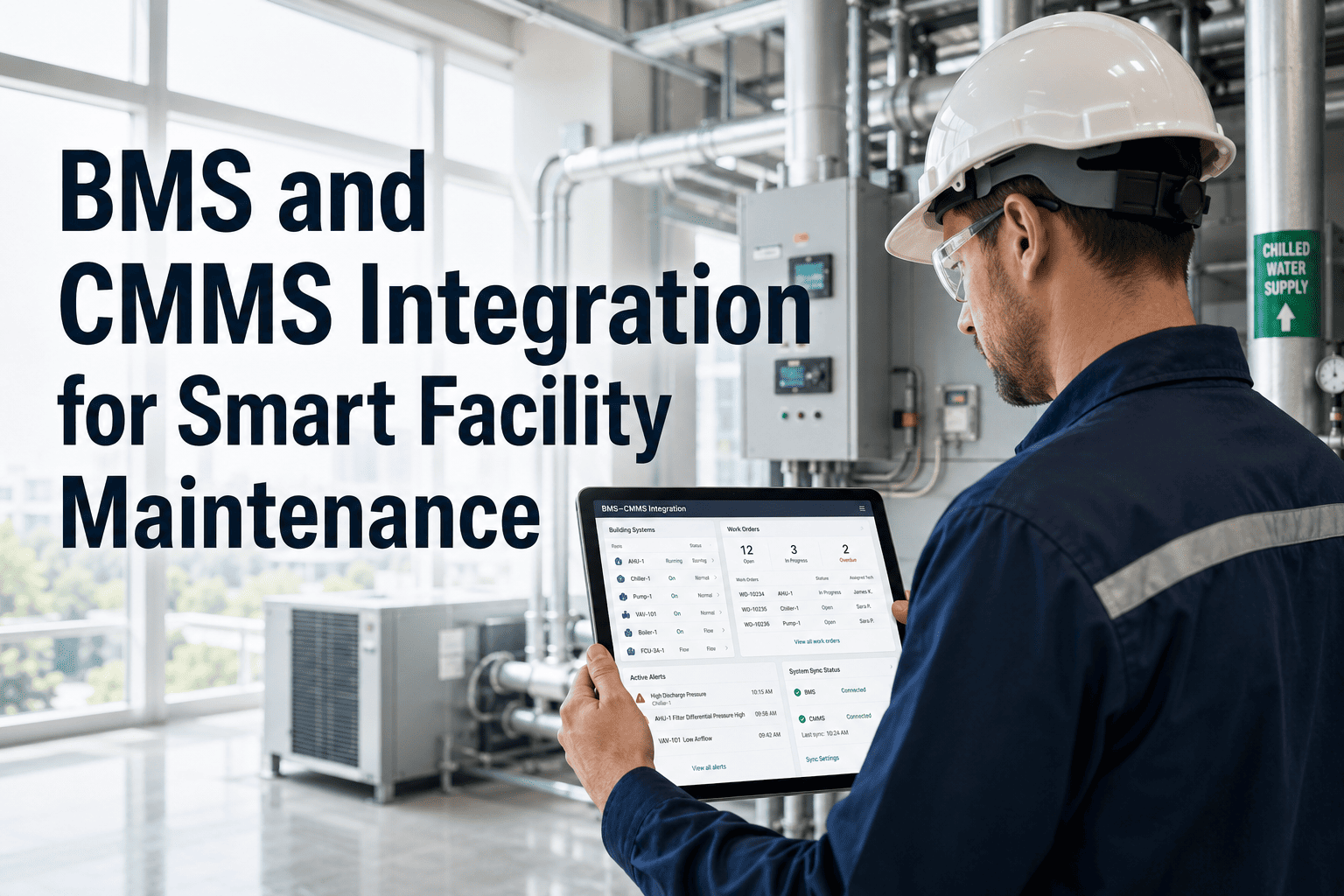
Smart building maintenance has shifted from calendar-based rounds to condition-driven action: IoT sensors on HVAC, electrical and mechanical equipment stream temperature, vibration and energy data that a CMMS turns into automated work orders. For facility teams managing connected buildings, the value isn't the sensor — it's the workflow that follows the alert. OxMaint integrates building IoT sensors directly into its AI-powered CMMS so that every alarm becomes a tracked, assigned and resolved maintenance task. When a chiller bearing begins to fail, the system generates a work order before occupants ever feel the temperature rise. Ready to modernize? Start Free Trial and connect your first assets today.
Smart Building IoT Maintenance Guide 2026
Is your building IoT generating data — or action?
Most connected buildings collect thousands of sensor readings per hour, yet 70% of facility teams still dispatch work orders manually. OxMaint closes the gap between an IoT alarm and a resolved work order — automatically.
The Integration Gap
Why most smart building IoT projects stall at the dashboard
A typical Class-A commercial building deploys 5,000–15,000 IoT points across HVAC, lighting, power meters and life-safety systems — yet the data dies in a BMS or energy dashboard. The missing layer is a CMMS that can ingest the signal, evaluate it and trigger a maintenance response.
The cost of that 48-hour lag is measurable. A stuck cooling-tower fan detected on Monday but dispatched Wednesday can push a 200,000-sq-ft office building 4°F above setpoint, generating tenant complaints, after-hours callouts and an emergency parts shipment that costs 3× the planned rate. Smart building IoT maintenance management eliminates that lag by making the sensor-to-work-order path instant and auditable.
Worked Example
From vibration alert to resolved work order in 90 minutes
Consider a 180-asset commercial portfolio spending $42,000 annually on reactive HVAC repairs. After integrating OxMaint with building IoT sensors on twelve critical air-handling units, the workflow looks like this:
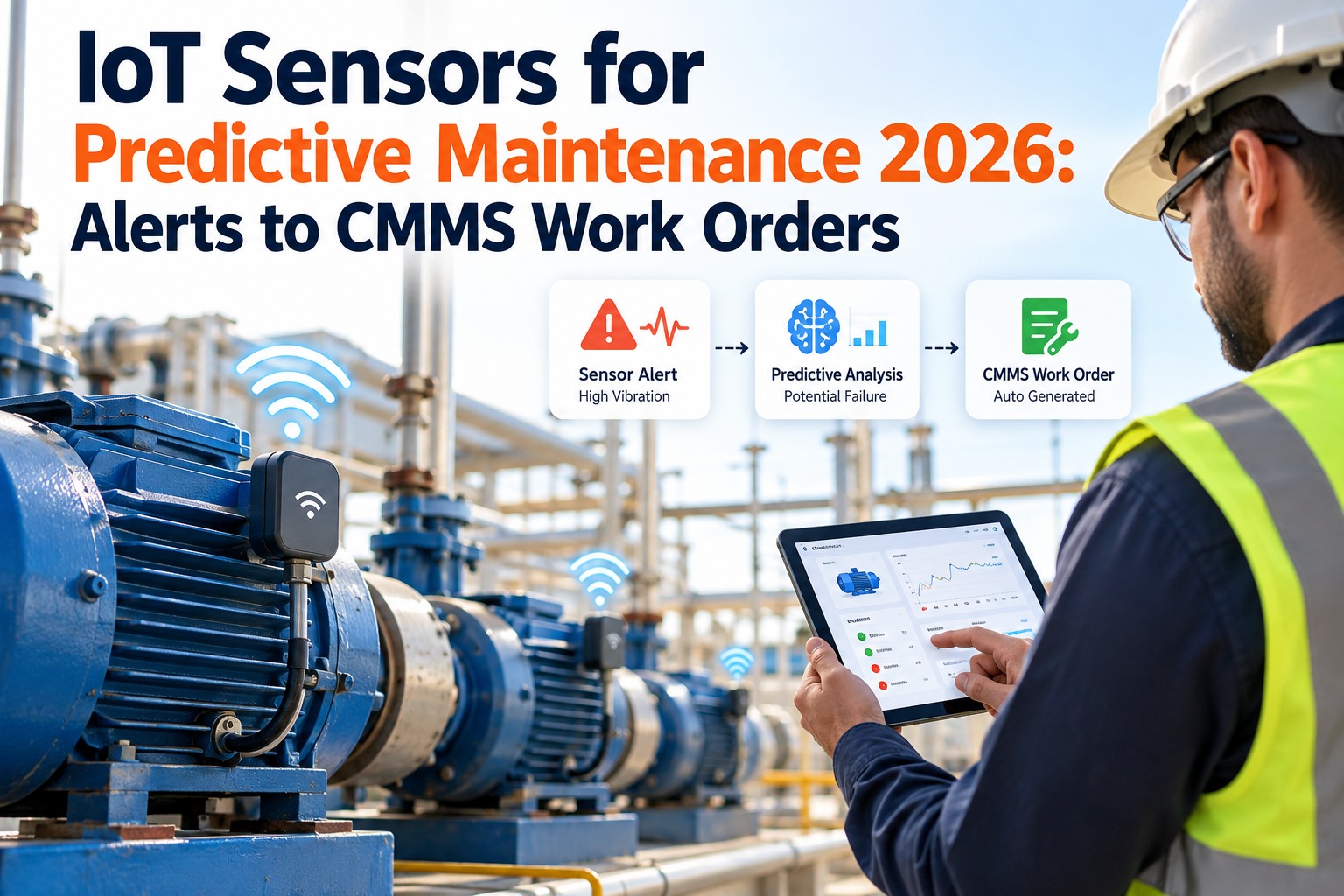
Sensor detects anomaly
A vibration sensor on AHU-7 crosses 4.5 mm/s RMS — above the ISO 10816 alarm threshold for a 1,800-RPM motor. The signal is pushed to OxMaint via MQTT API in under 2 seconds.
AI evaluates severity
OxMaint's predictive engine correlates the vibration spike with trending motor-current data and bearing-temperature rise over the prior 72 hours, classifying the event as a bearing-lubrication fault — not a false alarm.
Work order auto-generated
The system creates a priority-2 work order, attaches the sensor trend chart, checks spare-parts inventory for the correct grease cartridge, and assigns it to the technician whose route includes Floor 4 — all without dispatcher involvement.
Technician resolves and closes
The technician receives a mobile push notification, arrives with the right part, re-lubricates the bearing, logs 25 minutes of labor, and closes the work order. Vibration returns to 1.8 mm/s. The asset health score updates in real time.
Total elapsed time: 88 minutes. Cost avoided: an estimated $3,200 in emergency motor replacement and tenant downtime credits. Over twelve months the portfolio cut unplanned HVAC downtime by 38% and reduced emergency parts spend by $14,500.
Comparison
Reactive vs. scheduled vs. IoT predictive maintenance for buildings
Most facility teams operate in one of three modes. The table below shows the real-world cost and risk profile of each, based on data from FMI/Curry and DOE Federal Energy Management Program benchmarks.
| Dimension | Reactive (Run-to-Failure) | Scheduled (Time-Based PM) | IoT Predictive (OxMaint) |
|---|---|---|---|
| Trigger | Breakdown or complaint | Calendar interval (monthly, quarterly) | Sensor condition crosses threshold |
| Avg. response time | 4–48 hours after failure | Next scheduled PM window | Minutes — automated work order |
| Maintenance cost multiplier | 3–5× baseline | 1.2–1.5× baseline (over-maintenance) | 0.6–0.8× baseline |
| Unplanned downtime | High and unpredictable | Moderate — 20% of failures still occur between cycles | Low — 30–50% reduction vs. scheduled |
| Spare-parts impact | Emergency shipments, 3× cost | Parts replaced prematurely | Parts consumed at true remaining useful life |
| Audit trail | Paper tickets, incomplete | CMMS records, but no condition data | Full sensor-to-resolution digital thread |
How OxMaint Helps
The smart facility CMMS capabilities that turn IoT into outcomes
OxMaint is built to be the maintenance workflow layer that sits between your building IoT sensors and your technicians. Four capabilities drive the measurable ROI above:
Alarm-to-work-order automation
OxMaint ingests MQTT, BACnet and REST sensor feeds and automatically generates a classified work order when a condition threshold is crossed — no dispatcher required. Teams eliminate the 48-hour manual lag and cut average response time by up to 90%.
Predictive failure analytics
AI models trained on vibration, temperature, current and pressure trends predict bearing, motor and compressor failures 7–21 days before breakdown — enabling planned repairs during off-hours and cutting unplanned downtime 30–50%.
Smart spare-parts allocation
Every auto-generated work order checks real-time inventory and reserves the correct part before dispatch. One facility team cut emergency parts spend by 34% in six months by shifting from reactive ordering to condition-triggered reservations.
Portfolio-wide asset health scoring
OxMaint rolls up per-asset health scores to building-level and portfolio-level dashboards, giving facility directors a real-time risk view across every property. Prioritize capital planning with data, not guesswork.
ROI Snapshot
What a smart building CMMS pays back — and how fast
Based on deployment data across mid-sized commercial portfolios (5–40 buildings, 150–2,000 tracked assets), the financial picture is consistent:
Annual savings formula
(Downtime hours avoided × hourly cost) + (emergency parts delta) + (labor reallocation from reactive to planned) − OxMaint annual subscription = Net year-one savings
"Within four months of connecting our BMS to OxMaint, we stopped receiving a single after-hours HVAC call from three of our largest tenants. The sensors were already there — we just needed the CMMS to act on them."
— Facilities Director, 1.2M-sq-ft commercial portfolio
See OxMaint turn your building IoT data into maintenance action
Book a 30-minute demo and we'll map your sensor infrastructure to automated work orders in real time — on your assets, your floor plans, your priority rules.
FAQ
Smart building IoT maintenance — common questions
What is smart building IoT maintenance management?
It's the practice of using IoT sensor data — vibration, temperature, pressure, current, flow — to trigger maintenance work orders automatically through a CMMS. Instead of inspecting equipment on a fixed schedule or waiting for a breakdown, the building's own sensors tell the maintenance team when attention is needed, and the CMMS dispatches the right technician with the right parts before failure occurs.
How does OxMaint integrate with existing building IoT sensors?
OxMaint supports MQTT, BACnet, Modbus and REST API connections to most building automation systems and standalone sensor gateways. During onboarding, each sensor point is mapped to an asset record and assigned alarm thresholds. Once configured, sensor data flows into OxMaint continuously and triggers work orders automatically — no manual dashboard monitoring required. You can see the full integration in a 30-minute demo at Book a Demo.
Can a smart building CMMS work with older HVAC equipment?
Yes. Even legacy chillers, air handlers and pumps without native IoT connectivity can be retrofitted with wireless vibration, temperature and current sensors for $50–$300 per point. OxMaint treats retrofit sensor data identically to native BMS data — the asset receives a health score, the alarm triggers a work order, and the maintenance team gets the same predictive analytics and audit trail.
How long does it take to deploy IoT CMMS integration?
For a typical 10-building portfolio with 200–500 critical assets, OxMaint onboarding takes 3–6 weeks: sensor mapping and threshold configuration in week 1–2, work-order automation rules in week 3–4, and technician mobile rollout in week 5–6. Teams running on spreadsheets or legacy CMMS can migrate historical asset and PM data during onboarding so there's no loss of records.
What does smart building maintenance software cost?
OxMaint is priced per asset per month, with tiering based on portfolio size and predictive-analytics modules. Most mid-sized commercial portfolios (150–1,000 assets) see a net positive ROI within 4–7 months — the subscription cost is typically a fraction of the downtime, emergency-parts and energy savings it generates. You can explore the platform free for 14 days at Start Free Trial — no credit card required.
Stop collecting data. Start dispatching action.
Your building sensors already know when equipment is failing. OxMaint makes sure someone fixes it before anyone notices — automatically, auditably, across every property.
Free 14-day trial · No credit card


.png)