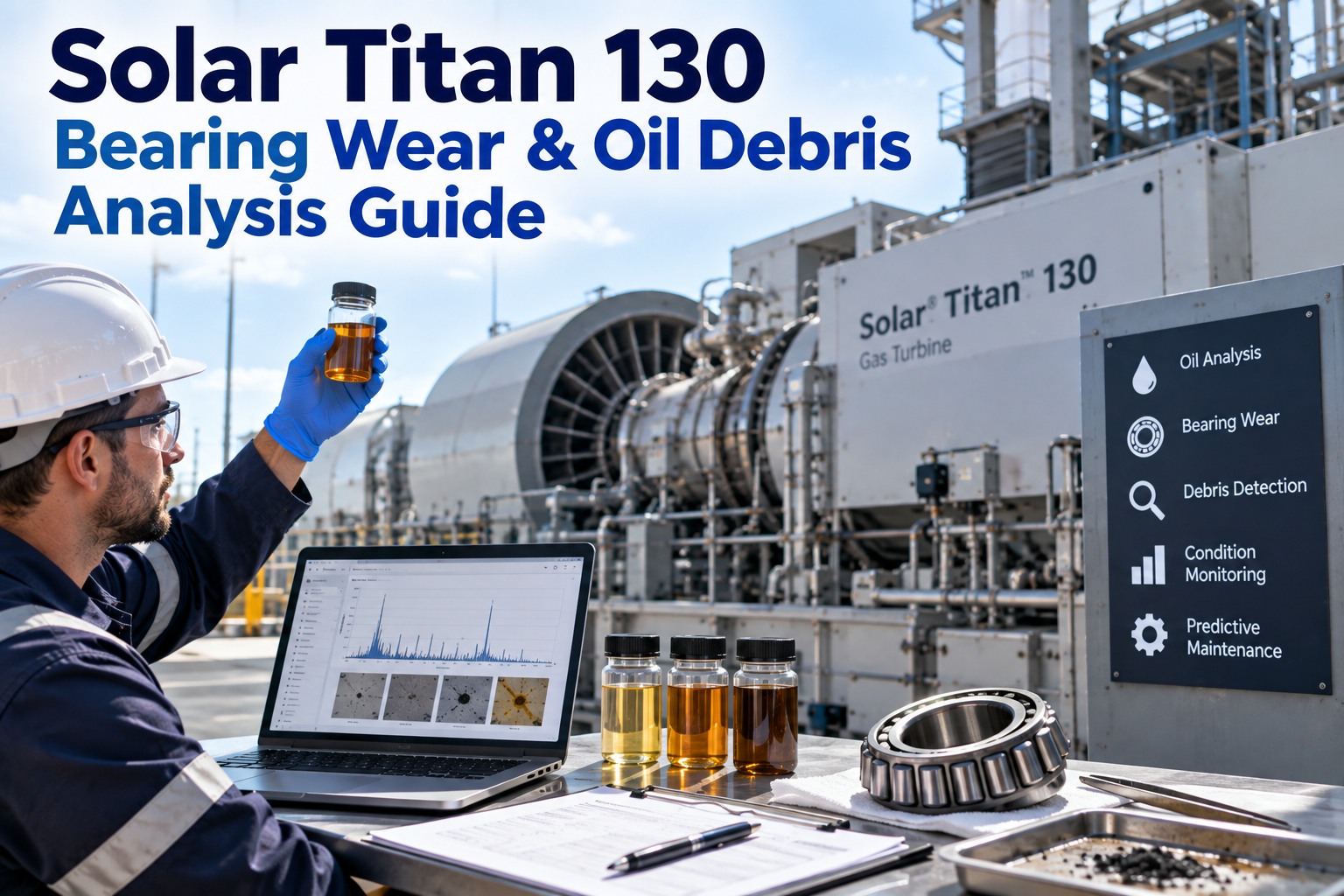
It's 02:10 on a Monday. The online oil-debris monitor for the Titan 130 gas producer (GP) bearing trips an alert: a fast jump in ferrous particle counts. The operator acknowledges the alarm and logs it in the DCS. At 06:45 the planner arrives, coffee in hand, scanning the historian triplet of debris, vibration, and temperature. Twelve years of bearing-related work orders sit in the CMMS with inconsistent notes: some quick swaps, some extended run-ons. What should the planner do before the next dispatch meeting? Who signs off, and how do you turn that lube-analysis blip into a defensible, scheduled work package? This walkthrough shows how Oxmaint AI ingests 5–15 years of historian + CMMS history and produces an evidence-backed WO for Maximo/SAP/Infor, and how a short demo lets you walk the event with your team.
Solar Turbines Titan 130 · GP Bearing · Oil Debris · 2026
Solar Titan 130 Gas Producer Bearing Wear and Oil Debris: Turning Lube Analysis Results into Scheduled Work Packages
Oxmaint AI overlays your historian, CMMS and OEM procedures — stitches events into an evidence timeline, ranks RCM failure hypotheses with confidence scores, and pushes an evidence-backed recommended WO to Maximo/SAP/Infor. Planners and OEM sign-off stay in charge.
02:10
ferrous debris spike on GP bearing circuit
5–15 yrs
historian + CMMS ingested for context
3-Pane
Timeline · Signal → Confidence · Suggested WO
Overlay
planner & OEM sign-off preserved
At a Glance
The event, the risk, and what the overlay delivers — before the next dispatch meeting. Start a free trial to run this event with your Titan 130 data.
Event & Risk
What the Planner Faces
✕ Problem: rapid spike in lube oil ferrous debris on a Solar Turbines Titan 130 GP bearing circuit
✕ Risk: unplanned bearing failure
✕ Risk: collateral rotor/shaft damage
✕ Risk: forced outage
✕ 12 years of bearing-related WOs with inconsistent notes — quick swaps vs extended run-ons
Oxmaint AI Outcome
Evidence-Backed WO Package
✓ Evidence-backed recommended WO package pushed to Maximo/SAP/Infor for planner review
✓ Retains site/OEM sign-off — planner authority intact
✓ Overlay principle: does not replace your EAM/CMMS
✓ Recommendations traceable back to historian tags, particle analyses and CMMS WOs
✓ Fleet-level aggregation for multiple Titan 130 units, unit-level detail preserved
What 5–15 Years of Your Historian + CMMS Looks Like in Oxmaint AI
Oxmaint AI ingests your historian tags and CMMS history and stitches them into an evidence timeline so you stop guessing context. Illustrative timeline entries (replace with your asset tags and dates) show patterns — debris spikes that precede bearing swaps vs spikes that follow oil-system work — so you calibrate response to your fleet's actual failure progression, not generic rules. Book a short demo to see your own asset tags on the timeline.
Evidence Timeline · GP_LUBE_DEBRIS · Titan 130 GP Bearing
2016-05-12
14:22 · GP_LUBE_DEBRIS ferrous spike · WO-2016-345: bearing change completed
2019-11-03
09:10 · GP_LUBE_DEBRIS mixed particle spike after filter replacement · WO-2019-802: lube filter service
2022-09-18
02:48 · GP_VIB_X asymmetric vibration alarm, no debris · WO-2022-412: shaft alignment
2024-06-05
02:10 · GP_LUBE_DEBRIS new event · current — under review
SIGNAL GP_LUBE_DEBRIS · GP_BRG_TEMP · GP_VIB_AX mapped to RCM hypotheses
EVIDENCE Particle metallurgy notes · vibration localization · recent CMMS actions
WO DRAFT Scope · spares · crew skills · safety · oil sample & metallurgical follow-up
EXPORT One-click to Maximo/SAP/Infor · rationale attached · planner edits/reschedules/cancels
The Three Panes That Turn a Blip Into a Work Package
Each pane carries a specific decision — spot the pattern, weigh the hypotheses, dispatch the work. Book a demo to see the three panes populated with your actual evidence.
Pane 1
Failure Mode Timeline
A combined chronology of historian events (debris, vibration, bearing temp), CMMS WOs and operator log notes, all aligned to the same time axis for the Titan 130 asset. Quickly spot whether past debris spikes preceded immediate bearing replacements or were benign — and whether similar spikes escalated within hours, days, or continued without incident.
Pane 2
Signal → Confidence
Each active signal (GP_LUBE_DEBRIS, GP_BRG_TEMP, GP_VIB_AX) mapped to a set of RCM failure hypotheses with an illustrative confidence score. Example: 85% accelerated bearing surface wear · 10% upstream oil system contamination · 5% adjacent component damage. Confidence is a probabilistic aid — every score links back to the exact evidence for reviewer validation or override.
Pane 3
Suggested WO → Maximo/SAP
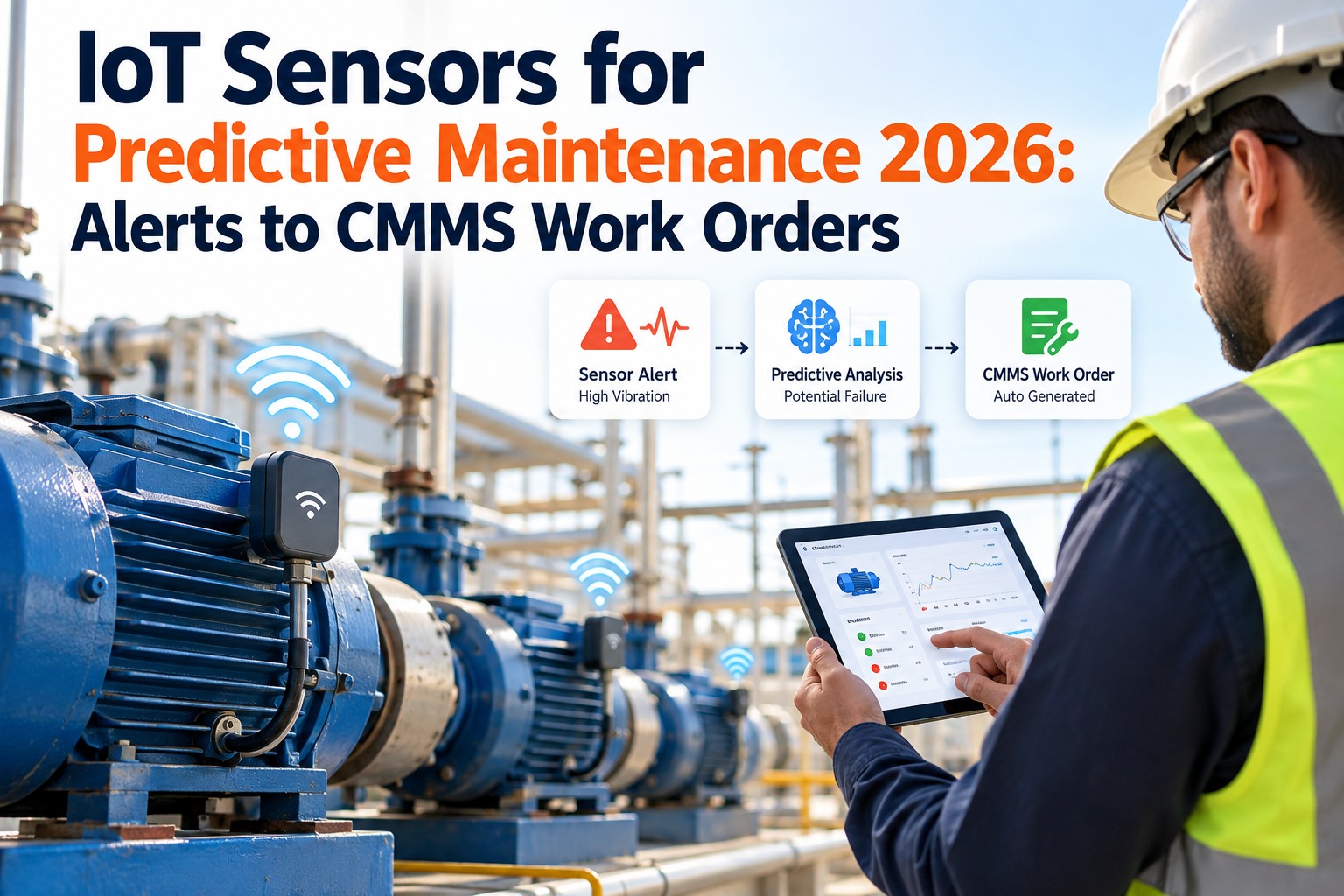
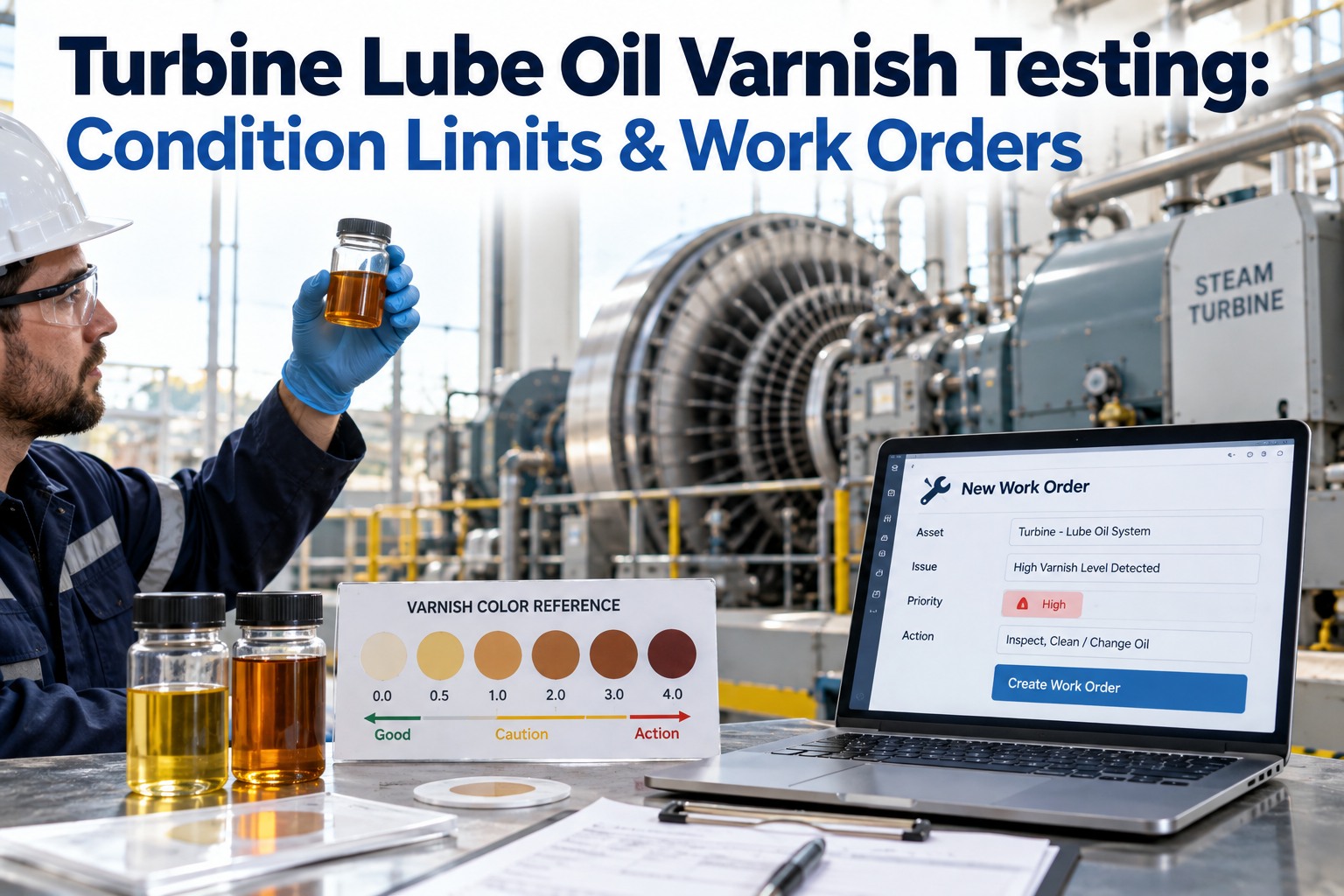
A recommended, RCM-justified work package template — scope, required spares, suggested crew skills, safety precautions, required oil sample & metallurgical follow-up. One-click export creates a draft WO in your EAM with the entire decision rationale attached as evidence. Planners keep authority to edit, reschedule or cancel.
Overlay
Not a Replacement
Oxmaint AI overlays historian evidence and RCM logic and pushes recommendations into your existing workflows while preserving planner and OEM authority. The EAM/CMMS remains the system of record.
RCM Decision Logic — Turning Failure Physics Into Actionable Tasks
Seven steps take a debris spike from raw signal to a task choice — PdM, PM, or functional-failure — always cross-checked with site procedures and OEM guidance before execution. Start a free trial to configure the logic for your Titan 130 fleet.
01
Function: GP bearing supports the rotor, maintains concentricity and accepts radial/axial loads while oil provides lubrication and heat removal
02
Functional failures: loss of lubricating film, excessive friction, loss of load-carrying capability, increased runout/vibration
03
Failure modes: debris-induced surface wear, oil starvation, microfatigue/microspalling, misalignment-induced edge loading, upstream contamination
04
Effects & consequences: localized wear → increased clearance → vibration → potential shaft contact and catastrophic damage; unplanned outage, high-cost repairs, safety risks in extreme cases
05
Detectable: rising ferrous debris counts, increasing bearing shell temperature, trending vibration amplitude/frequency shifts
06
Hidden: early subsurface fatigue releasing very small particles below sensor threshold; lubrication-property degradation not captured by a single sensor
07
Look-alikes: oil system contamination after a filter change can mimic bearing metal spikes; wear from an adjacent rotating component produces ferrous debris but needs different corrective action
08
Task choice: rapid historical escalation → immediate inspection + staged bearing replacement; slow sustained accumulation → PdM (increase sampling, vibration localization, metallurgical analysis) and PM at next planned outage
Overlay Principle — Planner & OEM Authority Preserved.
Oxmaint AI does not replace your EAM/CMMS. It overlays historian evidence and RCM logic and pushes recommendations into your existing workflows. Site and OEM procedures take priority; Oxmaint AI's output is advisory and designed to be reviewed and modified by your planners and engineers before action.
Differential Diagnoses for a High Oil-Debris Event
Three candidate causes for the current event, each with supporting evidence and an action path — the reason confidence scores matter and why every score is traceable to its evidence. Book a demo to see the differential engine on your particle metallurgy notes.
Accelerated Bearing Surface Wear
Supporting evidence: ferrous particle metallurgy consistent with bearing alloy, matched gradual increases in vibration and temperature.
Action path: prioritize inspection and prepare replacement parts if past events show rapid escalation.
Upstream Oil System Contamination
Supporting evidence: mixed particle composition, debris spike immediately following filter/piping work.
Action path: sample verification, flush/replace filters, quarantine oil change record, monitor for reoccurrence.
Adjacent Component Damage / Secondary Rub
Supporting evidence: asymmetric vibration signatures, particles inconsistent with bearing metallurgy.
Action path: focused vibration diagnostics, borescope/visual inspection of shaft collars/keys.
Closed-Loop: Detect → Diagnose → Prioritize → Dispatch (and Back)
The end-to-end loop the overlay executes, from real-time sensor trip through technician close-out. Start a free trial to close the loop on your next debris spike.
Detect
Real-time sensors + scheduled oil analyses trigger a flagged event in Oxmaint AI.
Diagnose
Oxmaint AI overlays the event with historical analogs, particle metallurgy notes and CMMS context to produce ranked hypotheses.
Prioritize
Computes a risk-priority using your asset-criticality and illustrative cost bands (low < $10k, medium $10–100k, high > $100k — illustrative only) and suggests planning windows tied to outage schedules.
Dispatch (and Back)
Recommended WO exported to Maximo/SAP with attached evidence; technician closes the loop by updating the WO and attaching post-inspection samples and photos.
Illustrative Scenarios & Disclaimer
One illustrative cost story and the honesty note that governs every number on this page. Book a short demo to talk through OEM guidance for your unit.
"
Example illustrative scenario (do not treat as guarantees): early inspection and staged bearing swap triggered at the first confirmed bearing-metal debris spike could change an unplanned $1M+ forced outage into a planned $150k intervention (illustrative only). All numerical values, confidence percentages, timelines and cost figures in this article are illustrative examples only. They are not OEM-endorsed thresholds or guaranteed outcomes. Planners, engineers and OEM service manuals retain the authority to set thresholds, approve actions and sign off on work. Do not bypass safety interlocks or operate outside approved procedures.
Oxmaint AI Reliability Desk
Frequently Asked Questions
How transparent are Oxmaint AI's recommendations?
Every recommendation is traceable. The Signal → Confidence pane links back to exact historian tags, particle analyses and CMMS WOs so you can review the "why" before creating a WO.
What if Oxmaint AI's suggestion conflicts with the OEM manual?
Site and OEM procedures take priority. Oxmaint AI's output is advisory and designed to be reviewed and modified by your planners and engineers before action.
Can Oxmaint AI handle a fleet of Titan 130 units?
Yes. Oxmaint AI aggregates evidence across identical assets to surface fleet-level patterns while preserving unit-level detail for local decisions.
Is Oxmaint AI a replacement for metallurgical oil analysis?
No. Metallurgical analysis remains the definitive identification tool; Oxmaint AI helps prioritize and schedule the necessary physical inspections and lab samples.
Data privacy and control?
Oxmaint AI works with your existing data and roles; you control access, overrides and final WO creation.
The Best Decisions Are Made With Evidence, Not Assumptions.
Run this event through Oxmaint AI with your Titan 130 historian and CMMS data to see the Failure Mode Timeline, Signal → Confidence and Suggested WO panes populated with your actual evidence. Book a short demo, or start a free trial to try with live data.