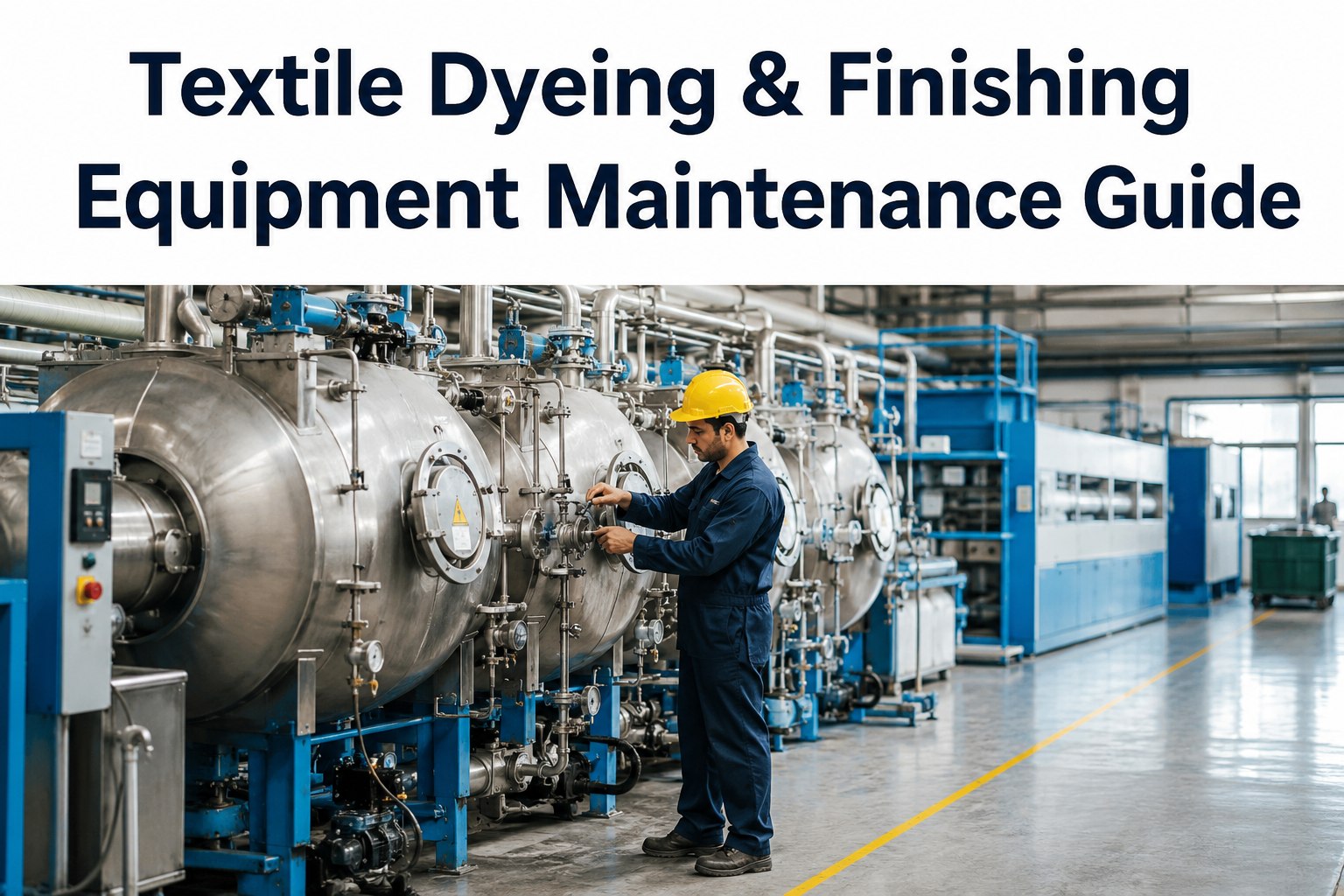
Dyeing and finishing is the last place a mill can ruin fabric that everything upstream has already paid for. By the time a roll reaches the jet dyeing machine, the fibre has been spun and the cloth woven; by the time it reaches the stenter, it has been dyed. Every defect introduced here lands on material at its maximum value, in the tightest delivery window, and it shows — because finishing determines dimensional stability, hand feel, surface appearance, and shrinkage performance, the exact properties a customer inspects. That is what makes maintenance in a dye house and finishing line different from maintenance anywhere else in the plant. A broken stenter pin does not stop the line, it tears a fabric edge. A drifting thermocouple does not trigger an alarm, it produces uneven dyeing across a batch. A worn dosing pump seal does not fail loudly, it quietly shifts a recipe. The machines keep running while the quality is destroyed. This guide covers a PM programme for dyeing and finishing built around that reality — jet dyeing, stenter frames, sanforizing, dryer sections, and chemical dosing. Start a free Oxmaint trial and link every PM task to the defect it prevents, or book a demo to see thermal and dosing alerts raise work orders automatically.
Textile · Dyeing & Finishing · Wet Processing
Textile Dyeing & Finishing Equipment Maintenance Guide
Jet dyeing machine PM, stenter frame maintenance, sanforizing, dryer sections, and chemical dosing — a maintenance programme for the stage where every failure becomes a fabric defect instead of a stoppage.
-
Weekly
stenter pin inspection — one missing pin tears a fabric edge
-
130–200°C
stenter operating range where temperature accuracy sets the finish
-
Monthly
thermocouple array calibration for width and temperature accuracy
-
Last stage
defects here hit fabric at its highest accumulated value
Every Defect Has a Maintenance Root
Read the Fault in the Fabric, Not the Machine
In finishing, the machine rarely tells you it is failing — the cloth does. Trace each common defect back to the component that caused it, and the PM schedule writes itself. This is the map to work backwards along.
- Torn selvedge Broken or missing stenter pin — pin and clip chains stretch and pins break; a single missing pin tears the fabric edge as it passes.
- Uneven dyeing Temperature drift in the jet machine — a degrading heat exchanger or zone imbalance shifts temperature uniformity long before anything alarms.
- Recipe shift, batch failure Dosing pump seal or valve wear — pump-seal wear and valve-integrity loss quietly change what actually reaches the bath, whatever the recipe says.
- Width and shrinkage out of spec Stenter frame drift, roller misalignment — the machine that memorizes fabric dimensions cannot do so if its own settings and rollers have wandered.
- Streaks, poor hand feel Burner nozzle fouling, airflow imbalance — nozzles and circulating fans that no longer distribute hot air evenly across the oven length.
Because these stages are interconnected, an upstream failure cascades — and finishing sits at the end, absorbing every delay into the delivery window. Book a demo to see PM tasks mapped to the defects they prevent.
The Wet Side
Jet Dyeing and Chemical Dosing
On the wet side, uniformity is everything. The jet machine propels fabric in rope form through a circulated stream while treatment agents act at controlled temperature and pressure — so temperature uniformity and dosing accuracy are not process settings, they are maintenance outcomes.
-
Jet Dyeing Machines
Fails from temperature drift, pump-seal wear, valve-integrity loss, and boiler faults — producing batch failures and uneven dyeing. Monitor every zone rather than trusting a single probe: a heat exchanger can degrade for months while readings stay plausible. -
Chemical Dosing Systems
Dosing-system calibration, seal and valve checks, and pump flow monitoring combined with pH sensor integration give the dye house the visibility to intervene before a batch fails — not after the roll is unsalvageable.
Real-time temperature uniformity monitoring across jet zones measurably lifts first-pass dye acceptance — the metric that decides whether a batch is sold or reworked. Sign up for Oxmaint to link thermal and pH alerts straight to work orders.
The Dry Side
Stenter, Sanforizer, and Dryer Sections
The stenter is the most expensive and important drying and finishing machine in the mill — the only one that controls fabric width during drying, applies finishing chemistry, and heat-sets dimensions so the cloth stops shrinking. Its friction points and its heat are the whole maintenance story.
-
1
Entry & padder
Centring devices, tensioning rollers, and the padder that applies chemical finish. Roller alignment here decides whether the fabric enters square. -
2
Pin and clip chains
Two continuous chains grip the selvedge. Chains and rails are the primary friction points, requiring consistent heat-resistant lubrication; inspect and replace damaged pins weekly. -
3
Heating chambers
Burners, heat exchangers, circulating fans, and the nozzle system distributing hot air. Clean and flow-calibrate burner nozzles quarterly; monitor fan-motor vibration to prevent bearing failure. -
4
Exhaust, cooling & sanforizing
Exhaust removes moisture and VOCs; cooling fans and ionizing bars finish the run. Downstream, the sanforizer's rubber belt and felt condition control compressive shrinkage.
Calibrate the thermocouple array monthly — width and temperature accuracy across a 130–200°C oven is what the customer is actually buying. Book a demo to see stenter chain, burner, and thermocouple PM scheduled together.
The Cadence That Holds Quality
A Finishing PM Schedule
Finishing PM runs on inspection frequency, not runtime hours — because the failure you are hunting is a defect forming, not a machine stopping. These are the intervals that carry the most quality risk.
| Task | Interval | Defect Prevented |
|---|---|---|
| Pin and clip chain inspection | Weekly | Torn selvedge, depinning |
| Chain and rail lubrication | Per schedule, heat-resistant | Chain wear, catastrophic failure |
| Thermocouple array calibration | Monthly | Width and temperature error |
| Burner nozzle clean & flow calibration | Quarterly | Streaks, uneven finish |
| Fan motor vibration monitoring | Continuous | Bearing failure, airflow imbalance |
| Dosing pump seal & valve check | Recurring | Recipe shift, batch failure |
Roller alignment and stenter setting verification belong on a cycle-count trigger rather than a date — the drift accumulates with metres run, not days elapsed. Sign up for Oxmaint to trigger PM by cycle count and running metres.
Quality Is the Uptime Metric
In Finishing, the Machine Running Is Not the Same as the Machine Working
A stenter with a missing pin runs at full speed. A jet machine with a degrading heat exchanger completes its cycle. A dosing pump with a worn seal reports flow. In every case the line is up, the output is moving, and the fabric is being ruined at the most expensive point in its life — then discovered at inspection, after the delivery window has already closed. This is why finishing maintenance has to be measured in first-pass acceptance rather than availability, and why condition data matters more here than anywhere upstream. Temperature per zone, vibration per fan, flow per dosing line, and cycle count per chain turn an invisible quality drift into a work order raised before the roll is cut.
Oxmaint for Dyeing & Finishing
How Oxmaint Runs Finishing Maintenance
-
Thermal Alerts
Zone Drift to Work Order
IoT-linked thermal alerts across jet zones and stenter chambers raise work orders when temperature uniformity drifts — catching a degrading heat exchanger months before it shows up as uneven dyeing.
-
Dosing Control
Seals, Valves, pH
Dosing-system calibration schedules with seal and valve checks, pump flow monitoring, and pH sensor integration — giving the dye house the visibility to intervene before a batch failure, not after.
-
Chain & Pin PM
Weekly, Every Pin
Recurring stenter chain inspections with damaged-pin replacement logged per machine, plus heat-resistant lubrication routes for the chains and rails that carry the machine's primary friction load.
-
Cycle Triggers
Metres Run, Not Days
Trigger roller alignment, stenter setting verification, and cam and needle inspection by cycle count and running metres — matching PM to the wear the machine has actually accumulated.
-
Vibration
Fans Before They Seize
Fan-motor vibration monitoring on circulating fans and blowers, so a bearing degradation that would imbalance airflow across the oven becomes a planned repair instead of a catastrophic stop.
-
Defect Traceback
Fault Linked to Asset
Log quality rejections against the machine and component that caused them, building the history that shows which chain, burner, or pump is generating the mill's rework — and what it costs.
Frequently Asked
Dyeing & Finishing Maintenance Questions
Why does finishing maintenance matter more than uptime suggests?
Because finishing determines the final physical properties of the fabric — dimensional stability, hand feel, surface appearance, and shrinkage performance — and it is the last step before inspection and shipping. Failures here compress into the tightest delivery windows and produce the most visible quality failures, on material carrying all the value added upstream. The machine often keeps running while the defect forms, so availability is the wrong metric; first-pass acceptance is the right one. Book a demo to see PM tracked against quality outcomes.
How often should stenter pins and chains be inspected?
Weekly. Pin chains and clip chains are subject to stretch and pin breakage, and a single missing pin causes a fabric edge tear on every metre that passes. Chains and rails are also the stenter's primary friction points, requiring consistent heat-resistant lubrication to prevent wear and catastrophic failure. Alongside that, burner nozzles need quarterly cleaning and flow calibration, and the thermocouple array needs monthly calibration to hold width and temperature accuracy.
What causes uneven dyeing in a jet machine?
Most often temperature drift, plus pump-seal wear, valve-integrity loss, and boiler faults — all of which produce batch failures and uneven dyeing rather than a stoppage. The difficulty is that a heat exchanger can degrade over months without triggering an alarm, because a single probe still reads plausibly. Monitoring temperature uniformity per zone in real time surfaces the degradation and measurably improves first-pass dye acceptance. Sign up for Oxmaint to run per-zone thermal monitoring.
Should finishing PM be scheduled by date or by cycle count?
Both, split by failure mode. Inspection tasks that guard against sudden defects — pin and chain checks weekly, thermocouple calibration monthly, burner nozzle service quarterly — run on a calendar. But wear-driven drift, such as roller misalignment, stenter setting drift, and cam and needle wear, accumulates with metres of fabric run rather than days elapsed, so those belong on cycle-count triggers. Matching the trigger to the wear mechanism is what stops both over- and under-maintaining. Book a demo to see calendar and cycle-count PM side by side.
Inspect · Calibrate · Lubricate · Trace
Protect the Fabric, Not Just the Machine
Every stretched chain, fouled burner nozzle, drifting thermocouple, and worn dosing seal is a defect forming on cloth that has already absorbed the cost of every process before it. Oxmaint gives dyeing and finishing teams one platform to link thermal and pH alerts to work orders, calibrate dosing systems, inspect pins and chains on a weekly rhythm, trigger alignment PM by metres run, monitor fan vibration, and trace every quality rejection back to the component that caused it.