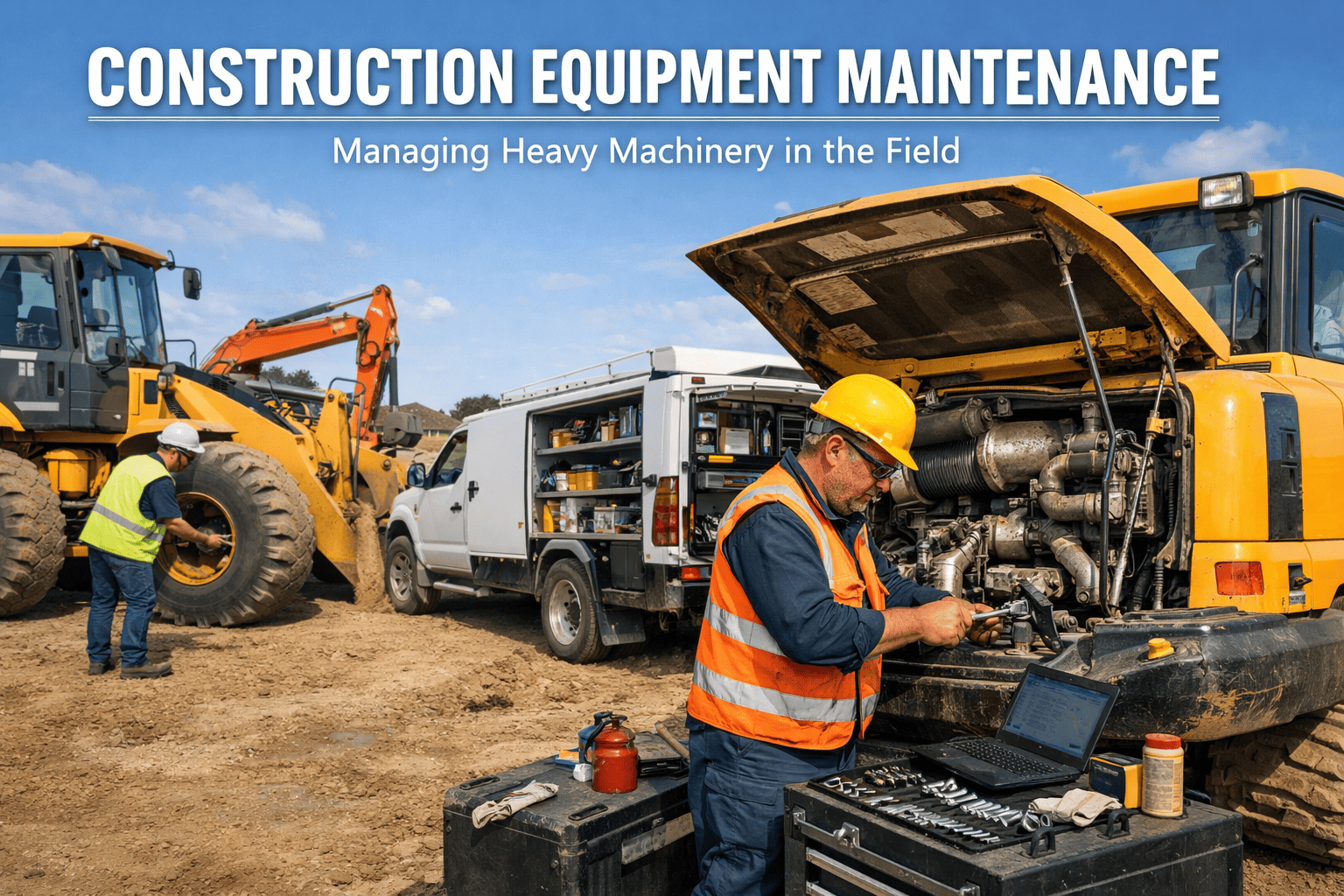
A single excavator breakdown on an active job site does not just stop one machine — it stalls the entire crew, delays concrete pours, pushes subcontractor schedules, and burns through project margins at $500–$1,200 per hour of idle time. The global construction equipment maintenance and repair market reached $24.1 billion in 2025 and is projected to hit $35.9 billion by 2035, driven by a simple reality: heavy machinery operating in dirt, mud, extreme temperatures, and constant vibration deteriorates faster than any other asset category. Yet 49% of construction companies still manage maintenance through spreadsheets, and most operate reactively — fixing equipment after it fails rather than preventing failures before they happen. The companies winning on profitability are the ones treating maintenance as a competitive advantage, not an overhead cost. Oxmaint's CMMS platform gives construction teams mobile-first maintenance management purpose-built for field conditions — offline work orders, telematics integration, usage-based PM triggers, and real-time fleet visibility from any job site.
Why Construction Equipment Maintenance Breaks Down in the Field
Construction maintenance is fundamentally different from facility or plant maintenance. Equipment constantly relocates between job sites, operates in harsh and unpredictable environments, and is often serviced by rotating crews and subcontractors with different standards. These conditions create maintenance challenges that generic CMMS platforms are not designed to handle.
Moving Targets
An excavator might work three different sites in a month. Without GPS-linked asset tracking and mobile CMMS, service history fragments across locations. Critical information — last oil change, hydraulic hose age, undercarriage wear measurements — gets lost when equipment moves, leading to missed PMs and premature failures.
No Connectivity, No Excuses
Job sites in rural areas, new developments, and underground work zones have zero reliable connectivity. If your CMMS requires internet to function, technicians revert to paper — and that data never makes it back into the system. Full offline capability with automatic sync is non-negotiable for construction maintenance.
Subcontractor Complexity
Construction companies frequently outsource equipment operations to subcontracted teams with their own tools and standards. When one team logs maintenance in a spreadsheet and another uses paper forms, precision and continuity disappear. A centralized CMMS enforces standardized workflows regardless of who operates or services the machine.
Brutal Operating Conditions
Dirt, mud, dust, extreme heat, freezing cold, constant vibration, and impact loading accelerate wear far beyond manufacturer assumptions. Calendar-based PM schedules under-maintain machines working double shifts on hard rock and over-maintain machines sitting idle between projects. Usage-based triggers aligned to actual operating hours solve this mismatch.
Companies implementing data-driven maintenance schedules report higher equipment availability and lower per-hour maintenance costs across their fleets. The difference between a profitable project and a margin-eroding one often comes down to whether your equipment starts on Monday morning. Book a demo with Oxmaint to see how mobile-first CMMS handles the specific realities of construction field operations.
Heavy Equipment Maintenance Profiles
Each equipment type in a construction fleet has distinct failure modes, wear patterns, and maintenance intervals. A CMMS must support equipment-specific PM templates with usage-based triggers tied to hour meters, cycle counts, or telematics data — not generic calendar schedules that ignore how hard each machine actually works.
The True Cost of Equipment Failure on a Job Site
When a critical machine goes down mid-project, the visible repair bill is the smallest part of the total cost. The real damage comes from idle crew time, missed project milestones, subcontractor delays, equipment rental to cover the gap, and the compounding schedule impact that turns a one-day repair into a one-week project delay.
Reactive maintenance costs construction companies 3–5x more per repair than planned maintenance for the same equipment. When you factor in crew idle time, rental equipment, and schedule delays, the true cost of a single preventable breakdown can exceed 10x the repair bill. A structured preventive maintenance program powered by CMMS eliminates the majority of these cascading costs. Sign up for Oxmaint to shift from reactive firefighting to planned maintenance that protects your project timelines and margins.
CMMS Capabilities Built for Construction
A CMMS for construction fleets must handle realities that plant-based systems never face — equipment that moves between sites, technicians working in areas with no connectivity, maintenance triggered by operating hours rather than calendar dates, and safety compliance requirements unique to construction job sites.
Usage-Based PM Scheduling
Trigger preventive maintenance by engine hours, cycle counts, or fuel consumption — not arbitrary calendar dates. An excavator running double shifts on hard rock needs service at 250 hours regardless of whether it has been 2 weeks or 6 weeks since the last PM. Telematics-connected CMMS reads hour meters automatically and generates work orders at the right time for each machine.
Offline Mobile Execution
Full work order creation, completion, and inspection capability without any network connection. Technicians download their assignments before heading to remote sites, complete all documentation including photos and parts consumption, and sync everything automatically when back in range. Zero data loss, zero paper workarounds.
Multi-Site Fleet Visibility
See every machine across every job site from a single dashboard. Know which excavator needs service, which crane inspection is overdue, and which loader is idle and available for redeployment. GPS-linked asset tracking eliminates the "where is my equipment?" problem that plagues companies managing dozens of machines across scattered locations.
Digital Inspection Checklists
OSHA-required pre-operation inspections for cranes, aerial lifts, and powered industrial equipment are built into the CMMS workflow. Operators complete digital checklists with photo documentation before starting work each day. Failed inspection items auto-generate work orders with priority flags — no separate reporting step needed.
Parts & Inventory Across Yards
Track spare parts across main shop, satellite yards, and job site tool trailers. Automated reorder points ensure critical filters, seals, and wear parts are always available. Parts consumption links to work orders and specific machines for accurate per-unit cost tracking — essential for equipment replacement decisions and project costing.
Subcontractor Access Control
Grant subcontracted maintenance teams controlled CMMS access to log their work on your equipment. They follow your standardized workflows, submit digital service records, and report issues through the same system your internal team uses — eliminating the documentation gaps that occur when outside crews service your machines without centralized tracking.
Your Equipment. Your Job Sites. One Platform.
Oxmaint gives construction teams mobile-first CMMS with offline execution, usage-based PM, telematics integration, and multi-site fleet visibility — built for the realities of managing heavy machinery in the field.
Telematics Integration: Connecting Machines to Maintenance
Modern construction equipment ships with built-in telematics from Caterpillar, Komatsu, John Deere, Volvo, and other OEMs. When this data flows into your CMMS, maintenance transforms from guesswork to precision — every machine tells you exactly what it needs and when it needs it. Try Oxmaint free and connect your fleet's telematics to automated maintenance workflows.
Getting Started: CMMS Implementation for Construction Fleets
Implementing CMMS in a construction operation does not require shutting down job sites. The deployment layers digital tools onto existing field operations — starting with highest-value equipment and expanding as the team builds confidence and data.
Fleet Inventory & Prioritization (Week 1–2)
Catalog every machine — make, model, serial, current hours, location, and assigned project. Prioritize equipment by revenue impact: machines that stop entire crews when they fail get the highest criticality rating and the most detailed PM programs. Connect telematics feeds where available.
PM Program & Mobile Deployment (Week 2–4)
Configure usage-based PM schedules using OEM service intervals (250/500/1000/2000-hour tiers). Build digital daily inspection checklists for OSHA-regulated equipment. Deploy mobile CMMS to field technicians and operators with offline capability enabled. Start capturing every work order digitally.
Parts, Costs & Reporting (Week 4–8)
Enable spare parts inventory tracking across shop and field locations. Link all parts consumption and labor hours to specific machines and projects for accurate cost-per-hour reporting. Activate fleet dashboards showing PM compliance, equipment availability, and maintenance cost trends across the entire operation.
Optimization & Predictive Growth (Ongoing)
Use accumulated data to refine PM intervals — are you changing oil too early or too late? Identify chronic failure patterns by equipment type and job site conditions. Build cost-per-hour models that drive rent-vs-own and repair-vs-replace decisions with real data instead of gut feel.
Safety and Compliance: Non-Negotiable in Construction
Construction is one of OSHA's "Focus Four" industries for workplace fatalities. Equipment-related incidents — crane collapses, aerial lift tip-overs, caught-in/between accidents — are directly linked to maintenance quality. CMMS creates the documented safety infrastructure that protects workers and shields your company from liability.
Crane Inspections
Daily pre-operation inspections, monthly detailed inspections, and annual structural examinations must be documented. CMMS automates inspection scheduling, captures digital checklists with photos, and maintains the complete inspection history required for compliance audits and incident investigations.
Aerial Lift Pre-Use Checks
Every aerial lift requires operator inspection before each shift. CMMS delivers the inspection checklist to the operator's mobile device, flags deficiencies that require immediate attention, and creates a timestamped record proving the inspection occurred — critical evidence in accident investigations.
Fall Protection Equipment
Harnesses, lanyards, and anchor points require regular inspection and documented retirement schedules. CMMS tracks each piece of fall protection equipment by serial number, schedules inspections at manufacturer-specified intervals, and automatically flags equipment that has reached its retirement date.
Wire Rope & Rigging
Wire ropes, slings, and rigging hardware require inspection before each use and periodic detailed examinations. CMMS logs inspection results, tracks discard criteria measurements (broken wires, diameter reduction, corrosion), and ensures replacement happens before safety limits are reached.
Maintenance-related fall protection violations alone resulted in $47.4 million in OSHA fines in a single recent year. A CMMS does not just track maintenance — it creates the documented safety culture that prevents the incidents leading to those fines. Book a demo to see how Oxmaint's digital inspection checklists and safety equipment tracking work for construction operations.
Keep Your Fleet Running. Keep Your Crew Safe.
Oxmaint combines usage-based PM scheduling, offline mobile execution, telematics integration, and OSHA-compliant inspection workflows in one platform built for construction field operations.