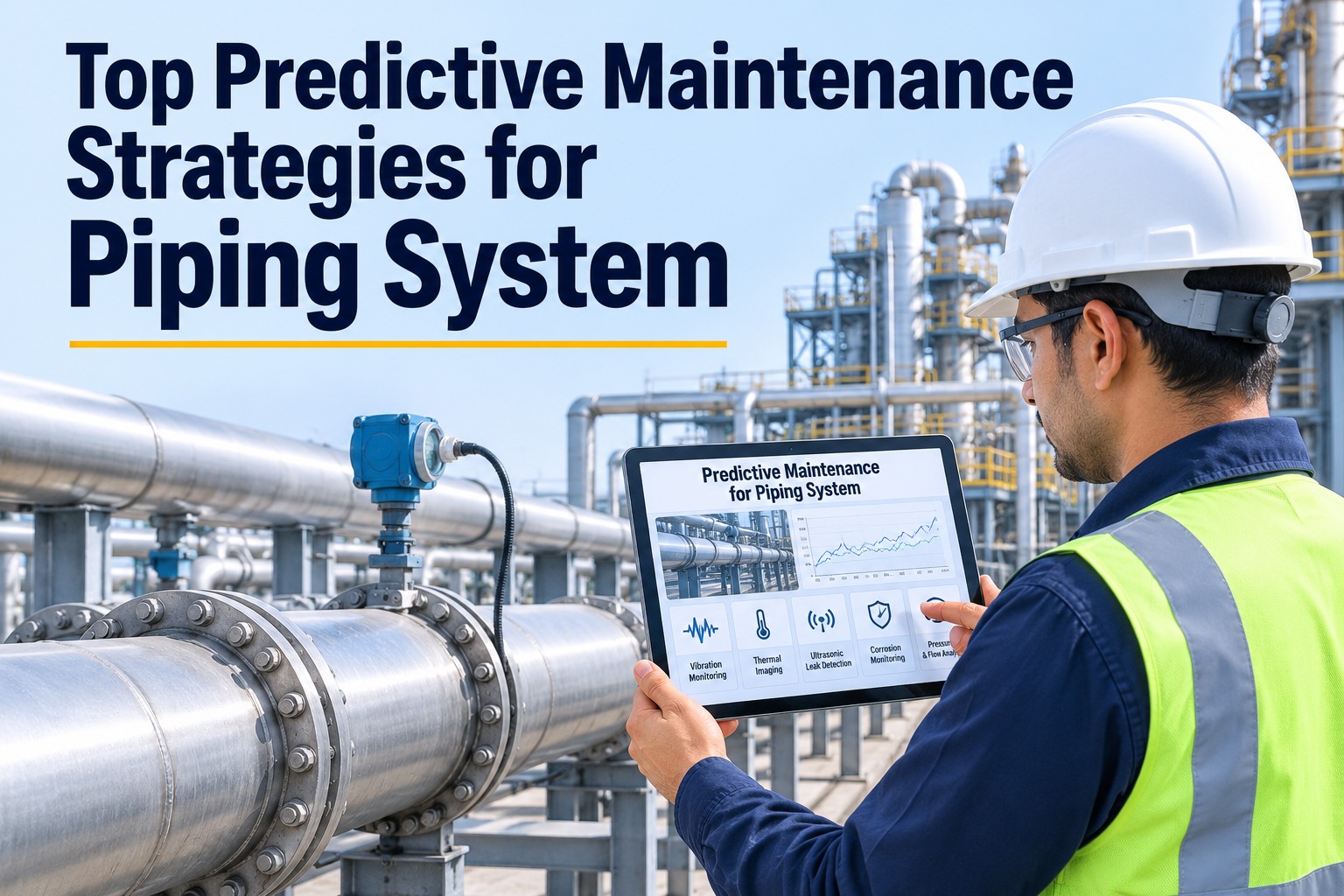
Predictive maintenance for piping systems replaces fixed inspection calendars with condition-based signals — you repair a line when wall-thickness data, vibration trends, or corrosion rates tell you to, not when the schedule says so. Because piping rarely fails suddenly but degrades through measurable mechanisms like corrosion, erosion, and flow-accelerated corrosion (FAC), it is one of the highest-ROI candidates for a PdM program: plants that trend degradation typically cut unplanned piping failures 40–70% and stretch inspection budgets toward the lines that actually need attention. This guide covers the strategies that work in the field — P-F interval analysis, sensor and NDT technique selection, alert threshold setting, and CMMS integration that turns every reading into a scheduled repair instead of a missed alert. If you want those signals wired directly into work orders, Start Free Trial and see how OxMaint connects condition data to action.
What if your piping told you it was failing 6 months before it leaked?
That is exactly what a well-built piping systems PdM strategy delivers. Degradation mechanisms like corrosion, erosion, and FAC move along a predictable P-F curve — catch them early in the interval and a $400 thickness reading replaces a $250,000 rupture, environmental release, and emergency shutdown.
How the P-F Interval Drives Piping Systems Failure Prediction
Every piping failure follows a curve: a potential failure point (P) where degradation becomes detectable, and a functional failure point (F) where the line leaks, ruptures, or can no longer hold pressure. The time between them — the P-F interval — is your entire maintenance window, and for piping it is often months to years, which makes piping one of the most forgiving and profitable asset classes for predictive maintenance.
Rule of thumb: your inspection interval must be shorter than half the P-F interval, so degradation is caught at least twice before failure. If a line corrodes from detectable to t-min in 4 years, inspect at least every 2 years — and let your CMMS auto-schedule it.
Best PdM Sensors and Monitoring Techniques for Piping Systems
There is no single "piping sensor" — the right piping systems PdM sensors depend on the damage mechanism. Match the technique to the failure mode, and match the failure mode to the service. This table covers the proven options and where each earns its keep.
| Technique | Detects | Best For | Typical Cost |
|---|---|---|---|
| Ultrasonic thickness (UT) spot readings | Wall loss — corrosion, erosion | TMLs on carbon steel lines, elbows, tees | $15–40 per reading |
| Fixed UT sensors / wireless wall monitors | Continuous wall-loss trending | High-consequence or hard-to-access lines | $1–3K per point installed |
| Guided wave testing (GWT) | Screening long runs for localized loss | Insulated, buried, or elevated pipe — 30m+ per test | $500–1,500 per test |
| Radiography (RT) / pulsed eddy current | Corrosion under insulation (CUI), FAC thinning | Insulated lines without stripping insulation | $200–600 per location |
| Corrosion coupons & ER probes | Real-time corrosion rate in process fluid | Validating chemical treatment programs | $300–2K per probe |
| Thermography (IR) | Blockage, fouling, refractory/insulation failure, steam traps | Quarterly route-based surveys | Low — camera + route time |
| Acoustic emission / ultrasonic leak detection | Through-wall leaks, valve pass-through | High-pressure gas and steam systems | Route-based, low per point |
For rotating equipment connected to your piping — pumps, compressors, blowers — add vibration analysis and oil analysis; for steam and compressed-air systems, ultrasonic surveys routinely find leaks wasting 20–30% of generated air. OxMaint stores every technique's readings against the asset record, so a UT trend and a vibration trend on the same pump-and-pipe system live in one place.
What a Piping PdM Program Is Worth: A Real-World Scenario
Consider a mid-size chemical plant with 2,400 piping TMLs across 180 lines. Before PdM, it averaged 3 unplanned piping failures per year at roughly $85,000 each in emergency repair, lost production, and cleanup — $255,000 annually, plus one near-miss HSE event.
Even a single avoided rupture on a 6-inch process line — typically $150K–$400K all-in — pays for years of monitoring. Piping systems PdM cost savings compound because trending also lets you defer unnecessary replacements: lines once swapped "on schedule" at 15 years often run safely to 25+ with data to prove it.
How to Set Piping Systems Alert Thresholds That Trigger Action
Most PdM programs fail not at detection but at response — a reading crosses a line and nobody acts. Structure thresholds in tiers so every alert has a pre-defined consequence, and wire each tier to an automatic work order in your CMMS.
Recalculate corrosion rate and remaining life; shorten the inspection interval by half. No repair yet — just tighter surveillance. OxMaint auto-adjusts the next inspection due date.
Auto-create a work order for engineering evaluation: confirm t-min per the original design code, check for localized pitting, and slot repair into the next planned outage. Spare parts and flanges are reserved from inventory.
Immediate escalation: operations notified, fitness-for-service assessment within days, temporary repair (clamp, composite wrap) or controlled shutdown. The work order carries the full reading history so the engineer decides with data, not guesswork.
The same tiered logic applies to FAC-susceptible carbon steel in wet steam service, erosion-prone slurry lines, and CUI-risk insulated piping — only the numbers change. Define them once per line class, and OxMaint applies them to every incoming reading automatically.
A 6-Month Plan to Launch Piping Systems Predictive Maintenance
You do not need a plant-wide sensor rollout to start. The highest-performing programs begin with the 10–15% of lines that carry 80% of the risk, prove value in two quarters, then expand.
Turn Piping Condition Data Into Scheduled Repairs — Automatically
Predictive maintenance only pays when a signal becomes a work order before the P-F window closes. OxMaint is the connective tissue between your readings and your wrench time.
Condition-Based Triggers
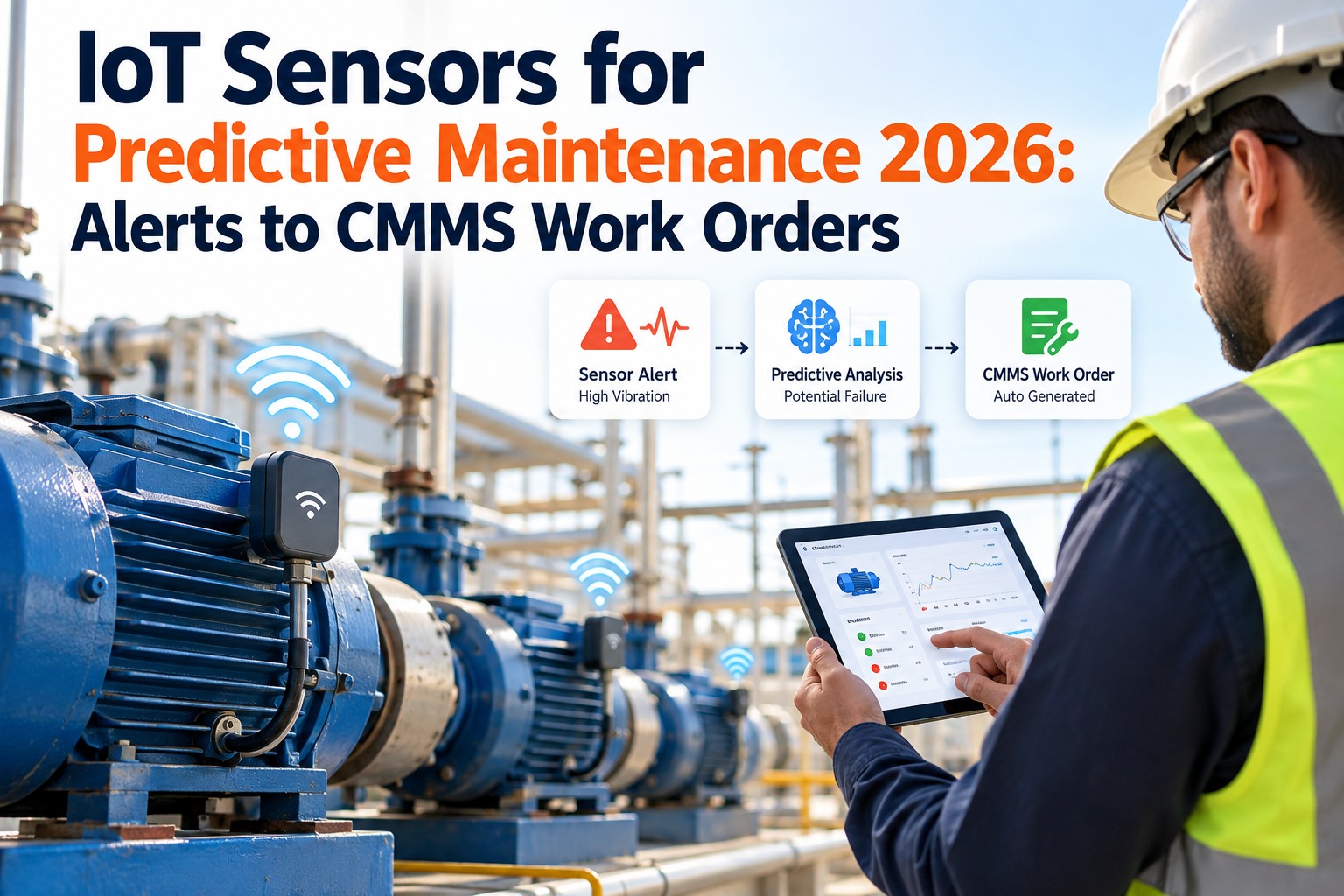
Ingest UT readings, sensor feeds, and inspection results; when a value crosses your threshold, OxMaint auto-creates a prioritized work order — cutting alert-to-action time from weeks to minutes and eliminating missed alerts entirely.
Remaining-Life Scheduling
OxMaint trends corrosion rates per TML and projects retirement dates, then schedules inspections at half the P-F interval automatically. Plants typically extend safe piping life 30–50% by replacing on condition, not calendar.
Audit-Ready Asset History
Every reading, alert, and repair is logged against the line's asset record — giving you API 570-style documentation and ISO 55000-aligned traceability for regulators and insurers without a single spreadsheet.
Parts & Crew Coordination
When a Tier 2 alert fires, OxMaint checks spare-parts inventory, reserves flanges and pipe spools, and assigns the right crew — so repairs land in planned outages and emergency procurement drops toward zero.
See OxMaint running on your piping assets — book a 30-minute demo
Bring one problem line to the call. We will show you exactly how its readings, thresholds, and work orders would flow in OxMaint — and what your first avoided failure is worth.
Predictive Maintenance for Piping Systems: Common Questions
What is the best predictive maintenance technique for piping systems?
Ultrasonic thickness testing is the backbone — it directly measures the wall loss that drives most piping failures. Pair it with guided wave testing for long or insulated runs, thermography for blockages and steam traps, and fixed wireless UT sensors on high-consequence lines. The "best" mix depends on your dominant damage mechanism: corrosion, erosion, FAC, or CUI.
How does the P-F interval apply to piping?
The P-F interval is the time between detectable wall loss and functional failure (leak or rupture). For piping it typically spans months to years, which is why piping is ideal for PdM: inspect at intervals shorter than half the P-F interval and you will catch degradation at least twice with time to plan a repair. A CMMS like OxMaint automates that scheduling — Start Free Trial to see it on your own asset list.
How much does a piping predictive maintenance program cost?
A focused program on critical lines typically runs $20K–$60K per year for a mid-size plant — UT routes, periodic guided wave campaigns, and CMMS software. Against an average unplanned piping failure cost of $85K–$250K+, most plants see 4–8x first-year ROI, and one avoided rupture can fund the program for years.
Can predictive maintenance detect corrosion under insulation (CUI)?
Yes — without stripping insulation. Pulsed eddy current screening, profile radiography, and guided wave testing all detect CUI through insulation and weather jacketing. Risk-rank insulated lines by temperature range (CUI peaks between −4°C and 175°C) and age, then screen the highest-risk circuits on a 2–5 year cycle.
How do I connect piping sensor data to work orders?
Define tiered alert thresholds per line class, then use a CMMS that converts threshold crossings into work orders automatically. OxMaint ingests inspection readings and sensor data, applies your thresholds, and generates a prioritized work order with the failure mode and recommended action attached — Book a Demo and we will walk through a live threshold-to-work-order flow.
Stop inspecting by calendar. Start repairing by signal.
OxMaint turns every thickness reading, sensor alert, and inspection result into a scheduled, documented repair — before the P-F window closes. Your first avoided piping failure pays for the program.


-optimizing-your-maintenance-strategy.png)
