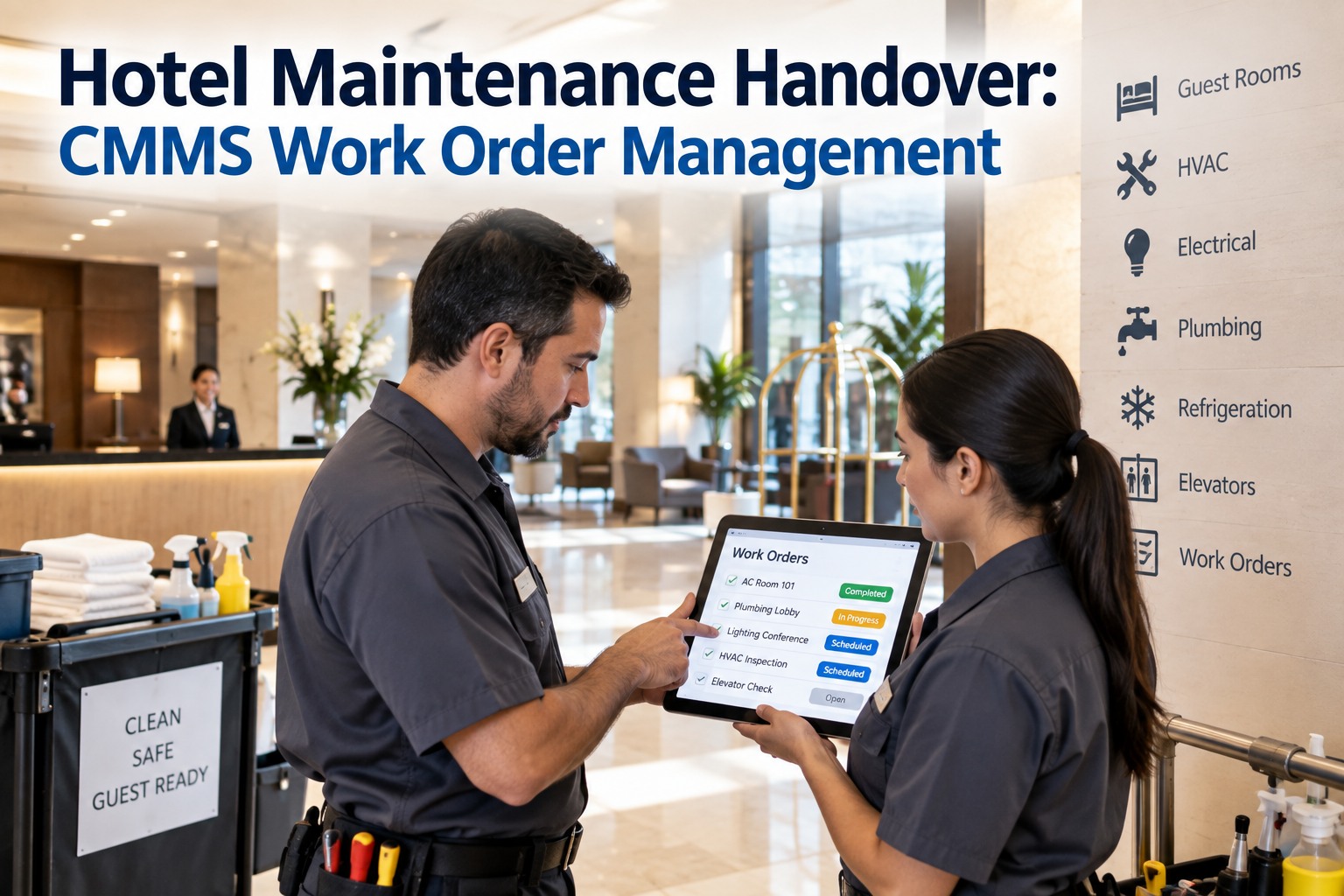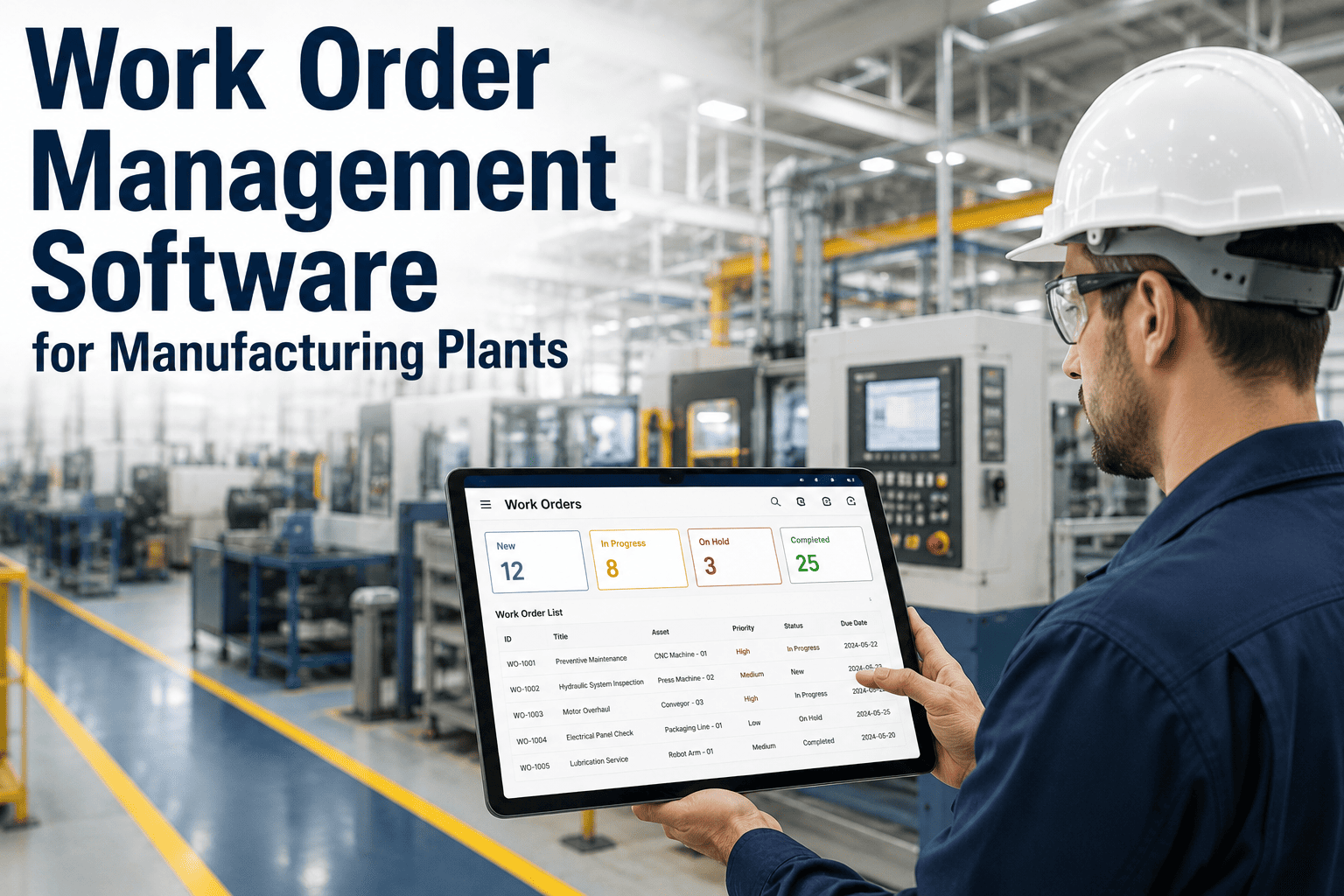
Oxmaint is the work order management software that turns a manufacturing maintenance team from reactive firefighters into a planned, measured operation — moving every request through a structured lifecycle from intake to closeout with the data quality, wrench time, and backlog control that best-in-class plants run on. The average maintenance team loses 30-45% of available wrench time to work order friction — searching for asset history, chasing parts, waiting for approvals, re-entering data across disconnected systems. Oxmaint eliminates that friction with mobile work orders, automated PM triggers, skill-matched assignment, and closeout enforcement. This guide covers the work order best practices manufacturing plants use to hit 70%+ wrench time, sub-15% emergency ratios, and 85%+ first-time fix rates — and how Oxmaint automates every one of them.
Work Order Management Best Practices for Manufacturing
From request to closeout — a practical 2026 workflow guide for manufacturing maintenance managers, planners, and reliability engineers, showing how Oxmaint's CMMS lifts wrench time, cleans up backlog, and produces the data quality that KPIs actually depend on.
Five stages every work order must move through — cleanly
The work order that a plant loses control of is almost never the one that failed in execution. It is the one that stalled at intake because the request was incomplete, or at triage because nobody scored the priority, or at closeout because the technician skipped the failure code. Oxmaint enforces the same five-stage lifecycle for every work order in the plant — no request enters without a mandatory field set, no closure happens without failure mode and parts consumed logged. To see the lifecycle running on live plant data, start a free Oxmaint trial.
Request & intake
Operators, PMs, sensors, or QR scans create a work order in Oxmaint with mandatory fields — asset, location, symptom, priority. No verbal fixes, no hallway conversations turned into repairs with no record. Every request timestamped, structured, and routed within 60 seconds.
Triage & prioritization
Oxmaint scores every request against a five-factor priority matrix: safety, asset criticality, production impact, compliance deadline, and cost consequence. Political prioritization ("whoever complained loudest") is replaced with quantified risk. P1 items surface immediately; P3/P4 items queue for planning.
Planning & assignment
Oxmaint matches the work order to a technician with the right trade certification, checks parts availability against MRO inventory, and holds the WO until parts are staged. No dispatch to a job the technician cannot complete. Skill mismatches — the source of 8-12% of first-visit failures — get eliminated at the assignment step.
Execution
Technicians open the Oxmaint mobile app, scan the asset barcode, pull up the checklist and asset history, log time, capture photos, and record parts used. Offline mode covers mechanical rooms and basements. Documentation happens at the point of work — not hours later at a desktop terminal.
Closeout & data capture
Oxmaint blocks closure until failure mode, root cause, corrective action, parts consumed, actual time, and return-to-service confirmation are all logged. Incomplete data cannot close a work order. Every closed WO feeds the reliability trend that surfaces recurring failures — the pump that fails every six weeks becomes the $400 fix that runs 14 months.
Six mandatory fields Oxmaint enforces at every work order
A work order that arrives incomplete wastes technician time before the job even starts. Every incomplete work order is a future data gap in the reliability trend, a missed part-consumption record, and a KPI number that cannot be trusted. Oxmaint makes the six fields below mandatory on every request in every plant it runs — no optional fields on critical information. To see the intake form configured for your plant, book a demo with our manufacturing team.
Asset identifier
Every WO in Oxmaint is linked to a specific asset — so failure history, repair cost, and PM schedule accumulate per asset over time. Barcode scan enforces this at intake.
Priority classification
P1 through P4 assigned by Oxmaint's scoring matrix — safety, criticality, production impact, compliance, cost. Priority drives scheduling; no priority = no schedule.
Failure mode / symptom
Structured failure code selected from a plant-specific taxonomy. Free-text descriptions kill trending — Oxmaint uses codes that roll up into reliability reports.
Corrective action taken
What the technician actually did — not "fixed" but the specific action from a standard action library. Feeds root cause analysis and PM template updates.
Parts consumed
Every part selected from Oxmaint's linked MRO inventory during execution — reorder triggers fire, cost-per-asset builds, and stockouts stop delaying MTTR.
Actual labour hours
Technician logs actual time in Oxmaint via mobile — separate from estimated. Delta between estimated and actual feeds planner accuracy and workload balancing.
The KPI gap between reactive plants and world-class operations
Every maintenance metric belongs on a spectrum from reactive baseline to world-class benchmark — and Oxmaint's dashboards track them live. Plants running structured work order programmes in Oxmaint typically move from the reactive column toward the world-class column within 12 months of deployment. The six KPIs below are the ones plant maintenance managers, planners, and reliability engineers own week-to-week. To baseline these metrics against your plant, sign up for Oxmaint and connect your first asset.
| KPI | Reactive baseline | Target range | World-class |
|---|---|---|---|
| Wrench time % of labour hours on direct work |
25-35% | 45-55% | 65-70%+ |
| Emergency-to-planned ratio Reactive as % of total WOs |
45-60% | 20-30% | <15% |
| First-time fix rate Closed without return visit |
60-65% | 75-80% | 85%+ |
| Backlog age Per technician, in weeks |
6-10 wks | 4-5 wks | 2-4 wks |
| PM compliance Scheduled PMs completed on time |
60-75% | 85-92% | 98%+ |
| Data quality WOs with complete closeout fields |
40-55% | 75-85% | 95%+ |
Six capabilities that turn Oxmaint into your work order engine
Oxmaint is the manufacturing work order software that consolidates request intake, priority scoring, technician assignment, mobile execution, and closeout data into one connected platform — replacing the paper work orders, spreadsheet trackers, and disconnected apps that drag reactive plants below 35% wrench time. The six capabilities below are how manufacturing maintenance managers use Oxmaint to reach world-class KPIs within 12 months. To scope Oxmaint against your plant, book a manufacturing demo with our team.
Mobile-first execution
Oxmaint's mobile app puts every WO, checklist, asset manual, and part in the technician's hand — with offline sync, barcode scan, and voice-to-text notes. Adds 22% to wrench time.
Priority scoring matrix
Oxmaint scores every WO across five factors — safety, criticality, production impact, compliance, cost — so the right jobs move first, not the loudest complaints.
Skill-matched assignment
Oxmaint checks technician certifications, current workload, and location before assignment — eliminating the skill mismatches that cause 8-12% of first-visit failures.
Automated PM triggers
Oxmaint generates PMs automatically from calendar intervals, runtime hours, production cycles, or IoT sensor thresholds — before an operator notices a problem.
Backlog analytics
Oxmaint surfaces backlog aging by priority — the metric that actually matters — with three-consecutive-days-of-growth alerts before backlog silently compounds.
Closeout enforcement
Oxmaint blocks WO closure until failure mode, corrective action, parts consumed, and actual time are all logged — no incomplete data enters the reliability trend.
Oxmaint for manufacturing work orders — FAQ
How does Oxmaint improve wrench time on a manufacturing maintenance team?
Oxmaint eliminates the friction that drags most teams down to 25-35% wrench time. The mobile app puts the work order, checklist, asset history, and parts inventory in the technician's hand at the point of repair — no walking back to the shop, no paper handoffs, no re-entering data. Skill-matched assignment prevents the wrong technician arriving at a job. Parts availability check before dispatch prevents return trips. Oxmaint customers typically move from the 25-35% baseline into the 45-55% target range within 3-6 months, and reach 65-70% wrench time inside 12 months of go-live.
What is the healthy work order backlog range for a manufacturing plant?
The target is 2-4 weeks of known work per technician, with 85% or more of items fully scoped — asset, priority, parts identified, estimated hours. Zero backlog is a warning sign, usually meaning inspections have stopped generating findings. Backlog above 6 weeks per technician is a resource or planning problem that Oxmaint's backlog analytics flag before it compounds. The right backlog metric is not total open WOs — it is open WOs by age and by priority. Zero open P1s over four hours is the non-negotiable Oxmaint dashboards enforce.
Can Oxmaint generate work orders automatically from PLC sensors or IoT thresholds?
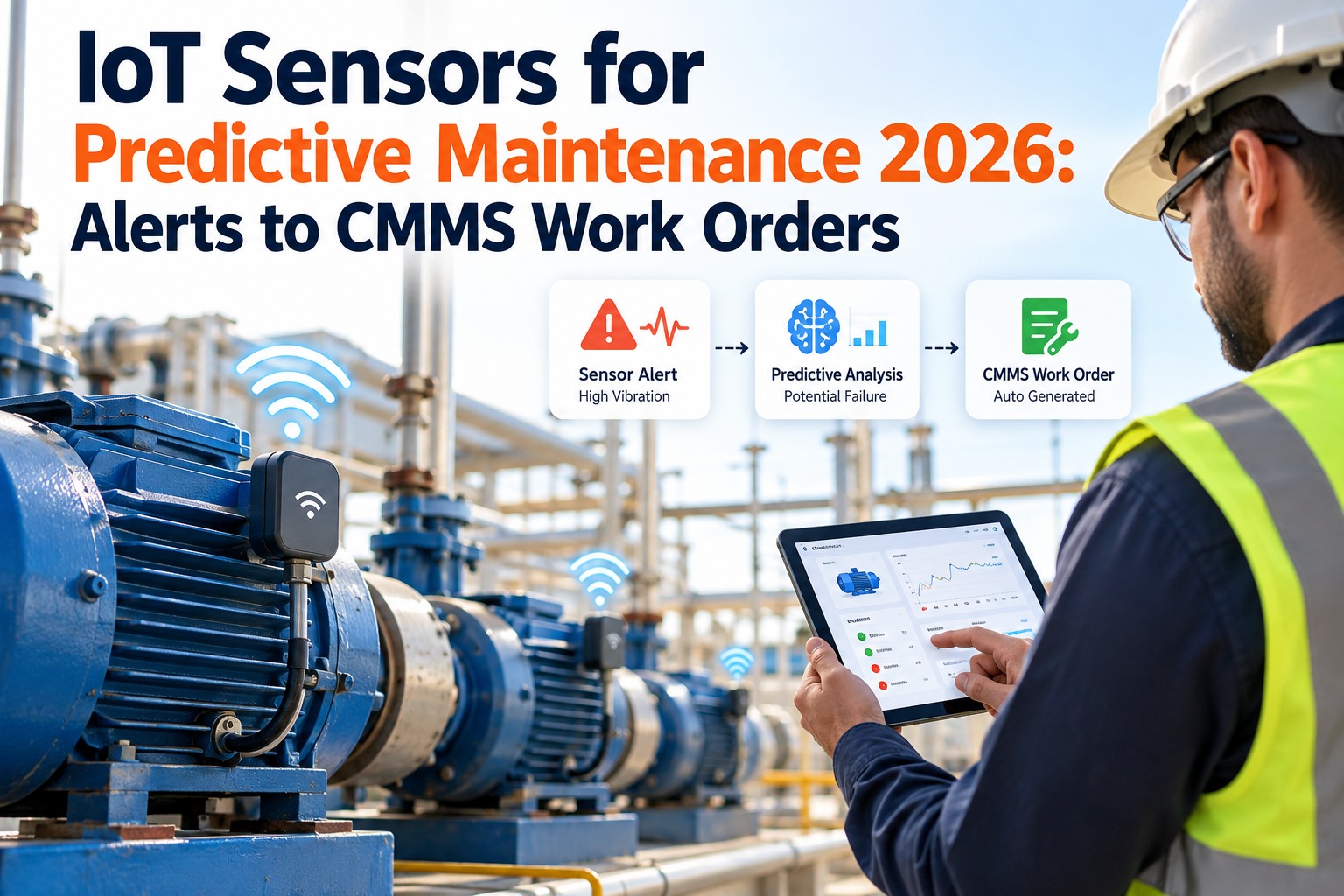
Yes. Oxmaint integrates with PLC fault codes, IoT vibration/temperature/pressure sensors, and AI vision systems — triggering work orders when readings exceed set thresholds, before an operator notices the problem. Every automated WO carries the sensor reading that fired it, so the technician sees the exact condition on arrival. This closes the gap between fault detection and maintenance response, and moves the plant from reactive to condition-based maintenance without replacing the existing automation stack.
What fields must be mandatory on every work order to actually improve reliability data?
Six fields are non-negotiable and Oxmaint enforces all of them: asset identifier (from barcode scan), priority classification, failure mode from a structured code library, corrective action taken from the standard action library, parts consumed from linked MRO inventory, and actual labour hours. Free-text descriptions kill trending — the codes are what feed the reliability reports that identify the pump failing every six weeks or the seal that consumes 40% of a category's parts spend. Oxmaint blocks closure until all six fields are complete.
How fast do manufacturing plants see backlog reduction after deploying Oxmaint?
Documented across manufacturing customers, Oxmaint typically drives 30-40% backlog reduction in the first 45 days from duplicate cleanup, stale WO retirement, and phantom record removal — before any technician does additional work. A further 15-20% reduction follows over the next 60 days from prioritization discipline and skill-matched assignment. One documented case moved from 2,340 open work orders to 680 in 90 days — a 71% reduction — without adding a single technician. The team was doing the same volume of work, just doing the right work in the right sequence.
What is the realistic ROI timeline when a manufacturing plant deploys Oxmaint?
Manufacturing plants typically see measurable gains within 90 days of Oxmaint go-live and full payback inside 6-12 months. The primary drivers are the 22% wrench time gain from mobile execution, the 25-40% increase in completed work orders per technician, and the elimination of the administrative overhead that consumes 30-45% of maintenance budgets. On a mid-size plant with a $12M annual maintenance budget, recovering even 20% of the administrative waste covers the Oxmaint investment inside the first year. To model this against your plant, start a free Oxmaint trial.
Every request tracked. Every job scoped. Every closeout complete.
Oxmaint gives manufacturing maintenance managers, planners, and reliability engineers one platform for the full work order lifecycle — mobile execution, skill-matched assignment, MRO-linked parts, backlog analytics, and closeout enforcement. Reactive plants running Oxmaint hit world-class KPIs within 12 months of deployment.