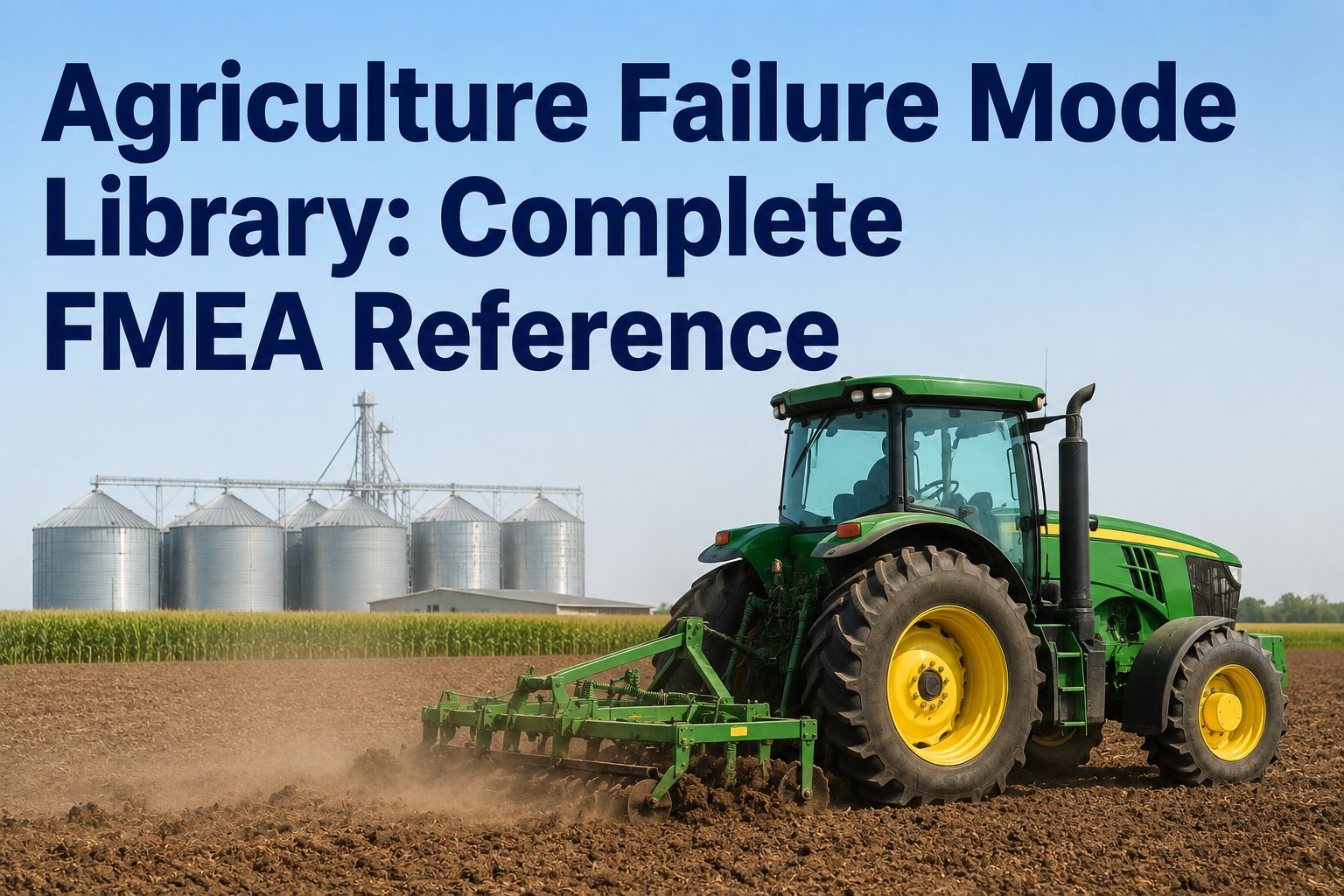
Agriculture and agribusiness failure modes follow predictable patterns — bearing wear on grain augers, seal leakage on irrigation pumps, control-loop drift on PLC-driven feed systems, and structural corrosion on storage silos — every breakdown has a root cause, a failure mode, and a downstream effect on production, safety, and cost. This complete FMEA reference catalogs the agriculture and agribusiness equipment failures your reliability team encounters on the floor, mapping each to its most likely root cause and recommended RCM task so you can shift from reactive firefighting to planned, condition-based maintenance. OxMaint turns this failure mode library into daily action by logging failure modes against every asset, triggering the right preventive or predictive task at the right interval, and building a searchable FMEA history that feeds smarter decisions on every future work order. Download the free worksheet and Start Free Trial inside OxMaint to start applying it today.
Every failure mode in your operation — mapped, cataloged, and ready for RCM action.
Stop firefighting the same agriculture and agribusiness equipment failures quarter after quarter. This reference library ties each failure mode to its root cause, downstream effect, and the optimal maintenance task to prevent it — so your team can prioritize PMs, spare parts, and condition monitoring with confidence.
Why agriculture and agribusiness failure modes demand a structured FMEA database
Unplanned downtime during a narrow planting or harvest window can cost a mid-sized grain operation $12,000–$25,000 per day in lost throughput, spilled product, and emergency repair premiums. Yet 60–70% of agriculture and agribusiness equipment failures are preventable when failure modes are identified early and matched to the right condition-based or time-based task.
Worked example: A 180-asset grain handling operation spending $42K/year on reactive bearing, seal, and conveyor belt replacements implemented an FMEA-driven PM program in OxMaint. Within one harvest cycle, unplanned downtime dropped 34%, emergency parts orders fell 51%, and overall maintenance spend decreased by $18K — an ROI achieved in under 5 months.
Agriculture and agribusiness failure modes: equipment, causes, effects & RCM tasks
This agriculture and agribusiness FMEA database covers the six equipment categories responsible for over 85% of unplanned downtime events across crop production, livestock, irrigation, and processing operations. Each row links a specific failure mode to its dominant root cause, production effect, and the recommended RCM task type.
| Asset / Equipment | Failure Mode | Root Cause | Effect | Recommended RCM Task |
|---|---|---|---|---|
| Grain auger / conveyor | Bearing wear & seizure | Lubrication degradation, misalignment, dust ingress | Auger stoppage, grain bottleneck, fire risk | CBM — vibration analysis + ultrasonic lubrication |
| Irrigation pump (centrifugal) | Mechanical seal leakage | Abrasive wear, cavitation, dry running | Water loss, motor damage, crop stress | RTF — flow & pressure trending, quarterly seal inspection |
| Feed mixer / mill PLC | Control loop drift | Sensor fouling, analog signal degradation | Ration inaccuracy, feed quality variance | PdM — auto-calibration cycle + monthly loop audit |
| Storage silo / bin | Structural corrosion | Moisture ingress, coating breakdown, chemical exposure | Wall failure, product contamination, safety hazard | FF — annual UT thickness survey + coating assessment |
| Tractor / combine hydraulic system | Hydraulic fluid contamination | Filter bypass, seal degradation, refueling errors | Valve sticking, cylinder failure, field breakdown | CBM — oil analysis (ISO 4406) at 250-hour intervals |
| Grain dryer (gas-fired) | Burner ignition failure | Flame sensor fouling, gas valve wear | Drying stoppage, grain spoilage risk | FF — bi-weekly burner clean + ignition component swap |
| Conveyor belt (bulk handling) | Belt tracking deviation & splice failure | Pulley misalignment, tension loss, material buildup | Belt damage, spillage, unplanned stoppage | FF — weekly alignment check + tension adjustment |
| Ventilation fan (livestock barn) | Motor overheating & winding failure | Dust accumulation, bearing drag, voltage imbalance | Air quality drop, heat stress, animal welfare risk | CBM — thermography + motor current signature analysis |
Top root cause categories driving agriculture and agribusiness equipment failures
Across hundreds of FMEA workshops, six root-cause categories account for nearly 90% of documented agriculture and agribusiness failure modes. Prioritizing your preventive maintenance program against these categories yields the fastest, most measurable reliability gains.
Lubrication breakdown
Degraded, contaminated, or under-lubricated bearings account for roughly 30–40% of rotating equipment failures in augers, fans, and pumps. Root triggers include wrong grease grade, missed intervals, and dust ingress past worn seals.
CBM · Ultrasound + oil analysisContamination & environmental ingress
Dust, moisture, chemical residues, and biological matter intrude into hydraulic systems, sensors, and structural members — accelerating wear, corrosion, and signal drift across 20–25% of failure events.
FF · Sealing & filtration PMMisalignment & mechanical drift
Pulley, shaft, and coupling misalignment develops from foundation settling, vibration, and thermal cycling — driving premature bearing, belt, and seal failures on conveyors, dryers, and PTO-driven equipment.
FF · Laser alignment quarterlyWear & fatigue (age-based)
Cyclic loading on chains, belts, sprockets, and structural welds produces predictable wear-out curves. Time-based component replacement at calculated life limits prevents 15–18% of in-field breakdowns.
RTF · Life-limit swapOperational & human error
Overloading, improper shutdown sequencing, and missed pre-start checks contribute to 10–12% of failures — particularly in feed mixing, drying, and irrigation start-up scenarios.
Training + SOP enforcementControl & instrumentation drift
Sensor fouling, analog signal attenuation, and PLC logic errors cause silent ration, flow, and temperature deviations — often undetected until product quality or yield is already compromised.
PdM · Auto-calibration + auditHow to build your agriculture and agribusiness FMEA worksheet — step by step
A defensible FMEA worksheet follows a five-step sequence aligned with RCM methodology (SAE JA1011) and ISO 55000 asset management principles. Each step narrows the field from all possible failures to the specific, actionable tasks that reduce risk most efficiently.
Define asset boundary & function
List each asset's primary and secondary functions with performance standards — e.g., "irrigation pump delivers 1,200 GPM at 65 PSI." Boundaries prevent scope creep and ensure failure modes are tied to a specific function loss.
Identify failure modes & causes
For each function, enumerate how it can fail — bearing seizure, seal leak, control drift — and trace each to its dominant root cause using this agriculture and agribusiness failure catalog as your starting reference.
Assess effects & severity
Document the production, safety, environmental, and cost impact of each failure mode. Assign a severity score (1–10) — silo wall failure scores 9–10; a single sensor drift may score 4–5 depending on detection redundancy.
Score occurrence & detectability
Rate how likely each failure is (1–10) and how likely your current detection methods catch it before impact (1–10, where 10 = undetectable). Multiply Severity × Occurrence × Detectability to calculate the Risk Priority Number (RPN).
Assign RCM task & interval
For high-RPN modes, assign a condition-based (CBM), predictive (PdM), time-based (FF/RTF), or run-to-failure (RTF) task. Log it against the asset in OxMaint so the PM triggers automatically at the correct interval.
Example: Silo structural corrosion — Severity 9, Occurrence 4, Detectability 3 → RPN = 108. Any RPN above 80 warrants a documented, scheduled mitigation task with a named owner.
How OxMaint turns your FMEA library into daily maintenance action
A failure mode catalog on a spreadsheet is static — it only reduces downtime when it drives the right work order at the right time. OxMaint operationalizes your agriculture and agribusiness FMEA database across work orders, PM triggers, inventory, and analytics in one AI-powered CMMS platform.
Attach failure modes to every asset record
Log each documented failure mode, root cause, and RPN against its parent asset in OxMaint. Technicians see the full FMEA history on every work order — cutting diagnostic time by 40% and ensuring the right fix the first time.
Auto-trigger condition-based & time-based PMs
Map each RCM task to a trigger — meter reading, calendar interval, or condition threshold — and OxMaint generates the work order automatically. Teams cut unplanned downtime 30–50% by catching failures before they escalate.
Pre-stage spare parts for high-RPN failures
Link critical spare parts to the failure modes they mitigate. OxMaint tracks min/max levels and auto-generates purchase requests — reducing emergency parts orders by up to 51% and eliminating 14-day lead-time delays.
Build a searchable FMEA analytics history
Every closed work order feeds OxMaint's analytics engine — surfacing recurring failure modes, MTBF trends, and RPN shifts over time. Reliability leaders use these dashboards to justify capex and refine the PM program quarterly.
See OxMaint on your assets — book a 30-minute demo
Watch how agriculture and agribusiness reliability teams log failure modes, auto-trigger RCM tasks, and cut unplanned downtime by up to 50% in a single harvest cycle.
Agriculture and agribusiness failure modes — your questions answered
What are the most common failure modes in agriculture and agribusiness equipment?
The most common agriculture and agribusiness failure modes are bearing wear and seizure on rotating equipment (augers, fans, pumps), mechanical seal leakage on irrigation pumps, control-loop drift on PLC-driven feed and drying systems, structural corrosion on storage silos, and hydraulic fluid contamination on tractors and combines. Together, these five mode categories account for roughly 70–80% of unplanned downtime events across crop, livestock, and processing operations. Cataloging them in an FMEA database lets your team match each to a targeted RCM task before failure occurs.
How do I create an FMEA worksheet for agriculture and agribusiness equipment?
Start by defining each asset's function and performance standard, then enumerate failure modes for each function using a reference catalog like this one. For every mode, document the root cause, effect on production/safety/cost, and assign Severity, Occurrence, and Detectability scores (1–10). Multiply the three to get the Risk Priority Number (RPN), then assign a condition-based, predictive, time-based, or run-to-failure task to any mode with an RPN above 80. You can operationalize the completed worksheet inside OxMaint by attaching each failure mode and task to its asset record — Start Free Trial to build yours today.
What RCM task types should I use for agriculture and agribusiness failure modes?
Match the task to the failure pattern: use condition-based monitoring (CBM) — vibration, oil analysis, thermography — for wear-driven modes like bearing degradation and motor overheating. Use predictive maintenance (PdM) for sensor and control-loop drift that can be auto-corrected. Apply fixed-interval replacement (FF) for age-based wear items like belts, filters, and ignition components. Reserve run-to-failure (RTF) for low-RPN, non-critical assets where proactive maintenance costs more than the failure impact. OxMaint supports all four task types with automatic trigger logic.
How much can an FMEA-driven maintenance program reduce downtime in agribusiness?
Operations that implement FMEA-driven preventive and condition-based maintenance typically cut unplanned downtime 30–50% within the first 12 months, reduce emergency parts orders by 40–55%, and lower total maintenance spend by 15–25%. The largest gains come during peak harvest windows, where a single day of unplanned stoppage can cost $12K–$25K in lost throughput — making the payback period for a CMMS like OxMaint often under 5 months.
Can OxMaint store and track agriculture and agribusiness failure mode history per asset?
Yes. OxMaint lets you attach a full FMEA record — failure modes, root causes, effects, RPN scores, and recommended RCM tasks — to every individual asset in your hierarchy. Each closed work order updates that asset's failure history automatically, building a searchable analytics database your reliability team uses to spot recurring modes, track MTBF trends, and refine PM intervals over time. To see it on your own asset register, Book a Demo with our team.
Turn your failure mode library into fewer breakdowns — starting today
Join agriculture and agribusiness reliability teams using OxMaint to log failure modes, trigger the right PM at the right interval, and shift from reactive firefighting to predictable, planned maintenance.
Free 14-day trial · No credit card