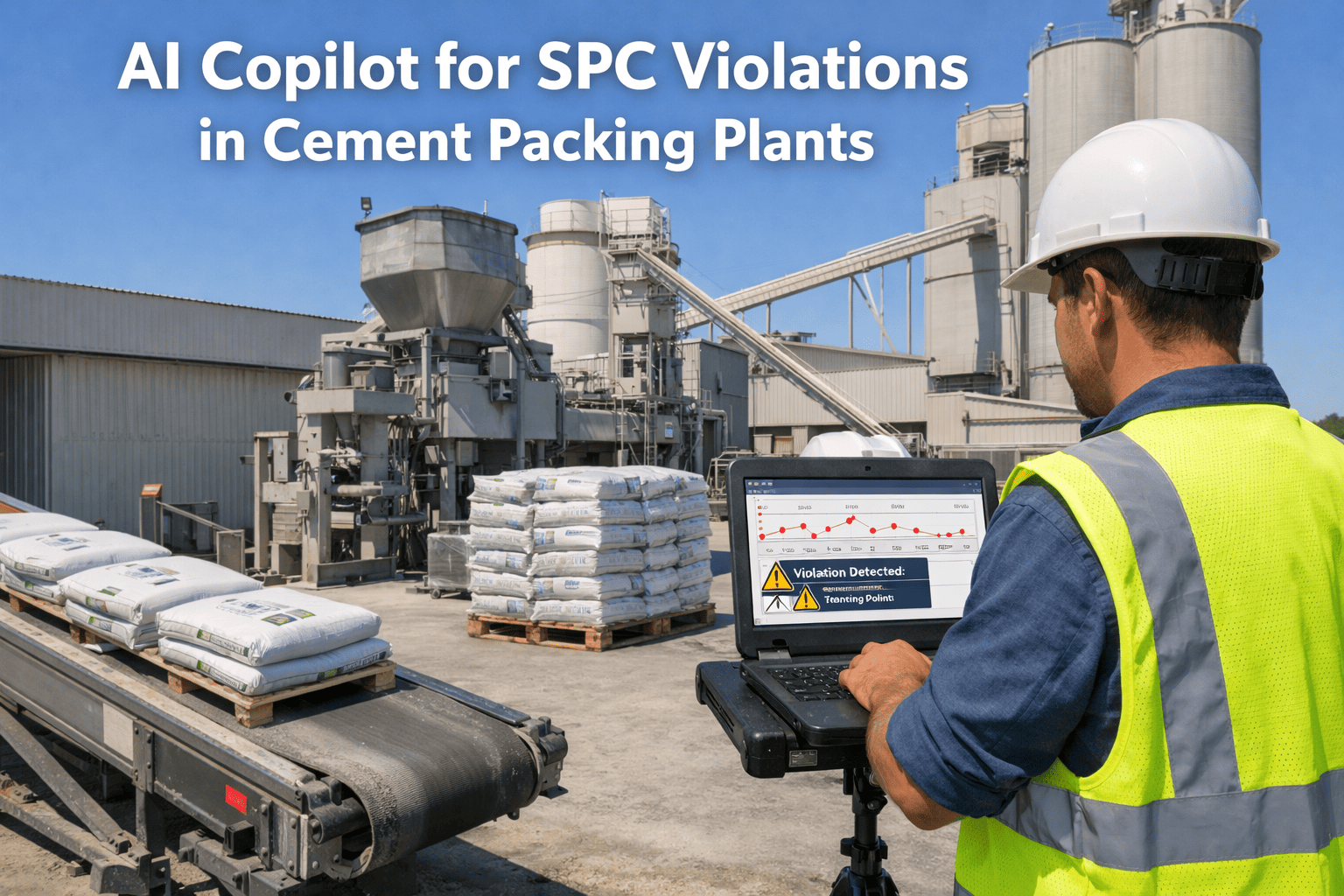
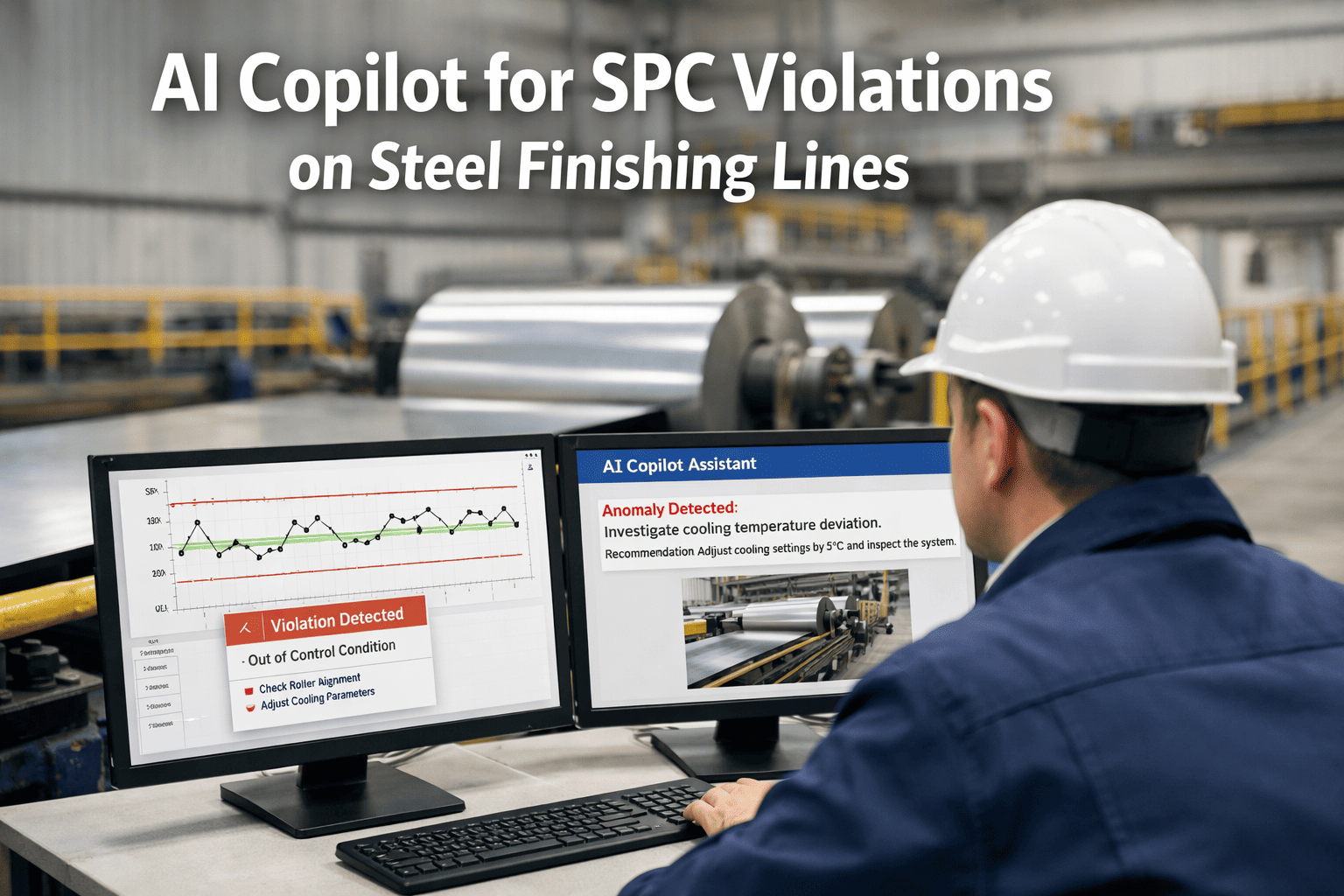
Every manufacturing plant running heat exchangers faces the same invisible threat — process drift that silently degrades thermal efficiency, compromises product quality, and eventually causes costly unplanned shutdowns. Statistical Process Control charts catch the violation, but they never tell you the "why." An AI copilot bridges that gap by instantly analyzing SPC deviations on heat exchangers, cross-referencing sensor streams with maintenance history, and delivering root cause explanations that used to take engineers hours of manual investigation. Schedule a consultation to see how AI-driven SPC root cause analysis can protect your heat exchanger fleet.
The Hidden Problem with Heat Exchanger SPC Alerts
A control chart flags that your shell-and-tube exchanger's outlet temperature has breached the upper control limit. Now what? The operator opens a logbook, pulls up historian trends, checks if maintenance was performed recently, and calls the process engineer. Meanwhile, the deviation continues — product goes off-spec, energy costs climb, and downstream equipment strains under abnormal conditions. This reactive cycle repeats hundreds of times a year across a typical plant, and most violations never receive a thorough root cause investigation because there simply is not enough time.
$16.5B
Estimated annual global cost of heat exchanger fouling alone in petroleum refining
4-8 hrs
Average time for manual root cause investigation per SPC violation event
The Gap
SPC Charts Tell You What Happened
Control charts detect when temperature, pressure, or flow parameters cross statistical boundaries — but they provide zero context about the underlying cause or recommended corrective action.
The Solution
AI Copilot Tells You Why It Happened
The AI copilot correlates violations with process variables, maintenance logs, ambient data, and equipment aging models to rank probable root causes with confidence scores — in under 5 minutes.
Start monitoring in minutes. Connect your historian data and let the AI copilot baseline your heat exchangers — no hardware changes required.
Inside the AI Copilot: From Alert to Root Cause in Minutes
Unlike rule-based alarm systems that simply compare values against fixed thresholds, the AI copilot treats every SPC violation as a multivariate investigation opportunity. It simultaneously examines dozens of correlated variables and maintenance events to isolate the true source of the deviation.
How the AI Copilot Resolves a Heat Exchanger SPC Violation
1
Real-Time SPC Engine
Monitors outlet temperature, approach temperature, pressure differential, flow rates, and U-value using adaptive X-bar, EWMA, and CUSUM charts. Control limits adjust dynamically based on operating regime — startup, steady-state, or load change.
2
Violation Pattern Recognition
Classifies the violation type using Western Electric and Nelson rules — distinguishing a sudden spike from a gradual trend, a mean shift from increased variance, or a cyclic oscillation from random noise.
3
Multivariate Correlation Scan
Cross-references the violation against upstream process changes, recent work orders, ambient weather shifts, feedstock quality logs, and equipment health indicators — all within seconds.
4
Ranked Root Cause Report
Delivers a prioritized list of probable causes — each with a confidence percentage and supporting data evidence — so the engineer can validate and act immediately rather than investigate blindly.
Six Violation Patterns the AI Copilot Recognizes Instantly
Heat exchangers produce a distinctive fingerprint of SPC deviations. Each pattern maps to a different family of root causes. The AI copilot is trained to recognize these signatures and skip the guesswork that typically delays resolution.
Sudden Temperature Spike
AI traces to upstream feed changes, bypass valve failures, or tube-side flow blockages
Gradual Approach Temp Drift
AI correlates with fouling accumulation rates and predicts optimal cleaning window
Cyclic Oscillation
AI identifies control valve hunting, upstream batch cycling, or steam supply instability
Process Mean Shift
AI detects baffle damage, tube leaks, or permanent fluid property changes
Increasing Variability
AI links to sensor degradation, inconsistent feed conditions, or mechanical looseness
Pressure Drop Excursion
AI differentiates tube blockage from shell-side fouling using pressure-flow signature analysis
See pattern recognition on your data. Walk through a live demo using real SPC violations from your heat exchanger fleet — we'll show you every root cause the AI identifies.
What the AI Copilot Monitors on Every Heat Exchanger
Effective SPC requires tracking the right parameters with the right chart type at the right frequency. The AI copilot applies multivariate analysis across all channels simultaneously — detecting cross-variable patterns that are invisible when engineers review one chart at a time.
SPC Monitoring Configuration per Heat Exchanger
Parameter
Chart Type
Sample Rate
Why It Matters
Outlet Temperature
X-bar & R
Every 10s
Primary thermal efficiency indicator; first to reveal fouling or flow issues
Approach Temperature
EWMA
Every 30s
Detects gradual efficiency loss weeks before it becomes critical
Differential Pressure
CUSUM
Every 10s
Reveals blockages, fouling buildup, and gasket degradation
Flow Rate (both sides)
X-bar & R
Every 5s
Validates pump health, valve position, and detects tube leaks
Overall U-Value
EWMA
Every 60s
Composite health score combining thermal and hydraulic performance
Before and After: Manual Investigation vs. AI Copilot
The difference between a manual SPC response and an AI-powered one is not just speed — it is completeness. Manual investigations often stop at the first plausible explanation. The AI copilot evaluates every possibility and ranks them by evidence strength.
Without AI Copilot
Engineer reviews single chart printout manually
Checks one variable at a time against historian logs
Relies on experience and tribal knowledge
Root cause takes 2-8 hours to confirm
No systematic documentation of findings
~65%first-attempt root cause accuracy
With AI Copilot
Instant multivariate scan across all sensor channels
Correlates process, maintenance, and ambient data
Ranked root causes with confidence scores and evidence
Complete analysis delivered in under 5 minutes
Auto-generates CMMS work order with full context
94%root cause accuracy with continuous learning
Move from Reactive SPC to Predictive Heat Exchanger Intelligence
Oxmaint connects AI copilot SPC analysis directly into your maintenance workflow — linking violation alerts to automatic root cause reports, work order generation, and corrective action tracking across your entire exchanger network.
Industry Applications: Where AI SPC Monitoring Makes the Biggest Impact
Different industries have different heat exchanger configurations, fouling mechanisms, and quality requirements. The AI copilot adapts its root cause models to each sector's unique failure signatures and operational context.
Oil & Gas Refining
Shell-and-tube, air-cooled fin-fan exchangers. AI focuses on crude blend impacts, desalter efficiency, and corrosion inhibitor performance to explain fouling-driven SPC violations.
Chemical Processing
Plate, spiral, and double-pipe exchangers. AI correlates reaction temperature instability with catalyst degradation, feed composition variance, and scaling rate patterns.
Power Generation
Condensers and feedwater heaters. AI monitors condenser vacuum deviations, terminal temperature differences, and drain cooler approach to detect tube leaks and air ingress.
Food & Beverage
Plate and scraped-surface exchangers. AI tracks pasteurization temperature compliance, CIP effectiveness decay, and protein/mineral fouling rates for high-protein products.
Pharmaceutical
Jacketed vessels and plate exchangers. AI monitors batch temperature uniformity, cooling rate deviations, and glycol concentration effects on jacket fouling progression.
Measurable Results from AI Copilot SPC Deployment
The financial and operational impact of AI-powered SPC monitoring compounds across multiple value streams — faster resolution, fewer shutdowns, extended cleaning cycles, and reduced off-spec production. Here is what plants are reporting after deployment.
40%
Less unplanned heat exchanger downtime
90%
Faster root cause identification vs. manual
25%
Longer cleaning intervals via predictive fouling
60%
Fewer off-spec batches from thermal deviations
Ready to cut investigation time by 90%? Join the plants already using AI-powered SPC to eliminate guesswork and protect heat exchanger performance across their entire fleet.
Rolling out AI copilot SPC monitoring does not require replacing your existing control system or installing new sensors. The platform layers on top of your current infrastructure, importing historian data and real-time feeds to begin delivering value within weeks.
Week 1-2
Connect & Baseline
Link historian/SCADA data feeds to AI platformEstablish SPC baselines on critical heat exchangersImport maintenance history into Oxmaint CMMS
Week 3-4
Train & Configure
AI models learn from historical violation-cause pairsConfigure chart rules, alert routing, and escalationCalibrate multivariate correlation thresholds
Week 5-6
Validate & Go Live
Run copilot in parallel with manual investigationCompare accuracy, refine models with field feedbackActivate automatic work order generation
Week 7+
Scale & Predict
Expand across full heat exchanger networkEnable predictive fouling and failure forecastsContinuous model improvement from resolved events
Your Control Charts Should Explain Themselves
Oxmaint's AI copilot connects directly to your SPC data, identifies the root cause of every heat exchanger deviation, and generates maintenance work orders automatically. Stop investigating manually — start resolving intelligently.
What kinds of SPC violations can the AI copilot detect on heat exchangers?
The copilot detects all standard Western Electric and Nelson rule violations — points beyond control limits, runs, trends, oscillations, and stratification — across X-bar, R-chart, CUSUM, and EWMA charts simultaneously for temperature, pressure, flow, and heat transfer coefficient parameters. Book a demo to see detection on your actual process data.
How does the AI determine the root cause instead of just flagging the alarm?
It uses multivariate correlation analysis across all monitored parameters, cross-references recent maintenance activities, ambient conditions, upstream and downstream data, and equipment degradation models. Machine learning trained on thousands of historical violation-resolution pairs ranks the most probable causes with confidence scores and supporting evidence.
Will this integrate with our existing DCS, SCADA, and CMMS?
Yes. The AI copilot connects via standard industrial protocols — OPC-UA, Modbus, MQTT — for real-time data, and integrates directly with Oxmaint CMMS for automatic work order generation. Sign up for a free account to explore the integration options with your existing infrastructure.
How quickly does the AI become accurate for our specific heat exchangers?
The copilot delivers value from day one using pre-trained models for common exchanger types. Within 4-6 weeks on your equipment, accuracy improves significantly as the model learns your unique operating conditions, failure modes, and process relationships. Most deployments reach peak accuracy within 3 months.
Does it work for different heat exchanger designs — plate, shell-and-tube, air-cooled?
Absolutely. The system supports shell-and-tube, plate, air-cooled, spiral, double-pipe, and specialty designs. Each type has distinct SPC violation signatures — plate fouling looks different from tube fouling — and the AI is trained to distinguish them. Schedule a consultation to discuss your specific equipment portfolio.
By oxmaint
✨
Experience Oxmaint's Power
Take a personalized tour with our product expert to see how OXmaint can help you streamline your maintenance operations and minimize downtime.