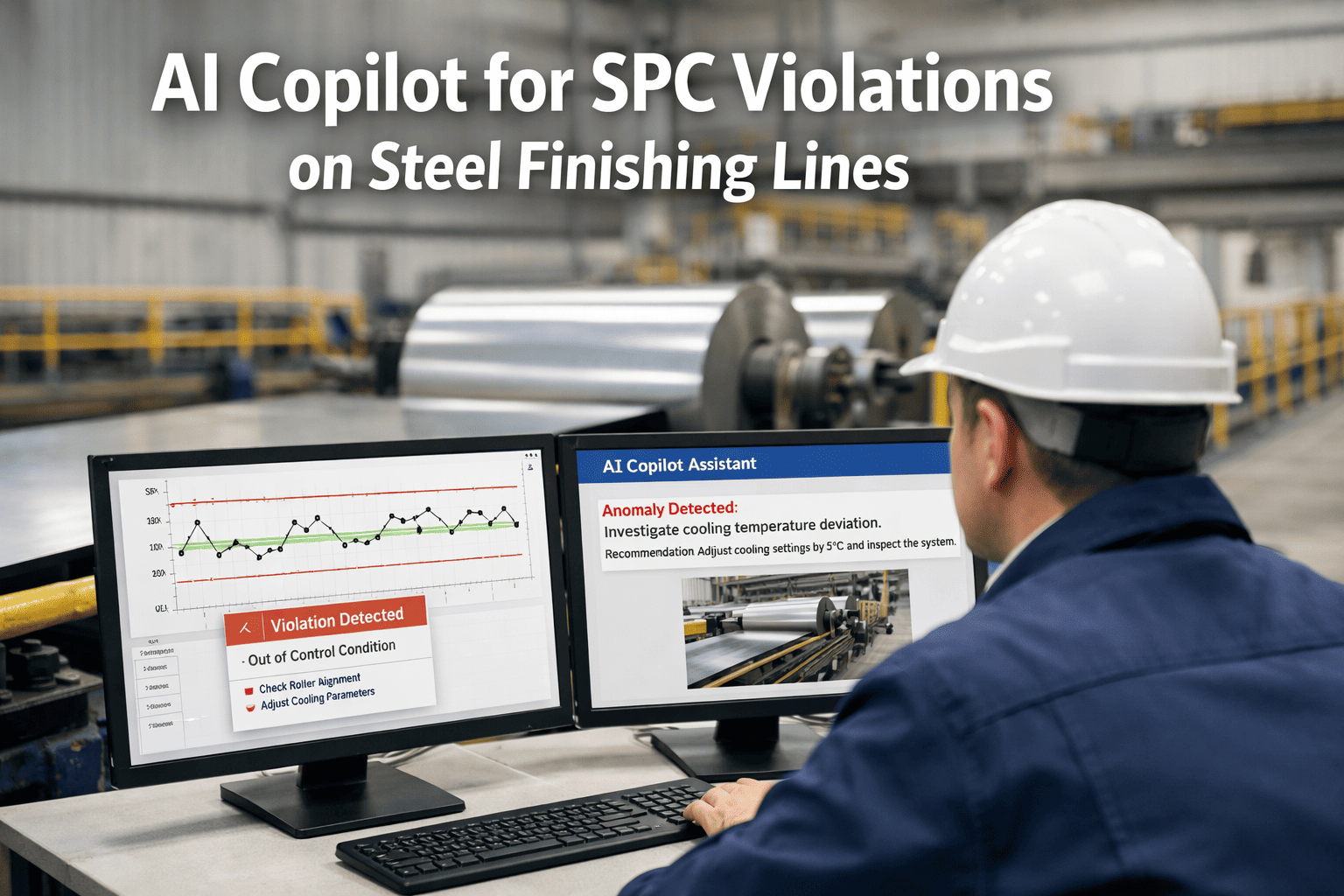
Every minute a steel finishing line runs with an undetected SPC violation, defective coils accumulate. Coating weight drifts outside specification, surface roughness exceeds customer tolerances, thickness profiles shift beyond control limits—and operators don't realize it until the quality hold report arrives hours later. An AI copilot purpose-built for steel finishing SPC changes this equation entirely. It watches every control chart in real time, instantly explains why a violation occurred, traces it to the specific asset responsible, and generates a corrective maintenance action before the next coil enters the line. Book a demo with our team to explore how intelligent SPC monitoring can protect your finishing line quality and throughput.
What Makes Steel Finishing SPC Uniquely Difficult
Unlike upstream steelmaking where process variables change slowly, finishing lines operate with razor-thin tolerances across multiple simultaneous quality dimensions. A single galvanizing line monitors coating weight, bath chemistry, surface appearance, strip tension, and thickness—all at production speeds exceeding 150 meters per minute. Traditional SPC software flags the violation but leaves operators guessing at the cause, creating a diagnostic bottleneck that costs real tonnage.
150+
SPC data points generated per second on a modern continuous galvanizing line
6
Simultaneous quality dimensions monitored across each finishing station
47 min
Average manual root cause investigation time per SPC violation event
The real cost isn't the violation—it's the time between detection and correction. Every coil processed during that gap is at risk. Oxmaint's AI copilot eliminates the diagnostic delay entirely.
From Alarm to Action: How the AI Copilot Works
The copilot sits between your SPC data streams and your maintenance management system. It doesn't replace your existing control charts—it makes them intelligent by adding instant root cause context to every violation event. Here is what happens within seconds of a control chart breach on your finishing line.
Detection
Multi-Rule Violation Identification
The copilot applies Western Electric rules, Nelson rules, and custom finishing-line pattern signatures simultaneously across all SPC parameters. It catches not just limit breaches, but subtle trends, runs, and stratification patterns that signal equipment degradation before traditional alarms fire.
Diagnosis
Asset-Level Root Cause Mapping
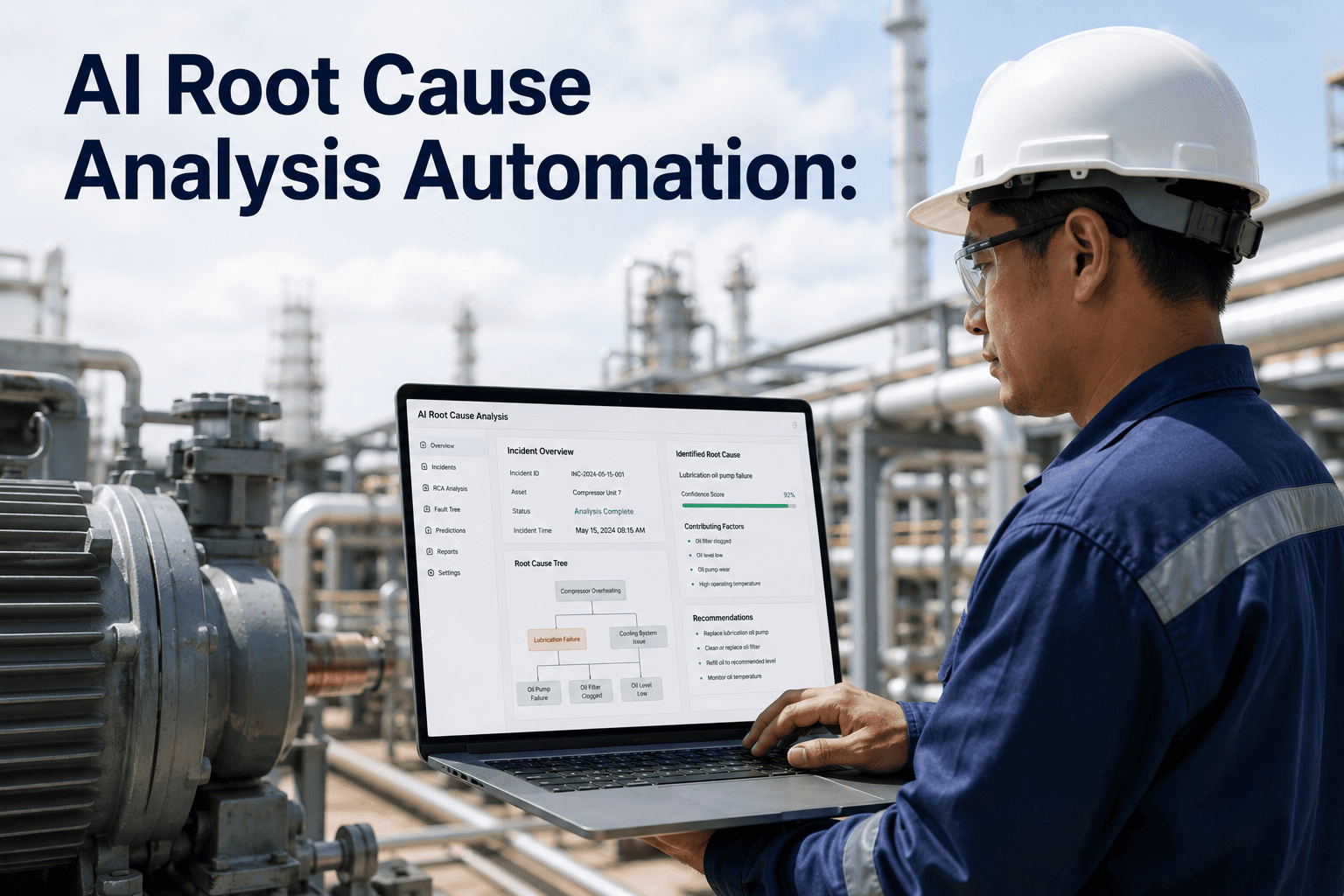
Each violation is cross-referenced against equipment maintenance records, roll campaign hours, bath chemistry logs, and upstream process data. The copilot determines whether the source is a worn air knife, depleted zinc bath aluminum, misaligned temper mill rolls, or a dozen other asset-specific causes.
Correlation
Cross-Station Pattern Intelligence
Finishing line quality problems often originate upstream. A coating adhesion failure at the galvanizing pot may trace back to cleaning section chemistry or annealing furnace temperature drift. The copilot connects violations across stations to find the true originating cause.
Resolution
Automated Corrective Work Orders
The copilot generates a plain-language explanation and a specific corrective action—then pushes it directly into your CMMS as a prioritized work order—
sign up with Oxmaint's CMMS to see it in action. Maintenance teams receive actionable instructions, not vague alarms. After correction, the copilot monitors subsequent SPC data to confirm resolution.
Violation Types the Copilot Identifies on Finishing Lines
Steel finishing quality is multi-dimensional. Each station produces its own SPC parameters with distinct violation signatures. The AI copilot is trained on finishing-line-specific failure modes, connecting each violation type to the most probable equipment or process root cause in your facility.
Coating Weight Drift
X-bar and R charts on zinc coating weight reveal shifts caused by air knife gap wear, nozzle blockage, bath aluminum depletion, or strip speed mismatches. The copilot correlates weight deviation magnitude and direction to specific air knife positions, bath age, and wiping system parameters.
Surface Roughness Exceedance
Temper mill Ra values trending beyond specification indicate roll surface degradation, incorrect elongation settings, or work roll bearing vibration. The copilot tracks roughness against roll campaign hours and predicts the optimal change window.
Thickness Profile Shift
Cross-strip thickness variation beyond tolerance signals roll crown wear, backup roll bearing degradation, or AGC control drift. The copilot maps thickness profiles to specific roll positions and wear patterns.
Tension and Elongation Anomalies
Skin pass tension violations affect mechanical properties and flatness. The copilot links elongation trend patterns to bridle roll slip, hydraulic pressure decay, or motor controller faults—differentiating equipment issues from material variability.
Visual Defect Clustering
Dross inclusions, zinc drips, bare spots, and scratches flagged by surface inspection systems. The copilot classifies defect type and spatial pattern, tracing clusters to stabilizer rolls, sink roll bearings, or wiping nozzle alignment.
Bath Chemistry Excursions
Aluminum concentration drops, iron saturation increases, and temperature deviations in galvanizing baths directly impact coating adhesion, spangle formation, and intermetallic layer quality. The copilot predicts bath chemistry drift trajectories and recommends corrective additions before SPC limits are reached—turning reactive chemistry management into proactive control.
Every violation type above generates a different corrective action. The AI copilot knows the difference—and routes each to the right maintenance team with the right instructions. Schedule a free demo to see it classify violations from your own finishing line data.
Station-by-Station Monitoring Coverage
Comprehensive SPC intelligence requires the copilot to understand the unique parameters, failure modes, and equipment relationships at every station on your finishing line. Here is how the copilot maps monitoring to each process stage.
Finishing Line SPC Intelligence Matrix
Measured Impact: Before and After AI Copilot Deployment
Steel finishing operations that deploy AI copilot SPC report measurable gains within the first 90 days. The improvements compound as the copilot's pattern library grows from your facility's specific data.
75%
Faster violation response time
50%
Fewer repeat violations per quarter
40%
Lower quality-related scrap tonnage
30%
Improvement in first-pass prime yield
$1.8M
Average annual savings per finishing line
Combining reduced scrap, faster throughput recovery, fewer customer quality claims, and optimized maintenance scheduling—AI copilot SPC delivers payback within the first two quarters of operation.
Sign up for a free Oxmaint account and our team will model the ROI for your specific line configuration.
What Connects to What: System Integration Map
The AI copilot operates as an intelligence layer between your plant floor systems and your maintenance management platform. It pulls context from everywhere and pushes corrective actions to the right place.
Data Sources
Level 2 / PLC Systems
Surface Inspection Cameras
Thickness Gauges & Sensors
QMS / Lab Systems
Action Targets
Oxmaint CMMS Work Orders
Operator HMI Dashboards
Quality Hold / Release
MES / Production Scheduling
Your control charts shouldn't just flag problems—they should explain them. Oxmaint connects SPC data directly to asset health, maintenance history, and process parameters for instant root cause analysis on every finishing line violation.
Getting Started: Deployment in Three Phases
Implementation follows a structured path designed to deliver measurable results on a single finishing line before scaling across your plant. Most facilities see the copilot producing accurate root cause recommendations within 60 days.
Baseline and Connect
Audit existing SPC data quality and coverage
Map finishing line instrumentation and data flows
Integrate with Level 2 systems and Oxmaint CMMS
Import historical violation records for model training
Train and Validate
Build asset-violation correlation models from your data
Calibrate SPC rule thresholds for your product mix
Run shadow mode alongside existing quality processes
Validate copilot recommendations against expert judgment
Activate and Scale
Go live with automated violation response on pilot line
Enable CMMS work order auto-generation
Expand to additional finishing lines and stations
Continuous model refinement from operator feedback
In steel finishing, the control chart tells you something went wrong. It doesn't tell you which air knife is wearing, which roll needs changing, or which bath parameter drifted. An AI copilot bridges that gap—turning every SPC violation from a question mark into a specific maintenance action.
— Quality Engineering Manager, Continuous Galvanizing Operation
Transform SPC from reactive charting to predictive quality intelligence. Oxmaint's AI copilot monitors every finishing line parameter, explains every violation at the asset level, and generates corrective maintenance actions automatically—so your team spends time fixing problems, not finding them.
Frequently Asked Questions
How does the copilot handle violation types it hasn't encountered before?
The copilot uses a combination of learned pattern matching and anomaly detection. For novel violation signatures, it ranks the most probable root causes by similarity to known patterns and flags the event for engineering review. As operators confirm or correct the diagnosis, the model learns and improves.
Book a demo to see the learning feedback loop in action.
Will this replace our existing SPC software?
No. The AI copilot integrates with your existing SPC tools and Level 2 systems. It adds an intelligence layer on top of your current infrastructure—consuming the same data your control charts use, but enriching every violation with root cause context and maintenance actions through Oxmaint's CMMS.
Which SPC rules does the copilot apply beyond standard control limits?
All eight Nelson rules, Western Electric zone rules, and custom pattern rules tailored to steel finishing processes. It also detects subtle trends, cyclic oscillations, and stratification indicating equipment wear—patterns that standard rules often miss until significant product has been affected.
Sign up for free to explore the full SPC rule configuration.
How fast does the copilot reach high-accuracy root cause analysis?
It delivers value from day one using pre-trained models for common finishing line patterns. With 4–6 weeks of your facility's specific data, accuracy improves significantly as it learns the unique relationships between your equipment, materials, and quality outcomes. Most plants report reliable root cause recommendations within 60 days.
Does this work for both galvanized and painted/coated finishing lines?
Yes—the copilot supports continuous hot-dip galvanizing, electrogalvanizing, color coating lines, tin plating, and chromium finishing. Each line type has specific SPC parameters and violation patterns that the copilot recognizes and diagnoses.
Book a demo to discuss your specific finishing line setup.