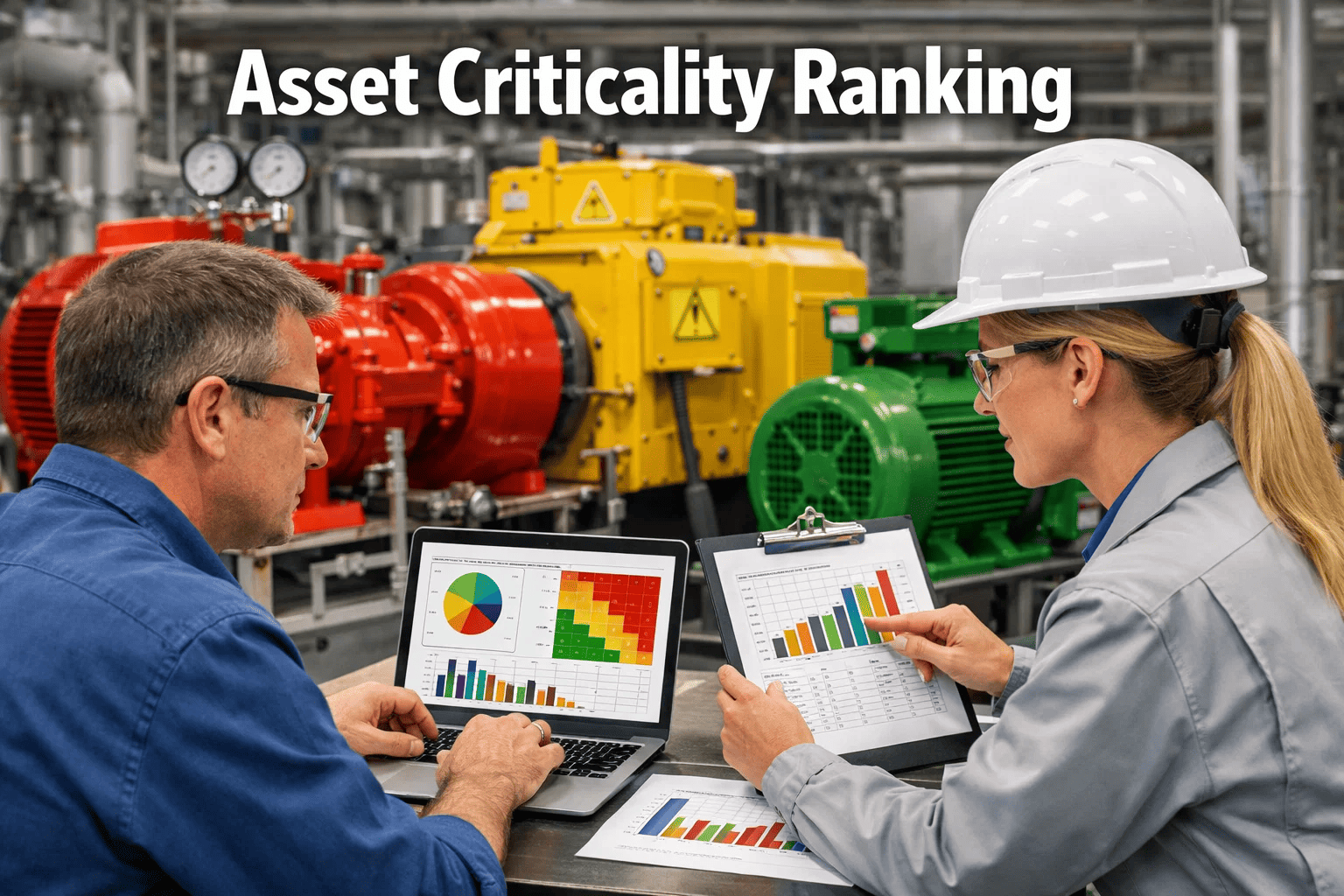
Asset criticality in chemical processing is the backbone of every effective reliability program — it determines which equipment receives preventive maintenance dollars, which failures trigger immediate response, and which assets pose the greatest safety, environmental, and production risks. A chemical processing criticality matrix gives maintenance and reliability teams a defensible, data-driven method for ranking every pump, reactor, heat exchanger, and compressor by consequence and probability. This guide breaks down exactly how to build a chemical processing risk scoring matrix, what consequence categories to include, and how to operationalize your chemical processing asset ranking matrix inside a modern CMMS so your team stops fighting fires and starts preventing them. You can download the template, configure it for your facility, and Start Free Trial to deploy it immediately across your operation.
Chemical Processing Criticality Template
Which asset failure will shut down your plant — or hurt someone — next?
A chemical processing equipment scoring system turns gut-feel prioritization into a defensible risk matrix. Rank every asset by safety, environmental, production, and cost consequence — then let OxMaint automatically trigger the right PMs, inspections, and work orders based on tier.
Why It Matters
The cost of running a chemical plant without an asset criticality assessment
Chemical processing reliability programs that skip formal criticality ranking waste 30–40% of their maintenance budget on low-impact assets while high-risk equipment runs unprotected until it fails.
Real-World Scenario
A 180-asset specialty chemicals plant in Texas was spending $42K annually on time-based preventive maintenance for non-critical centrifugal pumps rated "important" by tribal knowledge — while a single unranked reactor agitator failed mid-batch, causing a $310K product loss and a 9-day production stoppage. After implementing a chemical processing asset tier ranking system, the reliability team reallocated 35% of PM hours to A-tier assets, cut unplanned downtime by 28% in six months, and passed their next OSHA PSM audit with zero findings.
Matrix Framework
How to build a chemical processing risk scoring matrix
A defensible chemical processing criticality matrix scores each asset across four consequence dimensions and one probability dimension, then multiplies to produce a risk priority number (RPN) from 1 to 625.
Risk Priority Number Formula
RPN = Consequence Score × Probability Score
Consequence = highest score across Safety, Environmental, Production, and Cost categories. Probability = likelihood of failure within the analysis window (1–5 scale). Assets scoring 80+ are Tier A (critical); 25–79 are Tier B (essential); below 25 are Tier C (non-critical).
Asset failure causes safety incident, environmental release, or total production stoppage. Requires predictive maintenance, redundancy checks, and spare parts staged on-site.
OxMaint auto-generates condition-based PMs and instant failure alerts.
Failure reduces throughput or requires manual workaround but does not threaten safety or environment. Time-based preventive maintenance at OEM-recommended intervals.
OxMaint schedules PMs, tracks completion, and flags recurring failures.
Failure has minimal production, safety, or cost impact. Run-to-failure strategy with basic inspection routes and standard corrective work orders.
OxMaint logs failures, tracks repair costs, and auto-promotes assets if impact changes.
Consequence Scoring
Chemical processing consequence scoring categories explained
Every asset in a chemical processing risk based prioritization model must be scored on four consequence dimensions. The highest score across any single category becomes the asset's consequence rating — not the average — because a catastrophic safety event matters even if production impact is low.
| Score | Safety & Health | Environmental | Production Impact | Cost Impact |
|---|---|---|---|---|
| 5 — Catastrophic | Fatality or permanent disability; OSHA reportable with plant-wide evacuation | RCRA hazardous release exceeding reportable quantities; EPA violation | Total plant shutdown >72 hours; complete batch loss | >$500K loss per event |
| 4 — Major | Lost-time injury; hospitalization required; chemical exposure | Contained release inside unit; state agency notification required | Unit shutdown 8–72 hours; significant batch loss | $100K–$500K loss |
| 3 — Moderate | Medical treatment; restricted work duty; minor exposure | Release within secondary containment; internal documentation | Reduced throughput 4–8 hours; partial batch loss | $25K–$100K loss |
| 2 — Minor | First aid only; no lost time | Minor leak captured by drip pan; no notification | Delay <4 hours; minimal production impact | $5K–$25K loss |
| 1 — Negligible | No injury; near-miss only | No release; no environmental impact | No production impact; spare available immediately | <$5K loss |
Probability scores run 1 (failure expected >20 years) through 5 (failure expected within 1 year or already showing degradation signals). Multiply the highest consequence score by probability to get the asset's RPN.
Template Checklist
Chemical processing criticality template — fields every asset record must include
A ready-to-use template eliminates blank-page syndrome and ensures every reliability engineer captures the same data. Here are the mandatory fields for each asset in your chemical processing equipment scoring spreadsheet.
Asset Identification
- Asset tag number and serial number
- Equipment type, manufacturer, model
- Process unit / area location code
- Installation date and commissioning date
- Current operating status (running / standby / out of service)
Consequence Assessment
- Safety score (1–5) with justification note
- Environmental score (1–5) with regulatory reference
- Production impact score (1–5) with throughput data
- Cost impact score (1–5) with dollar range
- Highest consequence score selected and documented
Probability & Risk
- Failure probability score (1–5) with failure history
- Calculated RPN (consequence × probability)
- Assigned tier (A / B / C) with review date
- Redundancy or standby backup documented
- Spare parts criticality flag (yes / no)
Maintenance Strategy
- Selected strategy (PdM / PM / RTF / CBM)
- PM task frequency and description
- Inspection route assignment
- Predictive sensor / IoT monitoring tag
- RCM analysis reference (if completed)
Worked Example
Chemical processing asset ranking matrix — a step-by-step calculation
Walk through scoring a reactor cooling water pump at a polymer production facility to see how the chemical processing risk scoring matrix produces an actionable tier assignment.
Identify the asset
Centrifugal pump P-204, reactor cooling water loop, Polymer Unit 3. Serves a continuous stirred-tank reactor producing 40 tons/day of specialty polymer. No redundant backup pump installed.
Score each consequence category
Safety = 3 (operator could be exposed to 180°C water during repair). Environmental = 2 (contained in curbed area). Production = 4 (reactor must trip within 15 minutes; 8-hour batch loss). Cost = 4 ($180K lost product + $40K emergency repair). Highest consequence = 4.
Assign probability score
Bearing failure history shows 2 failures in 3 years. Vibration trend is rising. Probability = 4 (failure likely within 12 months without intervention).
Calculate RPN and assign tier
RPN = 4 × 4 = 16... but because safety score is 3 or above and there is no redundancy, apply the safety override rule: any asset with safety ≥ 3 and no backup is auto-promoted to Tier A. P-204 is Tier A — Critical. OxMaint auto-creates a vibration monitoring route, monthly bearing inspection, and stages a spare seal kit in inventory.
How OxMaint Helps
From spreadsheet to daily operation — how OxMaint activates your criticality matrix
A chemical processing criticality template in Excel is only a plan. OxMaint converts that plan into automated work order generation, predictive alerts, and real-time dashboards your team acts on every shift.
Automated tier-based PM scheduling
Import your asset ranking matrix and OxMaint automatically assigns PM frequencies by tier — daily inspections for Tier A, weekly for Tier B, monthly run-to-failure logs for Tier C. One chemical client cut PM scheduling time by 90% and eliminated 200+ overdue PMs in the first month.
Predictive maintenance with AI failure prediction
OxMaint's AI engine analyzes vibration, temperature, and pressure trends on Tier A assets and predicts failures 7–21 days before they occur — shifting your chemical maintenance strategy from reactive to predictive and cutting unplanned downtime 30–50%.
Spare parts inventory tied to criticality
Tier A assets automatically trigger min/max stock rules for critical spares. OxMaint tracks every seal, bearing, and impeller by asset tier so you never lose a reactor day waiting for a $400 part — while avoiding $50K tied up in unnecessary Tier C spares.
Audit-ready compliance documentation
Every work order, inspection, and failure event is timestamped and linked to the asset's criticality record. OSHA PSM, EPA RMP, and ISO 55000 audits become a 10-minute report export instead of a two-week scramble through paper records and spreadsheets.
See OxMaint rank your assets and auto-generate the right PMs — book a 30-minute demo
Bring your top 20 assets and we will load them into a live criticality matrix during the call. You will see exactly how OxMaint assigns tiers, schedules maintenance, and flags high-risk gaps — before you spend a dollar.
Frequently Asked Questions
Chemical processing criticality assessment — what teams ask most
What is asset criticality in chemical processing?
Asset criticality in chemical processing is a structured ranking of equipment by the consequence of its failure across safety, environmental, production, and cost dimensions. Each asset receives a risk priority number that drives maintenance strategy — Tier A assets get predictive and condition-based maintenance, Tier B gets time-based PMs, and Tier C runs to failure. The goal is to focus limited maintenance resources where failure impact is greatest.
How often should a chemical processing criticality matrix be reviewed?
Industry standards including ISO 55000 and API RP 580 recommend reviewing the criticality matrix at least every 2 years, or whenever a major process change occurs — new equipment installation, capacity expansion, process modification, or a significant failure event. OxMaint lets you set automated review reminders and re-scores assets dynamically when failure patterns or operating conditions change.
What is the difference between RCM and a criticality matrix in chemical plants?
A criticality matrix is a fast, plant-wide screening tool that ranks every asset by risk to prioritize where deeper analysis is needed. RCM (Reliability-Centered Maintenance) is a detailed failure-mode analysis applied to the highest-criticality assets identified by the matrix. In practice, a chemical processing RCM program uses the criticality matrix first to identify Tier A assets, then applies full RCM methodology — FMEA, failure history, and maintenance strategy optimization — only to those assets.
Can I import an existing criticality spreadsheet into OxMaint?
Yes — OxMaint accepts CSV and Excel imports and maps your existing asset tag, consequence score, probability score, RPN, and tier fields directly into the platform. Most chemical plants complete the import in under an hour. You can start by Start Free Trial and importing your template today, or book a guided demo and we will walk through the import live.
How does a chemical processing safety risk ranking reduce OSHA citations?
OSHA's Process Safety Management standard (29 CFR 1910.119) requires documented mechanical integrity programs for covered processes. A formal criticality matrix demonstrates that your facility has systematically identified high-risk assets, assigned appropriate inspection and testing frequencies, and allocated resources based on risk — which is exactly what PSM auditors look for. Plants with documented criticality programs report 40–60% fewer PSM findings during revalidation audits.
Stop guessing which assets matter most — let OxMaint show you
Deploy your chemical processing asset ranking matrix in days, not months. Auto-generate tier-based PMs, predict failures before they happen, and walk into your next audit with every record at your fingertips.
Free 14-day trial · No credit card