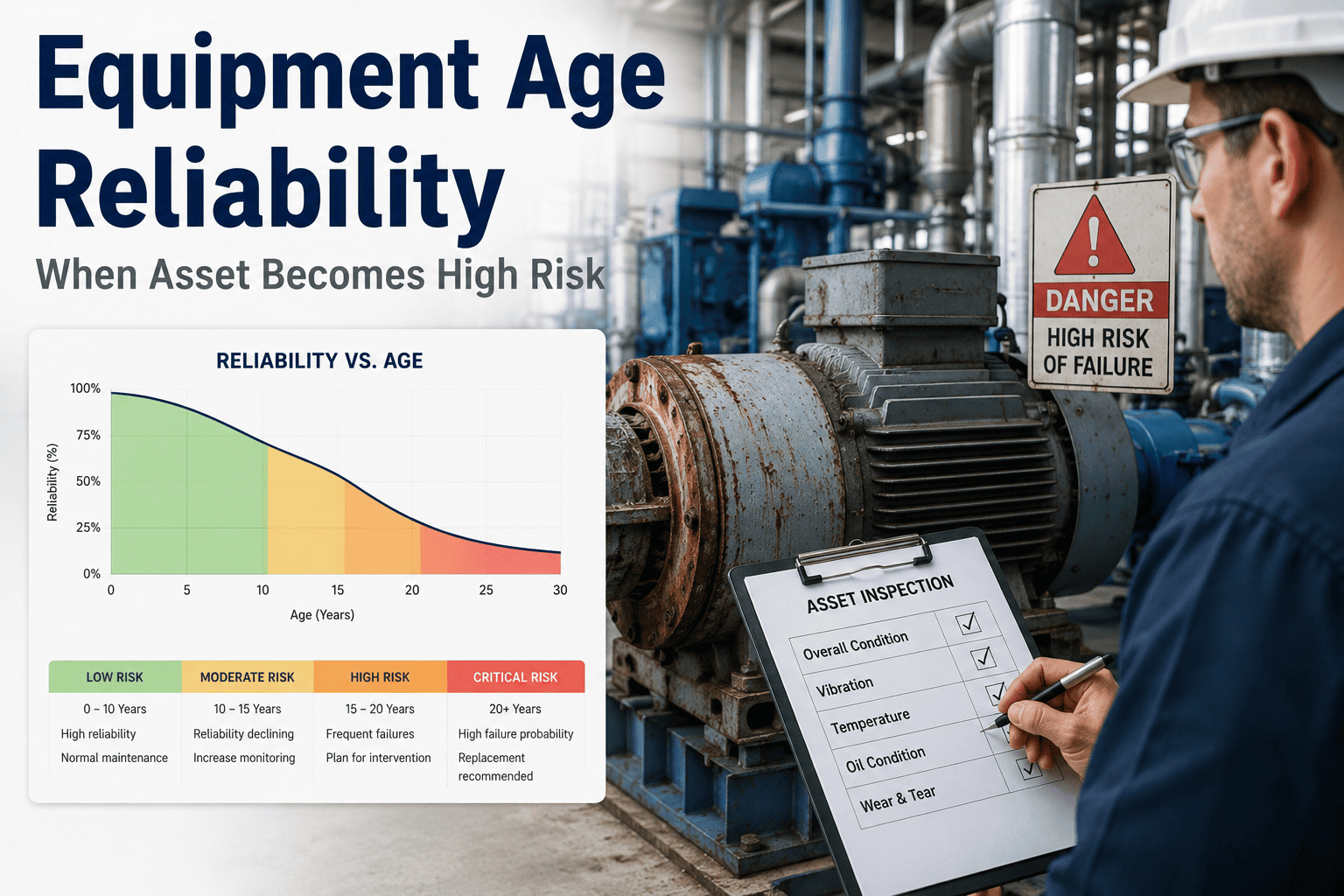
Equipment age and reliability follow a predictable curve — but most maintenance teams don't know where their assets sit on that curve until a failure makes it obvious. Knowing when an asset crosses into high-risk territory is one of the most financially consequential decisions in maintenance management, and organizations that track it systematically spend 30–40% less on emergency repairs than those that rely on gut feel and run-to-failure.
Know exactly which assets in your portfolio are aging into high-risk territory — before the next failure event.
- AI-powered asset age and reliability tracking across all equipment
- Predictive failure alerts weeks before breakdown
- Automated risk scoring — prioritize the right assets, right now
Trusted by 1,000+ teams managing aging equipment across manufacturing, healthcare, and facilities · Live in days
When does aging equipment become a high-risk asset?
Equipment age and reliability risk is the point at which an asset's probability of failure, combined with the operational or financial consequence of that failure, crosses a threshold that justifies intervention — replacement, major overhaul, or enhanced monitoring — rather than routine preventive maintenance. It is not simply about calendar years; a five-year-old asset run hard in a harsh environment may be higher risk than a fifteen-year-old asset on a rigorous PM program.
The industry standard framework for understanding this is the bathtub curve: a high early-life failure rate (infant mortality), a stable low-failure period (useful life), and a rising failure rate as components approach end of design life (wear-out zone). The question maintenance managers face is: where does each asset sit on that curve right now? Without centralized asset management with maintenance history, runtime data, and failure records attached to each asset, that question is genuinely unanswerable.
Identifying high-risk assets before they fail requires three data inputs working together: actual age (not just nameplate installation date), operational intensity (hours run, cycles completed, load profile), and maintenance quality (PM compliance rate, how many times the asset has been allowed to run past its PM due date). Predictive maintenance tools add a fourth layer — real-time sensor data that catches the early signature of wear before it becomes a failure event.
8 factors that determine whether an aging asset is high risk
Every asset has an OEM-specified design life in years or operating hours. Once an asset exceeds 80% of design life, risk assessment becomes mandatory rather than optional. This is the baseline trigger.
An asset running 16 hours per day ages faster than one running 8. Cumulative runtime hours — not calendar years — is the more honest measure of mechanical age for rotating equipment.
Assets that routinely miss PM schedules accumulate latent wear. A machine with 54% PM compliance over 5 years has a fundamentally different risk profile than one at 94% — even if the calendar age is the same.
MTBF that is shortening year over year is the clearest quantitative signal that an asset is entering the wear-out zone. A 20% reduction in MTBF over 24 months is typically a replacement decision trigger.
When annual maintenance cost exceeds 50% of current replacement value, the asset has typically crossed into high-risk territory economically even if it hasn't failed. Track cumulative repair spend as a ratio of asset value.
An asset whose OEM no longer manufactures replacement parts is high risk regardless of its current health. Parts scarcity risk converts every future failure into an extended, high-cost event with uncertain downtime.
Criticality is a multiplier on age risk. A 15-year-old non-critical pump is less urgent than a 10-year-old pump that feeds the only production line. Consequence — safety, production loss, compliance — must weight the risk score.
Real-time sensor data that shows a sustained increase in vibration amplitude or thermal signature — outside the historical operating envelope — is a condition-based high-risk signal that predates visible failure by days to weeks.
6 ways aging equipment risk destroys maintenance budgets
Most organizations can't answer "what percentage of your assets have exceeded design life?" without a manual audit. If age and runtime aren't tracked in your asset management system, high-risk equipment is invisible until it fails.
Budget conversations default to "replace the oldest assets first" — but age without maintenance history is a poor risk proxy. The same budget applied to the highest-criticality, highest-failure-frequency assets delivers far better outcomes than a simple age sort.
Without condition data, replacement decisions are often made too early. A well-maintained 18-year-old asset with a clean sensor baseline and falling repair costs is not high risk. Replacing it prematurely wastes CapEx that should go toward assets that genuinely are deteriorating.
In most facilities, one critical aging asset failure triggers a downstream cascade — production stops, safety risks emerge, emergency contractors arrive at 3x day-rate. The cascading cost of a single undetected high-risk asset failure routinely runs 10–30x the cost of planned replacement. Predictive maintenance intercepts this.
Safety-critical aging equipment — pressure vessels, fire suppression systems, elevators — carries regulatory inspection obligations that intensify as assets age. Missing an age-triggered inspection requirement creates both a safety liability and a compliance exposure. See Oxmaint's safety and compliance tracking.
Finance departments don't fund replacement requests based on intuition. Without documented failure history, maintenance cost trends, and condition data, even genuinely high-risk assets get deferred. Data-backed risk scores are what convert CapEx conversations from arguments into approvals.
Identifying your highest-risk aging assets before they fail is the highest-ROI maintenance activity you can run — start a free trial to see Oxmaint's asset risk scoring on your own equipment, or book a demo and we'll map it to your specific asset profile.
4 Oxmaint capabilities that turn aging-asset data into action
Oxmaint combines installation date, runtime hours, PM compliance history, failure frequency, and live sensor data into a single risk score per asset. Every asset in your register is ranked so you always know which 5% need attention first — not the 5% that happened to fail last week. Asset management details.
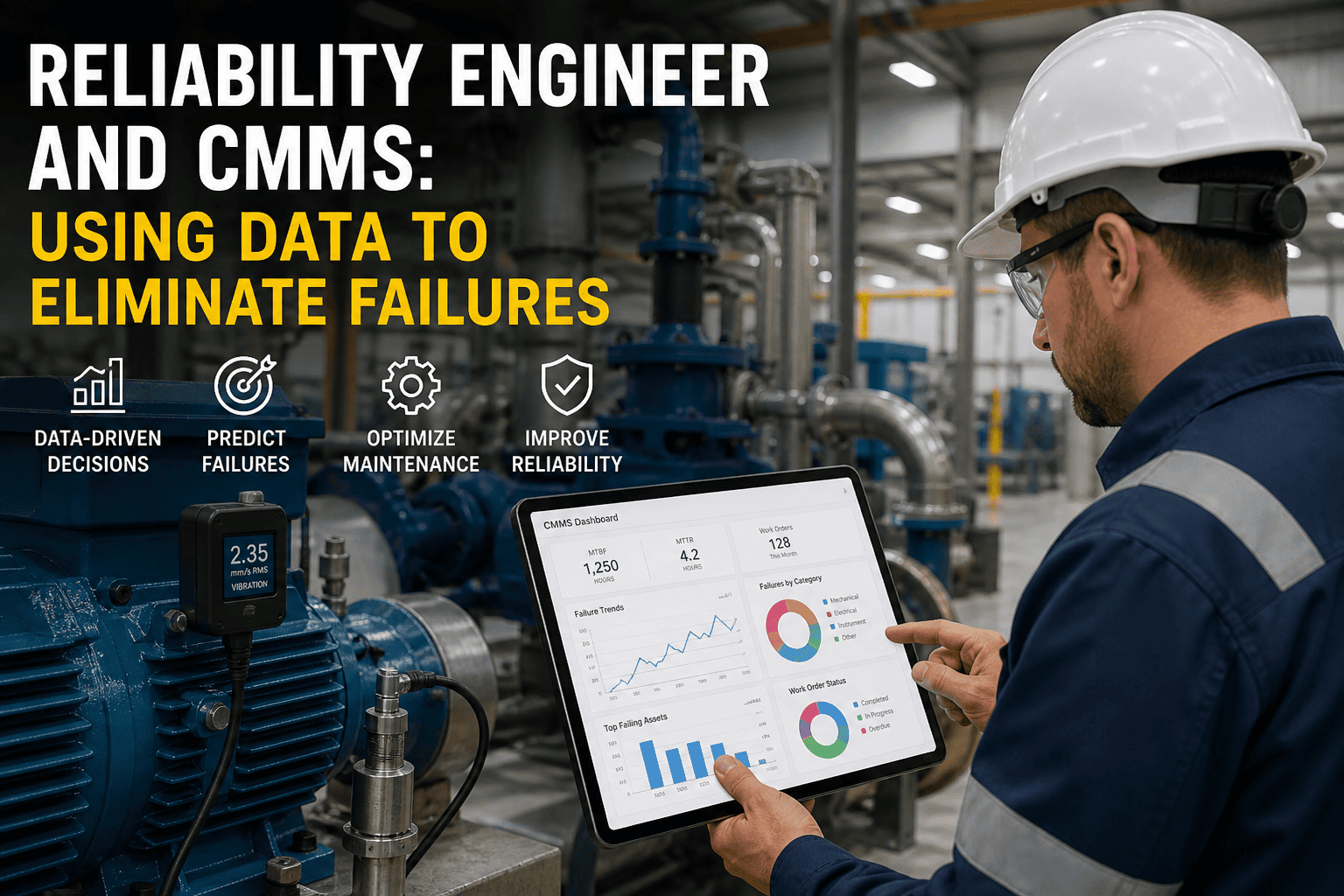
IoT and PLC sensor feeds analyze vibration, temperature, pressure, and runtime to flag anomalies that precede failure by days or weeks. When a bearing on a 12-year-old compressor starts showing abnormal vibration signature, Oxmaint auto-generates a work order before the compressor trips. Predictive maintenance module.
NVIDIA-powered cameras detect surface-level aging indicators — corrosion, cracks, thermal anomalies, seal degradation — at 99.2% accuracy. Visual deterioration that takes an inspector hours to survey is flagged automatically, 24/7. AI Vision Camera details.
Pull cumulative repair spend as a percentage of replacement value for any asset, any date range. When the ratio crosses the replacement threshold, Oxmaint flags it. Finance gets a data-backed case; maintenance gets approved CapEx. Analytics and reporting.
Run-to-fail vs proactive aging-asset management
| Decision point | Run-to-fail on aging assets | Proactive aging-asset management |
|---|---|---|
| Failure detection | After production stops | Weeks early via sensor + AI vision |
| Replacement timing | Emergency, highest-cost window | Planned, competitively quoted, scheduled |
| Risk visibility | Unknown until failure | Ranked risk score per asset, live |
| CapEx justification | Reactive, post-failure request | Data-backed, pre-approved budget line |
| Parts readiness | Emergency order, premium freight | Pre-staged, ordered at standard lead time |
| Compliance exposure | Age-triggered inspections missed | Auto-scheduled, audit-trail maintained |
| Maintenance cost trend | Escalating year over year | Declining as high-risk assets are addressed |
What proactive aging-asset management delivers
Teams that shift from reactive to proactive aging-asset management recover the platform cost within one prevented failure event — calculate your ROI here, or book a demo to see Oxmaint's risk scoring on your asset register.
Common questions about equipment age, reliability, and high-risk assets
At what age does equipment typically become high risk?
How do you measure equipment reliability as it ages?
When should you repair an aging asset versus replace it?
What is the best way to prioritize which aging assets to address first?
Know Which Assets Will Fail — Before They Do
Equipment age and reliability data has been sitting in your maintenance records for years. Oxmaint turns that history — plus live sensor feeds — into a ranked risk score for every asset in your facility, so the next replacement decision is backed by data, not by what happened to break last Tuesday.
- AI risk scoring: age, history, and condition combined into one number per asset
- 94% predictive accuracy — failure alerts weeks before breakdown
- Data-backed CapEx cases that get approved, not deferred
Trusted by teams managing 10,000+ aging assets across manufacturing, healthcare, and facilities · Live in days