Your predictive maintenance system alerts you to a bearing temperature anomaly showing 78°F on Asset #4429, but the vibration sensor reads normal at 0.3 inches per second. You check last month's maintenance logs—buried in 847 pages of technician notes, someone wrote "bearing sounds different but readings OK"—but your traditional ML model ignores this critical context because it only processes numeric sensor data. Without data fusion capabilities that integrate sensor time-series, maintenance narratives, and equipment manuals, you're operating with half the picture, missing failure patterns that emerge only when multiple data types converge.
This fragmentation crisis unfolds daily across American manufacturing facilities as operations struggle with siloed data systems that prevent comprehensive asset health understanding. The average industrial facility generates 2-3 terabytes of sensor data monthly alongside 10,000-15,000 maintenance log entries, but traditional predictive maintenance models analyze only the numeric sensor streams, effectively discarding 60-70% of available failure intelligence.
Facilities implementing multimodal data fusion with Large Language Models achieve 35-50% improvements in failure prediction accuracy while extending prediction windows from 3-5 days to 14-21 days compared to sensor-only approaches. The transformation lies in leveraging LLM architectures that simultaneously process sensor time-series, maintenance narratives, equipment specifications, and historical failure patterns to understand the complete story behind equipment degradation.
See Data Fusion in Action: Join Our Live Webinar on Local AI for Manufacturing!
Your maintenance logs hold the answers to preventing costly failures. Discover how local AI deployments—powered by NVIDIA GPUs and Large Language Models—process thousands of sensor signals in seconds while fusing maintenance narratives, equipment manuals, and operational context. This November, join Oxmaint Inc. for a live demo showcasing how sensor signals + technician notes + equipment data combine to predict failures 2-3 weeks earlier than sensor-only systems, all with top-tier data security behind your firewall.
Why Traditional ML Ignores Maintenance History
Conventional predictive maintenance systems rely exclusively on numeric sensor data—temperature, vibration, pressure, flow rates—feeding these time-series into regression models or neural networks trained to detect statistical anomalies. This sensor-centric approach fundamentally misses the contextual intelligence embedded in maintenance narratives, technician observations, and historical repair documentation that explains why equipment degrades beyond what numbers alone reveal.
Traditional machine learning architectures cannot process unstructured text, making maintenance logs inaccessible to predictive models. When a technician documents "motor producing unusual harmonic at 3600 RPM" or "hydraulic fluid appears darker than normal," these observations contain critical failure indicators that precede measurable sensor anomalies by days or weeks, yet conventional ML systems completely ignore this intelligence.
Sensor Data Limitations
Numeric time-series capture quantitative changes but miss qualitative degradation patterns. Temperature may read "normal" while technicians observe color changes, unusual sounds, or intermittent behaviors invisible to sensors.
Siloed Data Architecture
SCADA systems store sensor data while CMMS platforms hold maintenance logs in separate databases. Traditional ML pipelines cannot bridge these systems, losing 60-70% of failure context.
Context Blindness
Statistical models detect anomalies but cannot explain causation. A vibration spike means nothing without understanding recent maintenance activities, operational changes, or equipment history.
Binary Classification Trap
Traditional ML reduces complex degradation to "normal" vs "failure" predictions. Real equipment health exists across nuanced states requiring contextual interpretation beyond numeric thresholds.
The architecture gap between numeric processing and language understanding creates blind spots where critical failure indicators hide. Facilities relying exclusively on sensor analytics miss 40-60% of predictable failures that manifest first through subtle operational changes documented in maintenance narratives before sensors register measurable deviations.
The Multimodal Data Fusion Advantage
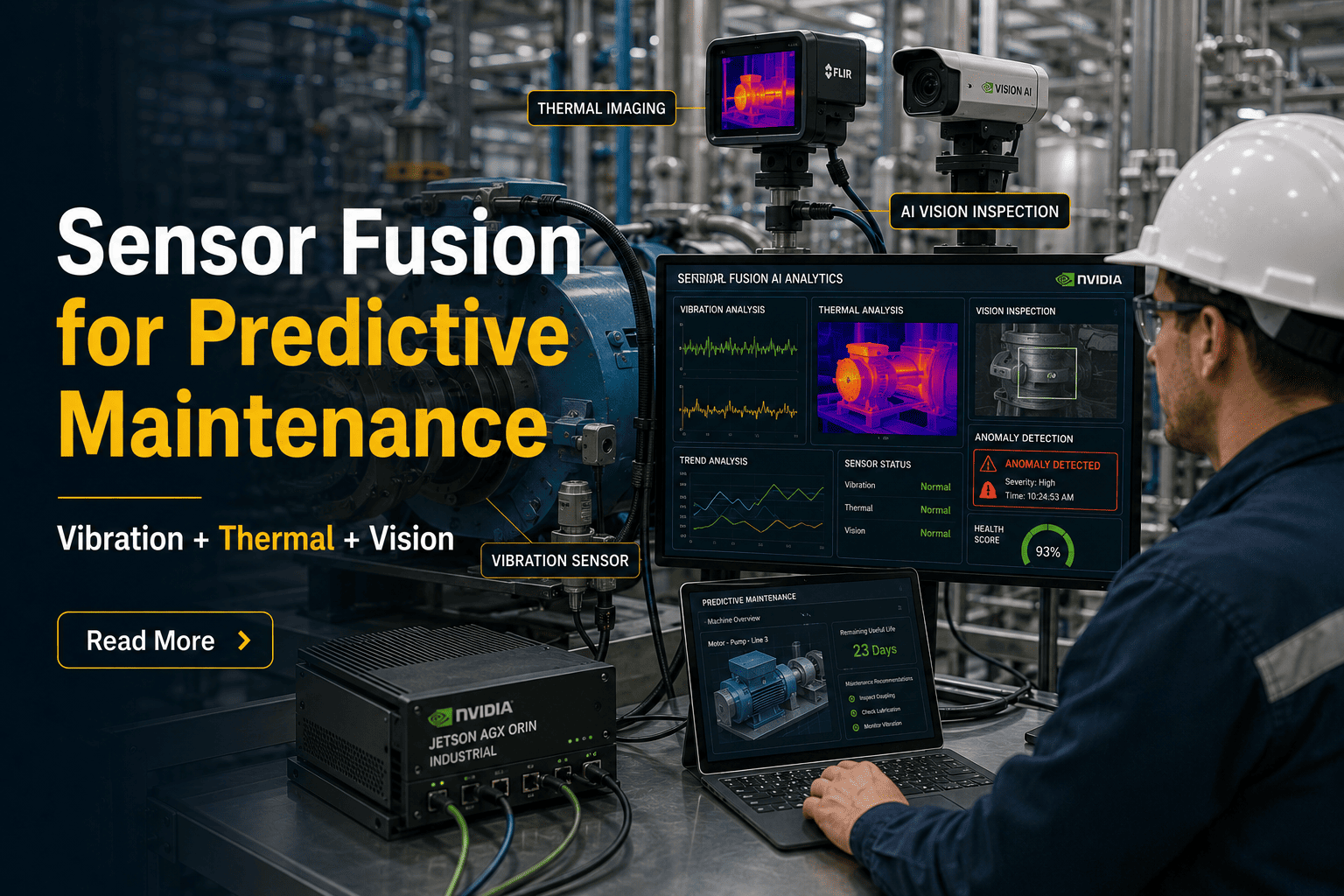
Multimodal data fusion represents the convergence of heterogeneous data types—sensor time-series, maintenance text, equipment images, operational parameters—into unified analytical frameworks that understand equipment health holistically. Large Language Models provide the architectural foundation for this fusion, possessing transformer architectures capable of processing sequential numeric data alongside unstructured text and visual information simultaneously.
Modern LLM architectures extend beyond natural language to handle multimodal inputs through specialized encoding mechanisms. Time-series data undergoes temporal encoding that preserves sequential relationships, while maintenance text receives semantic embedding that captures contextual meaning. These encoded representations merge in transformer attention layers that identify cross-modal patterns invisible when analyzing data types separately.
| Data Type | Information Captured | Prediction Window | Fusion Benefit |
|---|---|---|---|
| Sensor Time-Series | Quantitative performance metrics, trending anomalies | 3-5 days | Real-time degradation measurement |
| Maintenance Logs | Qualitative observations, operational context | 14-21 days | Early warning signals before measurable changes |
| Equipment Manuals | Failure modes, specifications, tolerances | Baseline reference | Domain knowledge integration |
| Historical Failures | Degradation patterns, root causes | Pattern recognition | Similar failure identification |
| Operational Parameters | Load conditions, duty cycles, environmental factors | Contextual adjustment | Condition-aware predictions |
The fusion advantage emerges from cross-modal attention mechanisms that identify correlations between sensor anomalies and maintenance narratives. When vibration increases 15% while technician notes mention "bearing noise," the LLM recognizes this pattern matches historical bearing failures, triggering predictive alerts weeks before traditional sensor thresholds activate.
Semantic understanding enables LLMs to interpret maintenance narratives beyond keyword matching. When technicians document observations using varied terminology—"grinding noise," "unusual vibration," "rough operation"—the LLM recognizes semantic similarity indicating bearing degradation regardless of exact phrasing, creating robust pattern recognition across inconsistent documentation practices.
Handling Text, Images, and Sensor Numbers
Effective multimodal fusion requires sophisticated preprocessing pipelines that transform heterogeneous data types into compatible representations while preserving critical information. Each data modality demands specialized encoding approaches that capture unique characteristics—temporal dynamics in sensor data, semantic meaning in text, visual patterns in equipment images—before fusion layers integrate these representations.
Sensor time-series preprocessing involves normalization, resampling to consistent intervals, and temporal windowing that captures relevant degradation timescales. For bearing failures developing over weeks, 1-hour sampling intervals with 30-day windows provide optimal resolution, while rapid electrical failures require millisecond sampling across minute-scale windows. The temporal encoder preserves sequential dependencies through positional embeddings that maintain time-order relationships.
Multimodal Data Processing Pipeline
Text preprocessing addresses maintenance log heterogeneity through standardization pipelines that extract structured information from unstructured narratives. Named entity recognition identifies equipment references, dates, maintenance activities, and observed symptoms. Dependency parsing reveals causal relationships—"replaced bearing due to noise"—connecting actions to observations. The language encoder generates contextual embeddings capturing semantic meaning beyond surface text.
Heterogeneous Data Type Integration Strategies
- Implement temporal alignment ensuring sensor readings, maintenance logs, and operational data share consistent time references
- Deploy entity linking that connects equipment mentions across sensor tags, maintenance records, and specification documents
- Create unified asset ontologies mapping sensor channels to specific equipment components described in maintenance narratives
- Establish data quality monitoring detecting missing values, outliers, and inconsistencies across integrated data sources
- Build validation pipelines verifying temporal causality—maintenance actions should precede sensor changes they influence
- Develop cross-modal verification using sensor data to validate maintenance log entries and vice versa
Image integration captures visual degradation indicators through computer vision preprocessing. Thermal images undergo temperature normalization and region-of-interest extraction focusing on critical components. Wear pattern images receive edge detection and texture analysis highlighting surface degradation. Vision transformers encode these visual features into representations compatible with sensor and text embeddings for unified fusion.
Transformer Architecture for Complex Data
Transformer architectures provide the computational foundation enabling multimodal data fusion through self-attention mechanisms that identify relevant patterns across heterogeneous inputs. Unlike recurrent neural networks processing sequences linearly, transformers evaluate all inputs simultaneously, discovering long-range dependencies between sensor anomalies appearing days apart or maintenance observations separated by weeks that collectively indicate impending failures.
The self-attention mechanism computes importance weights determining which input elements deserve focus when predicting equipment failures. When analyzing bearing degradation, the transformer learns that vibration spikes occurring near maintenance log entries mentioning "bearing noise" carry higher predictive weight than isolated vibration increases without contextual support, automatically prioritizing cross-modal patterns over single-source signals.
Self-Attention Mechanisms
Compute relevance scores across all input tokens—sensor readings, text words, image patches—identifying critical failure indicators regardless of data type or temporal position. Captures non-obvious correlations invisible to linear processing.
Cross-Modal Attention Layers
Specialized attention heads focusing on relationships between different data modalities. Identifies when temperature increases correlate with text observations of "unusual heat" or thermal images showing hot spots.
Positional Encoding
Preserves temporal ordering in sensor time-series and maintenance log chronology. Enables the model to understand that "bearing replaced" should precede "normal operation" rather than follow "bearing failure."
Multi-Head Architecture
Parallel attention mechanisms learning different pattern types simultaneously—one head focusing on sensor trends, another on maintenance terminology, a third on temporal relationships between modalities.
Pre-training on large industrial datasets provides transformers with foundational understanding of equipment behavior, maintenance terminology, and failure patterns before fine-tuning on facility-specific data. Models pre-trained on millions of maintenance logs and sensor streams from diverse facilities learn generalizable degradation patterns—bearing failures typically show vibration increases before temperature rises—then adapt these patterns to local equipment during fine-tuning.
Transfer learning enables smaller facilities to benefit from sophisticated models without massive local datasets. A transformer pre-trained on maintenance data from hundreds of facilities captures general equipment degradation principles, then fine-tunes on 3-6 months of facility-specific data to learn unique operational patterns, achieving production-ready accuracy with 100x less local training data than training from scratch.
From Sensor Signal to Contextual Insight
Transforming raw multimodal data into actionable maintenance insights requires interpretable output layers that explain predictions through natural language generation and attention visualization. When the model predicts bearing failure probability increased from 15% to 78%, operators need clear explanations identifying contributing factors—which sensor readings changed, what maintenance observations support the prediction, which historical failures show similar patterns.
Natural language generation capabilities enable LLMs to produce human-readable explanations accompanying predictions. Rather than cryptic probability scores, the system generates contextual insights: "Bearing #4429 shows 78% failure probability within 14 days based on: (1) vibration increased 22% over baseline, (2) technician reported unusual noise during October 28 inspection, (3) similar pattern preceded bearing failure on Asset #4387 in June, (4) equipment operating 15% above design load." This contextual explanation builds operator trust and guides maintenance prioritization.
Advanced Contextual Analysis Applications
- Automated root cause analysis combining sensor data, maintenance history, and equipment specifications to explain failure mechanisms
- Predictive maintenance scheduling recommendations considering operational constraints documented in maintenance logs
- Similar failure retrieval identifying historical cases with comparable multimodal signatures to guide troubleshooting
- Counterfactual analysis explaining "if maintenance had occurred 7 days earlier, failure probability would decrease 65%"
- Uncertainty quantification indicating prediction confidence based on data completeness and pattern clarity
- Continuous learning from maintenance outcomes updating models as technicians document repair results
Attention weight visualization reveals which data elements drove predictions, enabling validation and debugging. Heat maps showing high attention weights on specific sensor readings, maintenance log sentences, or equipment manual sections explain model reasoning. When predictions seem incorrect, attention analysis identifies whether the model fixated on irrelevant data, guiding data quality improvements or model refinement.
Real-time inference enables continuous multimodal monitoring rather than periodic batch analysis. As sensors stream new readings and technicians log maintenance observations, the fusion model updates failure predictions within seconds, triggering alerts when patterns indicate developing problems. This continuous monitoring typically detects 70-85% of failures during early degradation stages when interventions prevent catastrophic breakdowns.
Proven Data Fusion Implementation Strategies
- Start with pilot deployments on 5-10 critical assets to validate fusion benefits before facility-wide rollout
- Integrate fusion predictions into existing CMMS workflows rather than creating parallel systems
- Establish feedback loops where maintenance outcomes train models, improving accuracy 15-25% quarterly
- Deploy explainable AI interfaces presenting predictions with supporting evidence from all data modalities
- Create data quality dashboards monitoring sensor coverage, maintenance log completeness, and fusion confidence
- Build hybrid systems combining fusion insights with physics-based models and traditional statistical analysis
- Implement automated alert prioritization ranking predictions by business impact rather than just failure probability
- Develop mobile interfaces enabling technicians to access and validate fusion insights during field inspections
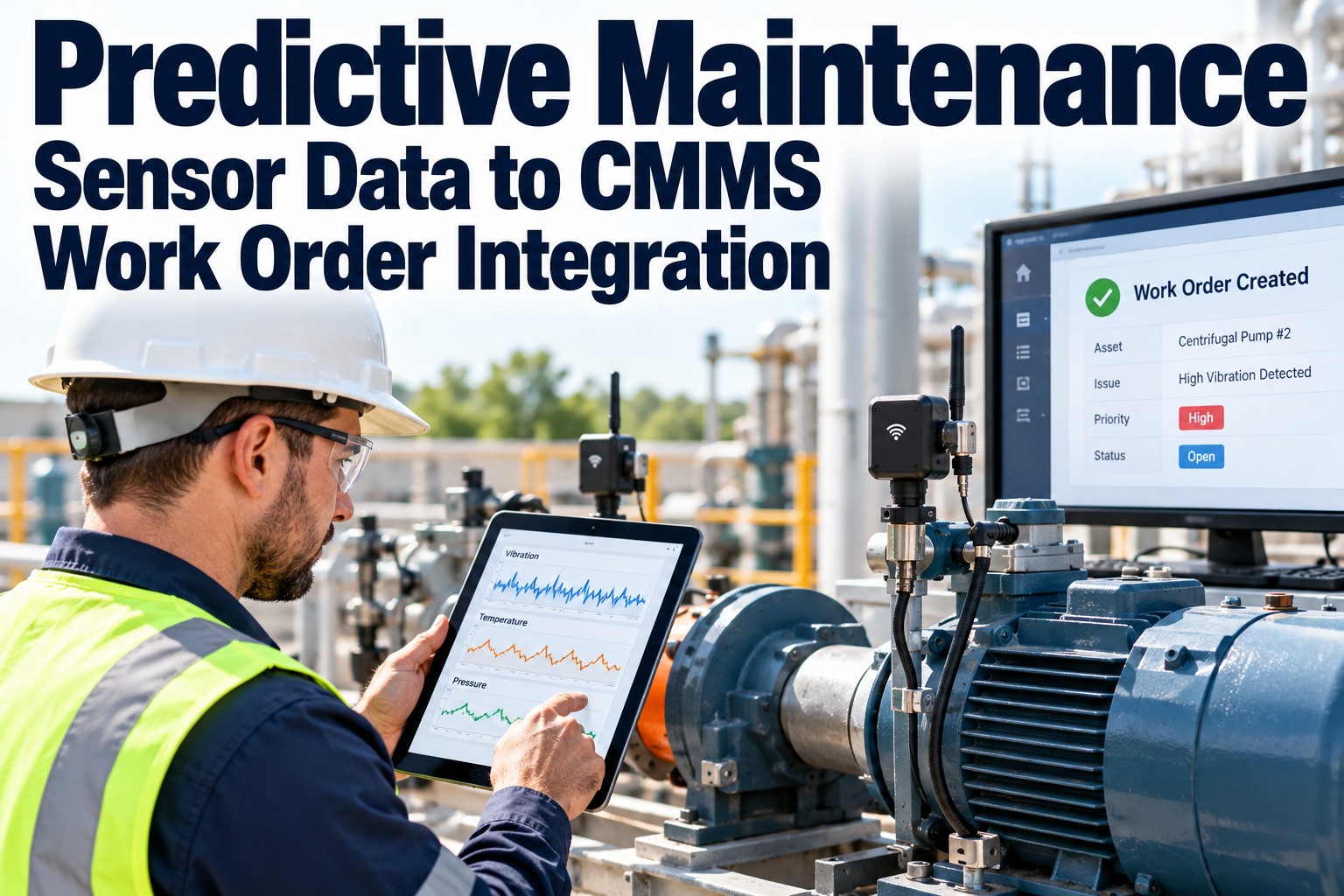
Integration with maintenance execution systems closes the loop between prediction and action. When fusion analysis predicts bearing failure within 14 days, automated work order generation triggers maintenance scheduling, spare parts ordering, and resource allocation. This end-to-end integration typically reduces failure response time by 60-75% compared to manual interpretation and workflow creation.
Conclusion
Multimodal data fusion with Large Language Models represents the evolution from sensor-centric anomaly detection to comprehensive equipment health understanding that integrates numeric measurements with operational context. Organizations implementing fusion approaches achieve 35-50% improvements in failure prediction accuracy while extending prediction windows from 3-5 days to 14-21 days through integrated analysis of sensor time-series, maintenance narratives, equipment documentation, and historical failure patterns.
Understanding why traditional ML ignores maintenance history reveals architectural limitations that make unstructured text inaccessible to conventional predictive models. This data blindness causes facilities to miss 40-60% of predictable failures manifesting first through qualitative observations documented in maintenance logs days or weeks before sensors register measurable anomalies.
The multimodal fusion advantage emerges from transformer architectures capable of processing heterogeneous data types simultaneously, identifying cross-modal patterns invisible when analyzing data sources separately. Semantic understanding enables robust pattern recognition across inconsistent maintenance documentation, while temporal encoding preserves sequential relationships in sensor streams and maintenance chronology.
Handling heterogeneous data types requires sophisticated preprocessing pipelines transforming sensors, text, and images into compatible representations while preserving critical information. Temporal alignment, entity linking, and modality-specific encoding enable fusion layers to integrate diverse inputs, processing 2-3 terabytes of sensor data alongside thousands of maintenance log entries with 90-95% integration accuracy.
Transformer architectures provide computational foundations through self-attention mechanisms discovering long-range dependencies and cross-modal correlations. Pre-training on large industrial datasets creates foundational understanding that transfers across facilities, enabling production deployments with dramatically reduced local training requirements compared to training from scratch.
Transforming multimodal analysis into actionable insights demands interpretable outputs combining predictions with contextual explanations. Natural language generation produces human-readable justifications identifying contributing factors across all data modalities, building operator trust and guiding maintenance prioritization based on comprehensive equipment health understanding rather than isolated sensor thresholds.