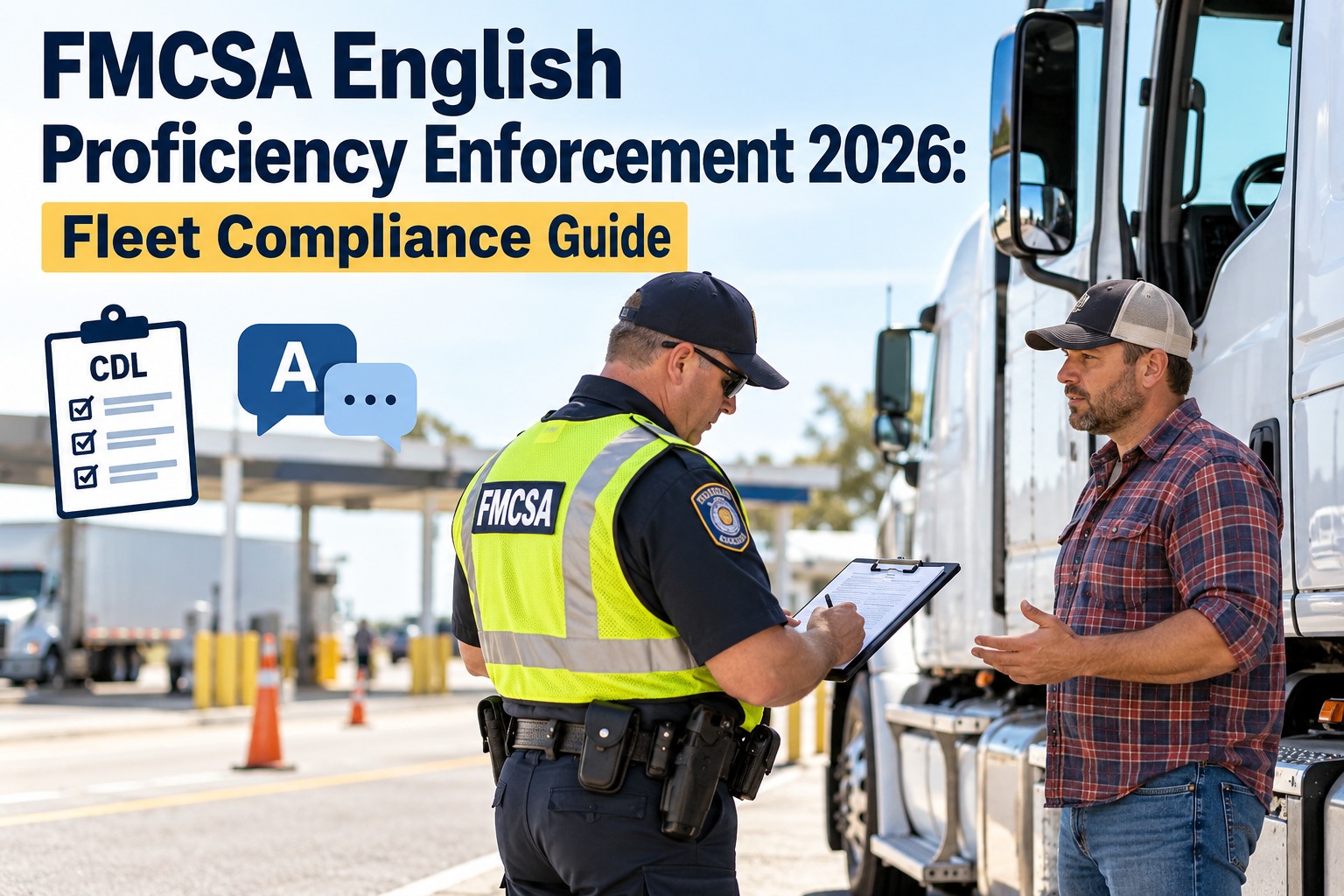
For the first time in years, a commercial driver who can't demonstrate English proficiency at the roadside can be placed out of service on the spot. As of June 25, 2025, non-compliance with the long-standing English rule in 9 CFR 391.11(b)(2)is once again an out-of-service violation — and enforcement is active nationwide heading into 2026. For fleet managers, this turns a paper requirement into an operational risk: a stopped load, a sidelined driver, and a mark on your safety record. This guide breaks down what changed, how inspectors test proficiency at the roadside, what an out-of-service order means, and the compliance steps that keep your drivers rolling. Digitize the driver-qualification and inspection records behind all of it with OXMAINT AI.
Fleet Compliance · FMCSA Enforcement · 2026
FMCSA English Proficiency Enforcement 2026: Fleet Compliance Guide
English Language Proficiency is now an out-of-service violation — a driver who fails the roadside assessment is parked until compliance is shown, and the record you kept beforehand is the only defense. OXMAINT AI keeps that record in one place: driver-qualification files, ELP assessment documentation and inspection history, tied to each driver and ready for an audit or a roadside challenge.
Jun 25, 2025
ELP non-compliance became an out-of-service driver violation
391.11(b)(2)
the federal standard now enforced at the roadside
2 steps
the roadside assessment: driver interview, then sign recognition
Out of service
a failed driver is sidelined until proficiency is demonstrated
How We Got Here: The Enforcement Timeline
The English requirement itself isn't new — it's been in the regulations for decades. What changed in 2025 is the consequence: FMCSA and the CVSA restored English Language Proficiency to the out-of-service criteria, so failing it now stops the driver, not just flags a note.
Start free and get your driver records audit-ready in OXMAINT AI.
Apr 28, 2025
Executive order issued directing FMCSA to strengthen ELP enforcement and move toward out-of-service treatment.
May 1, 2025
CVSA board votes under an emergency provision to add ELP non-compliance to the North American Out-of-Service Criteria.
May 2025
FMCSA issues guidance setting out how inspectors assess proficiency at the roadside, later revised in 2026.
Jun 25, 2025
Enforcement begins. ELP non-compliance is now an out-of-service driver violation — active nationwide.
Apr 1, 2026
Printed criteria updated. The published out-of-service handbook reflects the change — though enforcement has been live since mid-2025.
Dates reflect the public rulemaking and CVSA announcements. Always verify current requirements against the latest FMCSA guidance and your state enforcement agency — this guide is informational, not legal advice.
The Standard: What 391.11(b)(2) Actually Requires
The rule sets a four-part bar. A driver must read and speak English well enough to do each of the following — and the roadside assessment is built directly around them.
Book a walkthrough to see how OXMAINT AI documents driver qualification.
01
Converse With the Public
Read and speak English well enough to communicate with the general public during the course of the job.
02
Understand Traffic Signs
Understand highway traffic signs and signals in English — the basis of the second roadside step.
03
Respond to Official Inquiries
Answer questions from an officer about routes, hours, licensing, cargo and equipment — without an interpreter.
04
Make Entries on Records
Complete reports and records in English — logs, inspection reports and shipping documents.
At the Roadside: The Two-Step Assessment
Guidance describes a two-step check. A driver who can't complete Step 1 doesn't proceed — and notably, interpreters, smartphone translation apps and cue cards are not permitted during the assessment.
Start free and keep every driver's inspection record in OXMAINT AI.
Step 1
Driver Interview
The inspector asks job-related questions — route, hours of service, license, shipping papers, vehicle equipment — in English. The driver must respond without translation aids. This gauges the ability to converse and respond to official inquiries.
↓
Step 2
Highway Sign Recognition
Drivers who clear Step 1 are asked to identify and explain U.S. highway signs, including text-based and symbol signs from the MUTCD. This confirms the driver can understand traffic signs and signals in English.
The exact conduct of the assessment is set by FMCSA guidance and applied by individual inspectors. Treat this as the general shape of the check, not a verbatim script — confirm specifics against current federal guidance.
A Roadside Failure Is a Stopped Load. The Defense Is Documentation.
When an inspector questions a driver's qualification, the record you kept before the stop is what protects the load and the driver. OXMAINT AI holds DQ files, ELP assessment notes and inspection history in one place — tied to the driver, ready to produce.
What an Out-of-Service Order Actually Costs
An out-of-service order isn't a warning — it's an immediate stop. Understanding the ripple effect is what makes the case for getting ahead of it.
Book a walkthrough to protect your fleet's compliance record.
The Driver Is Parked
The driver can't operate a commercial vehicle until proficiency is demonstrated — the stop is immediate, wherever it happens.
The Load Is Stranded
A sidelined driver means a delayed or stranded shipment, recovery logistics, and a missed delivery commitment.
Your Safety Record Takes It
An out-of-service violation lands on the carrier's inspection history — the data that shapes your safety profile and scrutiny.
The Cost Compounds
Recovery, reassignment, reassessment and the administrative follow-up all stack on top of the lost trip.
Your Fleet Compliance Checklist
Enforcement rewards fleets that prepared before the stop, not after. These are the moves that keep drivers qualified and give you the documentation to stand behind them.
Start free and build this checklist into OXMAINT AI.
1
Audit your driver-qualification files. Confirm every interstate CDL driver's DQ file reflects the 391.11(b)(2) standard and is current.
2
Run a consistent, job-related ELP assessment. Use a standardized, documented check at hiring and on a schedule — not an ad-hoc judgment call.
3
Train recruiters and evaluators. Everyone assessing proficiency should apply the same protocol, the same way, every time.
4
Prepare drivers for the real scenario. Practice roadside-style questions and U.S. sign recognition so the assessment holds no surprises.
5
Document everything. Keep qualification, assessment and training records tied to each driver, retrievable on demand.
6
Keep records roadside-ready. Store inspection and DQ history where it can be produced fast, not buried in a filing cabinet.
Frequently Asked Questions
Is the English proficiency requirement actually new?
No — the standard in 49 CFR 391.11(b)(2) has existed for decades. What changed on June 25, 2025 is that non-compliance became an out-of-service violation, so a failed roadside assessment now sidelines the driver rather than just noting a deficiency.
Start free and get your DQ files current in OXMAINT AI.
Can a driver use a translation app during the assessment?
No. Per FMCSA guidance, interpreters, smartphone translation apps and cue cards are not permitted during the roadside assessment — the driver must respond in English on their own. Preparing drivers for that reality is the point of a standardized internal check.
Book a walkthrough of OXMAINT AI's driver records.
What happens to the load if my driver is placed out of service?
The driver can't operate until proficiency is demonstrated, which typically means the load is delayed or stranded while you arrange recovery or a replacement driver — plus the violation on your inspection history. Getting ahead of it is far cheaper than the stop.
Start free and keep inspection records ready in OXMAINT AI.
How should a fleet document ELP compliance?
Keep a standardized, job-related assessment on file for each interstate driver, tied to their qualification record, plus any training. If a roadside stop is ever challenged, that documentation is your evidence the driver was properly qualified.
Book a walkthrough to set this up in OXMAINT AI.
Does this apply to all commercial drivers?
The 391.11 requirements apply to interstate CMV drivers subject to the federal driver-qualification rules. Because enforcement details and intrastate rules can vary, confirm your specific obligations against current FMCSA guidance and your state agency.
Start free and organize driver qualification in OXMAINT AI.
Keep Your Drivers Qualified — and Your Records Ready.
Enforcement is live and out-of-service is real. Build standardized ELP assessment, driver qualification and inspection history into one place with OXMAINT AI, so a roadside stop meets documentation, not scramble.