A coal pulverizer mill running with worn grinding rolls drops coal fineness from the design 75% passing 200-mesh down to 55–60% — and the consequences cascade through the entire boiler island. Unburned carbon in fly ash climbs from 3% to 8%, NOx emissions spike, superheater fouling accelerates, and the unit derates 30–60 MW until the next outage window allows roll replacement. Yet most thermal plants still manage their pulverizer maintenance through paper logs, calendar-based PMs, and reactive replacements that ignore wear-rate data sitting unread in inspection notebooks. Start a free trial to digitize roll wear measurements, gearbox oil trends, and classifier vane data across every mill in your fleet — auto-generating work orders the moment thickness or wear-rate thresholds breach minimum allowable values. Coal pulverizer mill maintenance management replaces guesswork with structured data: per-mill asset histories, hardfacing campaign tracking, fineness sampling correlated to roll service hours, lube oil particle counts triggering condition-based oil changes, and outage scope built from real wear data rather than time-based assumptions.
Power Generation · Coal Pulverizers · Mill Maintenance
Coal Pulverizer Mill Maintenance Management for Thermal Power Plants
Pulverizer rolls and tables wear out in 8,000–18,000 service hours depending on coal abrasiveness — and every percentage point of fineness loss drives unburned carbon, NOx, and slagging penalties that cost a 500MW unit $1.8M–$3.2M annually. OxMaint structures every wear measurement, oil sample, and fineness test into mill-level asset histories that drive condition-based hardfacing, classifier rebuilds, and gearbox overhauls.
75%
Design fineness target — 200-mesh passing
$1.8M+
Annual heat-rate loss per 500MW unit from poor mill performance
1–2%
Of total plant power consumed by pulverizer mills
The Mill at the Heart of the Plant
Why Pulverizer Maintenance Defines Plant Heat Rate
A typical 500MW coal-fired unit operates 4–6 vertical roller mills (Babcock & Wilcox MPS, CE/Alstom Raymond Bowl, Foster Wheeler MB, or Riley Atrita designs), each grinding 60–100 tons of coal per hour to a fineness specification that determines how completely that coal will burn in the furnace. The grinding elements — three rollers and a rotating bowl, or hammers and races depending on mill type — operate under hydraulic loading of 50,000–150,000 lbs and abrade against coal particles for thousands of hours before requiring hardfacing or replacement.
The economics are unforgiving. A mill running 5 percentage points below design fineness drives unburned carbon up by 3–5 percentage points, costs 0.4–0.8% in boiler efficiency, and forces a 20–40 MW load derate to keep emissions within compliance. Across a fleet of 6 mills with 2 underperforming, the annualized cost of deferred grinding-element maintenance routinely exceeds $2M before any consideration of forced outages from gearbox failure, classifier blockage, or mill fires. Book a demo to see how OxMaint tracks every grinding-element wear measurement, fineness test result, and gearbox oil sample on a per-mill basis — surfacing the underperformer in your fleet before it costs another $400K in heat rate.
Wear Progression Visualization
The Lifecycle of a Pulverizer Grinding Roll
Roll wear follows a predictable curve, but the rate depends on coal abrasiveness (HGI value), mill loading, and the quality of the last hardfacing campaign. Tracking thickness measurements at consistent inspection points — taken each minor outage — converts mill maintenance from calendar-based replacements to data-driven rebuild scheduling.
100%
New / Hardfaced
0 hrs
Roll profile matches OEM specification. Coal fineness consistently above 75% passing 200-mesh at design throughput.
80%
Initial Wear
3,000–5,000 hrs
Surface texture worn smooth. Fineness still on target but rejects ratio increasing. Begin monthly thickness tracking.
60%
Active Wear
7,000–10,000 hrs
Profile flattened. Differential pressure climbing. Fineness drops 2–4 points. Plan hardfacing campaign for next outage.
35%
Critical Wear
12,000–15,000 hrs
Fineness 5–8 points below target. Unburned carbon climbing. Forced derate required if outage cannot be scheduled within 30 days.
15%
Replacement Required
16,000–18,000 hrs
Hub damage risk if operation continues. Vibration climbing. Mill must be removed from service for grinding-element replacement.
Remaining Roll Material
Replacement Threshold
Pulverizer Failure Mode Matrix
The Eight Failure Modes That Drive Mill Forced Outages
Pulverizer failures are not random. Each failure mode has a measurable precursor — a thickness reading, a vibration trend, an oil particle count, a differential pressure climb — that an organized maintenance program detects weeks before the failure occurs. Mills that operate without structured tracking discover these precursors only at autopsy.
01
Grinding Roll Wear-Through
Precursor: Thickness loss rate climbing >0.05 mm per 100 hours; coal fineness drop >4 points; rejects ratio doubling.
Impact: Unburned carbon spike, derate of 20–40 MW, NOx compliance risk, accelerated hub damage if missed.
02
Grinding Table Erosion
Precursor: Mill differential pressure rising at constant load; primary air flow imbalance between mills; vibration pattern change.
Impact: 1–2 weeks downtime for table resurfacing or replacement; $80K–$220K hardfacing campaign per mill.
03
Gearbox Bearing Failure
Precursor: Oil particle count above ISO 19/17/14; iron and chromium wear metals climbing; bearing temperature drift >5°C.
Impact: Catastrophic gear damage if missed; gearbox rebuild $400K–$900K; mill out of service 3–6 weeks.
04
Classifier Vane Erosion
Precursor: Coarse coal particles in fineness samples despite vane angle correction; rejects ratio inverted; mill amperage falling at constant load.
Impact: Persistent fineness deficit even after fresh hardfacing; 8–14 day classifier rebuild outage required.
05
Mill Fire / Pulverized Coal Ignition
Precursor: Mill outlet temperature drift above 85°C; CO climbing in mill exhaust; coal residue accumulation in dead zones.
Impact: Inerting required, regulatory incident report, 24–72 hour shutdown, refractory and seal damage common.
06
Hydraulic Loading System Failure
Precursor: Hydraulic accumulator pressure drift; cylinder leak-by detected during load test; loading pressure required to hold setpoint climbing.
Impact: Inability to maintain grinding pressure; coal fineness collapse; mill trip and forced derate.
07
Coal Feeder Discharge Wear
Precursor: Feeder weighbelt drift versus boiler heat balance; coal flow oscillation at constant set point; physical inspection finds chute holing.
Impact: Coal mass flow inaccuracy, combustion imbalance between burners, FEGT excursions, plant trip risk.
08
Lube Oil System Contamination
Precursor: Particle counts climbing past ISO 22/20/17; water contamination >500 ppm; viscosity shift outside ±10% of new oil specification.
Impact: Accelerated bearing and gear wear, oil change required ahead of schedule, potential $100K+ in collateral component damage.
Why Manual Mill Tracking Fails
Six Symptoms of an Unstructured Pulverizer Maintenance Program
Plants without structured pulverizer tracking share a recognizable set of operational symptoms — each one driven by data that exists somewhere in the plant but never reaches the people making maintenance decisions. The cost is not in the missing data; it is in the decisions that get made without it.
⚠
Roll thickness measurements live in inspection notebooks, not in trends
Inspectors record thickness readings during each minor outage, but the data sits in handwritten logbooks or scattered spreadsheets. Nobody calculates wear rate per 1,000 hours, projects remaining life, or schedules hardfacing campaigns based on real degradation curves. Replacement decisions get made on calendar intervals or after fineness has already collapsed.
⚠
Fineness samples are collected but never correlated to roll hours
Coal lab pulls 200-mesh samples weekly, but the results are filed without tying them to specific mill IDs and service hours since last hardfacing. The fleet-wide pattern that would reveal which mill is degrading fastest — and why — never emerges from the data.
⚠
Gearbox oil samples come back from the lab and get filed
Oil analysis reports flag rising particle counts or wear metals, but the alerts go to an email inbox that nobody owns. A bearing failure that cost $600K in gearbox rebuild was visible in oil samples 8 weeks earlier — but no work order ever got created from those samples.
⚠
Hardfacing campaigns happen at the same interval regardless of coal type
⚠
Outage mill scope is decided on hunches, not data
When the planned outage approaches, the maintenance manager picks which mills to tear down based on memory of recent issues. Mills with hidden critical wear get skipped because they have not raised alarms; mills with cosmetic wear get teardowns they did not need. Outage budget gets spent in the wrong places.
⚠
No history of which hardfacing alloy lasted longest in which mill
Different vendors quote different alloy chemistries — chromium carbide, complex carbide, weld overlay — but the plant has no record of which alloy delivered which service life on which mill burning which coal. Procurement defaults to the cheapest quote because there is no data to defend a more expensive choice.
OxMaint Solution Architecture
How OxMaint Structures Pulverizer Maintenance Across the Fleet
OxMaint treats every pulverizer mill as a parent asset with hierarchical child assets — grinding rolls, table, classifier, gearbox, hydraulic system, lube oil skid, coal feeder. Every measurement, work order, oil sample, and outage activity attaches to the correct child asset, building a per-mill history that drives condition-based scope decisions for every future outage cycle.
A
Grinding Element Wear Tracking
Every roll thickness measurement logged at the same six inspection points each minor outage. OxMaint calculates wear rate per 1,000 hours, projects remaining life against minimum allowable thickness, and generates a corrective work order when projected life falls below the next planned outage interval. Coal source changes annotate the wear curve so plant engineers see exactly when fuel-driven abrasiveness shifted the rate.
B
Fineness and Performance Correlation
200-mesh sieve results, mill differential pressure, primary air temperature, classifier amperage, and rejects ratio all logged against mill ID and service hours. Fleet-wide views reveal the underperformer in seconds — the mill running 4 points below the rest at equivalent service life is the one that needs investigation, not the one that happens to be next on the calendar.
C
Lube Oil and Wear Metal Workflow
Lab oil analysis reports import directly into OxMaint and post against the gearbox asset. ISO particle count alarms, wear metal trend breaches, water contamination events, and TAN drift all auto-generate corrective work orders with the lab report attached. The 8-week early warning that used to die in an unread email inbox now drives a planned bearing inspection during the next short outage.
D
Hardfacing Campaign History
Every hardfacing campaign logs vendor, alloy chemistry, deposit thickness, weld procedure, and post-campaign hours-to-next-rebuild. After two campaigns, the data shows which alloy actually delivered the longest service life on each mill burning each coal source — converting procurement from a price decision to a total-cost-of-ownership decision backed by years of plant-specific evidence.
E
Outage Scope Auto-Builder
As the next planned outage approaches, OxMaint auto-builds the recommended mill scope from real data — projected remaining life on grinding elements, oil analysis trends on each gearbox, classifier amperage histories, hydraulic system inspection findings. Maintenance leadership reviews and adjusts a data-built recommendation rather than constructing scope from memory and hunches.
F
Mobile Inspection Capture
Mill Overhaul Roadmap
Three-Phase Pulverizer Overhaul Workflow in OxMaint
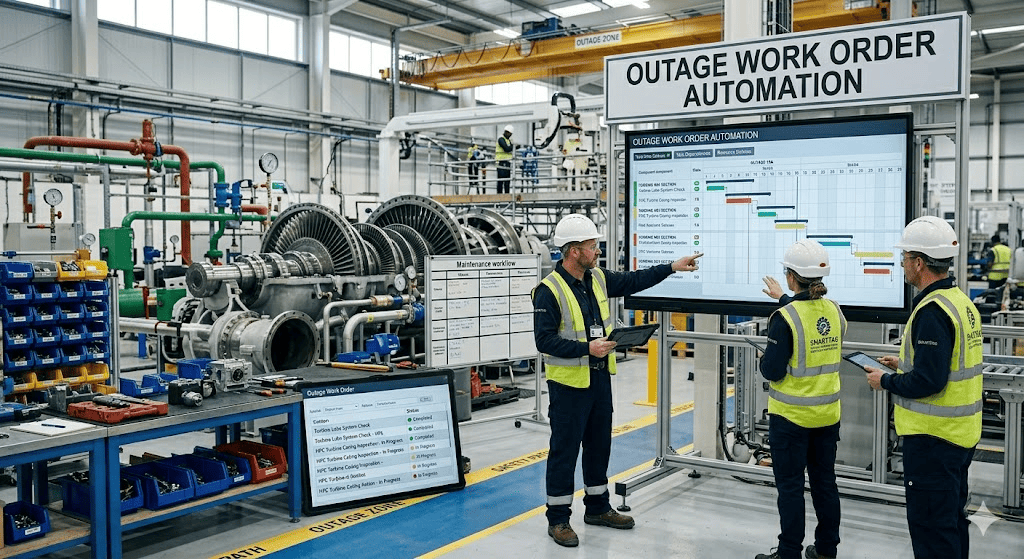
A typical mid-life pulverizer overhaul spans 7–14 days and involves 35–60 individual work orders. OxMaint breaks the overhaul into three managed phases, each with its own checkpoints, permit requirements, and quality gates — so nothing falls between cracks during the compressed outage window.
Pre-Outage Preparation
Window: 6–8 weeks before outage
OxMaint generates the mill scope from accumulated wear data, oil analysis trends, and inspection findings. Procurement work orders auto-create for grinding elements, classifier wear plates, gearbox seals, and hydraulic seals. Hardfacing vendor selected against documented alloy performance history. All confined-space entry permits, lockout-tagout procedures, and rigging plans pre-built and digitally signed.
Tear-Down and Inspection
Window: Days 1–4 of outage
Mill isolated, inerted, and cooled per OEM procedure. Mobile inspection workflow captures thickness measurements at standard inspection points on rolls, table, classifier vanes, and journal liners. Findings auto-generate corrective work orders within 60 seconds — including photos, measurements, and recommended action codes. Gearbox internal inspection logs against the gearbox asset history, with bearing condition photographs attached.
Repair, Hardfacing, and Reassembly
Window: Days 5–12 of outage
Hardfacing campaign executed with vendor, alloy, deposit thickness, and weld procedure all logged against the mill record. Classifier rebuild, hydraulic seal replacement, and gearbox reassembly close out individual work orders with QA hold points captured. Final reassembly logs torque values, gap measurements, and clearance checks. Post-startup performance test captures fineness, mill amperage, and differential pressure to establish the new baseline against which the next wear cycle will be measured.
Performance Comparison
Manual Pulverizer Maintenance vs OxMaint-Managed Programs
The shift from notebook-based mill tracking to structured asset histories transforms outage scope accuracy, hardfacing economics, and forced outage risk. The data below reflects benchmarks from coal-fired plants implementing structured pulverizer maintenance management against their previous unstructured baseline.
| Pulverizer Maintenance Practice |
Manual Tracking (Baseline) |
OxMaint-Managed Program |
| Roll Wear Measurement Tracking |
Logged in handwritten notebooks per outage; no fleet-wide wear-rate calculation; replacement timing based on calendar |
Per-mill thickness trends with wear rate per 1,000 hours; remaining-life projection against minimum allowable thickness; condition-based replacement |
| Fineness Sample Correlation |
Coal lab samples filed weekly; no correlation to mill service hours or hardfacing campaign date |
Fineness, differential pressure, and rejects ratio all logged per mill ID with service hours since last hardfacing — fleet underperformer surfaces immediately |
| Gearbox Oil Analysis Response |
Lab reports emailed to inbox without owner; particle count alarms and wear metal trends frequently missed; bearing failures arrive without warning |
Lab reports import directly to gearbox asset; threshold breaches auto-generate corrective work orders; 6–8 week early warning converts catastrophic failure to planned bearing inspection |
| Hardfacing Vendor Selection |
Default to cheapest quote because no data exists on which alloy lasted longest in which mill on which coal source |
Multi-year history of vendor, alloy chemistry, and post-campaign service life informs total-cost-of-ownership decisions backed by plant-specific evidence |
| Outage Mill Scope Decisions |
Constructed from memory and recent issues; mills with hidden critical wear get skipped; mills with cosmetic wear get unneeded teardowns |
Auto-built from accumulated wear, oil, and performance data; maintenance leadership reviews and adjusts a data-driven recommendation rather than building from scratch |
| Coal Source Change Response |
Hardfacing intervals stay fixed even when fuel switches drive abrasiveness up 50–100%; rolls run past economic replacement point |
Coal source changes annotate wear curves; intervals tighten automatically when actual wear rate climbs; hub damage from over-run avoided |
| Inspection Documentation |
Handwritten logbooks; missing measurements common; no audit trail for regulatory or internal reliability reviews |
Mobile capture with timestamp, inspector ID, mill ID, instrument calibration record; photos and measurements synced offline-capable; complete audit trail |
| Forced Outage Rate from Mill Causes |
2–4 forced outages per year typical from gearbox failure, classifier blockage, hydraulic loading failure, mill fire |
0–1 forced outages per year as condition-based maintenance converts unplanned events into scheduled work during planned windows |
Measurable Impact
What Plants See After 12 Months of Structured Mill Management
The financial case for structured pulverizer management is built from heat rate recovery, hardfacing economics, forced outage avoidance, and gearbox failure prevention. Each component is measurable on a per-mill basis, and the cumulative impact on a typical 4–6 mill installation routinely exceeds $1.5M in the first year.
3–5 pts
Coal Fineness Recovery
Catching wear before it collapses fineness — not after the unit has already derated
25–40%
Reduction in Forced Outages from Mill Causes
Oil analysis early warning, hydraulic system trending, and classifier monitoring convert unplanned events to planned work
15–25%
Hardfacing Campaign Cost Reduction
Data-backed alloy selection delivers longer service life per dollar spent — measured across multiple campaigns per mill
$400K–$900K
Avoided Per Catastrophic Gearbox Failure
Oil analysis particle count and wear metal trending detects bearing degradation 6–8 weeks before catastrophic failure
0.4–0.8%
Boiler Efficiency Gain
From restored coal fineness, reduced unburned carbon, and stabilized combustion across the burner deck
$1.5M+
Year-One Net Benefit, 4–6 Mill Plant
Combined heat rate recovery, hardfacing economics, and forced outage avoidance — independent of plant capacity factor
Common Questions
Coal Pulverizer Maintenance Management FAQ
Does OxMaint support all major pulverizer designs — Babcock & Wilcox MPS, CE Raymond, Foster Wheeler, Riley Atrita?
Yes. OxMaint is mill-design agnostic — the asset hierarchy (mill, grinding elements, table, classifier, gearbox, hydraulic system, lube skid, coal feeder) accommodates vertical roller mills, ball-and-race mills, and bowl mills equally. Inspection point templates, thickness measurement locations, and recommended PM intervals can be configured per design family and saved as fleet templates. Coal feeder and burner-line equipment downstream of the mill also live in the same asset hierarchy so mill performance can be correlated against the burner deck.
Start a free trial and configure your specific mill design — the template library accelerates setup for the most common pulverizer types.
How does OxMaint integrate lab oil analysis reports from external testing services?
OxMaint accepts oil analysis results via direct lab integrations (CSV/JSON imports from major labs like POLARIS, Bureau Veritas, ALS Tribology) or manual entry from PDF reports. Each result posts against the gearbox asset with date, sample point, and lab reference number. Threshold alarms — ISO particle count, wear metals, water contamination, viscosity drift, TAN — auto-generate corrective work orders with the lab report attached. The 6–8 week early warning that catastrophic gearbox failures provide in oil samples becomes an actionable maintenance event rather than a number filed in an inbox.
Can OxMaint capture the relationship between coal source changes and accelerated mill wear?
Yes. Coal source changes log as events on the mill timeline alongside fineness samples, wear measurements, and hardfacing campaigns. When wear rate accelerates, the operating engineer sees immediately whether the change correlates with a fuel switch — Powder River Basin to Illinois Basin, blend ratio change, alternative fuel introduction. Hardfacing intervals can be re-set automatically based on actual measured wear rate per 1,000 hours rather than calendar-based assumptions that ignored the fuel change.
How does OxMaint help build the right mill scope for a planned outage?
As the planned outage approaches, OxMaint auto-builds the recommended mill scope from accumulated data: projected remaining life on grinding elements, oil analysis trend on each gearbox, classifier amperage and rejects ratio histories, hydraulic system inspection findings, hardfacing campaign performance. The recommendation arrives with quantitative justification for each line item — not "Mill 3 needs hardfacing" but "Mill 3 grinding rolls projected to reach minimum allowable thickness within 4,200 hours; hardfacing campaign required this outage to avoid forced derate before the next planned window." Maintenance leadership reviews and adjusts the data-built recommendation rather than constructing scope from memory.
Does OxMaint support compliance documentation for mill fire incidents and pulverized coal handling?
Yes. NFPA 85 and OSHA pulverized fuel handling requirements drive mandatory documentation around mill outlet temperature monitoring, CO trending, inerting events, and mill fire incidents. OxMaint logs mill outlet temperature events that exceed the 85°C trigger, captures CO trend breaches, documents inerting actions, and produces incident reports with full timeline reconstruction for regulatory submission. Integration with permit systems ensures every confined-space entry into a hot mill carries the correct atmospheric testing, lockout verification, and rescue-team standby documentation.
Book a demo to walk through mill incident documentation, NFPA 85 reporting workflows, and the integrated permit lifecycle that makes regulatory submissions a one-click export rather than a multi-week scramble.
Power Plant Maintenance · Pulverizer Mills · OxMaint CMMS
Stop Running Your Pulverizers on Calendar PMs and Inspector Memory
OxMaint structures every roll wear measurement, fineness sample, oil analysis result, and hardfacing campaign into a per-mill asset history that drives condition-based decisions across every outage cycle. Catch the underperforming mill before it costs another $400K in heat rate. Convert catastrophic gearbox failures into planned bearing inspections. Build outage scope from data, not memory.
Per-mill wear-rate trending with remaining-life projection against minimum allowable thickness
Lab oil analysis auto-imports — particle count alarms generate work orders within minutes
Hardfacing campaign history reveals which alloy actually lasted longest on which coal source
Outage mill scope auto-built from accumulated data — not memory and hunches
Used by power plant operations teams managing 10,000+ rotating assets · Live in days, not months · Measurable impact in the first outage cycle