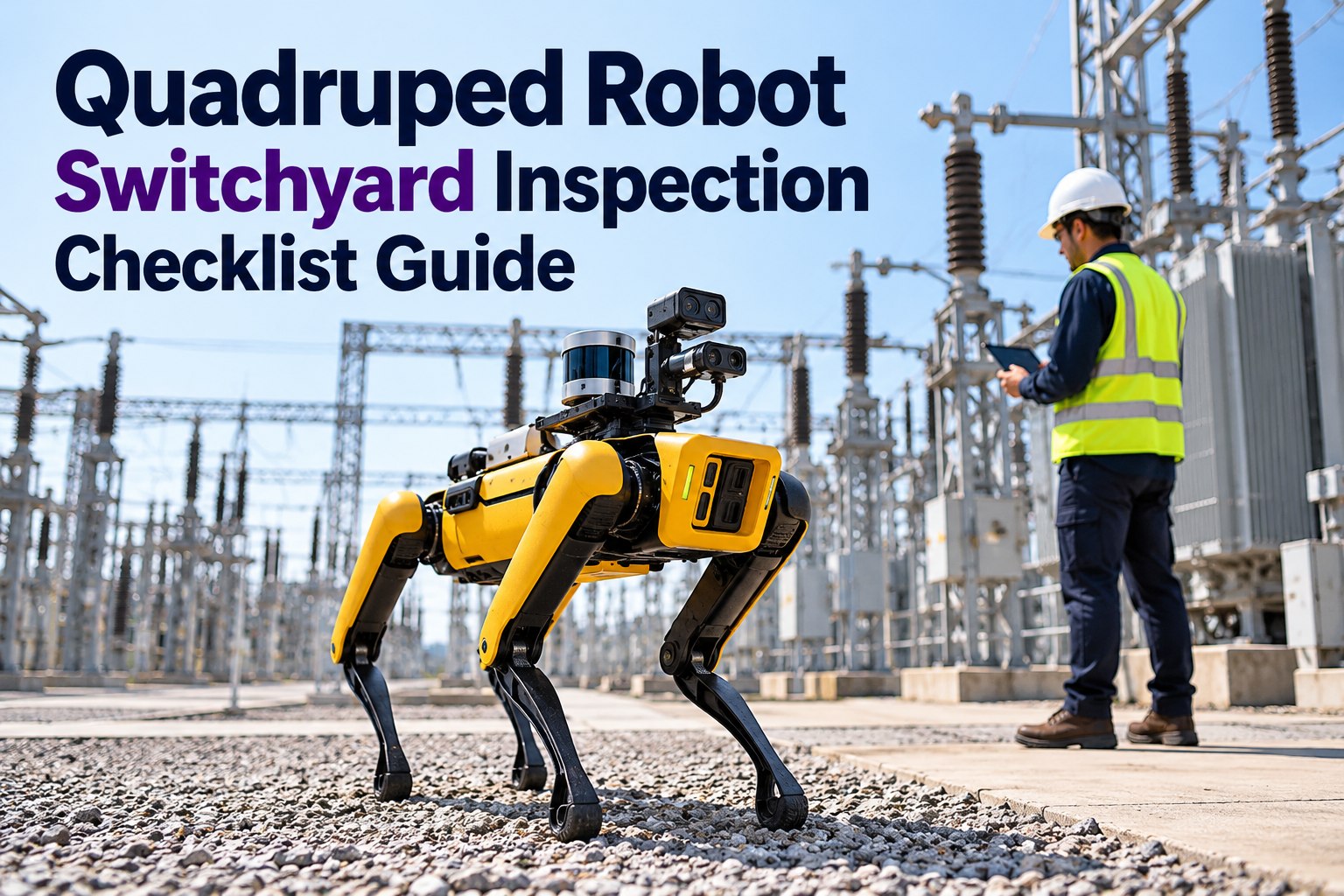
A switchyard is one of the most dangerous places a person inspects — energized to hundreds of kilovolts, arc-flash boundaries everywhere, and a walkdown schedule that still leaves most assets unseen for weeks at a stretch. A quadruped robot changes the economics of that: it patrols live equipment from a safe standoff, reads the same thermal, acoustic, and visual signals a technician would, and does it on a daily or twice-daily cadence no human crew can match — without entering the arc-flash zone. But the robot is only half the system. Its value is in what it captures and where that goes: a hot connection or a rising gas reading has to become a prioritized work order, not a log file. This checklist lays out the full robotic switchyard inspection program — routes, asset coverage, the sensor payload, and the handoff to maintenance. OxMaint AI turns each robot reading into a threshold-checked, auto-generated work order.
Quadruped Robot Switchyard Inspection Checklist
Legged robots can patrol energized switchyards from outside the arc-flash boundary, collecting thermal, acoustic, and visual data. A structured program defines patrol routes, asset coverage, sensors, and maintenance workflows. OxMaint checks readings against thresholds and automatically creates corrective work orders.
Why Robots, and Why a Checklist
The case for the robot is safety and cadence: it removes the inspector from the energized yard and closes the weeks-long gaps a quarterly walkdown leaves. The case for the checklist is that an autonomous patrol is only as good as its coverage — the right zones, the right sensors at the right assets, and a guaranteed path from reading to repair. Skip the structure and you've automated a walk, not an inspection program. Start free and turn robot patrols into a managed program in OxMaint AI.
Patrol Routes by Voltage Class
A switchyard divides into logical patrol zones matched to voltage class and asset density — each with its own cadence and standoff. This is the route backbone. Book a demo to map your zones into OxMaint.
- Transformer banks scanned with long-range thermal from safe standoff
- Circuit breakers checked for hot connections and bushing overheating
- Readings taken from outside the arc-flash boundary
- Switchgear cabinets checked at dense checkpoint intervals
- Acoustic sensing for partial discharge and corona
- OCR gauge and indicator reads at each cabinet
- Battery room monitoring with hydrogen gas detection near vented cells
- HVAC condition and room environment checks
- Runs during off-peak hours to stay clear of staff
- Full-perimeter fence integrity and security-gap check
- Vegetation encroachment along the boundary
- Grounding and structural spot checks
Routes run on LiDAR-based SLAM positioning with programmable geofences that enforce NFPA 70E approach boundaries per voltage class — the robot physically cannot cross them. Start free and schedule every zone in OxMaint.
The Sensor Payload: What the Robot Reads
Each asset calls for a different sensor, and a well-equipped quadruped carries the full set — so one patrol covers thermal, gas, acoustic, visual, and structural condition. Book a demo to see each sensor's reading land in OxMaint.
A Robot That Only Records Isn't an Inspection. It's a Camera on Legs.
The failure mode of robotic inspection isn't the robot — it's data that lands in a folder nobody acts on. A hot bushing scanned at 2 a.m. only matters if it's threshold-checked and turned into a prioritized work order before the crew arrives. The checklist's most important line isn't a sensor; it's the handoff to maintenance.
From Waypoint to Work Order: The Five-Stage Pipeline
This is the part of the checklist that turns a patrol into maintenance action — the sensor-to-work-order flow that runs at every checkpoint. Start free and run this pipeline on your switchyard in OxMaint.
If connectivity drops, readings buffer locally and sync automatically once it returns — no inspection record is lost. Book a demo of the data-to-work-order pipeline in OxMaint.
Deployment Readiness Checklist
Before a quadruped earns its place in a live switchyard, the platform and the program both need to clear a few essentials. Start free and stand up the program side in OxMaint.
- IP67+ weatherproofing for all-season outdoor operation
- EMI-hardened electronics and shielded sensors for HV environments
- Multi-terrain gait across gravel, concrete, grating, and trenches
- REST API with JSON export for asset ID, sensor type, and readings
- Patrol zones defined by voltage class and asset density
- Geofenced NFPA 70E approach boundaries per zone
- Asset baselines and alert thresholds loaded in the CMMS
- Work-order routing by asset ownership and crew availability
How OxMaint Completes the Loop
The robot captures; OxMaint decides and acts. Thresholds, work orders, baselines, and history all live in one CMMS, so the patrol becomes a maintenance program. Start free and close the inspection loop in OxMaint.
Frequently Asked Questions
Patrol Every Day. Enter the Yard Never.
A quadruped robot gives a switchyard daily eyes without putting an inspector inside the arc-flash boundary — but only if every patrol is structured by zone, carries the right sensors, and ends in a work order. Run the checklist, and the robot stops being a camera on legs and becomes a continuous inspection program. OxMaint threshold-checks each reading and raises the repair before the failure.