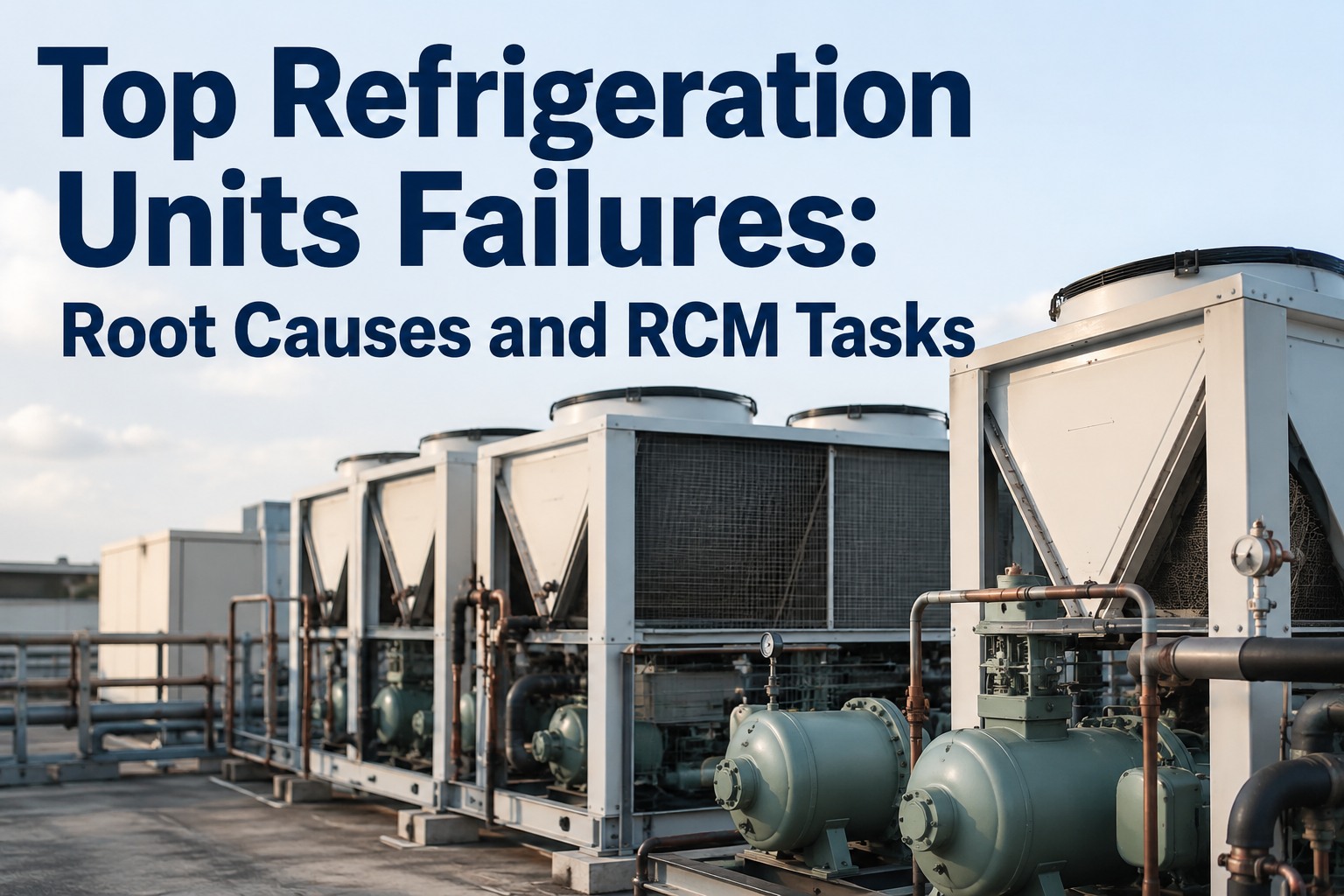
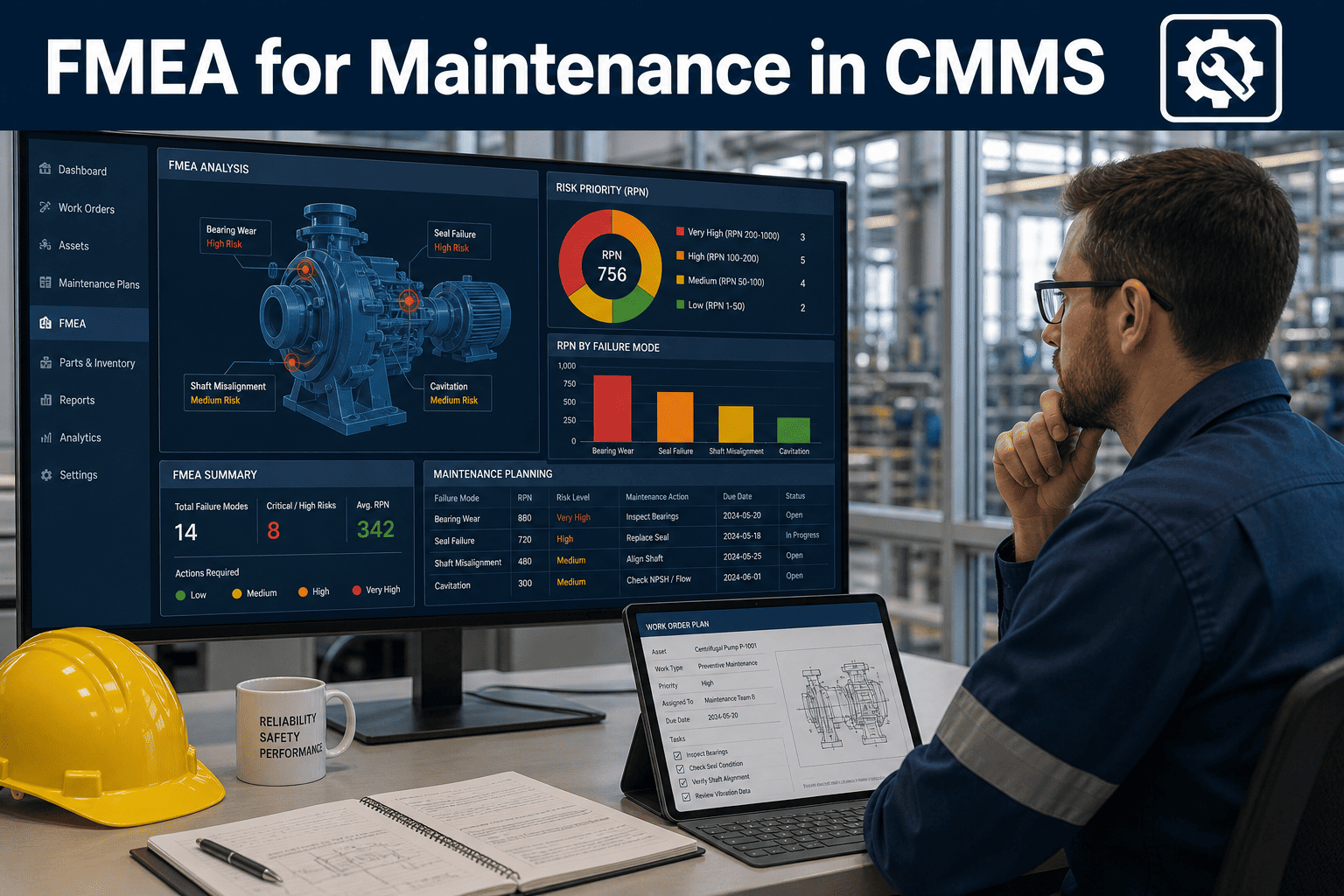
Refrigeration systems fail in patterns that repeat plant after plant, industry after industry — but the pattern is not random and the failures are not unpredictable. Every commercial and industrial refrigeration unit is built around the same seven-component thermodynamic loop, and each of those components has a bounded set of failure modes that FMEA methodology has been mapping for decades. What separates plants that get surprised by refrigeration breakdowns from plants that pre-empt them is not equipment quality — it's whether the FMEA analysis actually reached the CMMS as scheduled RCM tasks, or whether it lived in a consultant report that nobody read after month three. A recent structured FMEA study on marine refrigeration ranked accumulator failure at the top with an RPN of 180, condenser modes at 144 and 128, and evaporator issues at 135 — numbers most industrial reliability engineers instinctively recognize because the same rank order shows up on their own plants once the analysis is done properly. This guide is the working FMEA reference for cooling and refrigeration units: every dominant failure mode, root cause chain, severity and occurrence rating, detection method, and the RCM task that pre-empts it. Use it as a starting template for your own asset-linked FMEA, and route the resulting tasks into the CMMS so the analysis becomes operational reality instead of another shelf-ware document. Book a free demo to see FMEA-driven WOs firing against a refrigeration asset register.
RPN 180
Accumulator refrigerant/lubricant accumulation — highest-risk failure mode in structured refrigeration FMEA
RPN 144
Condenser fouling and heat rejection failure — the second most critical mode by risk priority number
RPN 135
Evaporator icing and heat absorption failure — third-highest RPN, drives compressor stress downstream
7 comps
Core components analyzed: compressor, oil separator, condenser, receiver, expansion valve, evaporator, accumulator
The Seven-Component Loop · Where Failures Actually Happen
Every industrial refrigeration unit — regardless of scale, from a walk-in cooler to a supermarket rack to an ammonia industrial chiller — is a variation on the same vapor-compression loop. Understanding the loop is the prerequisite for FMEA, because failure in one component cascades into stress on the next. A dirty condenser doesn't just fail as a condenser — it drives compressor overheating and eventual burn-out. A leaking evaporator doesn't just lose refrigerant — it starves the compressor and causes acid formation.
C1
Compressor
Draws low-pressure vapor from evaporator · compresses to high-pressure hot gas · the pump of the loop
↓
C2
Oil Separator
Removes lubricant carried over by discharge gas · returns oil to compressor sump · protects downstream components
↓
C3
Condenser
Rejects heat to ambient air or water · condenses refrigerant back to liquid · gets fouled most often
↓
C4
Receiver
Reservoir of liquid refrigerant · buffers load variations · ensures liquid feed to expansion valve
↓
C5
Expansion Valve (TXV)
Meters refrigerant into evaporator · drops pressure and temperature · maintains correct superheat
↓
C6
Evaporator
Absorbs heat from the space or product · vaporizes refrigerant · gets fouled and iced most often
↓
C7
Accumulator
Prevents liquid slugging back to compressor · vaporizes trapped liquid · highest RPN in most FMEA studies
Highest-RPN components — concentrate RCM effort here first
The Master FMEA Table · Every Dominant Failure Mode
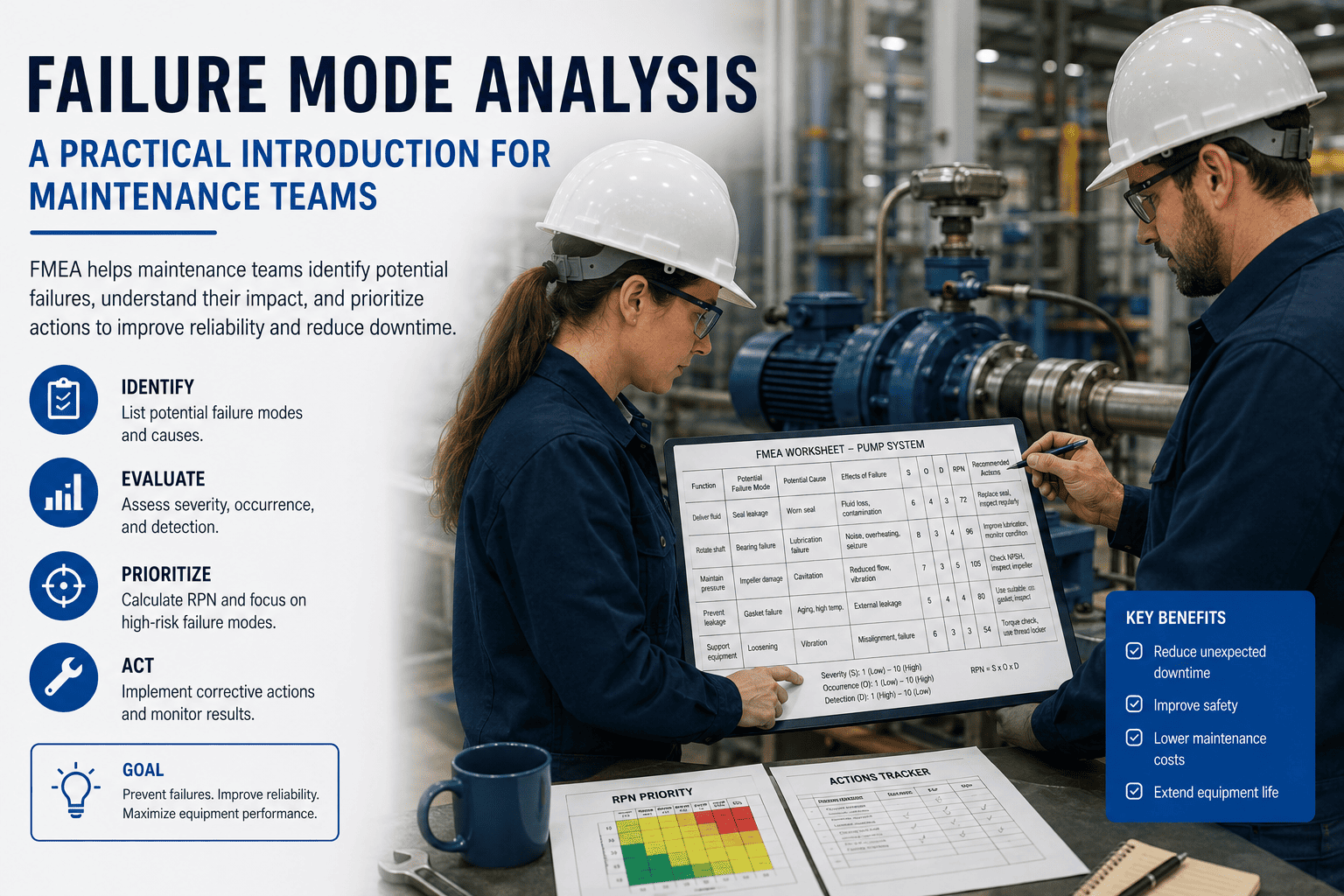
This is the working reference table — every failure mode a reliability team should have in the CMMS as a distinct FMEA record, with severity, occurrence, and detection scored on the standard 1–10 scale (higher is worse). RPN = S × O × D. Anything above 100 gets a dedicated RCM task; anything above 150 gets predictive monitoring plus a task.
Component
Failure Mode
Root Cause
Effect
S
O
D
RPN
Accumulator
Refrigerant & lubricant accumulation
Improper vaporization · undersized unit · low load
Liquid slugging to compressor · compressor damage
6
6
5
180
Condenser
Coil fouling / airflow blockage
Dust · agricultural debris · sandstorm · cottonwood
High head pressure · compressor overheating · trip
8
6
3
144
Evaporator
Coil icing / frost accumulation
Low refrigerant · defrost failure · restricted airflow
Loss of cooling · compressor floodback risk
7
5
3
105
Condenser
Fan motor / bearing failure
Bearing wear · winding degradation · blade imbalance
No heat rejection · rapid compressor overheat
8
4
4
128
Evaporator
Refrigerant leak
Corrosion · vibration crack · brazed joint failure
Undercharge · low cooling · compressor overheat
9
5
3
135
Compressor
Winding burn-out
Overheating · lubrication loss · liquid slugging · contamination
Total unit shutdown · high replacement cost
10
3
3
90
Compressor
Liquid slugging / floodback
Sudden load drop · accumulator undersized · TXV flood
Valve damage · compressor mechanical failure
9
4
3
108
Compressor
Contactor failure
Electrical arcing wear · loose connection · voltage transient
Short-cycling · start failure · winding stress
7
5
3
105
Expansion Valve
TXV hunting / stuck
Sensor bulb loss · valve wear · debris in orifice
Starved or flooded evaporator · high superheat swing
7
4
3
84
Oil Separator
Oil return failure / migration
Float valve stuck · low return velocity · long lines
Compressor lubrication loss · bearing wear
8
4
4
112
Evaporator
Fan motor / bearing failure
Bearing wear · fan blade imbalance · winding age
Loss of coil airflow · icing · loss of cooling
7
5
3
105
Evaporator
Defrost heater / cycle failure
Heater burn-out · defrost timer failure · sensor drift
Coil ice accumulation · airflow loss · cooling drop
6
5
3
90
Receiver / Filter Drier
Moisture / acid contamination
Improper evacuation · filter drier saturation · seal leak
Acid formation · winding attack · compressor burnout risk
9
3
4
108
S Severity 1 (no effect) to 10 (catastrophic / safety)
O Occurrence 1 (very rare) to 10 (constant)
D Detection 1 (certain to detect) to 10 (undetectable)
RPN Risk Priority Number = S × O × D · >100 triggers RCM task · >150 adds condition monitoring
Root Cause Deep-Dive · The Failure Chains That Kill Compressors
Compressors rarely fail because compressors are defective. They fail because upstream problems went undetected long enough to stress the compressor past its limit. Understanding the failure chain is what makes RCM tasks preventive rather than reactive — you address the root cause, not the symptom that killed the compressor.
Root Cause
Condenser coil fouling
→
Cascade
High head pressure · discharge temp rise · reduced heat rejection
→
Final Failure
Compressor thermal protection trip · winding burn-out
Root Cause
Refrigerant leak · slow undercharge
→
Cascade
Low suction pressure · superheat rise · oil dilution loss
→
Final Failure
Compressor overheating · lubrication failure · seizure
Root Cause
Sudden load drop / TXV flood
→
Cascade
Liquid refrigerant reaches suction · accumulator overwhelmed
→
Final Failure
Liquid slugging · valve plate damage · mechanical failure
Root Cause
Filter drier saturation · moisture ingress
→
Cascade
Moisture reacts with refrigerant · acid formation · oil breakdown
→
Final Failure
Motor insulation attack · winding short · compressor burnout
Root Cause
Evaporator fan bearing failure
→
Cascade
Airflow loss · coil frosts · low suction pressure worsens
→
Final Failure
Compressor floodback risk · loss of cooling · product loss
Audit Your Refrigeration FMEA in 30 Minutes
Working session with our reliability team — bring your unit list and PM cadence. We'll map the RPN table above onto your assets, flag the highest-risk gaps, and show how OxMaint converts each FMEA record into a scheduled RCM task without a consulting engagement.
The Recommended RCM Tasks · What Each FMEA Record Should Trigger
An FMEA record is not the deliverable — the scheduled task it triggers is. For each of the top failure modes above, the table below defines the RCM-selected task type (preventive, predictive, condition-based, or run-to-failure) and the cadence. Deploy these in the CMMS against your refrigeration unit register and 70%+ of the failure modes above become predictable weeks in advance.
Failure Mode
RCM Task Type
Cadence
Recommended Action
Accumulator refrigerant accumulation
Predictive
Continuous
Suction line temperature sensor · load balance monitor · maintain ≥50% load
Condenser coil fouling
Condition-Based
90 days · seasonal
Head pressure trend · coil inspection · high-pressure coil cleaning
Condenser fan motor failure
Predictive
Monthly
Vibration + current signature monitoring · bearing greasing per OEM
Evaporator coil icing
Condition-Based
Weekly inspection
Superheat monitor · defrost cycle verification · airflow check
Evaporator refrigerant leak
Predictive
Continuous
Refrigerant charge trending · leak detector alarm · annual EPA leak test
Compressor winding burn-out
Predictive
Continuous
Motor current signature analysis · winding megger · oil acid test
Compressor liquid slugging
Predictive
Continuous
Superheat monitor · TXV bulb inspection · accumulator size verification
Compressor contactor failure
Preventive
Annual
Contact inspection · resistance test · replace at wear threshold
TXV hunting / sticking
Condition-Based
Quarterly
Superheat/subcooling check · bulb charge verification · orifice cleaning
Oil separator return failure
Preventive
Semi-annual
Oil level check · float valve test · oil return line inspection
Evaporator fan motor failure
Predictive
Monthly
Vibration + current trending · bearing lubrication · airflow measurement
Defrost heater / cycle failure
Preventive
Quarterly
Heater continuity check · defrost cycle observation · timer verification
Moisture / acid contamination
Condition-Based
Annual · post-service
Filter drier change · oil acid test · sight glass moisture indicator
Early Warning Symptoms · What to Look For Before Failure
Every dominant failure mode gives observable warning signs weeks before functional failure — visible in pressure gauges, superheat/subcooling readings, current draw, and sound. Train operators and route these observations into work-order triggers in the CMMS and 60–70% of refrigeration surprises disappear.
Pressure
Head & Suction Anomalies
High head pressure → fouled condenser or overcharge · low suction → leak, restriction, or icing · both high → overcharge · both low → severe leak
Superheat
Superheat & Subcooling Drift
High superheat (>15°F) → TXV starved or undercharge · low superheat → flooded evap · high subcooling (>20°F on R32) with low suction = overcharge
Current
Motor Amperage Trend
Rising amps → mechanical binding or high head · low amps → undercharge or valve failure · asymmetric phase draw → winding degradation
Cycles
Short-Cycling & Extended Runs
Short-cycling → contactor failure, control fault, or overcharge · runs longer than baseline → fouled coil, low charge, or load increase
Sound
Acoustic Anomalies
Knocking → liquid slugging or valve damage · high-pitched → TXV hunting · squeal → fan bearing · hissing → leak
Visual
Frost & Sight-Glass Observation
Frost on suction line back to compressor → floodback · sight glass bubbles → undercharge · frost pattern uneven on coil → airflow restriction
Expert Perspective · Why Most Refrigeration FMEAs Die in a Binder
The refrigeration FMEA is one of the most well-established analytical frameworks in industrial reliability — the study on marine refrigeration that produced the RPN 180 for accumulator failures is one of hundreds documented in the literature. Every plant we work with has either done this analysis or paid a consultant to do it. Almost none of them have it operationally active. The FMEA report sits in a binder or a shared drive, the RPN table is a nice reference document, and the actual PM cadence on the plant floor was set five years ago by whoever inherited the maintenance program. This is the failure mode of FMEA itself — analysis without operational integration. What breaks the pattern is straightforward: every FMEA record has to live as a database row inside the CMMS, linked to the specific refrigeration unit it applies to. Every task the RCM decision logic selects has to become an actual scheduled work order on the calendar, or a threshold-triggered predictive WO if condition monitoring is available. Every closeout has to log what was actually found so the FMEA's predicted failure frequency gets validated against reality. That's when the RPN 180 accumulator mode stops being a paper exercise and becomes an operational reality — a monthly monitoring task, a load-balance alert, and a scheduled inspection the reliability team actually completes. That's the FMEA that pays back. The one in the binder never will.
FMEA Records in the CMMS
Failure mode records as database rows linked to the actual asset · not documents in a shared drive · living analysis, not shelf-ware.
RPN > 100 = Scheduled WO
Every mode above the threshold gets a recurring work order · every mode above 150 adds condition monitoring · no exceptions.
Closeout Tunes the Next Cycle
Predicted MTBF vs observed MTBF · task intervals auto-adjust · S/O/D scores recalibrate every 12 months from real operational data.
How OxMaint Runs the Refrigeration FMEA as Operational Reality
OxMaint delivers the full RCM cycle for refrigeration equipment — FMEA records linked to assets, RPN scoring, task selection through JA1011 logic, threshold-triggered predictive work orders, mobile execution, and closeout feedback. Every component of the seven-node loop gets its dedicated failure-mode library, and every RPN >100 record becomes a scheduled task without an integration project.
FMEA
Refrigeration Failure Library
Pre-populated failure-mode library for the 7-component loop · RPN scoring auto-calculated · linked to unit asset records · versioned as data flows in
Logic
JA1011 Task Selection Native
Every failure mode routed through the seven-question decision tree · task type selected (predictive/preventive/CBM/RTF) · cadence set per P-F interval
Sensor
Condition Data Ingest
Head/suction pressure · superheat · motor current · vibration · refrigerant charge trend · thresholds auto-fire predictive WOs on anomaly
Schedule
RCM Task Auto-Generation
Every RPN >100 mode generates recurring WOs on the calendar · P-F interval sets cadence · linked to the specific refrigeration unit
Mobile
Technician Delivery
WO on phone with pressure log, superheat trend, sight-glass check protocol · offline sync for cold-storage dead zones · photo evidence capture
Feedback
Predicted vs Actual Feedback
Closeout data feeds back into FMEA · S/O/D auto-recalibrate · task intervals tune · RPN scores refresh with real operational data
Turn the FMEA Reference Into Scheduled Repairs
Stop letting refrigeration FMEA analyses die in binders. See how OxMaint runs the full RCM cycle — failure library, JA1011 logic, condition monitoring, threshold-triggered WOs, mobile execution, closeout feedback — for cooling and refrigeration units. Free forever plan available.
Frequently Asked Questions
What are the most common failure modes in refrigeration units?
Structured FMEA studies consistently rank the same modes at the top by risk priority number. Accumulator refrigerant and lubricant accumulation scores RPN 180 (highest). Condenser coil fouling and heat rejection failure scores 144. Condenser fan motor failure scores 128. Evaporator refrigerant leak and icing modes score 135 and 105. Compressor burn-out, liquid slugging, and contactor failures score in the 90–108 range. Oil separator return failure, TXV hunting, defrost heater failure, and moisture contamination fill out the RPN >80 tier. Note that compressor failures are almost always downstream effects of upstream root causes — the compressor rarely fails because the compressor is defective.
Why do compressors burn out and how do I prevent it?
Compressors burn out from four dominant root cause chains: overheating from dirty condenser coils driving high head pressure, refrigerant leak causing undercharge and lubrication loss, liquid slugging from sudden load drop or TXV flood, and moisture-driven acid formation from a saturated filter drier. Preventing compressor failure means addressing each chain upstream — 90-day condenser coil cleaning cadence, continuous refrigerant charge trending with leak alarms, superheat monitoring to catch flood conditions early, and annual filter-drier changes with oil acid testing. Motor current signature analysis catches winding degradation weeks before functional failure.
Book a free demo to see compressor prediction live.
How is RPN calculated in refrigeration FMEA?
RPN (Risk Priority Number) = Severity × Occurrence × Detection, each scored on a 1–10 scale where higher is worse. Severity rates the consequence: 1 = no effect, 10 = catastrophic or safety-critical. Occurrence rates the frequency: 1 = very rare, 10 = constant. Detection rates how easily the failure would be caught before consequence: 1 = certain to detect, 10 = undetectable. Any RPN above 100 should trigger a dedicated RCM task in the CMMS. Any RPN above 150 should add continuous condition monitoring on top of the scheduled task. The RPN 180 accumulator mode qualifies for both — predictive monitoring plus preventive inspection cadence.
What RCM tasks pre-empt evaporator coil icing?
Evaporator icing has three dominant root causes and each needs a distinct RCM task. Low refrigerant charge is addressed by continuous charge trending and leak-detector alarms plus annual EPA compliance testing. Defrost cycle failure is addressed by quarterly defrost timer verification, heater continuity testing, and cycle observation. Restricted airflow from dirty filters, blocked coils, or fan motor failure is addressed by weekly airflow inspection, monthly evaporator fan vibration and current trending, and 90-day coil cleaning. Superheat monitoring provides continuous early warning across all three causes — a superheat below 5°F indicates a flooded condition that will lead to icing if not corrected.
How often should refrigeration units get FMEA-based inspections?
Cadence follows RPN and task type. RPN >150 modes with predictive tasks are monitored continuously via sensors — no fixed inspection cadence, the threshold crossing fires the WO. RPN 100–150 condition-based tasks typically run weekly (superheat/pressure checks) or monthly (vibration trending on motors). RPN 80–100 preventive tasks run quarterly to annually depending on the mode. Every unit gets a comprehensive FMEA-based inspection annually regardless — a walkthrough against the full failure-mode library to catch any degradation the routine monitoring missed. Critical units in food service, pharma cold chain, or process cooling get more aggressive cadence than back-of-house comfort cooling.
Sign up free to build your cadence per unit.
Does OxMaint have a pre-built FMEA library for refrigeration equipment?
Yes. OxMaint includes a pre-populated failure-mode library for the standard seven-component vapor-compression loop — compressor, oil separator, condenser, receiver, expansion valve, evaporator, and accumulator — with default severity, occurrence, and detection scores calibrated from published FMEA studies. When you add a refrigeration unit to your asset register, the library attaches automatically with all RPN >100 modes converted to recurring RCM work orders based on the JA1011 decision logic. You customize the S/O/D scores against your specific unit's history, and closeout data auto-refines the scores over 12–18 months. The free forever plan is available to trial the full workflow.
Book a free demo to see the library.