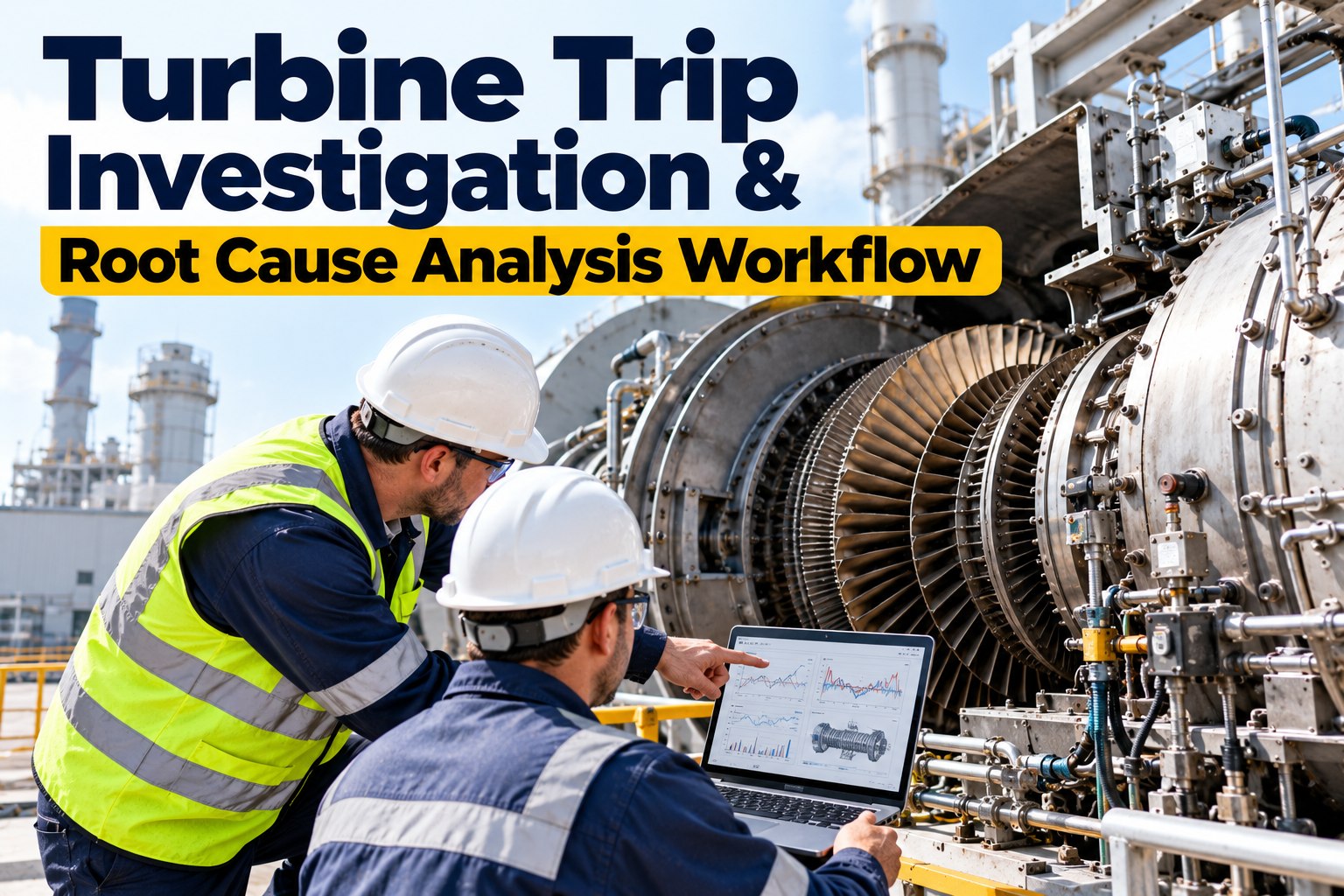
Turbine Trip Investigation & Root Cause Analysis Workflow

Connect with Industry Experts, Share Solutions, and Grow Together!

Join Discussion Forum
turbine-trip-root-cause-analysis-workflow

A unit trips at 2 a.m. By morning, the questions start: what alarm came in first, what were the operating conditions in the minutes before, which component actually failed, and will it happen again on restart? Without a standard workflow, each investigation becomes a scramble through DCS exports, operator memory, and paper logs — and the real root cause stays buried while the same trip waits to recur. This guide lays out a repeatable turbine-trip investigation and root-cause workflow, and how OXMAINT AI, the AI-powered power-plant CMMS, turns a trip into a timed, evidence-backed RCA that closes with verified corrective actions.

Power Generation · Turbines & Rotating Equipment · Unexpected Trips · 2026

Turbine Trip Investigation & Root Cause Analysis Workflow

An unexplained trip, a scramble through DCS exports, and no confidence it won't recur on restart — that's how a forced outage turns into a repeat failure. OXMAINT AI, the AI-powered CMMS and maintenance management software, runs the investigation as a timed workflow: capture the event and alarm sequence, reconstruct the minute-by-minute timeline, drive it through structured RCA, and convert verified corrective actions into work orders and revised PM tasks — so the trip is understood, fixed, and designed out.

1Capture Event → 2Reconstruct → 3Root Cause → 4Corrective Action
SEQUENCE OF EVENTS
T−04:00DCS trend window opens
T−00:12Vibration rises on bearing
T−00:03First-out alarm latched
T 00:00Unit trips offline
T+00:30RCA record created
Minute-by-minute, reconstructed from alarms + logs
5
investigation phases from trip to verified closure
4 hr
DCS alarm-journal window captured before the trip
24 mo
maintenance history auto-pulled on tagged assets
3
structured RCA methods: 5-Why, fault tree, fishbone

Why Trips Recur

A trip that's cleared and restarted without a disciplined investigation is a trip that will happen again. The evidence that explains it — the first-out alarm, the pre-trip trend, the failed component — degrades or disappears within hours if no one preserves it. A standard workflow exists to capture that evidence fast, reconstruct exactly what happened, and trace the failure past its surface symptom to the systemic condition behind it. Book a demo to see the trip workflow in OXMAINT AI.

The Five-Phase Investigation Workflow

Every turbine trip runs through the same five timed phases, each with its own window and deliverable — so nothing is skipped under restart pressure. OXMAINT AI structures the investigation across these phases from the first timestamp to verified closure. Start free and run the five phases in OXMAINT AI.

0–2 hr
Phase 1 · Immediate Capture
Create the RCA record, log the exact trip timestamp, unit state, alarm sequence and operator actions. Assign an RCA lead and tag the involved assets.
2–12 hr
Phase 2 · Evidence Preservation
Photograph failed components before cleaning or repair; collect lube-oil samples, vibration exports, thermography, and the DCS trend data for the window before the trip.
12–72 hr
Phase 3 · Timeline Reconstruction
Build a minute-by-minute timeline from DCS alarms, operator rounds and maintenance logs — with the full maintenance history of each tagged asset pulled automatically.
72 hr +
Phase 4 · Corrective Action
Categorize actions as immediate (before return to service), short-term (within 30 days) or long-term systemic, each with an owner, due date and priority.
30–90 d
Phase 5 · Reliability Integration
Verified actions close the RCA and feed back into PM task lists, inspection frequencies and spare-parts requirements — so the fix becomes permanent.

Three Categories of Evidence

A sound root cause rests on evidence, not opinion — and trip evidence falls into three categories, each perishable in its own way. OXMAINT AI preserves all three against the trip record before they're lost. Book a demo to see evidence capture in OXMAINT AI.

PHYSICAL
The Hardware
Failed components, fastener condition, wear patterns and fluid samples — photographed and sampled before cleaning or repair destroys the evidence.
DIGITAL
The Data
DCS alarm journals from the pre-trip window, vibration trend data, thermography images and the asset's CMMS maintenance history.
HUMAN
The Process
Operator logs, maintenance records, procedure-compliance documentation and crew interview notes — captured while memory is fresh.

The Alarm Journal Doesn’t Wait for the Investigation.

The DCS trend window before a trip, the first-out alarm, the vibration that climbed in the final minutes — the data that explains the trip is captured against the RCA record the moment it's created, not reconstructed from memory days later. Evidence preserved is a root cause found.

Digging Past the Symptom: Three Root-Cause Layers

A tripped turbine with a cracked seal has an obvious symptom — but the seal is rarely the root cause. A real investigation goes down three layers, because fixing only the top one guarantees the trip returns. OXMAINT AI documents the causal chain from immediate cause back to the latent systemic factor. Start free and trace the full chain in OXMAINT AI.

01
Physical — the failure mechanism
What physically broke: bearing fatigue, seal cracking, erosion. The visible mechanism of failure — necessary, but never the whole story.
↓
02
Human — the action or inaction
What enabled the mechanism: incorrect torque, the wrong lubricant, a skipped inspection. The decision or omission behind the physical failure.
↓
03
Latent — the systemic condition
Why the human factor was possible: inadequate monitoring, PM frequency set too low, a training gap. Fix this layer and the trip is designed out.

Choosing the Right RCA Method

Not every trip needs the same analytical tool — the structure of the failure decides the method. OXMAINT AI supports all three, each documenting the causal chain with evidence attached at every node. Book a demo to see the RCA methods in OXMAINT AI.

MethodUse it whenWhat it produces
5-Why The failure is a clear, linear chain of cause and effect A traced line from symptom back to the systemic condition
Fishbone / Ishikawa Multiple categories may have contributed together Contributing factors grouped by category for structured review
Fault Tree (FTA) The failure needs a combination of conditions that all occur together A logic tree of the conditions whose coincidence caused the trip

Whichever method fits, the root-cause statement is a single, specific description of the systemic condition that allowed the failure — supported by evidence at each node, not by assumption.

From Finding to Fix That Sticks

An RCA that ends in a report changes nothing; one that ends in tracked, verified actions changes the plant. OXMAINT AI turns approved corrective actions into live work — and keeps them from being abandoned. Start free and close the loop in OXMAINT AI.

◉
Actions to Work Orders
Approved corrective actions convert directly into work orders or revised PM tasks — no re-keying, no gap between finding and fix.
◉
Owner & Escalation
Every action carries an owner and due date, with automated escalation for overdue items so open actions aren't quietly abandoned.
◉
PM Feedback Loop
Findings revise PM task lists and inspection criteria — modifying task frequency so the same failure mode is caught earlier next time.
◉
Auto Maintenance History
Tagging an asset pulls its full maintenance history into the record, so patterns across past work surface during the analysis.
◉
Forced-Outage Register
Every closed RCA feeds a forced-outage register for benchmarking and reliability trending across units and failure modes.
◉
Verification of Effectiveness
The RCA only closes after follow-up confirms the action prevented recurrence — closure means fixed, not filed.
“

We used to treat a trip as something to clear and restart, and we kept seeing the same failures come back because nobody preserved the data or traced it past the broken part. Running every trip through the same phased investigation changed that — the alarm journal and the pre-trip trend are captured immediately, the timeline is built from real data instead of memory, and the corrective actions actually feed back into our PM schedule. Trips we used to repeat twice a year we now understand once and design out.

Reliability Engineering Lead · Combined-Cycle Power Plant

Frequently Asked Questions

What are the first steps right after a turbine trip?
In the first 0–2 hours, create the RCA record, log the exact trip timestamp, unit state, alarm sequence and operator actions, assign an RCA lead, and tag the involved assets. Fast capture is what preserves the evidence the investigation depends on. Book a demo to see immediate capture in OXMAINT AI.
How is the trip timeline reconstructed?
A minute-by-minute timeline is built from DCS alarms, operator rounds and maintenance logs, with the DCS trend data from the window before the trip and the full maintenance history of each tagged asset pulled automatically to anchor it.
Which RCA method should we use?
It depends on the failure's shape: 5-Why for a clear linear chain, fishbone when several categories may have contributed together, and fault tree when a combination of conditions all had to occur. OXMAINT AI supports all three with evidence attached at each node.
Why go past the physical cause?
A cracked seal or fatigued bearing is the mechanism, not the root cause. Fixing only the physical layer leaves the human action and the latent systemic condition in place — so the trip recurs. The three-layer analysis traces it all the way down.
How do corrective actions avoid being forgotten?
Approved actions convert into work orders or revised PM tasks, each with an owner and due date and automated escalation for overdue items, and the RCA closes only after verification confirms the action prevented recurrence. Start free and track actions to closure in OXMAINT AI.

Turn Every Trip Into a Trip That Never Repeats.

Run turbine-trip investigations on the OXMAINT AI maintenance management software — immediate event and alarm capture, minute-by-minute timeline reconstruction, structured 5-Why / fault-tree / fishbone RCA, and verified corrective actions that feed back into your PM program. Investigate once, fix for good.


By William Jerry

✨

Experience
Oxmaint's
Power

Take a personalized tour with our product expert to see how OXmaint can help you streamline your maintenance operations and minimize downtime.

Book a Tour

Share This Story, Choose Your Platform!

Connect all your field staff and maintenance teams in real time.

Report, track and coordinate repairs. Awesome for asset, equipment & asset repair management.

Schedule a demo or start your free trial right away.

iphone

Get Oxmaint App
Most Affordable Maintenance Management Software

Download Our App