By 2033, one in five aviation maintenance technician roles could remain unfilled. That is the projection from McKinsey's analysis of the MRO labor pipeline — and it describes a structural shortage, not a cyclical dip. Airlines are parking aircraft because they cannot find certified mechanics. Airports are deferring maintenance because their facilities teams are running on skeleton staffing. The traditional response — hiring more people — is no longer available as a primary strategy. The airports and aviation operators that are closing the gap are doing it with AI. Not AI that replaces technicians. AI that makes the technicians they have dramatically more effective — handling the cognitive overhead of scheduling, prioritization, data retrieval, and routine decision-making so their people can focus on the physical work only humans can do. Start a free trial with Oxmaint and put AI-powered maintenance scheduling to work for your team today — or book a demo to see how our AI copilot supports airport maintenance teams across multi-site operations.
AI Copilot · Maintenance Automation · Workforce Optimization · Predictive Scheduling
Your Technician Shortage
Is Not a Hiring Problem.
It Is an Efficiency Problem.
An AI copilot does not replace your maintenance team. It removes the invisible cognitive load — the scheduling decisions, the work order routing, the diagnostic research, the compliance checks — that currently consumes 30–40% of your senior technicians' working hours. The result: the same team produces significantly more completed, compliant, high-quality maintenance work per shift.
Oxmaint's AI copilot layer works alongside your maintenance team — automating the administrative and decision-support tasks that slow your most experienced people down.
Automated Work Order Routing
Predictive Scheduling
AI Task Allocation
Intelligent Prioritization
Skill-Based Assignment
Real-Time Capacity Planning
20%
MRO Roles Unfilled by 2033
McKinsey projects one in five aviation maintenance technician positions will remain unfilled within a decade — a structural workforce crisis
35%
Faster Troubleshooting
AI-assisted maintenance tools in aviation settings reduce troubleshooting time by at least 35% per incident on complex technical faults
25%
Lower Maintenance Expenses
AI-driven predictive maintenance reduces total maintenance spend by 25% through better scheduling, parts optimization, and failure prevention
4.8x
Emergency vs. Planned Cost Ratio
Every failure an AI copilot helps prevent costs 4.8x less than the emergency repair it replaces — the financial case for AI adoption is straightforward
The Problem Defined
What Is Actually Consuming Your Technicians' Time
The technician shortage is not purely a headcount problem. Even with full staffing, most airport maintenance operations have a hidden productivity crisis — experienced technicians spending 30–40% of their shifts on tasks that are not physical maintenance. These are the tasks an AI copilot eliminates.
18%
Work Order Administration
Creating, updating, and closing work orders. Searching for asset history before starting a job. Completing compliance forms after finishing a task. All of this is documentation overhead — essential, but not skilled maintenance work.
12%
Scheduling and Prioritization
Maintenance supervisors spend significant time each day deciding what gets done in what order — balancing urgency, technician availability, parts availability, and operational constraints. AI does this continuously, in real time, without supervisor intervention.
9%
Diagnostic Research
Before experienced technicians begin a complex repair, they search maintenance manuals, previous work orders, and asset histories for relevant context. The AI copilot retrieves and surfaces this in seconds — reducing pre-job research time from 20–30 minutes to under 2 minutes.
7%
Parts and Inventory Lookup
Technicians manually checking parts availability, raising purchase requests, and waiting for parts confirmation before beginning jobs. AI-integrated inventory management surfaces parts availability before the work order is assigned — eliminated as a mid-task delay.
AI Copilot Capabilities
What Oxmaint's AI Copilot Does for Airport Maintenance Teams
Oxmaint's AI copilot is not a chatbot layered on top of a CMMS. It is an intelligent decision-support and automation layer embedded in every maintenance workflow — operating continuously, not on demand. Book a demo to see the AI copilot operating inside a live airport maintenance workflow.
Intelligent Routing
Skill-Based Work Order Assignment
Every incoming work order is analyzed for asset type, fault complexity, regulatory certification requirement, and historical technician performance on similar tasks. The AI routes to the best-qualified available technician — not the first available — maximizing first-time fix rates.
Predictive Scheduling
Failure-Before-It-Happens PM Generation
Oxmaint's AI analyzes sensor trends, asset age, usage intensity, and environmental factors to predict which assets are trending toward failure — generating PM work orders in advance of the failure window, not on a static calendar schedule that ignores actual asset condition.
Diagnostic Support
Contextual Asset Intelligence at the Point of Work
When a technician opens a work order on their mobile device, the AI surfaces the last 6 months of maintenance history, similar fault events on identical assets, and the most common resolution for this fault type — giving junior technicians the context that only senior engineers previously held.
Capacity Management
Real-Time Team Workload Balancing
The AI monitors open work orders, technician capacity, and incoming demand in real time — automatically rebalancing allocations when unplanned failures spike demand. Supervisors see a live capacity view, not a static shift plan that becomes obsolete the moment the first emergency work order arrives.
Parts Intelligence
Inventory-Aware Work Order Dispatch
Before a work order is dispatched, the AI verifies that required parts are in stock. For parts below reorder threshold, a procurement request is generated simultaneously with the work order — eliminating the parts-wait delay that accounts for 15–30% of total maintenance downtime in most airport facilities.
Compliance Automation
Regulatory Documentation on Autopilot
Oxmaint's AI automatically flags work orders that require regulatory sign-off, specific certification documentation, or compliance form completion. Technicians are guided through the compliance fields as part of the digital work order — not as a separate post-job administrative step that gets deferred or skipped.
Workforce Efficiency Framework
How AI Copilots Multiply Technician Output Without Adding Headcount
The productivity math is straightforward. An airport maintenance team running 20 technicians — where each technician spends 35% of their shift on non-maintenance administrative tasks — is effectively operating with the output of 13 technicians. AI copilots that eliminate that overhead return the full output of 20 to the team. Start a free trial and see how quickly Oxmaint's AI layer reduces administrative overhead for your team.
Step 1
AI Predicts, Schedules, and Prioritizes
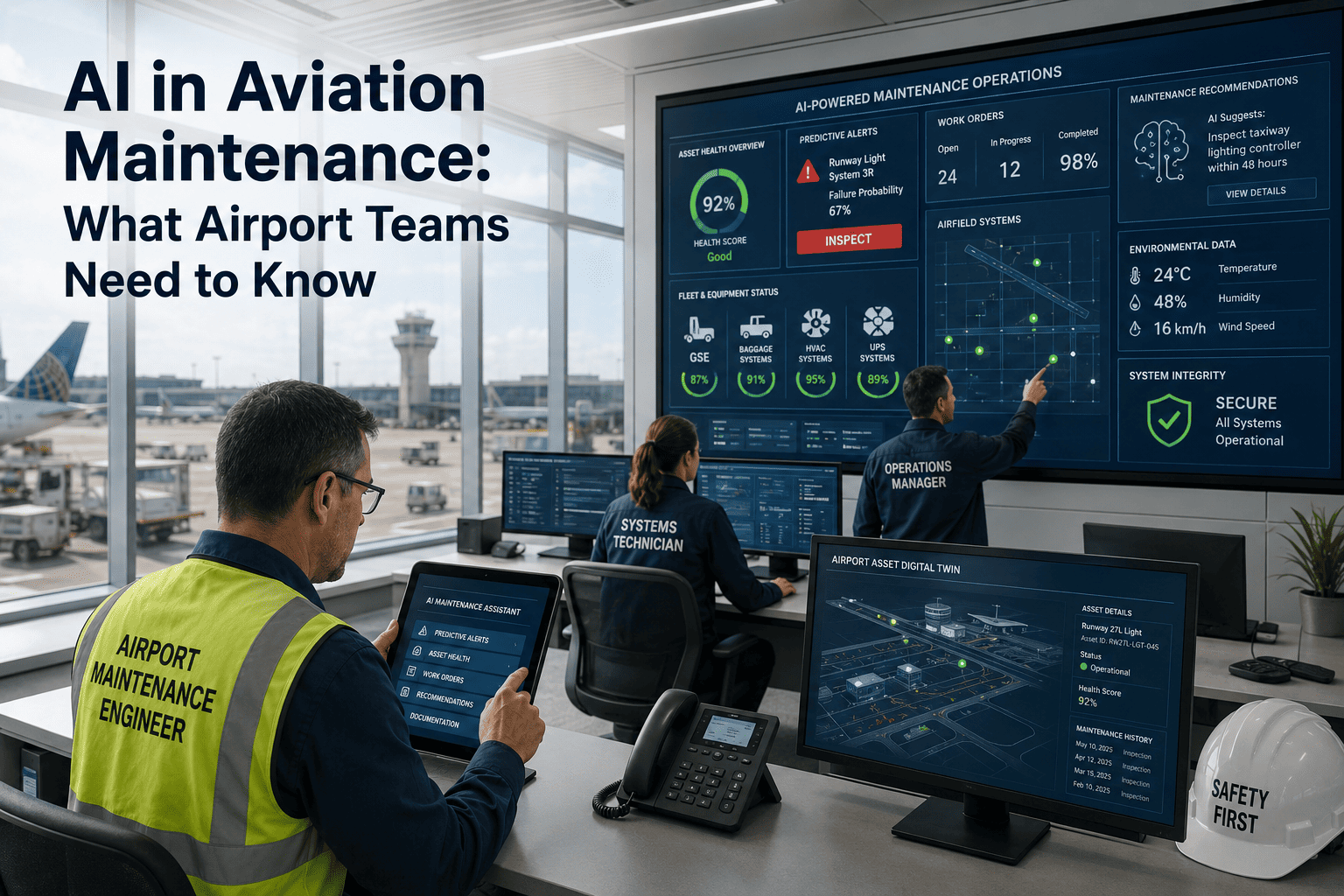
Oxmaint's AI scans sensor data, asset condition scores, and maintenance history continuously — generating a prioritized work order queue that reflects actual risk and urgency, not a static calendar. The maintenance supervisor reviews the AI-generated plan, not builds one from scratch each morning.
→
Step 2
AI Routes to the Right Technician
Skill matrix, certification status, current location, and workload are analyzed per work order. The AI assigns to the optimal technician — not the most available one. First-time fix rates improve because the right person is sent with the right information to the right asset.
→
Step 3
Technician Executes with AI Support
On-site, the technician works with AI-surfaced asset context, diagnostic guidance, and parts confirmation already in hand. Compliance forms are embedded in the work order flow. The experienced technician focuses on the physical repair — not the documentation around it.
→
Step 4
AI Learns and Continuously Improves
Every completed work order adds data to Oxmaint's learning layer — improving failure prediction accuracy, refining routing decisions, and identifying patterns across the asset fleet that no human analyst could detect across thousands of records simultaneously.
Before vs. After AI Copilot
Airport Maintenance Operations Without and With AI Copilot Support
| Operational Area |
Without AI Copilot |
With Oxmaint AI Copilot |
| Daily Schedule Planning |
Supervisor builds manually — 60–90 min per shift |
AI generates prioritized queue — supervisor reviews in 10 min |
| Work Order Routing |
Assigned by availability — skill match is inconsistent |
Routed by skill, certification, location, and workload |
| Diagnostic Support |
20–30 min manual research before complex jobs |
Asset context and fault history surfaced in under 2 min |
| Failure Prevention |
Calendar-based PM — misses condition-driven failures |
AI-predicted PM — based on actual asset condition trends |
| Parts Management |
Parts checks done mid-job — delays and return trips |
Inventory verified pre-dispatch — parts ready when tech arrives |
| Compliance Documentation |
Post-job paperwork — often incomplete or deferred |
Embedded in work order — completed at point of work |
Documented Impact
What AI Copilots Deliver in Airport Maintenance Operations
35%
Faster Troubleshooting Resolution
AI-assisted diagnostics with contextual asset history reduce the time from fault detection to repair start by at least 35% in aviation maintenance settings
25%
Reduction in Total Maintenance Cost
AI-driven predictive scheduling and parts optimization reduce total maintenance expenditure by 25% — through fewer emergency callouts, better parts purchasing, and reduced repeat repairs
40%
More Work Orders Per Technician
When administrative overhead drops from 35% of shift time to under 15%, each technician completes significantly more physical maintenance work per shift — without working harder
35%
Less Aircraft and Asset Downtime
AI-predictive maintenance tools in aviation operations reduce asset downtime by 35% — through earlier failure detection and optimized repair scheduling during planned maintenance windows
Expert FAQ
AI Copilots for Airport Maintenance — Common Questions
Does an AI copilot require data science expertise to implement and operate in an airport maintenance setting?
No. Oxmaint's AI copilot is embedded in the maintenance workflow — it operates as part of the normal work order and scheduling process, not as a separate analytics platform that requires specialist interpretation. Maintenance supervisors interact with AI recommendations through familiar interfaces: a prioritized work queue, a routing suggestion, a predictive PM work order. The underlying model runs automatically on the data already captured in the CMMS — asset condition scores, sensor readings, maintenance history, technician skill matrix. No data science team is required. The system learns from each completed work order and improves its recommendations continuously without any manual model retraining.
How does Oxmaint's AI copilot handle the skill and certification matching required for regulated airport maintenance tasks?
Oxmaint maintains a technician skill matrix that records certifications, license types, training completions, and specializations for each team member. When a work order is generated for a task that requires specific certification — FAA-mandated airfield lighting inspection, pressurized equipment servicing, electrical work above defined voltages — the AI routing layer filters the assignable technician pool to only those with the qualifying credential. A technician without the required certification simply does not appear as an available assignee for that work order type. This eliminates the compliance risk created when scheduling pressure causes supervisors to assign tasks without verifying certification status manually.
How quickly can an airport maintenance team expect to see productivity improvements after deploying Oxmaint's AI copilot?
Most teams see measurable scheduling and routing efficiency improvements within the first two to four weeks — these benefits are immediate because they come from automation of manual processes, not from historical data learning. Predictive maintenance quality improves progressively over the first three to six months as the AI accumulates sufficient asset history to identify reliable failure patterns for your specific equipment fleet. Teams that start with the highest-volume or highest-criticality asset categories — HVAC systems, baggage handling equipment, escalators — tend to see the fastest ROI because these assets have the most maintenance interaction data and the highest cost of unplanned failure. Full portfolio-level AI prediction quality typically stabilizes within 90 days of full system deployment.
Can Oxmaint's AI copilot support multi-terminal and multi-site airport operations from a single platform?
Yes. Oxmaint is built for multi-site operations — the asset hierarchy supports Portfolio, Property, System, Asset, and Component levels, meaning a single Oxmaint instance can manage an entire airport campus across multiple terminals, concourses, and satellite facilities. The AI scheduling and routing layer operates at the portfolio level — balancing work order demand across all sites, optimizing technician deployment across locations, and generating predictive insights from the aggregated asset fleet data. For airport authorities managing multiple airport facilities, this means one CMMS with one AI layer providing consistent maintenance quality standards, centralized compliance reporting, and portfolio-level capital forecasting across the entire estate.
Your Technicians Are Too Valuable to Spend 35% of Their Shift on Admin.
Give Every Technician an AI Copilot That Does the Administrative Work for Them
Oxmaint's AI copilot automates scheduling, routing, diagnostics, parts management, and compliance documentation — returning 30–40% of every technician's shift to the physical maintenance work that actually keeps your airport operational. No data scientists required. No long implementation. Productivity gains visible within weeks of deployment.