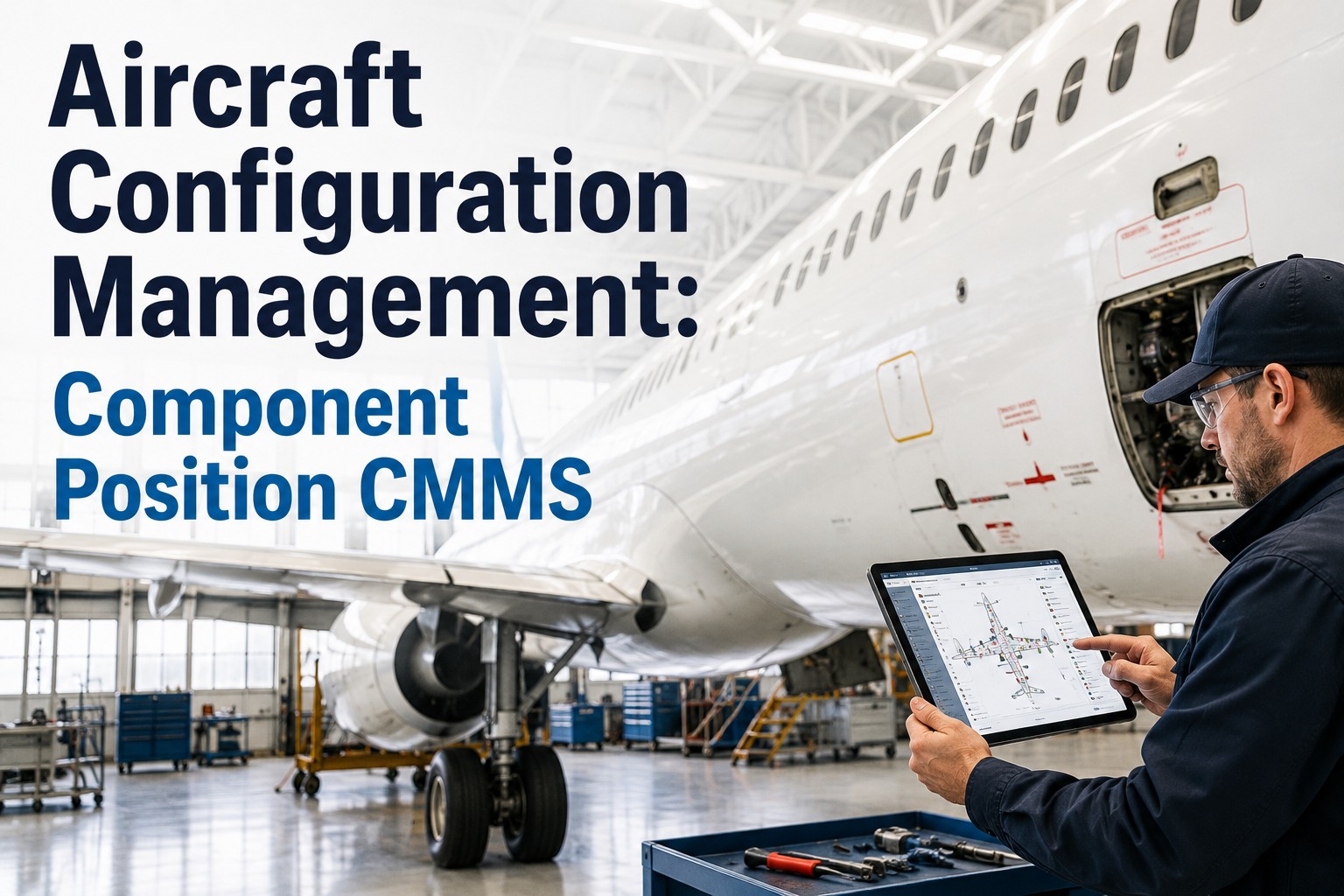
Aircraft configuration management — knowing exactly which serial-numbered component occupies which position on which tail at any moment — is the backbone of continued airworthiness, lease compliance, and insurance traceability. This CMMS aircraft configuration guide for 2026 walks maintenance and reliability teams through position mapping, swap history, dual-tag control, and as-maintained configuration records tight enough to satisfy the toughest audit. Whether you operate a 15-aircraft regional fleet or manage 200+ tails across multiple bases, moving from spreadsheet tracking to a configuration CMMS built for aviation eliminates the guesswork that costs operators millions in redelivery penalties and AOG events every year. You can Start Free Trial today or read on to see how position-level tracking transforms your maintenance operation.
Can you prove which serial number sits in which position on every tail — right now?
Most operators lose 40+ hours per lease return reconciling configuration records by hand. Position-level CMMS tracking closes that gap — giving you a live, audit-ready as-maintained snapshot of every installed component, every swap, and every incoming/outgoing tag across the fleet.
Aircraft configuration management: the foundation of airworthiness
Aircraft configuration management is the discipline of maintaining a real-time, position-accurate record of every serialized component installed on every aircraft in your fleet — from engines and APUs down to hydraulic actuators and avionics boxes. In aviation, airworthiness is not just about whether a part functions; it is about knowing which part, by serial number, occupies which position, and whether that installation complies with the applicable AD, SB, and type-design requirements.
Position-level traceability
Each tail has a defined set of component positions (e.g., L/H Main Landing Gear Actuator, STA 720). A configuration CMMS ties a serial number to each position, so you always know what is installed where — not just what is "on the aircraft."
As-maintained vs as-designed
Type-design data tells you what the airframe should look like. Configuration CMMS tells you what it actually looks like after every swap, repair, and modification — the record auditors and lessors demand.
Bidirectional swap history
When a component moves from position A on Tail 001 to position B on Tail 004, both aircraft configuration records update automatically — incoming and outgoing, with dates, tech-log references, and dual-release tags.
Airworthiness linkage
Every installed component is linked to its applicable AD/SB status, TSN/TSO, and next-due inspection — so configuration and compliance are never tracked in separate silos.
How component position tracking works in a CMMS
A CMMS built for aircraft configuration does not merely list parts in inventory. It maps each component to a physical position on a specific tail, records every installation and removal event, and maintains a full bidirectional swap history. Here is the five-step lifecycle the system manages automatically.
Position mapping
Every aircraft type has a position template — engine 1, engine 2, APU, MLG left actuator, NLG steering cylinder, etc. The CMMS loads this template per tail so each slot has a unique identifier and a lineage from day one.
Incoming component registration
When a serialized part arrives — new, repaired, or loaned — the CMMS captures its 8130-3 / EASA Form 1 dual-release tag, TSN/TSO, and vendor data. No part can be installed without a valid incoming record.
Installation to position
A work order installs the part into a specific position on a specific tail. The CMMS locks the position, stamps the install date, captures the technician and inspector sign-offs, and links the tech-log entry.
Removal and outgoing tag
When a part comes off, the CMMS generates an outgoing tag, records the reason for removal, updates TSN/TSO at the moment of removal, and flags the position as vacant until the next install.
Cross-tail swap reconciliation
If a part moves from Tail A to Tail B, both configuration records update in a single transaction. The swap history stays on the serial number forever — no matter how many tails it visits.
Configuration change records: closing the audit gap
A configuration change record is the atomic unit of airworthiness traceability. Every time a component is installed, removed, or moved between positions or tails, the CMMS must generate an immutable change record that answers five questions: what, where, when, who, and why. Spreadsheets cannot guarantee this; a purpose-built configuration CMMS can.
| Change record field | What it captures | Why auditors care |
|---|---|---|
| Position ID | Exact slot on the airframe (e.g., ENG-1, APU, STA-720-LH-ACT) | Confirms the part is in a type-design-approved location |
| Serial number | Unique identity of the installed/removed component | Links the position to the part's full life history |
| Incoming tag ref | 8130-3 / EASA Form 1 / dual-release tag number | Proves the part was airworthy when it arrived |
| Outgoing tag ref | Generated removal tag with reason for removal | Starts the repair-shop traceability chain |
| TSN / TSO at event | Time since new / since overhaul at install and removal | Drives the next-due calculation and LLP tracking |
| Tech-log reference | Flight-cycle and date stamp from the aircraft tech log | Ties the maintenance event to the operational record |
| Dual sign-off | Technician and inspector names, cert numbers, dates | Satisfies FAR 43 / EASA Part-145 release requirements |
A 30-aircraft narrowbody operator we studied was spending $180K per year in contractor hours reconciling configuration spreadsheets for a single lease return. A CMMS with position-level tracking reduced that to under $15K — a 92% cost reduction — because every change record was already captured at the work-order level.
How OxMaint closes the configuration tracking gap
OxMaint is an AI-powered CMMS and EAM platform that treats aircraft configuration as a first-class data object — not an afterthought bolted onto a work-order system. Every component installation, removal, and cross-tail swap flows through the same platform that manages your preventive maintenance, inventory, and analytics, so configuration records are always in sync with maintenance reality.
Live position-mapped configuration
OxMaint loads a position template per aircraft type and ties a serial number to each slot. Open any tail and see a live as-maintained configuration — no spreadsheet reconciliation, no guesswork, no surprises during a lease return.
Outcome: Cut lease-return reconciliation from 6 weeks to 3 daysAutomatic bidirectional swap history
When a part moves from Tail A to Tail B, OxMaint updates both configuration records in one transaction and preserves the full swap chain on the serial number — including incoming/outgoing tags, TSN/TSO, and dual sign-offs.
Outcome: Eliminate 40+ hours of manual cross-reference per swap eventDual-tag control & AD/SB linkage
No component enters a position without a valid 8130-3 or EASA Form 1 on file. OxMaint links every installed part to its applicable AD/SB status and next-due inspection, so configuration and compliance live in the same system.
Outcome: Pass CAA / FAA configuration audits with zero findingsAI-driven configuration analytics
OxMaint's analytics engine flags components approaching TBO, predicts which positions are likely to need attention based on removal patterns across the fleet, and generates redelivery-ready configuration reports on demand.
Outcome: Reduce AOG events from configuration errors by 60–80%Why configuration records make or break lease returns and audits
A typical narrowbody lease return requires a full as-maintained configuration package: every serialized component by position, every AD/SB status, every modification, every repair. Missing or inconsistent records trigger re-delivery penalties that range from $50K to $500K per aircraft — and that is before the cost of grounded aircraft during dispute resolution.
Worked example: a 45-aircraft fleet
Consider a regional operator with 45 narrowbodies cycling through leases every 6–8 years. On a spreadsheet-based system, each redelivery consumes roughly 320 labor-hours of configuration reconciliation at an average loaded rate of $95/hr — about $30K per tail, or $1.35M across the fleet per lease cycle. Add the average $120K in dispute penalties per tail, and the total cost of manual configuration management exceeds $6.7M. With OxMaint, the same operator generates redelivery packages in under 72 hours per tail with near-zero dispute exposure — a payback period under 4 months on configuration tracking alone.
See OxMaint track your fleet's configuration — book a 30-minute demo
Watch a live tail's position map, swap history, and dual-tag workflow in real time. Bring your toughest configuration question — we will answer it on the call.
Frequently asked questions about aircraft configuration management
What is aircraft configuration management and why does it matter?
Aircraft configuration management is the process of tracking which serialized component is installed in which position on which tail at all times, along with the full swap and compliance history of each part. It matters because airworthiness, lease compliance, insurance claims, and audit readiness all depend on having an accurate, position-level as-maintained record — not just an inventory list. Without it, operators face redelivery penalties, AOG events, and failed regulatory audits.
How does a CMMS handle component position tracking for aviation?
A CMMS built for aviation loads a position template per aircraft type — engine 1, engine 2, APU, MLG actuators, avionics bays, and so on — and ties a serial number to each slot. Every installation and removal is logged as a configuration change record with incoming/outgoing tag references, TSN/TSO, and dual sign-offs, so the system always reflects the real as-maintained state. You can book a demo to see OxMaint's position-mapping workflow on a live tail.
What is dual-tag control in aircraft configuration CMMS?
Dual-tag control means the CMMS enforces that no serialized component can be installed without a valid incoming certification tag (FAA 8130-3 or EASA Form 1) on file, and no component can be removed without generating a corresponding outgoing tag with a reason for removal. This creates a closed-loop chain of custody that satisfies FAR 43 and EASA Part-145 release requirements and makes every swap fully auditable.
Can OxMaint generate lease-return configuration reports?
Yes. OxMaint produces redelivery-ready configuration packages — full as-maintained position maps, AD/SB status per component, modification records, and swap histories — in hours rather than weeks. Because every change record is captured at the work-order level, the data is already audit-ready; the report is simply a structured export of what the system has been tracking all along.
How long does it take to switch from spreadsheets to a configuration CMMS?
Most operators with 10–50 aircraft can migrate their existing configuration data into OxMaint in 2–4 weeks, depending on data quality. OxMaint's onboarding team handles position-template setup, historical swap import, and dual-tag validation. You can Start Free Trial to explore the platform immediately, or book a demo for a guided migration plan tailored to your fleet size.
Stop reconciling configuration by hand — start tracking it by position
Every day without position-level CMMS tracking is another day of audit risk, lease-return exposure, and AOG vulnerability. OxMaint gives you a live, audit-ready as-maintained configuration across every tail — backed by AI analytics and dual-tag control.
Free 14-day trial · No credit card