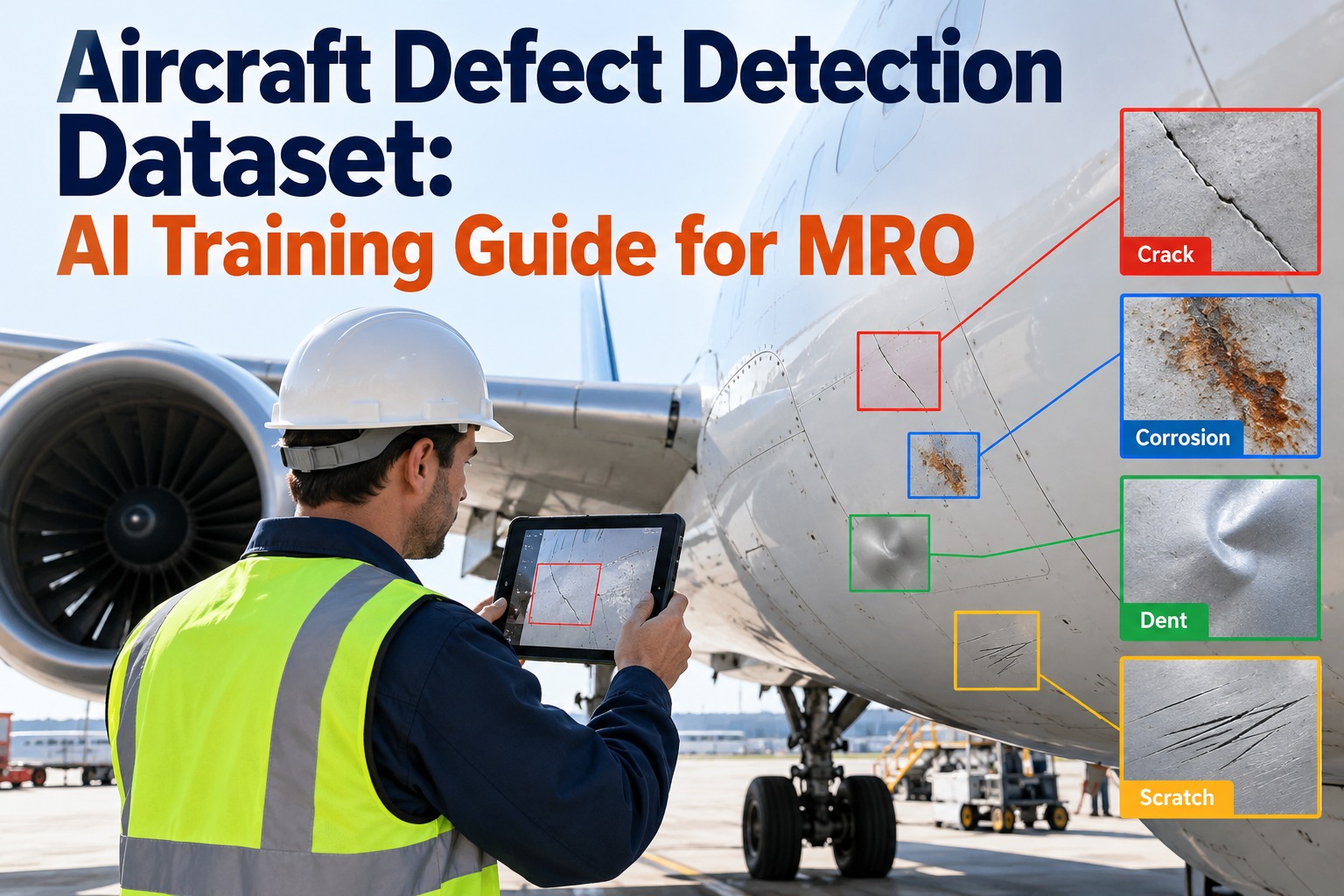
An AI model that finds cracks, corrosion and dents is only as good as the examples it learned from. A dataset built from a few hundred loosely labelled photos teaches a model to spot shadows, stickers and clean-looking panels, not damage. MRO teams that want reliable AI inspection need a different starting point: a well-defined defect taxonomy, consistent annotation, labels confirmed by real repair outcomes, and governance that keeps the data trustworthy over time. This guide walks through how to build an aircraft defect detection dataset step by step, and how a maintenance platform like OXMAINT AI, the AI-powered CMMS for aviation teams, supplies the confirmed findings that make labels credible.
MRO Artificial Intelligence · Training Data · OXMAINT AI-Powered CMMS
Aircraft Defect Detection Dataset: AI Training Guide for MRO.
Photos sit in one folder, findings in another, repair outcomes in a third. That is how label noise creeps into training data. OXMAINT AI connects inspections, defects, work orders and failure history in one platform, so every image can be tied to a confirmed outcome.
One connected workflow
1
Inspect & RequestPhotos and findings logged on mobile
▼
2
Issue or DefectRecorded on the aircraft asset
▼
3
Work OrderRepair outcome and sign-off captured
▼
4
PM & PredictiveFailure history informs future checks
Anatomy of One Training Sample
A useful sample is more than a photo. The metadata around the image is what lets you balance, audit and improve the dataset later. Here is an illustrative record. Sign up free and see how findings are recorded in OXMAINT AI.
Illustrative sample record
defect_classcrack
annotationbounding box / polygon
severityrepair required
zonefuselage, aft of door
capturelighting, angle, device
confirmed_bycertified inspector
outcomelinked work order
The 6-Stage Dataset Build
1
Define the taxonomy
Agree the defect classes, severity levels and zones before a single image is labelled.
2
Collect images deliberately
Cover aircraft types, lighting, angles, surface finishes and both damaged and healthy areas.
3
Annotate with written guidelines
Give annotators examples and edge cases so two people label the same image the same way.
4
Review with inspectors
Certified personnel confirm ambiguous labels, and disputed images are logged, not guessed.
5
Split and train
Separate training, validation and test sets carefully so no near-duplicate leaks across them.
6
Monitor and retrain
Feed corrected predictions and new confirmed findings back into the next dataset version.
Build a Defect Taxonomy That Annotators Can Actually Use
The most common dataset mistake is a vague class list. Keep classes clear, mutually exclusive and tied to how your maintenance manuals describe damage. Start small and expand once labelling is stable. Book a demo to see how defect records are structured.
Surface
Dent
Scratch / gouge
Paint & coating damage
Surface corrosion
Structural
Crack
Delamination / disbond
Impact damage
Lightning strike mark
Components & Fluids
Missing or loose fastener
Fluid leak / staining
Seal or sealant damage
Foreign object damage
Tip: add a "needs review" class for unclear cases, so uncertainty is recorded rather than forced into the wrong label.
Choosing the Right Annotation Type
Image label
Deciding whether an image contains a defect at all
Low
Bounding box
Locating dents, corrosion patches and fastener issues
Medium
Polygon / mask
Measuring thin or irregular damage such as cracks and paint loss
High
Labelling Accuracy: Three Habits That Protect Quality
Label quality matters more than label volume. A smaller, cleaner dataset often trains a more dependable model than a large noisy one. Start free and capture inspection findings in a consistent format.
1
Anchor labels to outcomes
Where possible, confirm labels against the repair record, not only the photo.
2
Double-label a sample
Have two annotators label the same subset and measure how often they agree.
3
Keep a decision log
Record how disputed cases were resolved, then fold the answers into the guidelines.
Your Best Labels Already Exist in Your Maintenance Records.
Confirmed findings, photos, repair actions and failure codes are created every day. OXMAINT AI keeps them linked, so they can become the ground truth behind your AI work.
5 Dataset Red Flags to Catch Early
Class imbalance
Rare but serious defects such as cracks are far outnumbered by common cosmetic ones.
Lighting and device bias
All damaged images come from one camera or hangar, so the model learns the setting.
Train/test leakage
Near-identical photos of the same damage appear in both sets and flatter the results.
Label noise
Inconsistent annotators teach the model contradictions.
Fleet blind spots
One aircraft type dominates, so performance drops on others.
Dataset Governance: Treat Training Data Like a Controlled Record
In aviation, trust depends on traceability. Treat each dataset version the way you treat maintenance records. Check your contracts and regulatory obligations before sharing or exporting images. Book a demo to talk through traceable records.
Provenance Where each image came from, which aircraft, when and who captured it
Versioning Every dataset release is numbered, with changes recorded
Access Defined roles for who can view, label, approve and export
Ownership Clear rights over customer and operator imagery
Review trail Who approved each label and when
Retention Agreed storage periods and a deletion process
The Active Learning Loop: Let the Model Ask for Help
After the first model is trained, you do not need to label everything. Active learning sends the images the model is least sure about to human reviewers, so effort goes where it improves accuracy most.
1
Predict
Model scores new images
→
2
Select
Uncertain cases are queued
→
3
Review
Inspectors confirm labels
→
4
Retrain
New version is released
How OXMAINT AI Supports Your Defect Data Foundation
OXMAINT AI is an AI-powered CMMS and EAM platform. It is not an annotation tool. It is the system of record where inspections, defects, work orders and failure history live, which gives your AI team confirmed, traceable source data. Start free and load your first assets into OXMAINT AI.
Inspection Management
Standard checklists so every inspector records findings in the same structure.
AI Vision Camera
Camera-based visual checks inside the maintenance platform. Book a demo to see how it fits your process.
Defect-to-Work-Order Trail
Each finding links to the repair, parts and sign-off, giving outcome evidence for labels.
Mandatory Failure Codes
Closeout rules build a consistent history of what failed and why.
Offline-First Mobile
Capture findings and photos at the aircraft, even where connectivity is weak.
Open API
Connect imaging and AI tools to your maintenance records through the API.
Frequently Asked Questions
How many images do I need for an aircraft defect detection dataset?
There is no single number. It depends on the number of defect classes, how varied the conditions are and how hard the defects are to see. Start with a focused set of classes, measure results, then add data where the model struggles.
Sign up free and start capturing structured findings.
Who should label aircraft defect images?
Can a CMMS replace an annotation tool?
How do I deal with rare defects like cracks?
Collect them deliberately, record every confirmed case, and use active learning to surface more examples. Track per-class results so rare defects are not hidden by average accuracy.
Book a demo to plan your data capture.
What is the best first step?
Better Labels Start With Better Maintenance Records.
Capture inspections, defects, repairs and failure history in one connected workflow. OXMAINT AI gives your MRO AI programme confirmed, traceable source data.