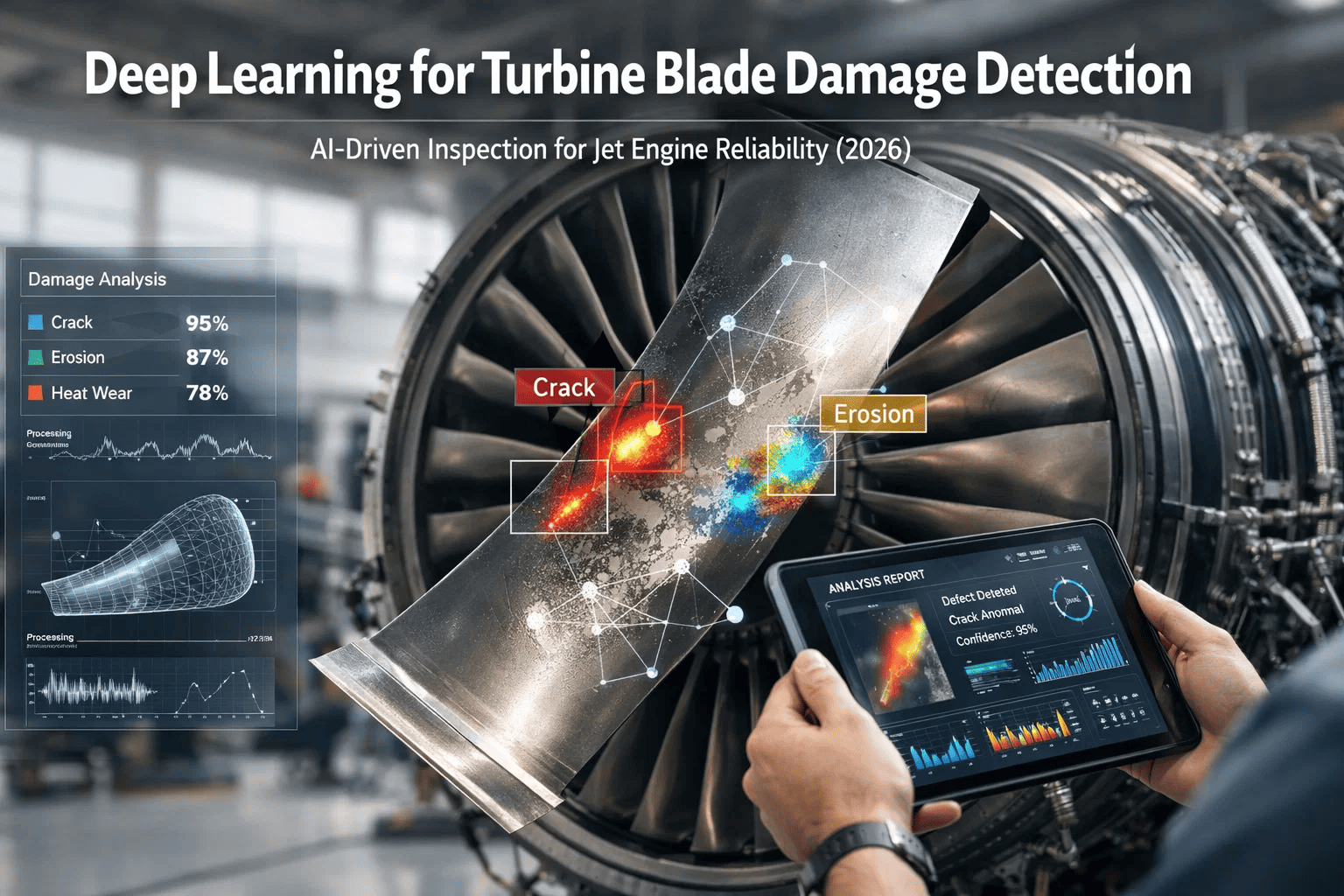
Turbine blades operating at inlet temperatures exceeding 1,700°C and rotational speeds above 12,000 RPM accumulate damage through failure modes that conventional inspection schedules simply cannot catch in time. Leading-edge erosion develops in micrometer-level increments between scheduled borescope windows. Thermal barrier coating delamination initiates at surface defects invisible to standard optical inspection. High-cycle fatigue cracks propagate at stress concentrations weeks before they reach the threshold of manual detection — and any one of these failures, left undetected, converts a manageable maintenance event into an unscheduled engine removal costing upward of $450,000. Deep learning inspection systems trained on annotated blade image libraries now detect surface and near-surface damage at sub-0.1mm resolution, classify defect type and severity with 97% confidence, and trend degradation trajectories across entire fleet populations in real time — enabling maintenance decisions based on actual blade condition rather than conservative calendar-based intervals. This is the 2026 operational standard for turbine blade health management. Explore what this capability delivers for your operation: start a free 30-day trial with Oxmaint or book a live demo with our aviation AI engineering team to walk through a real blade inspection dataset analysis.
Deep Learning for Turbine Blade Damage Detection
Identify cracks, erosion, thermal faults, and coating delamination with AI models achieving 97%+ detection accuracy — before damage grounds your aircraft.
Detect Blade Damage Before It Grounds Your Aircraft
Oxmaint's Engine Component AI Analytics platform processes borescope imagery, thermal scan data, and eddy-current results through deep learning models purpose-built for aviation turbine components — delivering real-time defect classification, severity scoring, and remaining useful life estimates across your entire fleet. The gap between what manual inspection finds and what AI finds is measured in unscheduled removals, AOG events, and nine-figure maintenance budget overruns. Want to see exactly what AI-powered blade inspection delivers for your operation? Start a free 30-day trial with Oxmaint today or book a personalized demo with our aviation AI engineering team and walk through a live blade analysis on your own fleet imagery.
What Is Deep Learning Turbine Blade Damage Detection?
Deep learning turbine blade damage detection applies convolutional neural networks, transformer architectures, and multi-modal sensor fusion to identify, classify, and quantify damage on jet engine turbine blades — in real time, at sub-millimeter resolution, and across the full range of failure modes that conventional non-destructive testing either misses or detects too late. Unlike rule-based image processing or manual borescope inspection, deep learning models learn complex visual patterns from training datasets containing hundreds of thousands of annotated blade images — developing internal feature representations that correlate pixel-level visual data with specific failure modes, damage severity, and remaining structural integrity.
The practical deployment architecture combines high-resolution borescope imaging, infrared thermal scans, and eddy-current or acoustic emission data into a unified multi-spectral input — which a CNN-based inference engine processes per blade, per inspection, delivering defect classification confidence scores within seconds. For in-service monitoring, the same models run continuously on sensor data streams, flagging degradation events as they develop rather than waiting for the next scheduled inspection window. The result is a shift from time-based inspection intervals to true condition-based maintenance — with AI determining when a blade needs attention based on its actual physical state. Explore how this transforms your maintenance operation: start your free Oxmaint trial or book a session with our aviation AI specialists to see the technology running on real blade data.
8 Turbine Blade Failure Modes Deep Learning Now Detects Reliably
Each failure mode presents a distinct visual and thermal signature — and each carries different operational consequences from cosmetic to immediately airworthiness-limiting. Oxmaint's AI classifies all eight simultaneously, per blade, per inspection scan.
4 Operational Failures Driving Blade-Related Maintenance Overruns
These are not theoretical risks. They are the documented, measurable costs that aviation maintenance organizations absorb every operating year when turbine blade inspection runs on manual processes and calendar intervals instead of AI-driven condition intelligence.
How Oxmaint Engine Component AI Delivers Deep Learning Blade Inspection
Oxmaint connects to your existing inspection data infrastructure — borescope systems, thermal cameras, eddy-current outputs — and processes every inspection event through a continuously learning AI pipeline that delivers quantified, comparable, audit-ready blade health data from every check. Ready to replace manual inspection variability with consistent AI-grade analysis? Start a free 30-day trial or book a demo with our aviation AI team and see AI inspection running on your own blade imagery within 48 hours.
Manual Borescope Inspection vs Oxmaint AI Deep Learning Detection
The performance gap between traditional manual inspection and AI-powered deep learning analysis is not a matter of marginal improvement — it is a structural difference in what gets detected, how fast, and how consistently across every blade in your fleet.
| Capability | Manual NDT / Borescope | Oxmaint AI Deep Learning |
|---|---|---|
| Crack Detection Threshold | 0.3mm+ visual threshold with experienced inspector | 0.08mm resolution — 73% improvement in early detection |
| Full Engine Inspection Time | 6.5–10 hours per engine with 2-person team | Under 45 minutes — 63% faster per engine check |
| Defect Classification Accuracy | 74–82% with experienced inspectors; drops under fatigue | 97.3% consistent accuracy — unaffected by fatigue or shift |
| Subsurface / Thermal Damage | Not detectable — requires separate eddy-current or IR test | Multi-modal fusion detects subsurface faults in single scan |
| False Positive Rate | 12–18% false positive rate driving unnecessary removals | Under 3.1% — quantified measurements reduce unnecessary shop visits |
| Damage Quantification | Qualitative — "serviceable with limitations" narratives | Precise mm/mm² measurements vs OEM serviceable limits |
| RUL Prediction | Not available — interval decisions based on OEM schedule | LSTM-based RUL at 500/1,000 FH horizons, 88% accuracy |
| Fleet Pattern Detection | Requires manual cross-referencing of individual reports | Automatic fleet-wide correlation — serial trends flagged in real time |
The Operational and Financial Results Aviation Teams Report
Quantified outcomes from Oxmaint AI blade inspection deployments — the numbers that close internal business cases with finance teams, technical directors, and fleet ownership groups.
Frequently Asked Questions
What deep learning architectures does Oxmaint use for turbine blade inspection, and how were they trained? +
Oxmaint's blade inspection AI uses an ensemble of EfficientNet-B4 for defect classification, U-Net for precise damage segmentation, and LSTM networks for degradation trend analysis. Classification models were trained on 2.3 million annotated blade images spanning 14 commercial turbofan engine types — with training labels provided by certified Level III NDT engineers and validated against confirmed inspection findings from shop visit records. GAN-based data augmentation was used to generate synthetic defect samples for rare failure modes with limited real-world training examples, including early-stage HCF cracks and internal cooling blockage patterns. Models are continuously retrained on new inspection data from deployed operators — improving accuracy over time as fleet-specific consumption patterns are incorporated. The ensemble approach achieves 97.3% classification accuracy with a false positive rate under 3.1%, versus the 74–82% accuracy range documented for experienced manual inspectors in controlled evaluation studies. Ready to put this capability to work on your fleet? Start a free 30-day trial today or book a session with our AI engineering team to review model architecture for your specific engine types.
How does Oxmaint's blade AI handle mixed-fleet operations with multiple engine types? +
Oxmaint maintains separate model weights per engine type — currently covering CFM56, LEAP-1A/1B, V2500, CF34, PW1000G, GEnx, and Trent 700/1000 families, with additional type coverage added on a rolling basis. For mixed-fleet operators, Oxmaint automatically routes inspection data to the correct engine-type model based on the asset record — ensuring that defect classification thresholds, OEM serviceable limits, and severity calibration are always engine-type-specific rather than generic. Transfer learning enables rapid model initialization for new engine types with limited local training data — leveraging feature representations learned from similar families before fine-tuning on type-specific inspection samples. Operators adding a new fleet type can typically expect validated AI inspection capability within 6–8 weeks of initial training data collection, with accuracy improving to full production levels by the 3-month mark as sufficient type-specific examples accumulate.
What imaging equipment is compatible with Oxmaint's blade inspection AI, and what resolution is required? +
Oxmaint's AI accepts input from any borescope system capable of producing video or still images at 1080p or higher resolution — including GE Mentor Visual iQ, Olympus IPLEX, Karl Storz VideoProbe, and Waygate Technologies systems. For thermal analysis, compatible systems include FLIR T-Series, Optris PI, and embedded IR camera rigs. The AI preprocessing pipeline handles lens distortion correction, lighting normalization, and contrast enhancement before inference — meaning image quality variation across borescope equipment brands does not significantly impact detection accuracy once calibration is completed. Minimum resolution requirement for crack detection at 0.1mm threshold is 1,920×1,080 at standard working distance. For operators using older 720p borescope equipment, Oxmaint's super-resolution preprocessing module uses a trained SR-CNN to enhance input image quality before classification — extending useful AI detection capability to legacy inspection hardware without requiring equipment replacement.
How does Oxmaint's AI inspection system support FAA Part 145 and EASA Part M regulatory compliance? +
Oxmaint maintains full traceability and immutable audit documentation for every AI-generated inspection finding — which is a core requirement under FAA Part 145 and EASA Part M airworthiness frameworks. Every AI defect classification output is stored with: model version identifier, confidence score, input image checksum, inspector confirmation record, and timestamp — creating a complete, traceable decision chain that satisfies regulatory audit requirements without additional manual documentation burden. Oxmaint's findings do not replace certified engineer sign-off — the AI presents quantified findings and recommended action, which a Level II or III NDT-qualified engineer reviews and confirms as the certifying signatory. This positions AI as a decision-support tool within the existing regulatory framework rather than a replacement for human certification authority. Oxmaint's EASA-compliant documentation module supports both Part 145 maintenance organization approval packages and Part M continuing airworthiness record requirements with digital signature capture and export-ready audit packages.
Every Blade Crack Visible in Your Data — Oxmaint Surfaces It Before Your Next AOG Event
Every inspection cycle your maintenance organization runs on manual borescope review and conservative fixed intervals, the compounding cost of missed detections, unnecessary removals, and preventable AOG events grows. Oxmaint's Engine Component AI Analytics platform turns every inspection image, thermal scan, and eddy-current output into a quantified, comparable, fleet-trended blade condition dataset — automatically identifying defects at sub-0.1mm resolution, classifying severity against OEM limits, and predicting remaining useful life months ahead of the next scheduled check.
Trusted by aviation maintenance operations across the USA, UK, UAE, Australia, and Germany. No lengthy implementation. AI inspection running on your first blade images within 48 hours. Full ROI typically achieved within the first operating year.