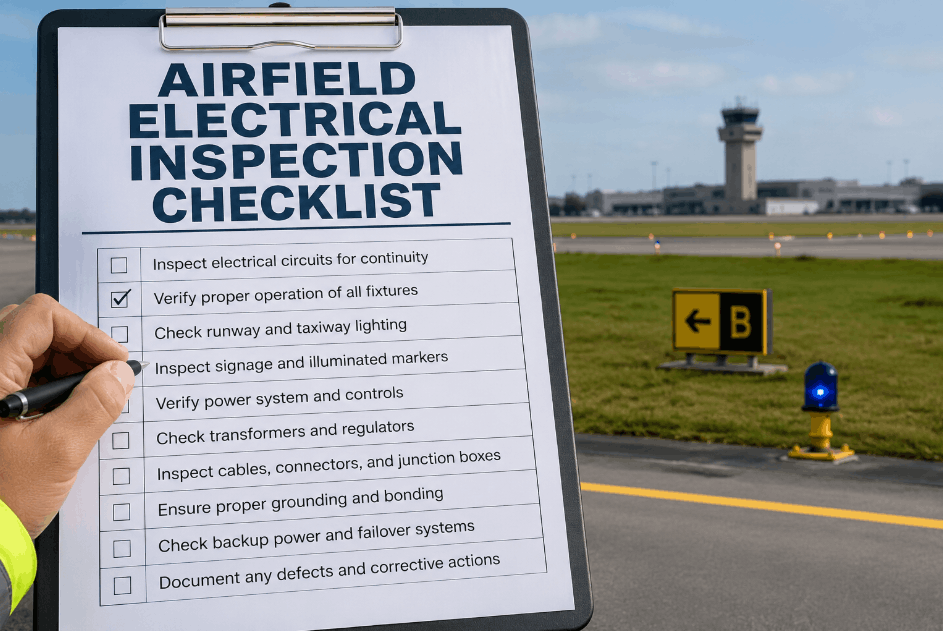
The airfield electrical vault is the one room where a single fault can go dark across an entire runway. Constant current regulators drive the series lighting circuits, isolation transformers keep each fixture's loop closed, and the whole system runs on insulation that degrades quietly, year over year, until a wet cable or a drifting regulator takes a circuit down — often on the night you can least afford it. FAA AC 150/5340-26C doesn't leave that to chance: it sets a maintenance cadence from nightly checks to annual insulation testing, with the records kept at the vault for review. This checklist lays out that program by frequency, so nothing is skipped between certifications. OxMaint AI schedules every vault task, logs the readings, and turns a resistance trend into a work order before it becomes an outage.
Airfield Electrical Vault Inspection: PM Checklist Guide
The vault runs the runway's lighting — and its failures are rarely sudden. Insulation declines, a regulator drifts off a brightness step, moisture creeps into a direct-buried transformer, and the warning is in the trend long before the outage. A structured PM program, run to the FAA AC 150/5340-26C cadence, catches it in time. This guide organizes the full vault checklist by frequency — nightly, monthly, semi-annual, annual — with the tests and readings each demands. OxMaint schedules the cadence, trends the results, and keeps the vault record FAA-ready.
The Vault Inspection Checklist, by Frequency
The program is built on cadence — each interval catches a different class of problem, and skipping one leaves a blind spot until the next certification. Here's the full checklist organized the way it's actually run. Start free and schedule every interval in OxMaint AI.
- Visual operational check of fixtures on all brightness steps
- Vault control operation confirmed from the control point
- Regulator on/off and step response verified
- Any dark or dim fixtures logged for follow-up
- Relay operation checked across all circuits
- Fuse holders and breakers inspected and exercised
- Meter readings recorded at the vault control point
- CCR output current compared to expected per step
- Isolation transformers checked for moisture and connector condition
- Vault housekeeping, ventilation, and signage confirmed
- Photometric testing on precision approach runways
- PAPI aiming verified and adjusted as needed
- Fixture cleaning and lens condition on approach lighting
- Connector and buried-transformer spot checks
- Full insulation resistance test per series circuit at the vault
- CCR output verified at every brightness step, not just the one in use
- Resistance results trended against each circuit's baseline
- Grounding and bonding continuity checked in the vault
- Records reconciled and retained for FAA review
Run this way, the vault is never more than a month from its last full equipment check and never more than a night from a known-good runway. Book a demo to load this cadence into OxMaint.
Constant Current Regulators: Hold Every Step
The CCR drives fixed current through the series circuit, and pilots rely on it holding the exact brightness commanded. The trap is checking only the step in use — a regulator can be perfect at one level and drifting at another. Start free and log CCR output per step in OxMaint.
A Circuit Doesn't Fail on Inspection Day. It Fails on the Trend You Didn't Track.
Insulation resistance rarely collapses overnight — it declines a little each year until a wet cable finishes the job. Recorded once as a pass, that decline is invisible. Trended per circuit against its baseline, a steeper-than-normal decline is a scheduled repair weeks ahead of the outage — and weeks ahead of an FAA certification finding.
Insulation Resistance: Trend It, Don't Just Pass It
Series-circuit cable is the quiet failure point of the whole airfield. The reading that matters isn't this year's number — it's the slope from baseline. Book a demo of per-circuit resistance trending in OxMaint.
Because it's the slope that warns, resistance is tested and trended per circuit — never filed as a single pass/fail. Start free and trend every circuit in OxMaint.
The FAA AC 150/5340-26C Cadence at a Glance
The circular sets the intervals; a CMMS keeps them from slipping. This is the backbone schedule for a compliant vault program. Book a demo to automate this schedule in OxMaint.
| Interval | Core task | Record |
|---|---|---|
| Daily / Nightly | Visual operational check on all steps; vault control operation | Dark-fixture log |
| Monthly | Relays, fuse holders, breakers; meter readings at the vault | Vault reading sheet |
| Semi-Annual | Photometric testing on precision approaches; PAPI aim | Photometric results |
| Annual | Full insulation resistance test per circuit; CCR output all steps | Trended resistance log |
Precision approach runways carry the tighter rhythm — photometric testing at least twice a year. Start free and hold the cadence per runway in OxMaint.
How OxMaint Runs the Vault Program
Every regulator, circuit, and fixture becomes its own asset, so scheduling, readings, trends, and records live against the equipment itself — and the FAA record assembles itself. Start free and turn the vault checklist into a managed program.
Frequently Asked Questions
Keep the Runway Lit — and Prove You Can.
A vault failure is a dark runway, and it almost always announces itself first in a trend nobody was tracking. Run the checklist to the FAA cadence, trend every circuit, verify every CCR step, and the outage becomes a scheduled repair — with the record ready for certification. OxMaint schedules the program, tracks the trends, and keeps the vault FAA-ready.