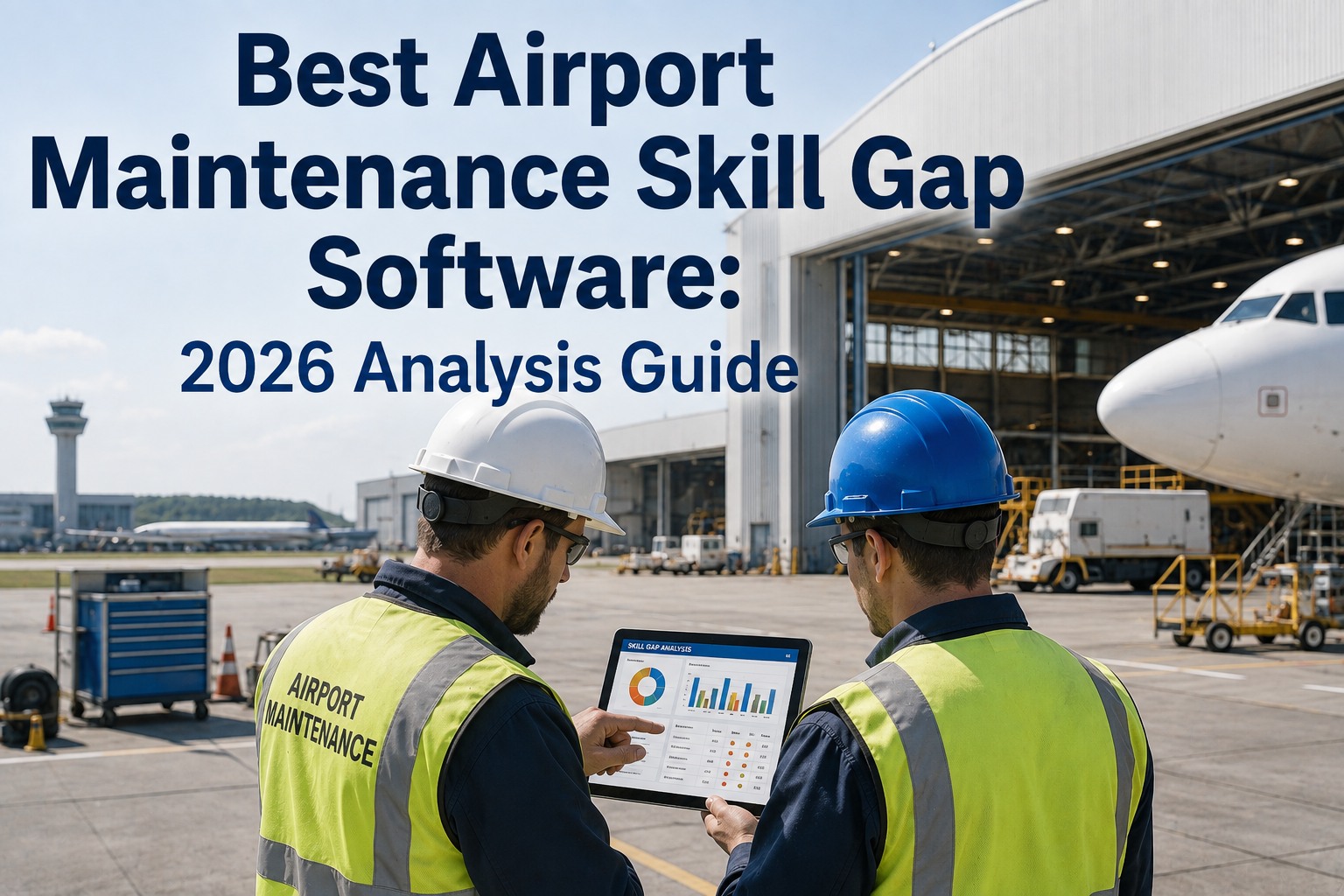
Every airport maintenance program is one retirement notice away from a capability it can no longer perform. When a 40-year-old aviation technician retires, roughly 60% are already over 60 in the current workforce — the airport doesn't just lose a headcount, it loses the only person who knew the override sequence on the jet bridge, the quirk in the baggage handling drive, the undocumented fix for the terminal HVAC. Boeing projects the industry will need 710,000 new maintenance technicians globally by 2044, and North America is already short an estimated 17,000 today. For an airport running 24/7 against safety, compliance, and passenger-experience pressure, the skill gap is not an HR line item — it's an operational risk that shows up as slower repairs, missed certifications, and knowledge that walks out the door forever. This guide breaks down what the best airport maintenance skill gap software actually does in 2026, the capabilities that separate a real skill-gap platform from a checkbox feature, and how to score your options. Book a free skill-gap assessment against your airport's current maintenance roster.
710K
New maintenance technicians the aviation industry needs globally by 2044 (Boeing forecast)
~60%
Share of aviation maintenance technicians over 60 — a knowledge-transfer cliff, not a slope
17,000
Estimated current technician shortfall in North America — widening every year
15–45%
Range of technician "wrench time" — proving productivity, not just headcount, is the lever
Why the Airport Skill Gap Is a Software Problem, Not Just a Hiring Problem
The instinct is to solve a skill shortage by hiring. But the aviation pipeline can't keep up — about one-third of maintenance technician training seats sit unfilled, retirements outpace new certifications, and every airport is competing for the same shrinking pool. The airports that stay reliable through the crunch aren't the ones that hire fastest. They're the ones that make the skills they already have visible, transferable, and matched to the right work order. That is a data problem, and the CMMS is the only system positioned to solve it.
Knowledge Is Invisible Until It's Gone
Two decades of asset-specific know-how live only in one technician's head. Without a system that maps who can do what, the airport can't see the gap until the person is already retired.
Wrench Time Beats Headcount
Technician productivity varies from 15% to 45% across the industry. Getting more usable hours from the team you have often beats winning a bidding war for scarce new hires.
Compliance Can't Wait for Memory
Certifications lapse, renewals get missed, and under-qualified assignments create safety exposure. Skill-gap software turns this from a manual spreadsheet into an automated, audit-ready control.
The Six Capabilities the Best Skill-Gap Software Actually Has
"Skill tracking" appears on nearly every CMMS feature list. What separates a real airport skill-gap platform from a checkbox is whether these six capabilities work together — turning a static roster into a living workforce intelligence layer that feeds work-order assignment, training, and capital planning.
01
Live Competency Matrix
A real-time map of every technician against every required skill and proficiency level — so the coverage gap on a critical asset is visible on a dashboard, not discovered during an outage.
02
Certification & Renewal Tracking
Automated alerts before licenses, endorsements, and safety certifications expire — so no technician is assigned to work they're no longer certified to perform. Zero missed renewals is the standard.
03
Skills-Based Work Routing
Competency data acts as gating logic: work orders release only to technicians with verified proficiency on that specific asset and task — preventing under-qualified assignments before they happen.
04
Passive Knowledge Capture
Every closed work order captures diagnostic steps, resolution notes, and parts used — building a searchable knowledge base from daily work, so tribal expertise is encoded before the retirement dinner.
05
Structured Training Paths
Individual development plans tied to the highest-priority gaps, with verified competency sign-off on completed work orders — so a skill rating reflects demonstrated field capability, not just course attendance.
06
Multi-Site Skill Visibility
Portfolio-level view across terminals, airfield, and facilities in one dashboard — so leadership can see coverage risk by shift, location, and critical asset across the whole operation.
See Your Airport's Skill Coverage Map in 30 Minutes
Working session with our aviation reliability team — bring your maintenance roster and critical asset list. We'll show how OxMaint builds a live competency matrix, flags certification renewals, and routes work orders by verified skill across your operation.
How to Score a Skill-Gap Platform · The 2026 Evaluation Table
Most CMMS vendors will claim skill management. The distinction shows up when you test each capability against the airport's actual reality — a 24/7 operation, a retiring workforce, and compliance stakes. Use the criteria below during vendor selection.
Capability
Basic CMMS
Best-in-Class Skill-Gap Platform
Competency matrix
Static spreadsheet, updated rarely
Live, auto-updates on verified work order completion
Certification tracking
Manual calendar reminders
Automated renewal alerts, zero missed expirations
Work assignment
Supervisor picks from memory
Skill-gated routing to verified-proficient technicians
Knowledge capture
Notes lost in closed tickets
Searchable knowledge base built from every closure
Training linkage
Separate LMS, disconnected
Development plans tied to real gap data and work orders
Multi-site view
Per-site silos
Portfolio dashboard, coverage risk by shift and asset
The Knowledge-Transfer Window · Why 2026 Is the Year to Act
Maintenance organizations have roughly a five-year window to transfer expertise before the bulk of senior technicians retire. The cost of waiting isn't abstract — it's measured in downtime hours, safety incidents, and months of onboarding time. The chart below reflects the reality across the aviation workforce today.
Wrench time (industry low)
The gap between 15% and 45% wrench time is the productivity headroom skill-gap software unlocks — matching the right technician to the right work order and removing the friction that wastes skilled hours.
How OxMaint Closes the Airport Skill Gap
OxMaint is built for the exact workflow airport maintenance leaders need — structured assets, a live competency matrix, automated certification tracking, skills-based work routing, and passive knowledge capture that turns every closed work order into retained institutional knowledge.
Matrix
Live Competency Map
Every technician mapped against every required skill and asset — coverage gaps visible on a dashboard before they become an outage.
Certs
Automated Renewal Alerts
Licenses, endorsements, and safety certifications tracked with expiry alerts — no technician assigned to work they're not certified to perform.
Routing
Skill-Gated Work Orders
Work orders release only to verified-proficient technicians — the right person responds to every failure event, every time.
Capture
Passive Knowledge Base
Diagnostic steps, resolution notes, and parts used captured on every closure — building searchable standard work from daily activity.
Training
Gap-Driven Development
Individual development plans tied to real gap data, with competency verified on completed work — not just course attendance.
Scale
Multi-Site Intelligence
Portfolio-level coverage view across terminals, airfield, and facilities — workforce risk by shift, location, and critical asset in one place.
Stop Losing Decades of Expertise Every Retirement
Turn the airport's skill gap from an invisible risk into a managed program. See how OxMaint maps competency, tracks certifications, routes work by verified skill, and captures knowledge before it walks out the door. Free forever plan available.
Frequently Asked Questions
What is airport maintenance skill gap software?
It's a CMMS capability that maps every maintenance technician against the skills, certifications, and asset-specific knowledge the airport needs — then makes the gaps visible and manageable. The best platforms combine a live competency matrix, automated certification renewal tracking, skills-based work-order routing, passive knowledge capture from closed work orders, structured training paths tied to real gap data, and a multi-site coverage dashboard. Together these turn workforce risk from something discovered during an outage into a controlled program leadership can act on.
Why is the aviation skill gap so urgent in 2026?
Boeing forecasts the industry will need 710,000 new maintenance technicians globally by 2044, with roughly 123,000 of those in North America. Meanwhile the region is already short an estimated 17,000 technicians, and around 60% of the current aviation maintenance workforce is over 60. About a third of technician training seats sit unfilled, so hiring alone can't close the gap. Maintenance organizations have roughly a five-year window to transfer senior expertise before the bulk of it retires — which is why capturing and mapping skills now is the priority.
Book a free assessment to map your window.
How does a CMMS actually help with skill gaps?
In three ways. First, it captures knowledge passively — every completed work order records diagnostic steps, resolution notes, and parts used, building a searchable base of standard work. Second, it tracks competency and certifications, updating a technician's skill rating when a supervisor verifies demonstrated capability, and alerting before certifications expire. Third, it routes work by skill, so work orders release only to technicians with verified proficiency on that specific asset — preventing under-qualified assignments and getting more usable hours from the team you already have.
Can't we just hire our way out of the shortage?
Hiring is part of the answer, but it can't be the whole answer — the pipeline is constrained, roughly a third of training seats are unfilled, and every airport is competing for the same shrinking pool. The more durable lever is productivity: technician wrench time varies from 15% to 45% across the industry, so getting more usable hours from existing staff often beats winning a bidding war for scarce hires. Skill-gap software raises both retention and productivity by matching the right person to the right work and giving newer technicians the digital procedures and asset histories that replace years of tribal knowledge.
Does OxMaint support airport-scale skill gap management?
Yes. OxMaint provides a live competency matrix, automated certification and renewal tracking, skills-based work-order routing, passive knowledge capture from every closure, gap-driven training paths with verified competency sign-off, and a multi-site dashboard showing coverage risk by shift, location, and critical asset. It runs as structured maintenance management — assets, PM automation, mobile work orders, and leadership reporting — so the skill program scales alongside operations. A free forever plan is available to trial the full workflow.
Sign up free to start mapping skills.