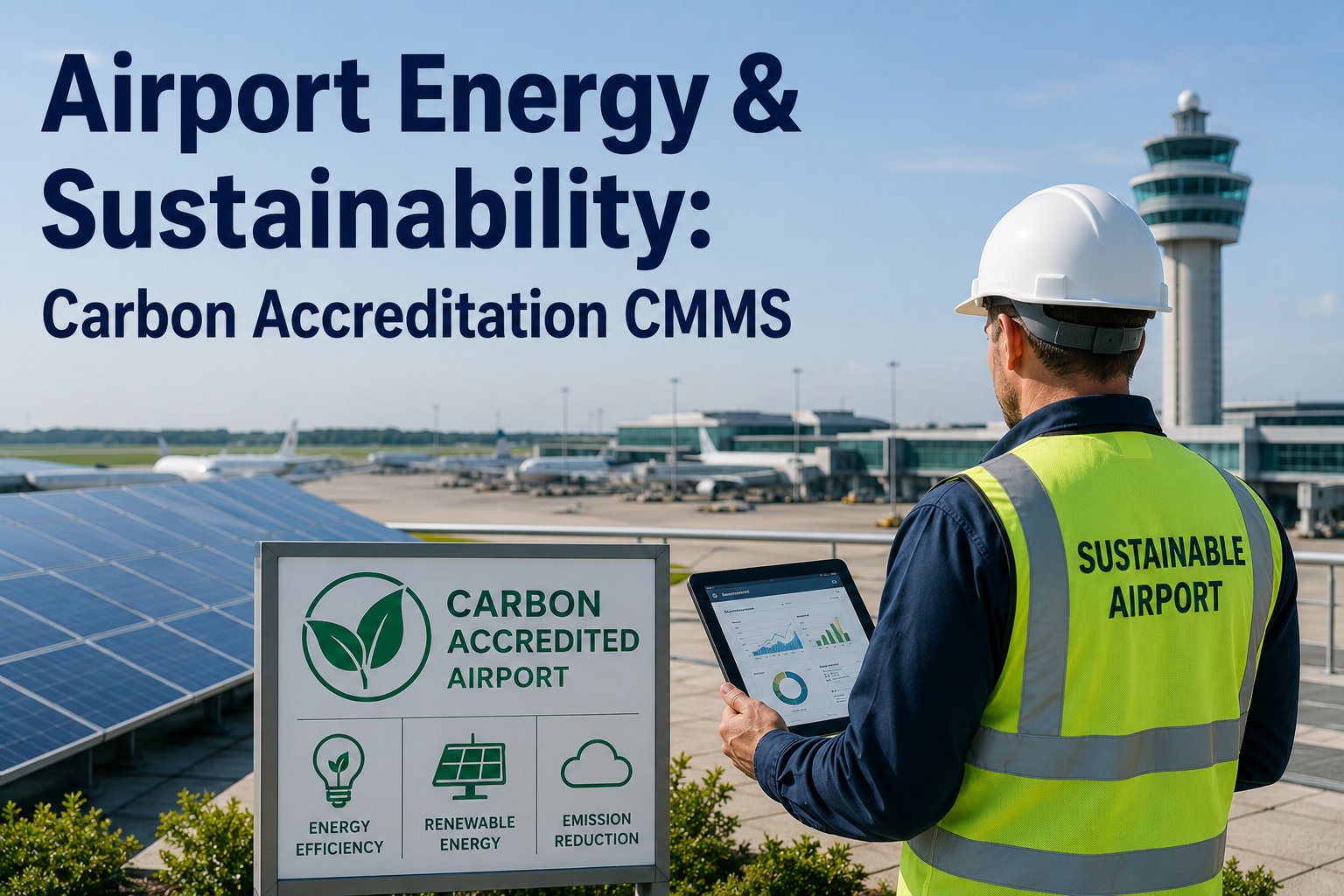
When an Airport Carbon Accreditation verifier sits down with your submission, they don't want a headline number — they want the trail behind it: which meter, which fuel delivery, which F-gas top-up, and whether the figures reconcile. That evidence already exists inside your maintenance operation, scattered across meter logs, fuel records and refrigerant service sheets. The gap is that it lives in spreadsheets and binders instead of one traceable record. This guide maps every Scope 1 and 2 emission source to the maintenance data that proves it, and shows how OXMAINT AI turns your CMMS into the evidence backbone. See it on your assets with a live demo.
Airport Sustainability · ACA Evidence · Scope 1–2 · 2026
Airport Carbon Accreditation: Maintenance Scope 1–2 Data Guide
ACA accreditation is won or lost on evidence quality — not ambition. The activity data behind your Scope 1 and 2 numbers already lives in your maintenance operation. OXMAINT AI is the AI-powered CMMS that ties every meter read, fuel record and F-gas log to a timestamped asset, so your carbon inventory reconciles the first time a verifier checks it.
Meters · fuel · F-gas logs
→
Asset-linked records
→
Scope 1–2 activity data
→
Verifier-ready evidence
One record, source to submission
Every meter read tied to its asset
Fuel & F-gas logs as timestamped evidence
Chiller & plant efficiency trended
Audit-ready export for your verifier
The 7 Levels — and Where Scope 1–2 Evidence Carries the Weight
ACA runs on seven certification levels, from first mapping your footprint to maintaining a net-zero balance. Scope 3 grows in importance as you climb, but Scope 1 and 2 — the emissions you directly own and control — form the evidence base at every single level. Get that base clean and the rest is built on solid ground. Start free and organise your Scope 1–2 evidence in OXMAINT AI.
1
Mapping
Quantify the Scope 1 & 2 footprint and inventory every emission source.
2
Reduction
Set targets and prove year-over-year cuts against a 3-year rolling average.
3
Optimisation
Expand the footprint to third parties operating inside the airport boundary.
3+
Neutrality
Offset residual controlled emissions with high-quality carbon credits.
4
Transformation
Set an absolute reduction target aligned to the Paris pathways.
4+
Transition
Offset residual controlled emissions with recognised offsets.
5
Net-Zero Balance
Maintain ≥90% absolute Scope 1 & 2 cuts and address all Scope 3.
Every level rests on a verified Scope 1 & 2 inventory — independently checked under ISO 14064 by an approved verifier. The cleaner your activity data, the smoother that verification.
Scope 1 vs Scope 2: What Counts, and What Proves It
The GHG Protocol splits your controlled emissions into two buckets. Scope 1 is what you burn or leak directly; Scope 2 is the electricity you buy. Each source has a specific piece of maintenance evidence a verifier will ask for — and that's exactly what a CMMS is built to hold. Book a demo to see these sources mapped to your assets.
Scope 1 · Direct
Emissions you own and control
Stationary combustion
Boilers, heaters, standby generators — gas & diesel meter reads
Mobile combustion
GSE fleet, shuttles, ops vehicles — fuel-card & delivery records
Fugitive emissions
Refrigerant / F-gas leaks — service logs & top-up quantities
Process emissions
De-icing fluid, on-site wastewater — usage & batch records
Scope 2 · Indirect (Energy)
Energy you purchase and use
Purchased electricity
Terminal, airfield, plant loads — supplier invoices & meter data
Purchased heat / steam
District or on-site supply — metered consumption records
Purchased cooling
Bought chilled water — sub-meter reads by circuit
Green tariff / PPA
Clean-supply contracts — certificates & market-based factors
The Number Isn't the Hard Part. The Evidence Is.
Any consultant can calculate a tonne of CO₂e. What stalls an ACA submission is the audit trail underneath it — the meter read nobody logged, the F-gas top-up recorded on a paper sheet, the fuel delivery that doesn't reconcile. OXMAINT AI captures each of these as a timestamped, asset-linked record the moment the work happens, so the evidence is already built when the verifier arrives.
The 7 Gases Behind the Number
A GHG inventory isn't only CO₂. The GHG Protocol requires you to account for seven gases — and two of them, the refrigerants, are pure maintenance data that never appears on a utility bill. Miss the F-gas log and your Scope 1 number is quietly wrong. Sign up free and log every refrigerant top-up against its asset.
CO₂
Carbon Dioxide
Fuel combustion
N₂O
Nitrous Oxide
Combustion, process
HFCs
Hydrofluorocarbons
Refrigerant / F-gas
PFCs
Perfluorocarbons
Refrigerant / F-gas
SF₆
Sulphur Hexafluoride
Switchgear
NF₃
Nitrogen Trifluoride
Electronics
Refrigerants are high-GWP — small leaks, big numbers. Only your maintenance logs capture them.
From Work Order to Verified Number: The Evidence Chain
Good carbon evidence isn't a report written once a year — it's a chain that starts the moment a technician logs a reading and ends at the verifier's desk. Break any link and the number loses its defensibility. Here's the chain OXMAINT AI keeps intact end to end. Book a demo to walk this chain on your own data.
1
Capture at source. Meter read, fuel delivery or F-gas top-up logged against the specific asset, with who and when — not on a clipboard.
2
Attach the factor. Each activity figure paired with the correct emission factor (national, IPCC or supplier) so the conversion is transparent.
3
Reconcile. Consumption cross-checks against invoices and deliveries, so gaps and double-counts surface before the verifier finds them.
4
Baseline & trend. Roll figures into the 3-year average and track year-over-year, the exact shape ACA's Reduction level asks for.
5
Export for verification. One consistent evidence pack — the same datasets to ACA and to your ISO 14064 verifier.
Chiller & Plant Efficiency: Where Reduction Gets Proven
Reduction levels demand evidence that emissions actually fell — and terminal HVAC is usually the biggest controllable Scope 2 load. A chiller drifting out of efficiency quietly raises your electricity draw and your carbon number. Trending plant performance is how you both catch the drift and prove the reduction. Sign up free and trend your chiller efficiency in OXMAINT AI.
Chillers
Efficiency (kW/ton) trended over time. A rising curve means more electricity per unit of cooling — a Scope 2 increase you can catch and correct.
Boilers & Heating Plant
Gas consumption per degree-day. Rising burn against weather-normalised demand flags a Scope 1 problem before the annual bill does.
Cooling Towers & AHUs
Condition and run-hours tracked so degraded equipment doesn't silently push the whole HVAC system's energy draw up.
Airfield & Building Lighting
Circuit-level loads and LED-retrofit savings evidenced — a clean before/after that documents a real reduction.
Where OXMAINT AI Fits: Your CMMS as the Evidence Backbone
Most airports still compile carbon evidence by hand from spreadsheets and paper the week before submission. OXMAINT AI holds the activity data as it's created, so the inventory is a by-product of normal maintenance — not a scramble. Here's what it puts in your sustainability team's hands. Sign up free and turn your CMMS into your ACA evidence base.
Asset-Level Energy Records
Every meter, fuel record and F-gas log tied to the specific asset that produced it — the granularity a verifier expects.
Timestamped Digital Evidence
Every reading and service carries who, what and when — defensible records that replace unsigned paper sheets.
Meter & Utility Integration
Consumption data flows in from meters and utility records, so activity figures reconcile against invoices automatically.
F-Gas & Refrigerant Ledger
Every top-up quantity captured against its unit — the only reliable source for the high-GWP part of Scope 1.
Efficiency Trending
Chiller and plant performance tracked over time, so you catch drift early and evidence real year-over-year reduction.
Audit-Ready Export
One consistent evidence pack for ACA and your ISO 14064 verifier — compiled from live data, not rebuilt by hand.
"
Our first ACA cycle was a fortnight of chasing meter logs, matching fuel deliveries and hunting for the refrigerant sheets the HVAC crew kept in a folder. The number was fine — proving it nearly broke us. Once every meter read and F-gas top-up went into OXMAINT AI against its asset, the evidence pack stopped being a project. The verifier asked for the trail behind a figure and we had it on screen in seconds instead of days.
Sustainability & Facilities Lead · Regional Airport
Frequently Asked Questions
What's the difference between Scope 1 and Scope 2 at an airport?
Scope 1 is direct emissions from sources the airport owns or controls — boilers, the GSE fleet, refrigerant leaks and de-icing. Scope 2 is indirect emissions from purchased energy, mainly electricity for terminals, airfield and plant. Both are within the airport's operational control and form the ACA evidence base.
Why does refrigerant data matter for carbon accreditation?
Refrigerants (HFCs and PFCs) have very high global warming potential, so even small leaks add meaningful Scope 1 emissions. They never appear on a utility bill — maintenance and F-gas logs are the only source, which is why a CMMS record of every top-up is essential to a complete inventory.
Does a verifier really need the maintenance-level detail?
Yes. ACA footprints are independently verified (typically under ISO 14064), and verifiers trace activity data back to its source — meter reads, delivery records, service logs. The same datasets you submit to ACA must reconcile with what you give the verifier, so source-level evidence is what makes the number defensible.
How does OXMAINT AI help with the year-over-year reduction requirement?
ACA's Reduction level compares emissions against a 3-year rolling average. Because OXMAINT AI holds consumption and efficiency data continuously per asset, it builds that baseline and tracks the trend as normal work happens — so the reduction evidence is ready rather than reconstructed each cycle.
Does OXMAINT AI replace our carbon accounting software?
No — it feeds it. OXMAINT AI is the operational evidence backbone: it captures the asset-level activity data and timestamped records that your carbon calculation and reporting rely on, so the numbers you report trace cleanly back to source.
Make Your Next ACA Submission an Export, Not an Expedition.
Every Scope 1 and 2 number you report should trace back to a meter read, a fuel record or an F-gas log. Capture them in OXMAINT AI as the work happens, and your evidence pack is ready before the verifier asks.