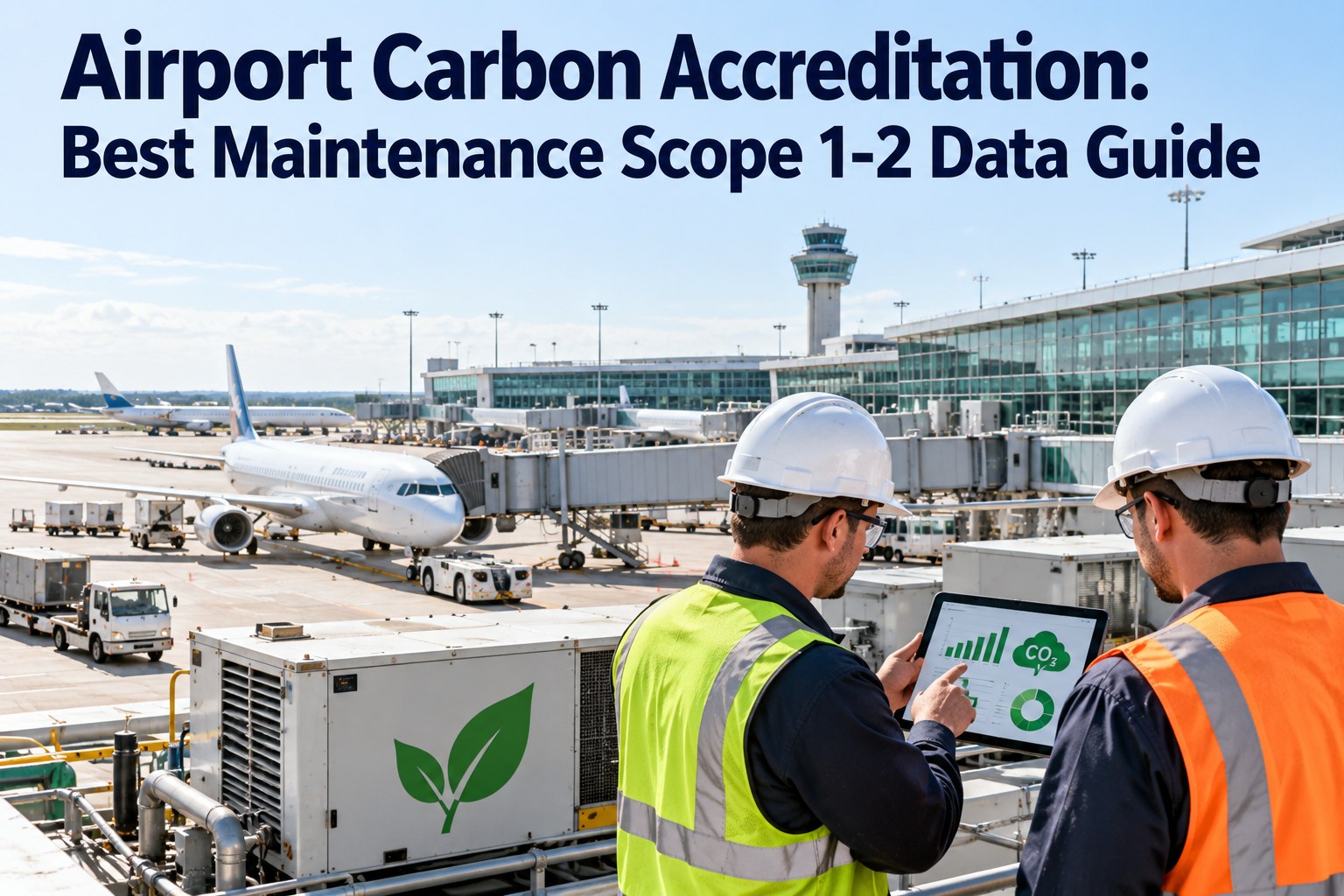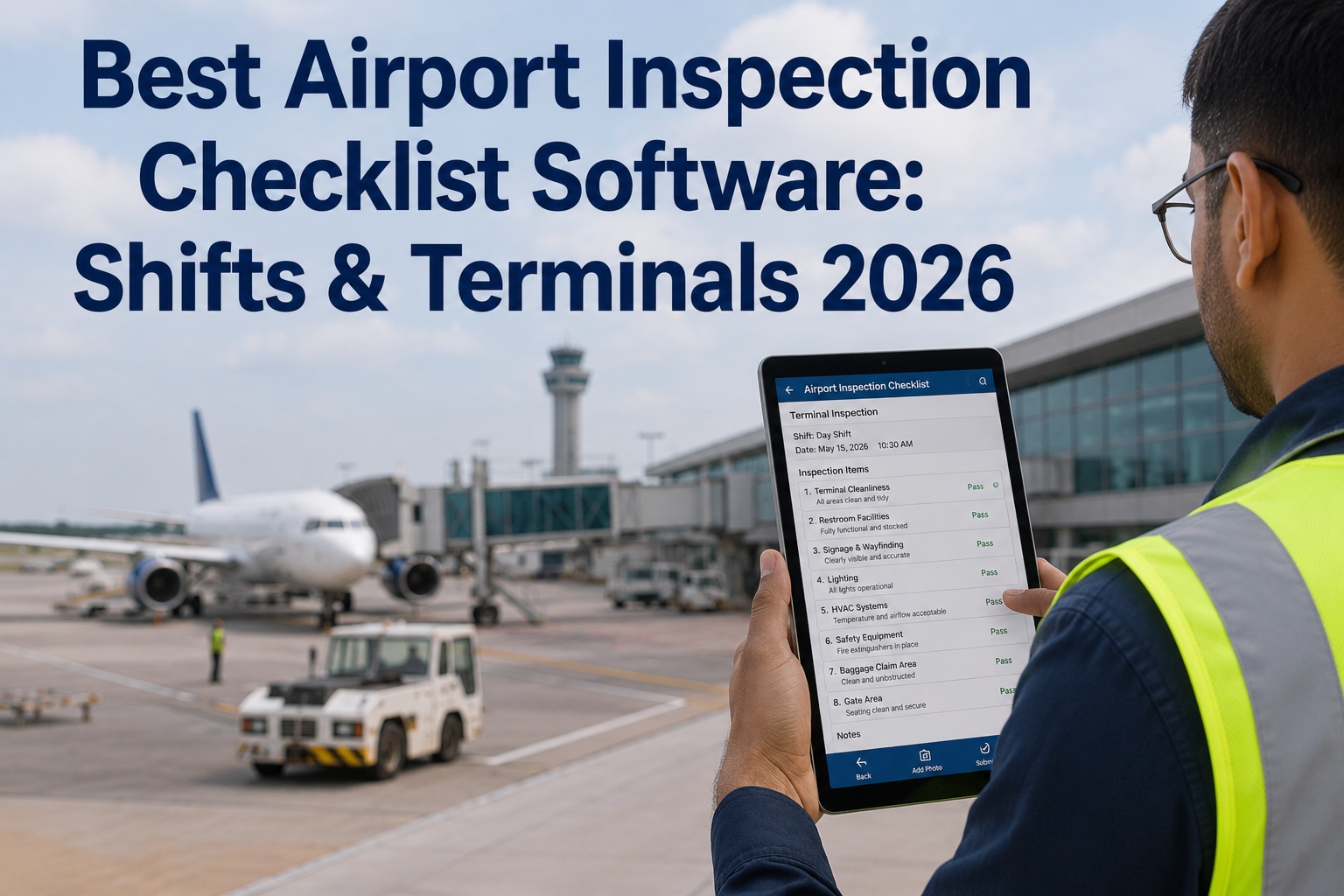
Airport energy and sustainability programs now hinge on maintenance data as much as renewable installations, because HVAC plant, baggage conveyors, and electric ground support equipment collectively drive 60–80% of a terminal's controllable kilowatt-hours. ACI Airport Carbon Accreditation, ISO 50001 alignment, and airline ESG mandates each require defensible kWh-per-terminal tracking, solar output logging, and a documented PM trail—exactly the data that a CMMS built for airport sustainability captures, structures, and reports on automatically. Whether your team manages a Level 2 certification renewal or is planning the path to Level 4+ neutrality, embedding energy and carbon metrics inside your maintenance platform eliminates spreadsheet sprawl and creates an audit-ready evidence trail. This airport sustainability guide for 2026 walks through energy PM, electric GSE integration, HVAC efficiency tracking, and carbon-accreditation reporting through a CMMS lens—and you can Start Free Trial to see the workflows live on your assets.
Can your CMMS prove carbon reduction to ACI auditors — or just file work orders?
Airport energy and sustainability programs lose credibility without maintenance-linked evidence. OxMaint ties every kWh, every solar watt, and every electric GSE charge event to a work-order trail, so your ACA submission is defensible, your ISO 50001 checks are audit-ready, and your ESG reporting is real.
ACI Carbon Accreditation fails without CMMS-backed energy evidence
The Airport Carbon Accreditation programme requires airports to demonstrate year-over-year carbon reductions — not just intent. Yet up to 70% of Scope 1 and Scope 2 emissions at a mid-size airport trace back to assets that maintenance teams own: boilers, chillers, AHUs, lighting circuits, baggage belts, and the diesel GSE fleet transitioning to electric.
A carbon accreditation CMMS closes the evidence gap. When every preventive maintenance task, every meter reading, and every asset replacement is logged with an energy tag, sustainability managers can produce a verifiable reduction narrative in hours rather than weeks. Without it, airports resort to manual data pulls across five or six systems, and auditors flag gaps — costing re-submission fees and, at Level 3 and 4, reputational damage with airline partners.
A 14-million-passenger regional airport spent 11 weeks assembling its ACA Level 3 renewal dossier, pulling data from BMS logs, finance invoices, and 14 spreadsheets maintained by three different engineers. After implementing OxMaint as their airport sustainability CMMS, the same dossier took 4 days to assemble — with every kWh figure traceable to a work order or meter log.
The four sustainability data streams every airport CMMS must track
Airport energy sustainability isn't one metric — it's four interlocking data streams. Each one needs a structured home inside your CMMS so that ACA, ISO 50001, and ESG reports draw from a single source of truth.
Energy-linked preventive maintenance schedules
Filter changes, coil cleaning, chiller tube brushing, and BMS recalibration are scheduled as PMs with an energy-impact tag. Each completed task logs the estimated kWh saved — typically 3–8% per asset — feeding directly into your carbon reduction ledger.
kWh-per-terminal monitoring and HVAC COP tracking
OxMaint ingests meter data and normalises it against passenger throughput and degree-days, producing a kWh-per-terminal metric that auditors expect. Chiller COP, boiler efficiency, and AHU static pressure trends flag degradation before it becomes a 15% energy penalty.
Rooftop and field solar generation tracking
Solar arrays on terminal roofs and parking canopies feed clean kWh back into the airport grid. OxMaint logs daily generation, flags underperformance against nameplate capacity, and auto-creates inspection work orders when output drops beyond a 5% variance band.
Electric ground support equipment charge management
As airports electrify GSE fleets, charge-event logging becomes critical for Scope 1→Scope 2 accounting. OxMaint tracks each charger session, links it to a vehicle asset, and schedules smart-charging PMs to avoid peak-demand spikes that inflate utility bills by 20–30%.
How to map ACI carbon accreditation levels to CMMS workflows
Each ACA level demands progressively deeper data. Here's how a CMMS airport sustainability platform supports the journey from Level 1 mapping to Level 5 neutrality — and what to set up at each stage.
Establish the carbon baseline
Tag every energy-consuming asset in OxMaint with a location, meter ID, and fuel type. Export the asset register as the foundation for your Scope 1 and Scope 2 inventory. Most airports complete this in 3–6 weeks.
Prove year-over-year energy cuts
Activate energy-linked PMs — coil cleaning, filter swaps, setpoint audits — and log kWh impact per task. OxMaint's analytics dashboard compares current-period consumption against the baseline, producing the reduction evidence ACA auditors require.
Engage stakeholders and third parties
Share CMMS dashboards with airlines, concessionaires, and ground handlers. Track their energy-reduction actions as work orders inside OxMaint, so third-party contributions are documented and verifiable during the Level 3 audit.
Align with ISO 50001 and offset residual emissions
OxMaint's ISO 50001 alignment module maps energy management system requirements to CMMS workflows — energy planning, monitoring, measurement, and continual improvement — so your EnMS audit and ACA Level 4 submission share the same evidence base.
Sustainability formulas and KPIs your airport CMMS should calculate
These are the core equations that translate raw maintenance and meter data into the metrics ACA, ISO 50001, and ESG frameworks demand. OxMaint computes them automatically from logged work orders and integrated meter feeds.
kWh per Terminal
The baseline intensity metric for ACA Level 1. A well-run terminal typically lands between 250–450 kWh/m²/year; airports above 500 kWh/m²/year have immediate PM-driven savings opportunities of 15–25%.
Energy PM Savings
Quantifies the kWh rescued by preventive maintenance. OxMaint tags each completed energy PM with the measured delta, building a cumulative reduction ledger that feeds directly into your ACA renewal dossier.
Solar Performance Ratio
A PR below 0.75 triggers an automatic inspection work order in OxMaint. Dirty panels, inverter faults, and shading issues typically drop PR by 8–15% — catching them early recovers thousands of kWh per array annually.
Carbon Reduction Percentage
The headline ACA metric. OxMaint converts energy savings and renewable generation into tCO₂e using local grid emission factors, then reports CR% by terminal, by asset class, and by PM category for full audit traceability.
How OxMaint powers airport energy and sustainability programs
OxMaint is an AI-powered CMMS and EAM platform built for maintenance and reliability teams. For airport sustainability leaders, it transforms maintenance data into carbon evidence — automatically.
Energy-tagged work orders
Every PM and corrective task carries an energy-impact tag, so completed work auto-populates your carbon reduction ledger. Airports typically document 8–15% energy savings in year one — directly attributable to maintenance.
ACA-ready reporting dashboards
Pre-built dashboards map to ACA Level 1–5 requirements, pulling kWh, tCO₂e, solar output, and GSE charge data into a single view. Export your renewal dossier in 4 days instead of 11 weeks — with every figure traceable to a work order.
Predictive HVAC efficiency
AI models analyse chiller COP trends, AHU static pressure, and BMS setpoint drift to predict efficiency losses 2–4 weeks before they impact kWh. Airports using OxMaint cut unplanned HVAC energy waste by 25–40%.
ISO 50001 EnMS alignment
OxMaint maps energy planning, monitoring, measurement, and continual improvement workflows to ISO 50001 clauses — so your EnMS audit and ACA submission share one evidence base, cutting dual-audit effort by 50–60%.
"OxMaint turned our maintenance logs into our strongest sustainability evidence. We assembled our ACA Level 3 renewal in under a week, and for the first time every kWh-saving claim linked back to a completed work order."
See OxMaint track your terminal's energy — book a 30-minute demo
Watch how energy-tagged work orders, solar output tracking, and ACA-ready dashboards replace spreadsheets and manual data pulls. Your sustainability dossier, built from maintenance truth.
Airport energy, sustainability, and CMMS — what teams ask
How does a CMMS support ACI Airport Carbon Accreditation?
A CMMS supports ACA by logging every energy-related maintenance task — filter changes, coil cleaning, cheller overhauls, solar inspections — with a kWh-impact tag, creating a verifiable reduction trail. OxMaint's dashboards aggregate these savings into the year-over-year carbon reduction evidence that ACA Levels 2 through 5 require, replacing manual spreadsheet assembly with audit-ready exports.
Can a CMMS track kWh per terminal for sustainability reporting?
Yes. OxMaint ingests meter data per terminal zone, normalises it against floor area and passenger throughput, and calculates kWh/m²/year — the core intensity metric for ACA and ISO 50001. You can view trends by terminal, by asset class, or by PM category, and export directly into your sustainability report. To see it on your meter data, Book a Demo.
What sustainability metrics should an airport CMMS track in 2026?
At minimum: kWh per terminal, chiller and boiler efficiency (COP/AFUE), solar performance ratio, electric GSE charge events, tCO₂e by scope, and energy-PM savings delta. Advanced airports also track water consumption, waste-to-landfill diversion, and refrigerant leak rates — all of which OxMaint can tag to work orders and assets.
How does electric GSE integration work in a CMMS?
Each electric GSE unit is registered as an asset with a battery capacity, charger ID, and charge-event log. OxMaint tracks every charging session, schedules battery-health PMs, and flags peak-demand charging that inflates utility costs. This data feeds Scope 2 accounting and supports the GSE electrification evidence that ACA Level 3 and 4 submissions increasingly require.
Is OxMaint aligned with ISO 50001 energy management requirements?
Yes. OxMaint maps its workflows to ISO 50001 clauses for energy planning, monitoring, measurement, and continual improvement. Energy reviews, significant energy-use identification, operational controls, and corrective actions all live inside the platform, so your EnMS audit and ACA submission draw from the same evidence base — cutting dual-audit effort by 50–60%.
Turn maintenance data into your strongest sustainability evidence
Join airports using OxMaint to cut energy waste 15–25%, assemble ACA dossiers in days not weeks, and prove every carbon-reduction claim with a work-order trail. Start free or book a personalised demo today.
Free 14-day trial · No credit card