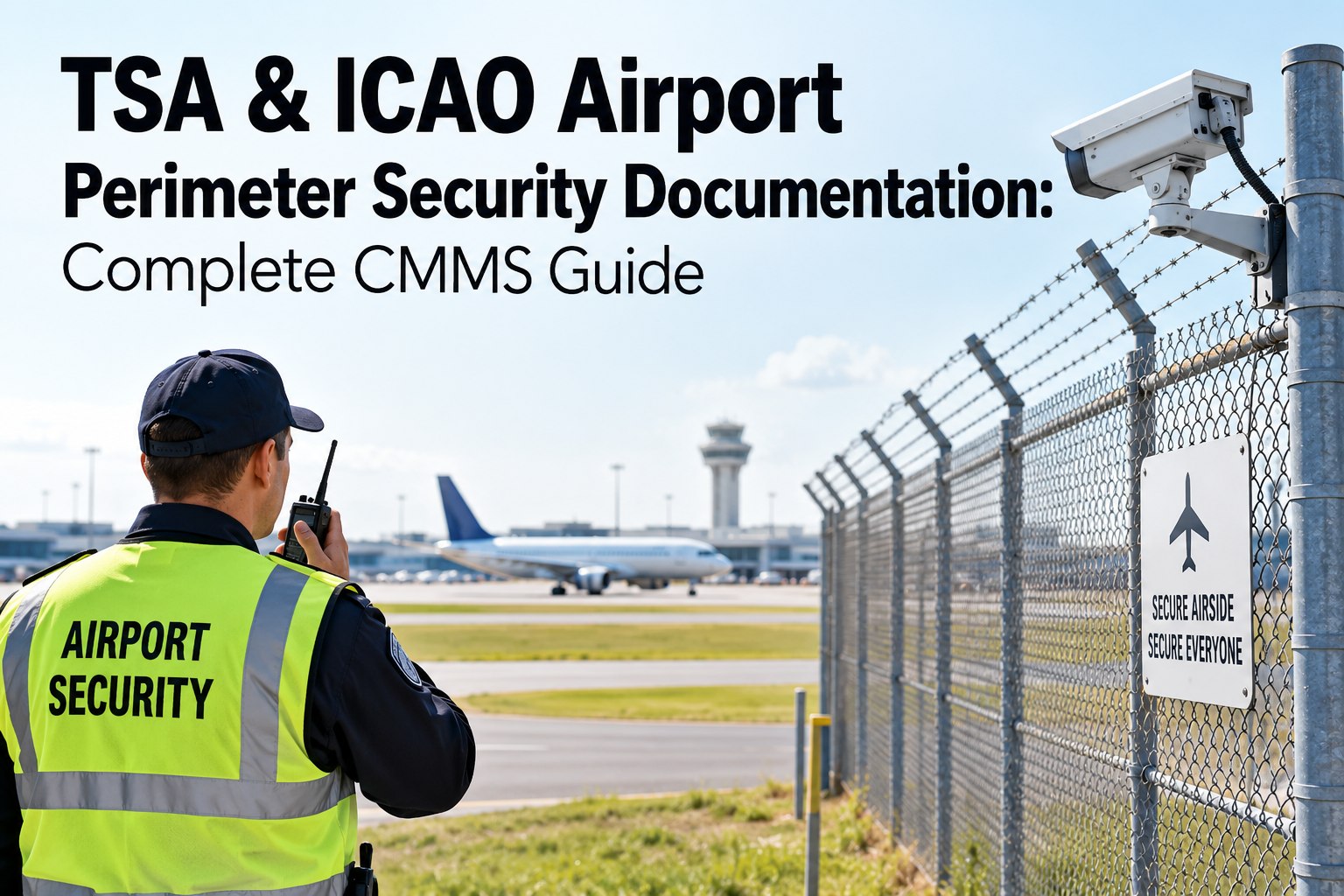
TSA 49 CFR Part 1542 doesn't accept a verbal assurance that your perimeter fence was checked last Tuesday — it requires airports to maintain a documented Airport Security Program with inspection records an inspector can actually pull. Civil penalties for security violations at commercial airports run $11,000 or more per day, and industry data attributes the large majority of perimeter breaches to physical infrastructure failures — a gate sensor, a fence panel, a camera — not sophisticated attacks. ICAO Annex 17 adds its own layer for international operations, requiring documented access control and perimeter security measures as part of a state's overall security programme. None of this is optional paperwork; it's the record that shows your patrols, tests and corrective actions actually happened. This guide walks through what TSA and ICAO Annex 17 expect to see documented, and how OXMAINT AI organizes that evidence trail in one system instead of a filing cabinet.
Aviation Security · TSA & ICAO Annex 17 · Perimeter Documentation · 2026
TSA & ICAO Airport Perimeter Security Documentation: Complete CMMS Guide
When an inspector asks for your last twelve months of perimeter patrol logs, "we have them somewhere" isn't an answer. OXMAINT AI connects the full documentation workflow in one platform: perimeter patrols and sensor tests get logged digitally, any finding becomes a tracked corrective-action work order, and every record — patrol, test, repair and closure — stays retrievable in one place instead of split across paper logs, spreadsheets and email threads.
Patrol / Test Logged
→
Finding Flagged
→
Corrective Work Order
→
Record Retained
$11,000+/day
civil penalty range for security violations at commercial airports under TSA rules
82%
of perimeter breaches attributed to physical infrastructure failure, not system attacks
Daily
minimum inspection frequency commonly required for security-critical perimeter zones
12 mo
typical minimum retention period expected for perimeter inspection documentation
What TSA & ICAO Annex 17 Actually Expect to See Documented
Neither framework asks for a fence — they ask for proof the fence is checked, tested and fixed on a documented schedule. Sign up free and start logging your perimeter patrols digitally today.
TSA 49 CFR Part 1542
Requires a documented Airport Security Program covering perimeter inspection — conducted, recorded and retained. Verbal confirmation of a check doesn't satisfy the requirement.
ICAO Annex 17
Requires contracting states to implement layered access control and perimeter security measures as part of a national aviation security programme, with the evidence to show the layers function.
Inspection Frequency
Security-critical perimeter zones typically require daily or near-daily checks — a frequency that's difficult to prove after the fact without a timestamped digital log.
Corrective Action Trail
Finding a defect isn't the end of the requirement — regulators expect to see it fixed, and the fix documented against the original finding.
Where Perimeter Documentation Actually Breaks Down
📝
Paper Logs That Go Missing
A patrol sheet from eight months ago is exactly the kind of record an inspector asks for — and exactly the kind that's easiest to lose in a filing cabinet.
✉️
Findings Trapped in Email
A technician emails a supervisor about a damaged fence panel. There's no formal record tying that email to a completed repair.
📉
Inconsistent Inspection Frequency
Daily checks slip during short-staffed weeks, and there's no dashboard flagging the gap until an inspector's records request does.
🔗
No Link From Finding to Fix
The inspection log says "sensor fault noted." Nothing connects that entry to the work order — or confirms the sensor was ever repaired.
The Perimeter Documentation Record Chain
Every regulator wants the same thing at the end of the day: a chain that runs unbroken from the check, to the finding, to the fix, to the closed record. Book a demo to see a patrol log turn into a closed, retained record.
1
Patrol or test conducted
Fence walk, gate test or sensor check performed on schedule by patrol or maintenance staff.
→
2
Digitally logged
Entry timestamped and attached to the specific zone or asset — not a general note in a shared notebook.
→
3
Finding flagged
Any defect or anomaly noted during the check is recorded against that zone's inspection history.
→
4
Corrective work order
A work order is created from the finding, assigned to a technician, with the original entry attached as context.
→
5
Record retained
Closure evidence links back to the original finding, and the full chain stays retrievable for the retention period.
A Finding With No Linked Corrective Action Isn't a Record. It's a Loose End.
OXMAINT AI keeps every patrol, test, finding and repair connected in one chain — so "we checked it" and "we fixed it" are the same retrievable record.
Paper & Spreadsheet Logs vs. a Digital Record Chain
Paper Logs & Spreadsheets
Records scattered across binders, sheets and email
Inspection frequency gaps invisible until requested
Findings and repairs live in separate, unlinked records
Retrieving twelve months of history means physically searching
Digital Record Chain in OXMAINT AI
Every patrol, test and repair in one searchable system
Missed inspection intervals visible on a dashboard, not discovered later
Every finding links directly to its corrective work order
Any date range pulls up in minutes, not a filing-room search
What a Reviewer Typically Wants to Examine
✓
Patrol & inspection logs by zone, with timestamps and inspector name
✓
Sensor, gate and PIDS test records showing tests were actually run, not just scheduled
✓
Corrective action records showing each finding was assigned, worked and closed
✓
Evidence that inspection frequency was actually met across the retention period, not just on paper
✓
A record retained and retrievable for the full period your program requires
What OXMAINT AI Gives Airport Security & Facilities Teams
Digital Patrol & Test Logging
Perimeter patrols, gate tests and sensor checks logged from a mobile device, timestamped and tied to the specific zone or asset.
Finding-to-Work-Order Linking
A finding logged during a patrol becomes a work order automatically, with the original entry attached for context.
Inspection Frequency Tracking
Dashboard visibility into which zones are on schedule and which checks are overdue, before a records request surfaces the gap.
Corrective Action Closure Records
Every repair closes back against the originating finding, so the chain from check to fix stays intact and retrievable.
Configurable Retention
Records stay stored and searchable for the retention period your program requires, without a manual archiving process.
Exportable Records by Date Range
Pull any zone's patrol, test and corrective action history for a given period in minutes when it's requested.
"
Our perimeter patrol logs used to live on paper sheets that got filed in a binder by shift — finding a specific week from eight months back meant someone physically going through pages. Once we moved patrols and gate tests into OXMAINT AI, every entry is searchable by zone and date, and a finding from a patrol doesn't just sit there — it's already linked to the work order that closed it. Pulling a full record for a specific date range now takes minutes instead of an afternoon.
Airport Security Operations Manager · Regional Commercial Airport
Frequently Asked Questions
Does using OXMAINT AI mean our airport is TSA or ICAO compliant?
No single software tool makes an airport compliant — compliance depends on your Airport Security Program, your procedures, and how consistently they're followed. OXMAINT AI is a documentation and work order system that helps organize the patrol, test and corrective-action records your program requires, so they're consistent, retained and retrievable.
What records does TSA 49 CFR Part 1542 expect for perimeter security?
Part 1542 requires airports to maintain a documented Airport Security Program that includes conducted, recorded and retained inspections of perimeter security elements — verbal assurance that a check happened isn't sufficient on its own.
How does a finding during a patrol turn into a tracked repair?
When a patrol or test logs a defect, OXMAINT AI creates a work order linked to that specific finding. When the repair closes, the closure record stays attached to the original entry, so the full chain from check to fix is retrievable together.
How long should perimeter inspection records be retained?
Retention requirements vary by jurisdiction and your specific Airport Security Program, but a commonly cited minimum is around twelve months. OXMAINT AI lets you configure retention periods to match what your program specifies.
Make Every Patrol, Test and Repair a Record You Can Actually Find.
Stop hoping the binder has last spring's log. OXMAINT AI keeps every perimeter patrol, test and corrective action connected in one retrievable chain.