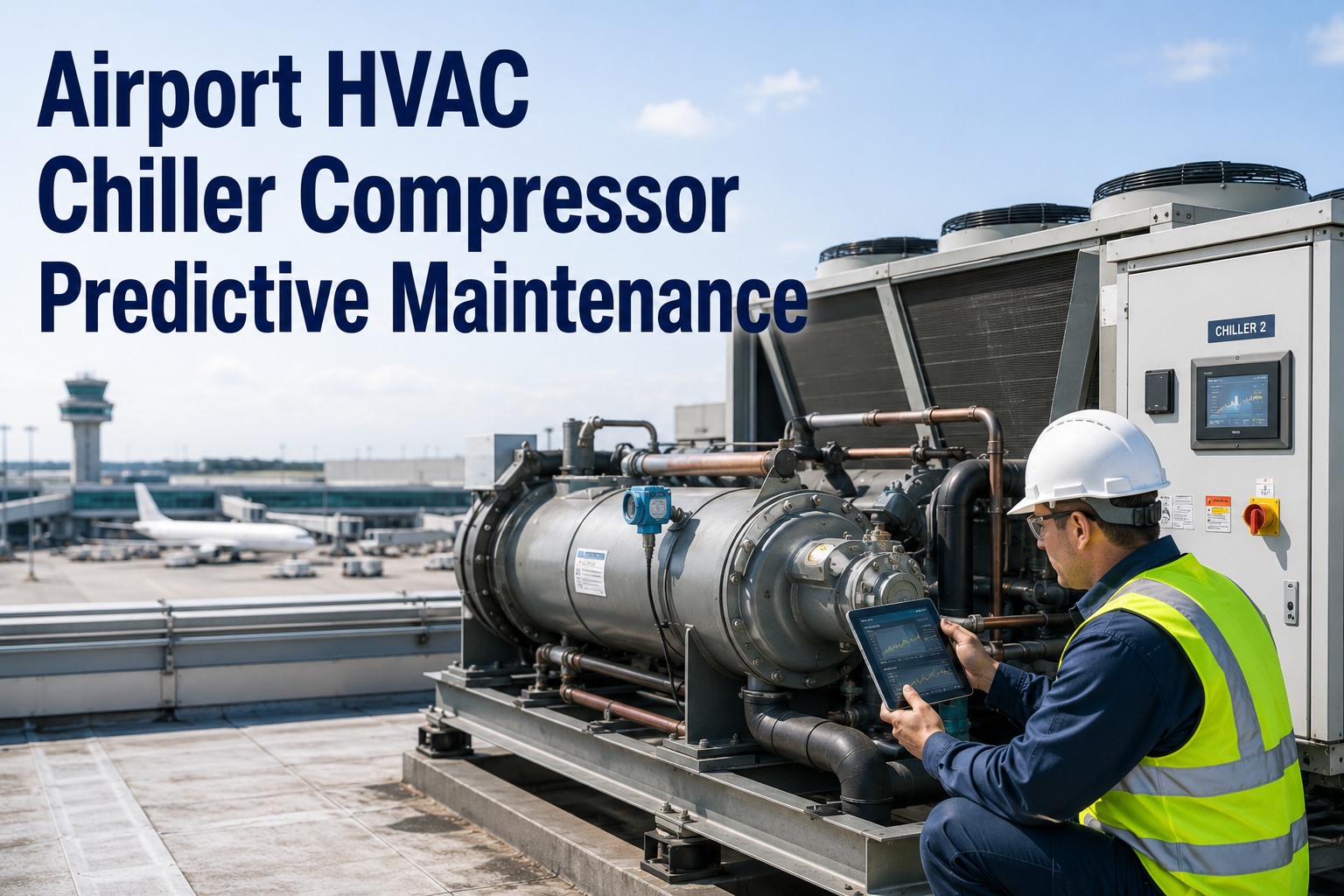
Airport HVAC chiller predictive maintenance is the difference between a comfortable July concourse and a 2,000-passenger evacuation caused by a single compressor failure. This guide covers how airport facilities teams use CMMS-based chiller AI alerts, compressor vibration trending and terminal climate system health scoring to keep 500-ton centrifugal chillers ahead of failure — without adding overtime PM labor. You will learn the exact predictive signals to monitor, how a modern CMMS chiller compressor strategy pays for itself in one avoided outage, and how to deploy an airport HVAC CMMS guide that works for your 2026 reliability roadmap. Ready to stop reacting? Start Free Trial and deploy your first AI alert in under an hour.
Can your terminal chiller survive a 95 deg. F July weekend — without a single unplanned shutdown?
A failed airport chiller compressor can spike terminal temperatures past 85 deg. F in under 90 minutes, grounding flights and triggering emergency evacuations. Airport HVAC chiller predictive maintenance catches the failure 14–60 days early — at one-tenth the cost of a reactive repair.
Four Chiller Failure Indicators Every Airport HVAC CMMS Should Track
Most terminal chiller failures announce themselves weeks in advance. The problem is that paper logs and reactive maintenance let those signals slip through. A CMMS chiller AI alert system continuously watches these four indicators — flagging deviations long before a comfort complaint is ever filed.
Compressor Vibration Trending
A 1X RPM vibration spike on a centrifugal compressor bearing typically precedes a catastrophic failure by 21–45 days. ISO 10816 vibration severity zones (A through D) provide the benchmark. OxMaint ingests vibration sensor data and auto-creates a priority work order when a chiller crosses from Zone B into Zone C — turning raw FFT data into action without manual analysis.
Approach Temperature Drift
Approach temperature (condenser leaving water minus refrigerant saturation temp) should hold steady within 1–3 deg. F. A gradual 2 deg. F rise over two weeks signals tube fouling or non-condensable buildup. Left unchecked, it cuts chiller efficiency by 8–15% and stresses the compressor. OxMaint logs every reading and flags drift trends automatically.
Refrigerant Leak Detection
Centrifugal chillers holding 500–2,000 lbs of R-134a or R-1233zd lose 2–5% of charge annually through micro-leaks. A 10% undercharge cuts cooling capacity by 20% and can overheat the compressor motor. CMMS-based leak trend charts — fed by weekly log data or inline sensors — catch the leak before EPA Section 608 reporting thresholds are breached.
Oil & Motor Health
Compressor oil acidity (TAN) above 0.1 mg KOH/g and moisture content above 50 ppm indicate refrigerant decomposition and bearing wear. Monthly oil sampling stored in the CMMS creates a longitudinal health record. When TAN trends upward over three consecutive samples, OxMaint auto-schedules an oil change and bearing inspection work order.
How to Build an Airport Chiller Predictive Maintenance Program in 90 Days
A phased rollout prevents technician overwhelm and delivers a measurable win inside one quarter. Here is the proven CMMS chiller predictive guide that airport facilities teams use to go from reactive to predictive — fast.
Baseline & Asset Registration
Inventory every chiller in the CMMS: make, model, tonnage, refrigerant, compressor type, install date and baseline sensor readings. Upload existing log sheets and PM checklists. OxMaint's bulk-import tool ingests 500+ assets in under 20 minutes — no spreadsheet left behind.
FoundationsInstrument & Threshold Setting
Mount vibration sensors on compressor bearings, connect approach-temperature logs and set initial alert thresholds based on OEM baselines and ISO 10816. Define three severity tiers: Watch (Zone B), Alert (Zone C) and Critical (Zone D). OxMaint's rules engine routes each tier to the correct technician automatically.
InstrumentationAI Activation & First Catch
Turn on CMMS chiller AI alerting. The system begins correlating vibration, approach temp, refrigerant pressure and oil quality into a single chiller health score (0–100). By week 10, most airports log their first true predictive catch — typically a bearing-wear trend on a secondary compressor — proving the ROI before the peak cooling season.
Go-LiveThe Real Cost of Reactive Airport Chiller Maintenance
Consider a mid-sized airport with four 500-ton centrifugal chillers, running 24/7 from May through September. A single unplanned compressor failure in July costs far more than the repair bill alone.
| Metric | Reactive (Status Quo) | CMMS Predictive (OxMaint) |
|---|---|---|
| Unplanned chiller downtime / year | 18–36 hours | < 3 hours |
| Mean time to repair (MTTR) | 22 hours | 6 hours (planned) |
| Overtime labor (May–Sept) | $48K | $9K |
| Energy efficiency penalty | 12–18% wasted kWh | 2–4% baseline |
| EPA Section 608 compliance risk | High (manual logs) | Audit-ready (digital trail) |
| Annual chiller O&M cost (4 units) | $340K | $190K |
One avoided compressor failure pays for an entire year of OxMaint — and most airports see two to three near-miss catches in the first cooling season alone.
How OxMaint CMMS Powers Airport HVAC Chiller Predictive Maintenance
OxMaint is an AI-powered CMMS and EAM platform built for the maintenance and reliability teams who cannot afford a 3 a.m. July callout. Here is how four core capabilities map directly to your terminal chiller challenge.
CMMS Chiller AI Alert Engine
OxMaint ingests real-time vibration, approach-temperature and refrigerant-pressure data from your BAS or standalone sensors. The AI correlates multi-variable trends and fires an alert 14–60 days before failure — with a recommended corrective action pre-attached to the work order.
Automated PM & Work Order Scheduling
Replace clipboard-based monthly PM checklists with digital work orders that auto-generate based on runtime hours, calendar intervals or condition triggers. Technicians receive step-by-step procedures, OEM manuals and required spare parts on their mobile device — eliminating paper and missed steps.
Spare-Parts Inventory for Chillers
Track critical spares — bearing kits, shaft seals, refrigerant drums, contactors — by serial number, min/max levels and bin location. When an AI alert fires, OxMaint checks stock, flags shortages and auto-generates a purchase request so the part is on-site before the technician starts the repair.
Maintenance Analytics & Health Scoring
Every chiller gets a live 0–100 health score rolled up to a terminal-level dashboard. Reliability engineers see MTBF, MTTR, energy-efficiency trends and PM compliance rates in real time — giving airport directors the audit-ready reporting they need for capital planning and FAA Part 139 compliance.
In our first summer on OxMaint, the AI flagged a bearing-wear trend on Concourse B's primary chiller six weeks before it would have failed. We scheduled the repair during an overnight low-load window — zero passenger impact, zero overtime, and roughly $240K in avoided emergency costs.
See OxMaint predict your next chiller failure — before it happens
Book a 30-minute demo and we will connect your chiller data, show you the AI alert engine live, and map your 90-day predictive rollout plan.
Airport HVAC Chiller Predictive Maintenance: Frequently Asked Questions
What is airport HVAC chiller predictive maintenance?
It is a strategy that uses sensor data (vibration, approach temperature, refrigerant pressure, oil quality) and AI analytics to detect chiller compressor failures 14–60 days before they occur. Unlike preventive maintenance, which runs on a fixed calendar schedule, predictive maintenance triggers work orders only when a measurable condition deviates from baseline — reducing unnecessary PM labor while catching real failures earlier.
How does a CMMS chiller AI alert system work?
The CMMS ingests continuous data from your building automation system or standalone sensors. Its AI engine correlates multiple variables simultaneously — for example, a rising vibration trend combined with an increasing approach temperature — and assigns a health score. When the score crosses a configured threshold, the system auto-creates a work order with the likely failure mode, recommended parts and a priority level. You can see this live by Booking a demo.
How much does airport chiller predictive maintenance cost versus reactive repair?
A single unplanned airport chiller compressor failure typically costs $200K–$300K in emergency parts, overtime, flight delays and passenger compensation. A predictive catch — scheduled during off-peak hours with parts pre-staged — costs roughly $15K–$20K. Most airports recover the full annual cost of a CMMS like OxMaint with a single avoided failure, making the ROI effectively immediate for facilities running four or more large chillers.
Can OxMaint integrate with our existing building automation system?
Yes. OxMaint supports BACnet, Modbus and REST API integrations with all major BAS platforms (Siemens Desigo, Johnson Controls Metasys, Schneider EcoStruxure, Honeywell Niagara). Vibration, temperature, pressure and flow data flow into the CMMS automatically — no manual data entry required. Your existing sensors are sufficient to start; you can add dedicated chiller-mounted sensors as your program matures.
How long does it take to deploy an airport HVAC CMMS for chiller predictive maintenance?
Most airport facilities teams go live in 60–90 days. Month one covers asset registration and baseline data import; month two adds sensor integration and threshold configuration; month three activates AI alerting. OxMaint's bulk-import tool and pre-built chiller PM templates accelerate setup, and you can start a free trial to begin importing assets today.
Stop reacting to chiller failures. Start predicting them.
Join the airport facilities teams using OxMaint to cut unplanned chiller downtime by 50%, eliminate paper work orders and stay audit-ready — all in one AI-powered CMMS.
Free 14-day trial · No credit card