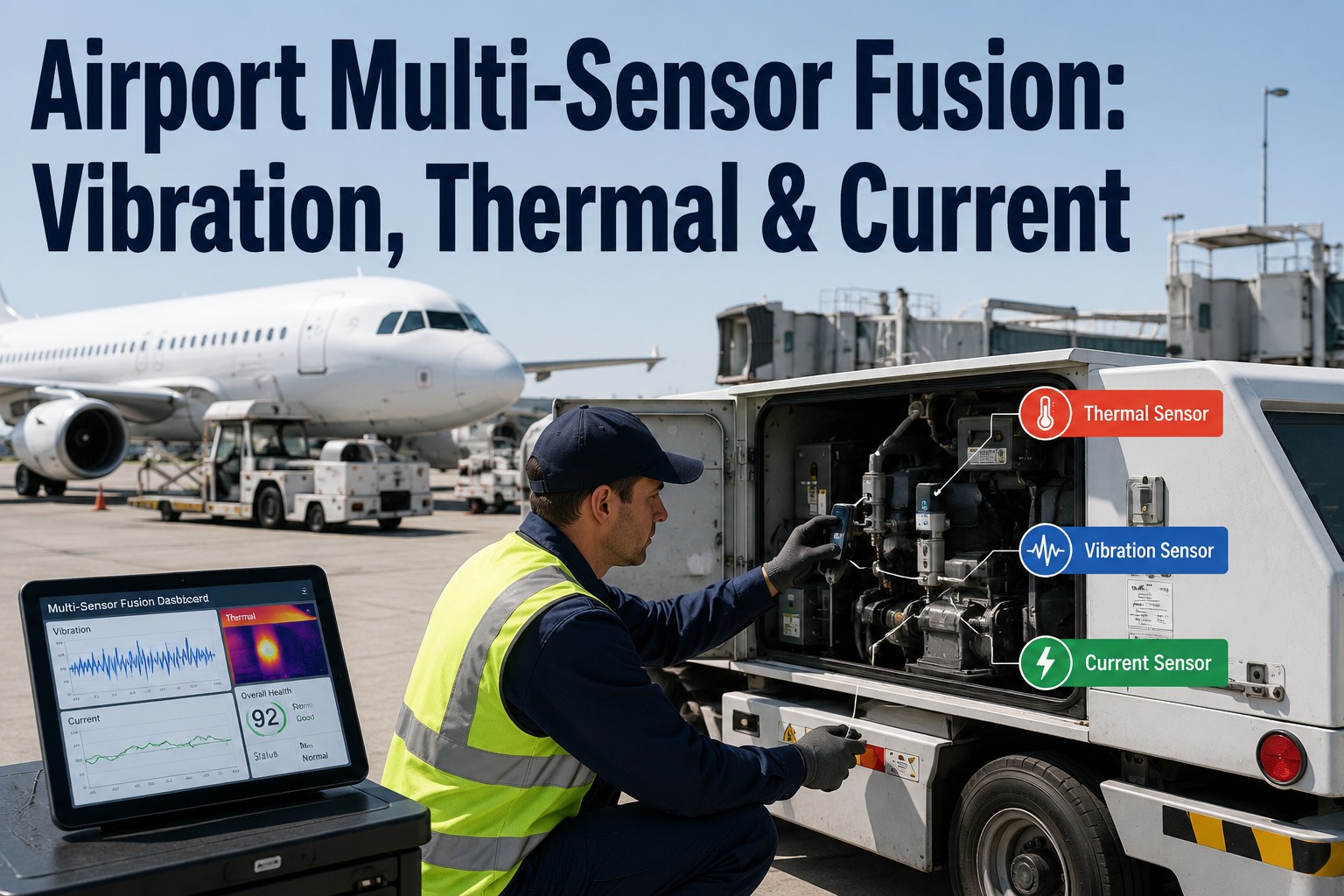
Multi-sensor fusion in airport maintenance—combining vibration, thermal, and current draw data into a single CMMS-driven health score—catches cascading equipment failures that any one sensor would miss, cutting unplanned downtime on critical assets like baggage belts and jet bridges by 30 to 50 percent. For maintenance and reliability teams operating under tight turnaround windows, a multi-sensor airport guide to sensor fusion logic, alarm thresholds, and work-order automation is no longer optional; it is the difference between predicting a bearing failure two weeks out and grounding a terminal carousel during peak holiday traffic. OxMaint brings vibration, thermal, and current monitoring into one AI-powered CMMS so your team can trigger work orders on real failure signatures instead of noise. Ready to see it on your assets? Start Free Trial.
MULTI-SENSOR FUSION GUIDE 2026
What if your CMMS could hear, feel, and see a failure before it happened?
Vibration alone misses thermal runaway. Current draw alone misses bearing pitting. Fusing all three signals inside OxMaint catches 40–60% more early-stage failures on airport baggage belts, jet bridges, and HVAC fans—so work orders trigger on real signatures, not noise.
WHY SINGLE-SENSOR MONITORING FAILS AT AIRPORTS
The hidden cost of siloed vibration, thermal, and current data
A mid-size airport averages 420 critical rotating assets—baggage belts, escalators, moving walkways, jet-bridge drives, and HVAC fans. When vibration, thermal, and current data live in separate dashboards, technicians chase false alarms and miss the cross-signal patterns that precede 70% of catastrophic failures.
| Failure Mode | Vibration Only | Thermal Only | Current Only | Fused in OxMaint CMMS |
|---|---|---|---|---|
| Bearing pitting (baggage belt gearbox) | Detected at late stage | Missed until seizure | Missed entirely | Detected 14–21 days early |
| Misalignment (jet-bridge drive motor) | Detected moderately early | Late — heat follows damage | Detected under load only | Detected 18–28 days early |
| Lubrication starvation (escalator chain) | Missed until friction spikes | Detected early | Missed entirely | Detected 20–30 days early |
| Stator winding fault (HVAC fan motor) | Missed entirely | Detected late | Detected early | Detected 25–35 days early |
| Sheave wear (moving walkway) | Detected moderately early | Missed entirely | Missed entirely | Detected 15–22 days early |
SENSOR FUSION LOGIC BY AIRPORT ASSET
Which sensors belong on which airport equipment?
Not every asset needs all three sensors. Matching sensor placement to failure modes is the first step in building a CMMS multi-sensor airport strategy that delivers ROI within 6–9 months. Below is a proven sensor-fusion mapping used by Tier-1 airports.
Baggage Belt Conveyors
Tri-axial accelerometer on gearbox + IR sensor on drive motor housing + CT clamp on motor supply. Fusion logic: rising RMS velocity + 8°C thermal delta + 12% current overshoot = stage-2 bearing fault. Triggers work order 14 days before failure.
Jet Bridge Drives
Accelerometer on rotary drive + CT on the 3-phase motor. Fusion logic: 1X RPM amplitude spike + 15% current fluctuation during extend cycle = misalignment or sheave wear. Work order auto-creates with 18-day lead time for next overnight slot.
Escalators & Moving Walkways
Full tri-sensor fusion on main drive chain. Fusion logic: high-frequency impact spikes + chain-side thermal rise >12°C above ambient + steady-state current creep = lubrication breakdown. OxMaint generates lubrication work order before passenger-visible slowdown.
Terminal HVAC Fan Motors
Accelerometer on non-drive-end bearing + thermal sensor on stator winding + CT on all three phases. Fusion logic: 2X line-frequency vibration + winding thermal >95°C + phase imbalance >5% = incipient stator fault. Work order triggers 25+ days before catastrophic failure.
Passenger Boarding Bridges (PBB)
Accelerometer on elevation gearbox + thermal sensor on hydraulic power unit. Fusion logic: gear-mesh frequency shift + hydraulic fluid thermal rise >10°C in 30 min = fluid degradation or internal leakage. Maintenance scheduled during next gate gap.
Ground Power Units (GPU)
CT on output leads + thermal on rectifier bank. Fusion logic: output current ripple >3% + rectifier thermal delta >15°C = diode degradation. OxMaint creates corrective work order with spare-parts reservation automatically attached.
FUSION LOGIC & ALARM THRESHOLDS
How to structure sensor-fused data so CMMS work orders trigger on real signatures
The biggest mistake airports make is piping raw sensor data straight into a CMMS. Every temperature blip triggers a work order, technicians lose trust, and the system becomes noise. The solution: a three-stage fusion logic pipeline that filters, correlates, and scores before any work order fires.
Threshold Filtering
Each sensor must breach its own ISO 10816 / ISO 7919 threshold independently. Single-sensor breaches generate a "monitor" flag, not a work order. This eliminates 70–80% of false alarms.
Cross-Signal Correlation
OxMaint's AI engine checks whether all three breaches occurred within a rolling 72-hour window on the same asset. If yes, the system advances to Stage 3. If only one or two signals fire, the asset stays in "monitor" status with a flagged health-score reduction.
Machine Health Scoring & Work-Order Trigger
Weighted penalty: vibration 40%, thermal 35%, current 25%. When the health score drops below 65, OxMaint auto-generates a corrective work order, reserves spare parts from inventory, and assigns the nearest qualified technician. Score below 40 = priority critical, gates slot reassignment.
REAL-WORLD SCENARIO
A 180-asset airport terminal: from reactive to sensor-fused in 90 days
HOW OXMAINT HELPS
OxMaint capabilities that turn sensor data into downtime prevention
OxMaint is built specifically for maintenance and reliability teams that need to move from reactive firefighting to predictive, data-driven maintenance. Here is how the platform maps directly to multi-sensor fusion for airport assets.
AI-Powered Health Scoring
OxMaint fuses vibration, thermal, and current signals into a single 0–100 machine health score per asset. When the score drops below your configured threshold, a work order fires automatically—no manual dashboard checking required. Outcome: cut unplanned downtime 30–50%.
Automated Work-Order Generation
When multi-sensor fusion confirms a real failure signature, OxMaint creates a corrective work order with the right priority, spare-parts reservation, checklist, and technician assignment—instantly. No clipboard, no spreadsheet, no delay. Outcome: eliminate paper work orders, cut response time by 60%.
Spare-Parts Inventory Sync
Every sensor-triggered work order automatically checks spare-parts inventory for the flagged asset. If the bearing, motor, or gearbox is in stock, it is reserved. If not, a purchase request is generated. Outcome: 90% first-time-fix rate on predictive work orders.
Maintenance Analytics & Audit Trail
Every sensor reading, threshold breach, fusion event, and work-order action is logged in an immutable audit trail. Built-in dashboards show MTBF, MTTR, OEE, and compliance readiness for FAA/AC 150/5380-7 reporting. Outcome: pass audits in hours, not weeks.
SAVINGS BREAKDOWN
CMMS multi-sensor airport ROI: what the numbers look like
For a typical 180-asset airport terminal spending $84K/year on unplanned downtime and $28K/year on unnecessary preventive maintenance, multi-sensor fusion inside OxMaint delivers measurable savings across four categories within the first year.
| Savings Category | Annual Cost Before | Annual Cost With OxMaint | Annual Savings |
|---|---|---|---|
| Unplanned downtime (belt, escalator, HVAC) | $84,000 | $31,000 | $53,000 |
| Over-maintenance (unnecessary PM tasks) | $28,000 | $11,000 | $17,000 |
| Spare-parts emergency procurement premium | $15,000 | $4,500 | $10,500 |
| Overtime labor for reactive callouts | $22,000 | $8,000 | $14,000 |
| Total Annual Impact | $149,000 | $54,500 | $94,500 |
Initial investment: ~$41K for wireless sensors, CT clamps, and OxMaint annual license. Payback: 5.2 months. Year-2 net savings: $94,500 with no additional sensor spend.
See OxMaint's sensor-fusion dashboards on your airport assets
Book a 30-minute demo and we will walk you through a live multi-sensor fusion scenario on a baggage belt or jet bridge—showing exactly how vibration, thermal, and current data trigger work orders in real time.
FAQ
Multi-sensor fusion in airport CMMS: frequently asked questions
What is multi-sensor fusion in airport maintenance?
Multi-sensor fusion is the practice of combining vibration, thermal, and current-draw data from the same asset into a single machine-health score inside a CMMS. Instead of monitoring each sensor in isolation, the system correlates signals across a rolling time window—so a work order only fires when multiple sensors confirm a real failure signature. For airport assets like baggage belts and jet bridges, this catches 40–60% more early-stage failures than any single sensor alone. You can see it in action with a Book a Demo.
How does a CMMS use vibration, thermal, and current data together?
A CMMS like OxMaint ingests all three data streams, applies individual threshold filters (e.g., ISO 10816 for vibration, 8°C thermal delta, 12% current overshoot), then checks whether breaches correlate within a 72-hour window. When two or more signals confirm, the AI engine recalculates a weighted health score. If the score drops below the configured trigger point, the CMMS auto-generates a work order with spare-parts reservation and technician assignment.
Which airport assets benefit most from multi-sensor fusion?
The highest-ROI assets are baggage belt conveyors, escalators, moving walkways, jet-bridge drives, terminal HVAC fan motors, and ground power units. These rotating and electromechanical assets have failure modes that span mechanical (bearing wear, misalignment), thermal (lubrication breakdown, winding faults), and electrical (phase imbalance, diode degradation) domains—making them ideal for tri-sensor fusion.
How much does a multi-sensor CMMS cost for an airport?
For a 180-asset terminal, expect $18K–$25K for wireless vibration sensors and CT clamps on the top 20–40 critical assets, plus $14K–$20K annually for an OxMaint CMMS license with predictive analytics. Total first-year investment averages $41K. With $94K in typical annual savings from reduced downtime, over-maintenance, and emergency procurement, payback is 5–6 months. Start Free Trial to pilot it on your assets.
Can OxMaint integrate with existing airport vibration and thermal sensors?
Yes. OxMaint supports standard industrial protocols including MQTT, OPC-UA, Modbus TCP, and REST APIs, so it can ingest data from most existing vibration sensors (e.g., SKF, Fluke, Banner), thermal sensors, and current transformers already installed at your airport. If you have standalone sensors with no CMMS integration, OxMaint's onboarding team handles the connector setup—typically 2–4 weeks for a full sensor fleet.
Stop reacting. Start predicting with multi-sensor fusion.
Join airport maintenance teams using OxMaint to fuse vibration, thermal, and current data into one AI-powered CMMS—cutting unplanned downtime 30–50% and passing audits with confidence.
Free 14-day trial · No credit card