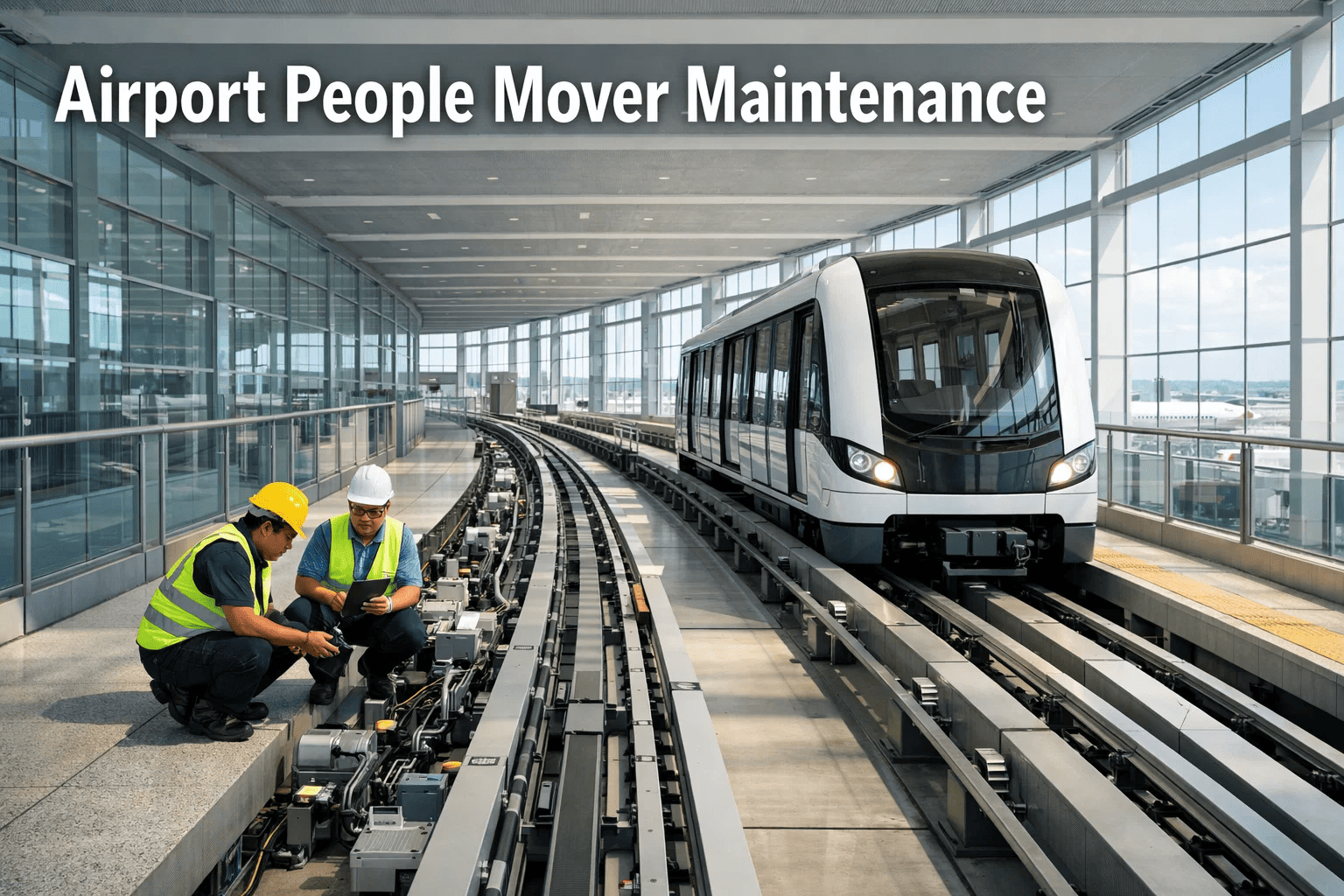
An automated people mover (APM) system failure during peak travel hours does not merely inconvenience passengers — it creates cascading gate-hold delays, misconnection chains, and passenger welfare incidents that can cost an airport authority $200,000 or more in a single disruption event, before the reputational damage to airlines and the airport itself is counted. Oxmaint's airport CMMS manages APM and automated transit systems with propulsion-level asset tracking, predictive maintenance scheduling, and real-time fault-to-work-order automation — keeping inter-terminal trains, people movers, and guideway systems available above the 99.5% uptime threshold that modern passenger volume requires. From guideway inspection records to station platform door PM schedules, every component in your transit system deserves a structured, data-driven maintenance program. Book a demo and see Oxmaint managing your APM asset hierarchy live.
Keep Your People Mover Moving — With Data-Driven Predictive Maintenance
Oxmaint gives APM maintenance teams full asset visibility across propulsion, guideway, station, and control systems — with PM schedules tied directly to asset condition and operating cycle counts. Deploy in weeks and see your first predicted fault before it causes a disruption.
APM System Components: What Needs to Be Maintained
An automated transit system is not a single asset — it is a multi-layer system of interdependent subsystems where the failure of any one component can halt the entire operation. Each subsystem requires its own PM schedule, condition monitoring approach, and safety inspection protocol.
Propulsion System
Linear induction motors, power rails, onboard traction systems, and braking hardware. Failure mode: overheating, brush wear, rail contamination. PM interval: every 50,000 operating cycles minimum.
Guideway and Track
Running rails, switch actuators, beam structure, and alignment systems. Failure mode: fastener fatigue, rail wear, switch misalignment. Requires weekly visual and monthly dimensional inspection.
Station Platform Equipment
Platform screen doors, tactile paving, HVAC, passenger information displays, and emergency call systems. Each with independent PM schedules and safety compliance documentation requirements.
Communication and Control
Automatic train protection (ATP), central control system, CCTV, public address, and radio systems. Firmware update cycles, system redundancy testing, and fail-safe verification are compliance requirements.
Vehicle Fleet
Cabin doors, air conditioning, emergency egress systems, suspension, and coupling mechanisms. Fleet-wide PM programs track vehicle operating hours, cycle counts, and component replacement intervals.
Power and Traction Supply
Substations, third rail or overhead supply, rectifiers, and distribution switchgear. Preventive testing every 6–12 months with thermographic inspection of high-current connections.
Why Airport APM Systems Fail — The Maintenance Gaps That Cause Disruptions
These are the structural maintenance program weaknesses that turn preventable faults into passenger-affecting service disruptions.
Time-Based PM Misses Cycle-Driven Degradation
APM propulsion and guideway components degrade by operating cycles and passenger loads — not calendar days. Fixed-interval PM schedules over-maintain low-usage vehicles and under-maintain high-cycle routes simultaneously.
No Cross-Subsystem Fault Correlation
A recurring platform door fault and a propulsion thermal event on the same vehicle route are often related — but without asset-level correlation across subsystems, maintenance teams treat them as isolated incidents and never address the root cause.
Safety Inspection Records Fragmented Across Systems
APM safety compliance documentation spans multiple subsystem owners, contractor maintenance providers, and OEM service teams. Airport authorities routinely cite fragmented inspection records as a primary compliance finding.
Fault-to-Technician Dispatch Takes 20+ Minutes
When an ATP system fault triggers an emergency halt, the average time from fault detection to technician arrival at the affected system exceeds 20 minutes on airports without automated dispatch — directly extending passenger impact duration.
How Oxmaint Manages Airport APM and Transit System Maintenance
Full APM Asset Registry — Subsystem to Component
Build your complete APM asset hierarchy in Oxmaint: System > Vehicle > Subsystem > Component — with condition scores, PM intervals, and compliance status tracked at every level.
Maintenance Triggers on Operating Cycles, Not Just Time
Link PM tasks to vehicle operating cycle counters, door open/close cycle counts, and route distance meters — so high-utilisation assets get attention before failure, not after a fixed calendar interval expires.
Fault Pattern Detection Across the Fleet
Oxmaint's predictive analytics flag repeating fault signatures across vehicles and subsystems — identifying systemic issues weeks before they become service disruptions. 70% of APM failures show detectable precursor patterns.
Automated Fault-to-Work-Order in Under 2 Minutes
ATP system faults, platform door alarms, and propulsion temperature alerts auto-generate priority work orders in Oxmaint and dispatch to the qualified technician's mobile app — eliminating the 20+ minute manual response gap.
Safety Inspection Records — Unified Across All Contractors
All subsystem inspections — whether performed by in-house staff or OEM contractors — logged in a single audit-ready record with digital signatures. One-click compliance package for airport authority review.
APM Availability and MTTR Dashboards
Live dashboards showing system availability, MTTR per subsystem, open PM backlog, and overdue safety inspections — giving airport operations directors the real-time visibility needed for service level reporting.
Reactive APM Maintenance vs Predictive Maintenance With Oxmaint
Frequently Asked Questions
Can Oxmaint handle APM systems from multiple OEM vendors within the same airport?
Yes. Oxmaint's asset hierarchy is vendor-agnostic — you can register Bombardier, Doppelmayr, Siemens, and Mitsubishi Heavy Industries APM systems within the same platform, each with their OEM-specified PM intervals, component serial numbers, and inspection checklists. This is essential for airports that have expanded capacity using different technology generations. Start free to see multi-vendor APM configuration.
How does cycle-based PM scheduling work for APM propulsion systems?
Oxmaint accepts cycle counter data from APM control systems via API or manual input. PM tasks for propulsion components are triggered automatically when cycle thresholds are reached — not on a fixed calendar. This means high-utilisation vehicles on peak routes get PM at the right interval, while lower-use vehicles are not over-maintained. Book a demo to see cycle-trigger PM configuration for your APM fleet.
What safety inspection documentation does Oxmaint generate for airport authority compliance?
Oxmaint generates timestamped, digitally signed inspection records for every APM safety inspection — guideway structural checks, platform screen door safety tests, ATP system verification, emergency egress testing, and power supply inspections. All records include the inspector's digital identity, photo evidence where required, and a compliance status against the scheduled interval. One-click export provides the complete safety inspection history for authority audit packages.
How does Oxmaint integrate with the APM central control system for real-time fault alerts?
Oxmaint connects to APM central control systems via REST API, SCADA interface, or structured alarm export — receiving fault events and translating them into prioritised work orders in under 2 minutes. For systems without direct API access, fault notifications can be input via the Oxmaint mobile app by control room operators. Book a demo to review integration options for your specific control system platform.
Keep Your APM Above 99.5% Availability — Before the Next Disruption Costs You.
Oxmaint gives airport APM maintenance teams cycle-based PM scheduling, predictive fault pattern detection, automated dispatch, and unified compliance documentation — all in a platform that deploys in weeks without a lengthy IT project. Start free today and have your first APM asset hierarchy configured this week.