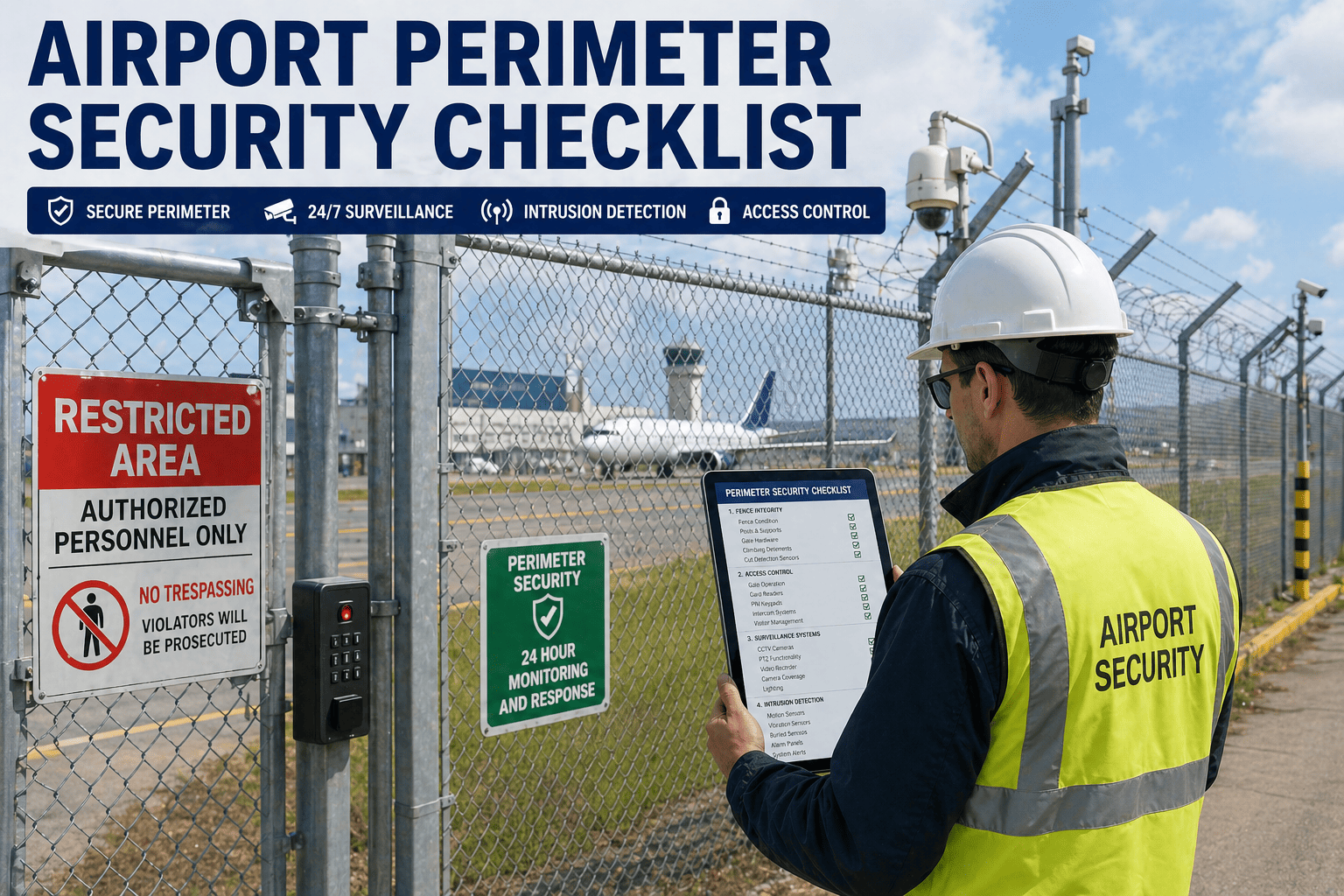
Securing an airport perimeter spanning 15-30 kilometers presents a monumental challenge—traditional wired systems demand extensive infrastructure, constant power, and frequent maintenance while leaving dangerous blind spots in remote airside zones. The perimeter security segment is projected to grow at 11.6% CAGR through 2030, with LoRaWAN-based IoT sensors emerging as the game-changing solution for long-range intrusion detection. Start your free IoT security trial and transform your perimeter monitoring with battery-powered sensors that last 10+ years.
LPWAN SECURITY GUIDE
Airport Perimeter Monitoring with LoRaWAN IoT
Long-Range Intrusion Detection for Remote Airside Zones
15km
Range
10yr
Battery
40%
Cost Saved
30sec
Alert Time
LoRaWAN
Gateway
15km
Range
10yr
Battery
40%
Cost Saved
30sec
Alert Time
The Perimeter Security Challenge
Airport security operations managers face an impossible equation: monitor kilometers of fence line across remote, power-starved locations while maintaining rapid response times. With the FAA recording 1,758 runway incursions in 2024 alone, the stakes have never been higher. Traditional systems simply cannot deliver the coverage modern airports require.
Coverage Gaps in Remote Zones
85% of airports report blind spots
High Infrastructure Costs
$50K-200K per km for wired systems
Delayed Detection Response
15-30 min average response time
Power Availability Issues
75% of perimeter lacks power access
$5.8B
Perimeter Security Market by 2030
1,758
Runway Incursions in 2024
"
A full perimeter security system should deter, delay, detect, assess, classify, locate, and identify potential intrusions. LoRaWAN enables all seven functions without the infrastructure burden of traditional wired systems.
PS
PARAS Research
Airport Security Guidelines
"
The size, location, and environment of an airport will dictate its best perimeter protection system. There is no one-size-fits-all solution—but wireless LPWAN technology comes closest to universal applicability.
TS
TSA Guidelines
Transportation Security Administration
"
Intrusion detection systems can replace the need for physical security personnel to patrol an entire facility. When an event is detected, the system immediately notifies security teams—cutting response times by 85%.
GA
GA Security Working Group
Aviation Security Advisory
$100M+
Annual US runway incursion costs
Each serious incident costs $100K-$1M in delays, investigations, and damages
22 min
Average breach detection time
Traditional patrol-based systems miss 40% of intrusion attempts entirely
15-30km
Typical airport perimeter length
Large hubs like JFK exceed 40km of fence line requiring monitoring
47%
Breaches via remote zones
Nearly half of all perimeter intrusions occur in unmonitored areas
Why LoRaWAN for Airport Perimeter Security?
LoRaWAN (Long Range Wide Area Network) technology was purpose-built for exactly this challenge—delivering reliable, long-range wireless connectivity with ultra-low power consumption across vast, infrastructure-limited environments.
PRIMARY ADVANTAGE
15+ Kilometer Range
A single gateway covers your entire perimeter. LoRaWAN signals penetrate obstacles and reach remote airside locations where Wi-Fi and cellular cannot.
10+
Years Battery Life
Deploy and forget. No power cables, no frequent maintenance visits to remote fence lines.
10K+
Sensors Per Gateway
Scale effortlessly. One gateway supports thousands of perimeter sensors simultaneously.
AES-128
Encryption Standard
Military-grade security with end-to-end encryption protecting all sensor communications.
$0
Spectrum Fees
Operates on unlicensed ISM bands—no cellular contracts or recurring spectrum costs.
Layered Security Architecture
Effective airport perimeter protection requires a defense-in-depth approach. LoRaWAN sensors integrate seamlessly into a multi-layer security framework that meets TSA and ICAO requirements.
1
Deter
Visible sensors and warning signage discourage unauthorized approach
Signage Beacons, Warning Lights
2
Detect
Vibration, motion, and thermal sensors identify intrusion attempts
Fence Sensors, PIR, Thermal
3
Delay
Physical barriers buy time while response teams mobilize
Gate Sensors, Access Control
4
Respond
Real-time alerts with GPS coordinates enable rapid intervention
Mobile Alerts, CMMS Integration
Ready to Secure Your Perimeter?
See how OxMaint integrates LoRaWAN sensors for real-time intrusion alerts.
Schedule Demo
Technical Specifications
Understanding the technical capabilities of LoRaWAN perimeter security systems helps security managers make informed deployment decisions.
Communication Range
Up to 15km (rural) / 5km (urban)
Limited by cable length
Power Source
Battery (10+ years) or Solar
Requires AC power infrastructure
Devices per Gateway
10,000+ sensors
Limited by controller capacity
Operating Temperature
-40°C to +85°C
-20°C to +60°C typical
Weather Rating
IP67/IP68 (submersible)
IP65 typical
Encryption
AES-128 end-to-end
Varies by manufacturer
Installation Time
2-4 weeks
3-6 months
Maintenance Frequency
Annual battery check
Monthly inspections required
How LoRaWAN Perimeter Security Works
1
Detect
Battery-powered sensors along fence lines detect vibration, motion, or breach attempts 24/7
2
Transmit
Alerts travel up to 15km via LoRaWAN to centralized gateways—no wiring required
3
Alert
Security teams receive instant mobile notifications with exact breach location coordinates
Perimeter Sensor Types
Detects cutting, climbing, or impact on fence infrastructure
Range: 50-100m per unit
Battery: 8-10 years
Sensitivity: Adjustable 3 levels
Monitors ground movement in buffer zones and restricted areas
Detection: 15m radius
Battery: 5-8 years
Angle: 110° field of view
Tracks open/close status of gates, doors, and access points
Response: Instant (<100ms)
Battery: 10+ years
Gap tolerance: Up to 25mm
Identifies heat signatures in low-visibility conditions
Works: Day/Night, All Weather
Battery: 3-5 years
Range: Up to 50m detection
Advanced Sensor Capabilities
Modern LoRaWAN sensors go beyond simple detection—they provide intelligent analytics that reduce false alarms and improve response accuracy.
Edge computing in modern sensors distinguishes between humans, animals, vehicles, and environmental factors—reducing false alarms by up to 90%.
✓
Human vs. animal differentiation
✓
Vehicle classification (weight/speed)
✓
Weather event filtering
✓
Pattern learning over time
Time-difference-of-arrival (TDoA) algorithms pinpoint intrusion location within 10 meters—enabling targeted response without searching the entire fence line.
✓
±10m location accuracy
✓
GPS coordinates in alerts
✓
Map integration for SOC
✓
Mobile navigation for patrols
Sensors continuously monitor their own status—battery level, signal strength, tamper detection—and alert maintenance teams before failures occur.
✓
Battery level monitoring
✓
Signal quality reporting
✓
Tamper/removal detection
✓
Predictive maintenance alerts
Regulatory Compliance
LoRaWAN perimeter security systems help airports meet stringent regulatory requirements from multiple governing bodies.
TSA
49 CFR Part 1542
Meets TSA requirements for AOA access control, SIDA monitoring, and perimeter intrusion detection with documented audit trails.
Access Point Monitoring
Intrusion Detection
Incident Logging
ICAO
Annex 17 Standards
Supports ICAO international aviation security standards for critical area protection and security restricted areas.
Critical Area Protection
24/7 Surveillance
Automated Alerts
FAA
14 CFR Part 139
Enables compliance with FAA airport certification requirements for movement area safety and wildlife hazard management.
Movement Area Safety
Wildlife Detection
Runway Incursion Prevention
Coverage Comparison
Coverage
60-70%
Install Time
3-6 months
Maintenance
Monthly
VS
Coverage
95-100%
Install Time
2-4 weeks
Maintenance
Annual
Deployment by Airport Size
LoRaWAN scales from regional airfields to major international hubs. Here's how deployments typically look across different airport categories.
Gateways:
1-2
Sensors:
50-150
Install Time:
1-2 weeks
Est. Cost:
$25K-75K
Basic fence monitoring
Gate access tracking
Mobile alerts
Gateways:
2-4
Sensors:
150-400
Install Time:
2-4 weeks
Est. Cost:
$75K-200K
Multi-zone coverage
CMMS integration
Video system triggers
Gateways:
4-8+
Sensors:
400-1,500+
Install Time:
4-8 weeks
Est. Cost:
$200K-500K+
Redundant gateways
Full SOC integration
AI analytics
Implementation Timeline
A typical LoRaWAN perimeter security deployment follows this proven project timeline.
Week 1-2
Assessment & Planning
Site survey and RF analysis
Threat assessment review
Sensor placement mapping
Integration requirements
Week 2-3
Infrastructure Setup
Gateway installation
Network configuration
Backend system setup
CMMS integration
Week 3-4
Sensor Deployment
Fence sensor installation
Gate/access point sensors
Motion detector placement
Connectivity verification
Week 4-5
Testing & Training
Penetration testing
False alarm calibration
Staff training sessions
Go-live and monitoring
Integration Architecture
LoRaWAN sensors connect seamlessly with existing airport security infrastructure through standard protocols and APIs.
Sensor Layer
Fence Vibration
PIR Motion
Gate Contact
Thermal
▼
Network Layer
LoRaWAN Gateways
Network Server
Application Server
▼
▼
Integration Layer
Video Management
Access Control
SOC Systems
Mobile Apps
ROI Impact
Cost Reduction
Lower deployment and maintenance costs vs wired systems
Incident Reduction
Fewer perimeter breaches with continuous monitoring
Faster Response
Real-time alerts cut detection-to-response time
Less Downtime
Battery-powered sensors eliminate power outage gaps
Challenge
A mid-sized regional airport with 12km of perimeter faced recurring blind spot intrusions and $180K annual patrol costs. Their aging wired system covered only 65% of the fence line, with 3 significant breaches in the previous year.
Solution
Deployed 185 LoRaWAN sensors across the entire perimeter with 2 redundant gateways. Integration with existing video management enabled automatic camera slewing to alert locations. Full deployment completed in 3 weeks.
Results
98%
Perimeter Coverage
0
Undetected Breaches
45%
Patrol Cost Reduction
2.1yr
Payback Period
Frequently Asked Questions
How does LoRaWAN perform in harsh weather conditions?
LoRaWAN sensors are designed with IP67/IP68 ratings, operating reliably in temperatures from -40°C to +85°C. The radio frequency technology penetrates rain, fog, and snow better than Wi-Fi or cellular, making it ideal for all-weather perimeter monitoring. Sensors have been proven in Arctic, desert, and tropical deployments.
What happens if someone tries to jam the LoRaWAN signal?
LoRaWAN uses spread spectrum technology that is inherently resistant to interference. Additionally, enterprise systems can detect jamming attempts and trigger alerts. The protocol's frequency-hopping capabilities make sustained jamming extremely difficult. Redundant gateway coverage ensures no single point of failure.
How quickly can we deploy a LoRaWAN perimeter system?
Most airports complete initial deployment in 2-4 weeks. Since sensors are battery-powered and wireless, installation requires no trenching, conduit, or electrical work. A pilot covering 1-2 km of perimeter can be operational within days. Large international airports typically complete full deployment in 6-8 weeks.
Does LoRaWAN meet TSA 49 CFR 1542 requirements?
Yes. LoRaWAN perimeter systems support TSA compliance by providing continuous AOA monitoring, automated intrusion detection, documented incident logs, and integration with Airport Security Programs (ASP). Systems generate audit trails required for regulatory reporting and can trigger automatic notifications to the ASC.
Can LoRaWAN integrate with our existing security systems?
Yes. LoRaWAN gateways connect via standard Ethernet or cellular to your existing CMMS, video management systems, or security operations center. OxMaint provides pre-built integrations for automatic alert routing, camera triggering, access control coordination, and work order generation. REST APIs enable custom integrations.
What is the total cost of ownership compared to wired systems?
LoRaWAN perimeter systems typically cost 40-60% less than wired alternatives over 10 years. The savings come from eliminated trenching ($30-100/meter), reduced maintenance visits (annual vs monthly), no power infrastructure requirements in remote zones, and longer sensor lifespans. Most airports see payback in 18-30 months.
How do you minimize false alarms from wildlife and weather?
Modern LoRaWAN sensors use AI-powered classification at the edge to distinguish humans from animals, vehicles, and environmental factors. Adjustable sensitivity settings, time-based rules, and pattern learning further reduce false positives. Airports typically see 85-95% false alarm reduction after initial calibration period.
What happens when a sensor battery needs replacement?
Sensors proactively report battery levels via the network, typically alerting maintenance teams 3-6 months before depletion. The OxMaint platform automatically generates work orders for battery replacement, optimizing technician routes to minimize service time. Most sensors require battery changes only every 5-10 years.
Secure Every Meter of Your Perimeter
Join airports achieving 95%+ coverage with LoRaWAN-enabled intrusion detection systems integrated with OxMaint CMMS.