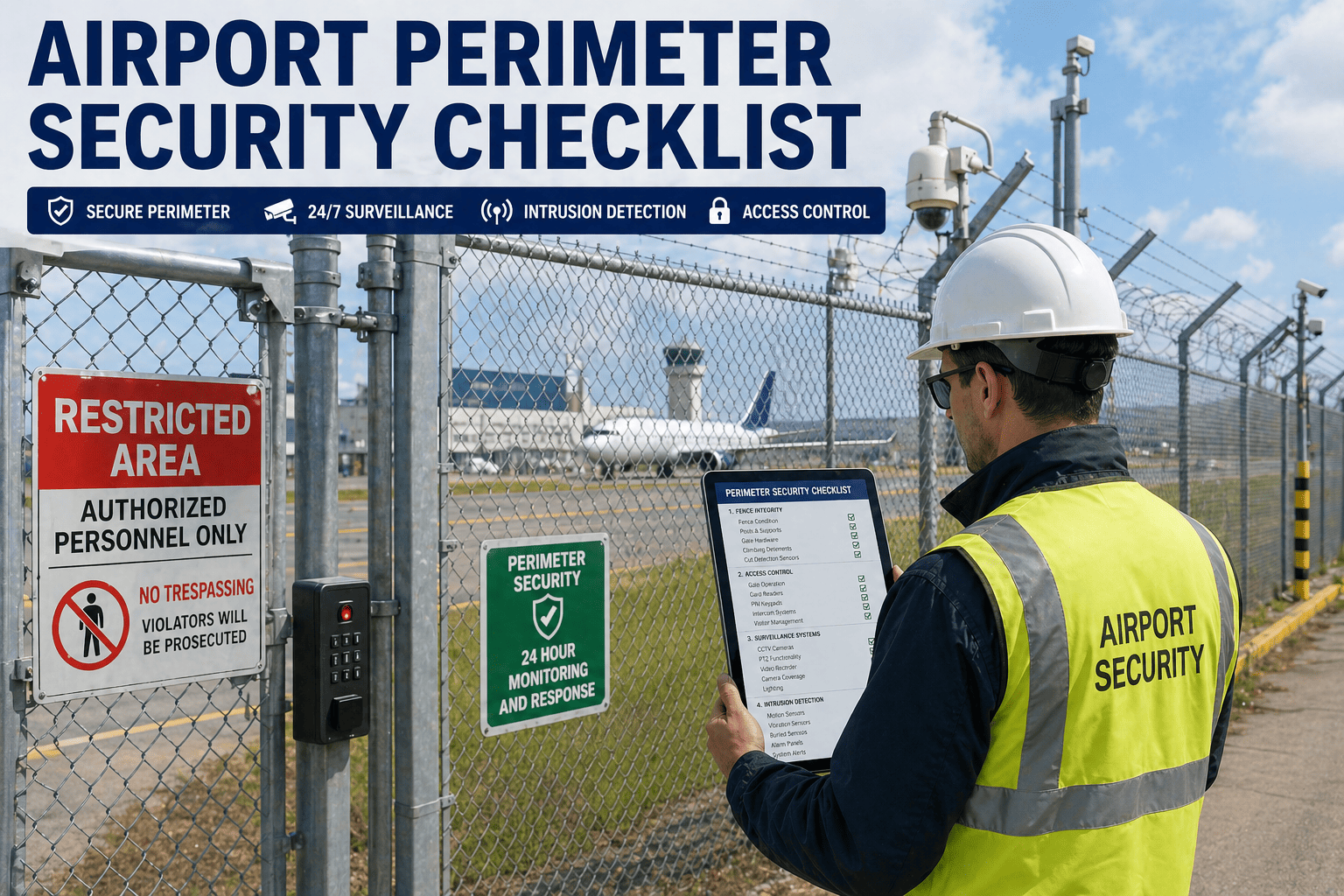
Airport perimeter security is not an IT problem — it is a physical infrastructure maintenance problem. A CCTV camera with a dirty lens, a fence post shifted 3 inches by vehicle impact, or an access gate sensor that fails intermittently can create a TSA-reportable security event even when the technology budget is substantial. TSA and FAA Part 139 require that airport perimeter systems be maintained to a documented standard with verifiable inspection records. Airports that rely on reactive reporting — waiting for a breach event to identify infrastructure failures — face enforcement actions, operational disruptions, and the kind of headline coverage no airport authority wants. Book a demo to see how Oxmaint automates perimeter security inspection scheduling and compliance documentation.
$11,000+
per day TSA civil penalty for security violations at commercial airports
82%
of perimeter breaches attributed to physical infrastructure failures, not system hacks
Daily
minimum TSA-required inspection frequency for security-critical perimeter zones
12 mo
minimum record retention period for all perimeter inspection documentation per TSA
TSA-Required Perimeter Inspection Framework
TSA 49 CFR Part 1542 requires commercial airports to maintain an Airport Security Program (ASP) that includes documented inspection of all perimeter security elements. Inspections must be conducted, recorded, and retained — verbal assurances do not satisfy regulatory requirements. Airports using digital CMMS-based inspection programs complete audits 60% faster with zero documentation gaps. Want to build a compliant digital inspection program? Start a free trial and deploy TSA-aligned perimeter checklists in Oxmaint.
Daily
Perimeter Walk Inspection
Visual inspection of fence line integrity, access gate status, lighting function, and signage condition. Must be documented with inspector ID, time, and any deficiencies noted. Deficiencies require same-day corrective action initiation.
Weekly
CCTV & PIDS Verification
Test camera coverage, image quality, and recording function. Verify perimeter intrusion detection sensors, alarm transmission, and response protocol documentation. Any gaps in coverage must be documented and escalated.
Monthly
Access Control Testing
Full functional test of all access gates — vehicle and pedestrian. Verify credential readers, interlock logic, emergency egress, and manual override. Document pass/fail for each gate with technician sign-off.
Annual
Full Security Infrastructure Audit
Comprehensive assessment of all fence structures, CCTV angles and coverage, lighting photometric levels, PIDS sensitivity calibration, and access control database accuracy. Feeds directly into ASP review documentation.
Never Miss a TSA-Required Inspection Again
Oxmaint schedules daily perimeter walks, weekly CCTV checks, monthly gate tests, and annual audits automatically — with timestamped digital records and deficiency tracking that satisfies TSA documentation requirements.
Perimeter Security Inspection Checklist
Fencing & Physical Barrier
Fence fabric — inspect for cuts, holes, bent sections, or pulled-away bottom rails
Post integrity — check for shifted, leaning, or impacted posts requiring realignment
Top guard — barbed wire, razor ribbon, or anti-climb topping intact and properly tensioned
Clear zone — 10-foot vegetation-free zone maintained on both sides of perimeter fence
CCTV & Surveillance
Camera image quality — verify clarity, focus, and no lens obscuration from debris or vandalism
Coverage zones — confirm no blind spots at fence line, gates, or critical areas
Recording function — verify storage capacity, retention period, and playback access
Housing and mounting — check for physical damage, corrosion, and cable condition
Access Gates & Control
Vehicle gates — test full open/close cycle, detection loops, and anti-tailgate sensors
Pedestrian gates — verify credential reader, alarm on unauthorized entry, and self-closing
Emergency egress — test fail-safe operation and alarm notification to security
Gate log audit — verify access events are captured and retained per TSA requirements
Perimeter Lighting
All fixtures operational — test during evening hours, document any outages immediately
Light levels — verify minimum foot-candle levels at fence line and gate areas
Emergency backup — verify battery or generator-backed lighting for power failure
Vegetation obstruction — clear any growth reducing lighting coverage at fence line
Manual Security Audits vs. CMMS-Managed Compliance
| Compliance Area | Manual Approach | With Oxmaint CMMS |
|---|
| Daily inspection records | Paper logs, handwritten entries | Timestamped digital records with GPS and photo capture |
| Deficiency tracking | Noted verbally, often not resolved | Auto-generated work orders with closure tracking |
| TSA audit preparation | Days assembling scattered paper records | Instant retrieval — all records searchable by date and zone |
| Missed inspections | No alert — gaps discovered in audit | Auto-escalation when scheduled inspection is overdue |
| CCTV outage tracking | Discovered reactively after incident | Scheduled weekly verification with failure escalation |
| Record retention | Physical storage, risk of loss | Digital retention with 12-month+ audit trail guaranteed |
Security Compliance Impact
60%
Faster Audit Completion
Digital checklists with photo capture complete inspections 60% faster than paper-based walks.
100%
Documentation Coverage
Every inspection, every deficiency, every corrective action permanently recorded with timestamps.
Zero
Missed TSA Deadlines
Automated scheduling with escalation alerts eliminates the oversight that creates TSA compliance gaps.
$11K+
Daily Fine Avoided
Documented compliance prevents TSA civil penalties that can reach $11,000 per day per violation.
Perimeter security compliance is not periodic — it is daily, documented, and auditable at any moment. A TSA inspector who arrives unannounced expects immediate access to inspection records, deficiency logs, and corrective action histories. Organizations that cannot produce this documentation face enforcement regardless of their actual security posture. Protect your compliance standing — book a demo to see TSA-aligned security inspection workflows in Oxmaint, or start a free trial to deploy compliant perimeter checklists today.
How often does TSA require airport perimeter inspections?
TSA 49 CFR Part 1542 requires daily inspections of security-critical perimeter zones at commercial airports. All inspections must be documented with inspector identification, time of inspection, areas covered, and any deficiencies noted. Records must be retained for a minimum of 12 months.
Start a free trial to deploy daily inspection schedules in Oxmaint.What constitutes a TSA-reportable perimeter security event?
Unauthorized access or entry into a Security Identification Display Area (SIDA), sterile area, or Air Operations Area (AOA) must be reported to TSA. Physical infrastructure failures that created the access condition — fence damage, gate malfunction, lighting failure — must be documented and corrective actions recorded.
Book a demo to see incident and corrective action tracking in Oxmaint.What are the minimum fence height and specification requirements?
TSA specifies minimum fence height of 8 feet plus a top guard of 12-18 inches of outward-facing barbed wire or equivalent. The fence must be constructed to prevent climbing, crawling under, or pushing through. CMMS tracks fence segment conditions and flags degradation before specifications are compromised.
Can CMMS generate the documentation TSA requests during inspections?
Yes. Oxmaint stores all inspection records with timestamps, inspector identification, GPS coordinates, and photo evidence. During a TSA inspection, the complete record history for any time period, zone, or system is retrievable within seconds — not after hours of manual document assembly.
Start a free trial to see TSA-ready documentation capabilities.
TSA Compliance Is Daily — Your Documentation System Must Match That Pace.
Oxmaint automates daily perimeter walks, CCTV verification, gate testing, and lighting inspections — with digital records, deficiency tracking, and corrective action workflows that satisfy TSA requirements and protect your airport from enforcement action.
TSA 49 CFR 1542 ComplianceDaily Inspection AutomationDeficiency Tracking12-Month Record Retention