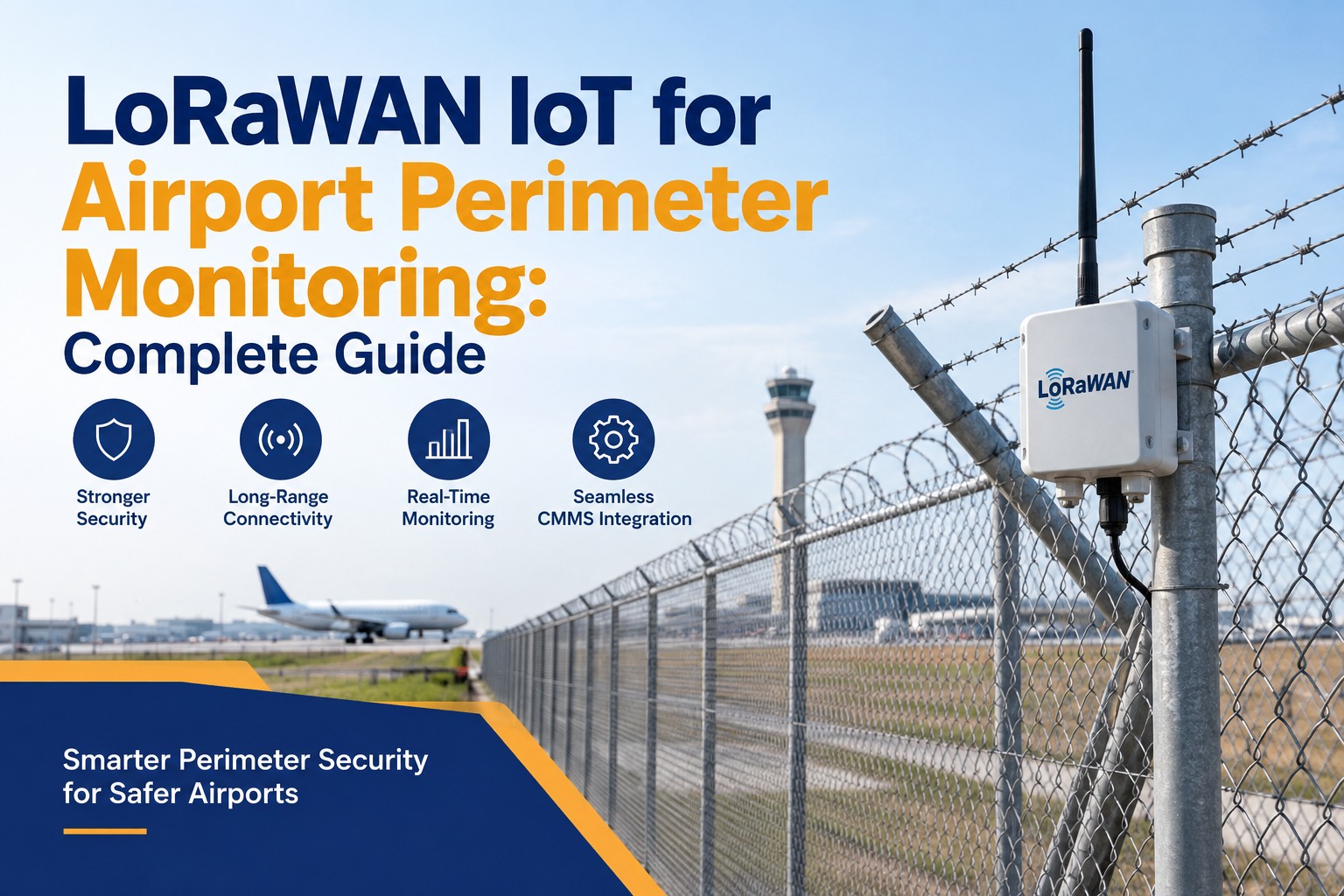
An airport perimeter is 20–40 km of fence, gates and remote airside points where power & cellular don't reach. LoRaWAN changes the arithmetic: one sub-GHz gateway covers the whole fence line, sensors run 5–10 years on a single battery, and every event lands in your CMMS software. This guide walks the architecture, sensor types, deployment timeline and cost drivers — and how OXMAINT AI turns LoRaWAN traffic into inspections, defects, work orders and PMs on one platform.
Aviation IoT · LoRaWAN Perimeter · CMMS Integration · 2026
LoRaWAN IoT for Airport Perimeter Monitoring: Complete Guide
Long-range wireless sensors across every fence, gate and remote asset — with OXMAINT AI, an AI-powered CMMS, turning each LoRaWAN packet into a routed inspection, defect, work order or predictive-maintenance alert in one platform.
Up to 15 km
LoRaWAN range in open airport environment
5–10 years
battery life per sensor on a single charge
AES-128
end-to-end encryption on every uplink
$14.25B
global LoRaWAN market 2026 (34.7% CAGR)
Why LoRaWAN Fits an Airport Perimeter Better Than Wi-Fi or Cellular
Wi-Fi tops out around a 100 m range — a 25 km fence would need 50+ access points, each with power & backhaul. Cellular works but stacks recurring SIM & data costs across thousands of sensors. LoRaWAN was built for exactly this shape of problem: a few kilometres between transmitter and gateway, small payloads, years of battery on a coin cell. Here's the connectivity comparison for an airport perimeter deployment. Start free and start ingesting sensor packets into OXMAINT AI today.
The right architecture pairs LoRaWAN (backbone for perimeter & environmental sensors) with cellular (mobile assets) and Wi-Fi/5G (terminal & video). LoRaWAN is not for streaming video — it's for event-driven sensor traffic where a small packet at the right moment matters.
The 4-Layer LoRaWAN Perimeter Architecture
A LoRaWAN perimeter deployment is a clean four-layer stack — end-device sensors on the fence, gateways aggregating their traffic, a network server decoding it, and an application layer (OXMAINT AI) turning it into inspections, work orders and PMs. Each layer has a defined role, and OXMAINT AI is where a raw sensor packet becomes actionable maintenance. Book a demo to see all four layers wired together.
Layer 4 · Application
OXMAINT AI — CMMS & Workflow Engine
Ingests decoded LoRaWAN events, routes each one to the right workflow: inspection → defect → work order → PM. This is where sensor packets become maintenance actions with owners & timers.
Layer 3 · Network Server
LoRaWAN Network Server (LNS)
Deduplicates uplinks from multiple gateways, decrypts & validates payloads, and pushes clean sensor events to the application layer via MQTT/HTTP webhooks. On-prem or cloud.
Layer 2 · Gateway
LoRaWAN Gateway(s)
One or two gateways mounted on a tower or building at height cover the entire perimeter. Forwards every uplink to the network server over Ethernet/cellular backhaul.
Layer 1 · End Devices
LoRaWAN Sensors on Fence, Gate & Ground
Battery-powered sensors — fence vibration, gate reed, PIR motion, seismic, environmental — sending small event packets on the 868/915 MHz sub-GHz band with AES-128 encryption.
The 6 LoRaWAN Sensor Types That Cover an Airport Perimeter
A perimeter isn't one problem — it's a chain of local ones: fence panels that get climbed, gates that get propped open, apron zones that get walked across, drainage that floods sensor pits. Each one needs a different sensor. Every one of these lands in OXMAINT AI as its own event stream. Sign up free and configure event routing per sensor type in OXMAINT AI.
Fence Vibration Sensor
Accelerometer clipped to a fence panel. Detects cutting, climbing & impact. Packet fires only on event → 8+ year battery.
OXMAINT: intrusion event → patrol WO
Gate Reed / Open-Close
Magnetic reed switch on every access gate. Reports open/close with timestamp — flags props, unauthorised entries & late-shift openings.
OXMAINT: gate log & anomaly alert
PIR / Motion Detector
Passive-infrared motion sensor at chokepoints — culvert crossings, service roads. Confirms presence when a vibration alarm fires.
OXMAINT: verify layer for fence event
Buried Seismic Node
Ground-buried geophone detecting footsteps & digging. Covert — an intruder can't see or defeat it. Long-lived on a lithium cell.
OXMAINT: buried-zone incident record
Environmental / Weather
Temperature, humidity, pavement-temp, wind & rain. Feeds PM triggers for runway lights, drainage, deicing & sensor calibration.
OXMAINT: weather-triggered PMs
Asset Tracker / GPS-Lite
Low-power GPS on ground vehicles, GSE & portable gates. Location every few minutes, geofence breach alerts on any zone violation.
OXMAINT: geofence alert → task
A LoRaWAN Packet Is Data — OXMAINT AI Turns It Into Action.
Piped into OXMAINT AI, each packet becomes a routed inspection, a defect with photo capture, a work order with an owner, or a PM triggered on runtime. Your sensors and your maintenance system share one record.
LoRaWAN → OXMAINT AI: The Packet-to-Work-Order Journey
A fence vibration at 02:17 is a good stress-test for the whole architecture. Here's what actually happens between sensor and closed work order — the seven steps that turn a wireless uplink into a documented, resolved incident in OXMAINT AI. Book a demo to walk through this journey on your fence line.
1
02:17:03 — Event
Vibration sensor at fence bay 12 detects impact above threshold, wakes from sleep.
2
02:17:04 — Uplink
Sensor sends an 11-byte payload on 915 MHz, AES-128 encrypted, to any gateway in range.
3
02:17:04 — Gateway forward
Two gateways receive the packet (redundant coverage), forward to the LoRaWAN Network Server.
4
02:17:05 — Decode
LNS deduplicates, decrypts & decodes: {sensor: bay-12, event: vibration, magnitude: 4.2g}.
5
02:17:06 — OXMAINT AI ingests
Event lands in OXMAINT AI via webhook — auto-classified by rule (magnitude 4.2g = intrusion suspect).
6
02:17:08 — Task routed
OXMAINT AI dispatches a patrol task to the nearest responder with fence-bay location & SOP checklist.
7
02:34 — Closed on record
Responder logs findings + photo in OXMAINT mobile — incident closes with a full chain-of-custody trail.
The 5-Phase Deployment Timeline
A LoRaWAN perimeter rollout is one of the least disruptive IoT projects you can run — no trenching, no conduit, no electrical work along the fence. Sensors are magnetic or clip-mount, gateways are pole-top, and the whole thing wires into OXMAINT AI at the application layer. Most airports go end-to-end in a few weeks. Sign up free and start Phase 1 with a sample sensor set.
Phase 1
Site Survey & RF Analysis
Walk the perimeter, map dead zones, pick gateway mount points, decide sensor spacing.
Phase 2
Gateway Installation
Mount 1–2 gateways at height (tower, terminal roof, hangar) & verify coverage with a walking sensor.
Phase 3
Sensor Deployment
Clip vibration sensors to fence panels, reed switches on gates, PIR at chokepoints — no cabling.
Phase 4
OXMAINT AI Integration
Wire the LoRaWAN Network Server to OXMAINT AI via webhook, define event-to-workflow routing rules.
Phase 5
Pilot & Tune
Run a pilot zone, tune vibration thresholds & PIR sensitivity, expand to full perimeter coverage.
Cost Drivers — Where the Money Actually Goes
LoRaWAN's real cost advantage isn't the sensor sticker price — it's what you don't spend: no trenching, no cellular data plans, no monthly access-point maintenance, no battery-swap crew every quarter. Here's where the budget on a typical perimeter deployment lands. Book a demo to scope a LoRaWAN + OXMAINT AI pilot on your fence.
45%
Sensors
Fence vibration, gate reed, PIR, seismic & environmental nodes across the perimeter.
15%
Gateways
One or two outdoor-rated gateways with cellular or Ethernet backhaul to the network server.
15%
Network Server
Cloud LNS subscription or on-prem stack (ChirpStack, The Things Stack) for private deployments.
15%
Integration
Webhooks, event decoding, OXMAINT AI workflow rules & VMS/access-control integration.
10%
Install Labour
Mounting sensors on fence panels & gates — clips & brackets, no trenching or electrical work.
7 Best Practices for a LoRaWAN + OXMAINT AI Deployment
Every airport that runs into trouble with a LoRaWAN rollout hits the same handful of avoidable issues — sensor spacing wrong, thresholds untuned, OXMAINT AI routing rules left as defaults. Here's what the airports doing this well get right. Sign up free and configure these routing rules in OXMAINT AI on day one.
01
Run a real RF site survey — sub-GHz doesn't care about walls, but does care about terrain & metal hangars.
02
Redundant gateways from day one — two gateways with overlapping coverage cost little & catch every packet.
03
Tune vibration thresholds on-site over 2 weeks — factory defaults chase wind, weather & wildlife.
04
Define event-to-workflow rules in OXMAINT AI before you turn sensors on — no orphan events.
05
Put every sensor on a battery-health PM in OXMAINT AI — 5-10 year life still needs a lookup table.
06
Pair PIR verification with fence vibration — the two together dramatically reduce nuisance alarms.
07
Use OXMAINT AI mobile for field evidence on every alarm — photo & GPS-tagged findings, no radio-only trail.
What OXMAINT AI Adds to Your LoRaWAN Deployment
A LoRaWAN stack detects & reports. OXMAINT AI decides & closes — turning every packet into inspections, defects, work orders and PMs on one platform, connected to the sensors, the responders and the auditors. Book a demo to see the routing rules configured on your sensor list.
Event-to-Work-Order Routing
Every LoRaWAN uplink lands in OXMAINT AI via webhook, auto-classified & routed to the right workflow.
Sensor-Health PMs
Every fence, gate & ground sensor on a battery-check, calibration & firmware-update PM cadence.
Mobile Field Response
Responders open the task on the OXMAINT AI mobile app, log photos & GPS-tagged findings on-site.
Predictive Alerts
Trend-based rules on environmental & vibration data trigger PMs before a sensor drifts or a fence fails.
Asset Visibility
Every sensor, gateway & gate on one asset register — location, history, next PM, spare-part list.
Vendor-Agnostic
Works with any LoRaWAN Network Server (ChirpStack, TTS, Loriot) & any certified LoRaWAN sensor OEM.
"
We started with a pilot zone — fifteen fence vibration sensors and one gateway on the terminal roof. Two weeks in we had the vibration thresholds tuned and the OXMAINT AI routing rules dialled: vibration + PIR confirm = patrol task, gate open outside shift = alert, environmental humidity spike = drainage PM. From there we scaled to the full perimeter. What changed our thinking wasn't the sensors — it was that every packet lands somewhere in OXMAINT AI now. No more sensor data sitting in a dashboard nobody looks at. Every uplink either becomes a work order or it doesn't, and that's the whole architecture.
Airport Facilities & Security Lead · Regional Hub
Frequently Asked Questions
How is LoRaWAN different from Wi-Fi or cellular for airport perimeter monitoring?
LoRaWAN operates on sub-GHz unlicensed bands with long range (up to 15 km per gateway), tiny power draw (5–10 year battery), and no recurring SIM fees — matching the geometry of a 20–40 km airport perimeter where Wi-Fi would need 50+ APs. It's built for event-driven sensor packets, not video streaming.
How does OXMAINT AI integrate with a LoRaWAN deployment?
Your LoRaWAN Network Server (ChirpStack, The Things Stack, Loriot or a managed cloud LNS) pushes decoded events to OXMAINT AI via webhook. Inside OXMAINT AI you define routing rules — vibration event → patrol WO, gate anomaly → alert, environmental trend → PM — so every uplink becomes an action.
Is LoRaWAN secure enough for airport perimeter sensors?
LoRaWAN uses AES-128 end-to-end encryption between device and network server, and mission-critical deployments typically add a private LNS & extra transport encryption. Best practice is a private LoRaWAN network for perimeter use rather than a shared public network.
How many sensors can one LoRaWAN gateway support at an airport?
A single outdoor gateway can support thousands of end-devices in an airport-scale deployment, since perimeter sensors send small event-driven packets rather than constant telemetry. Most airports run two gateways for redundant coverage rather than for capacity.
How quickly can OXMAINT AI be wired into a LoRaWAN network?
Once your LNS is up, integration with OXMAINT AI is a webhook & a set of routing rules — usually configurable in a few working days. Import your sensor list as assets, define event-to-workflow mapping, and every new uplink starts generating tracked work & PMs.
Long-Range Sensors, Zero-Effort Maintenance — On One Platform.
Deploy LoRaWAN sensors across your perimeter, wire them into OXMAINT AI, and every packet becomes an inspection, defect, work order or PM — with an owner, a timer & a chain-of-custody trail.