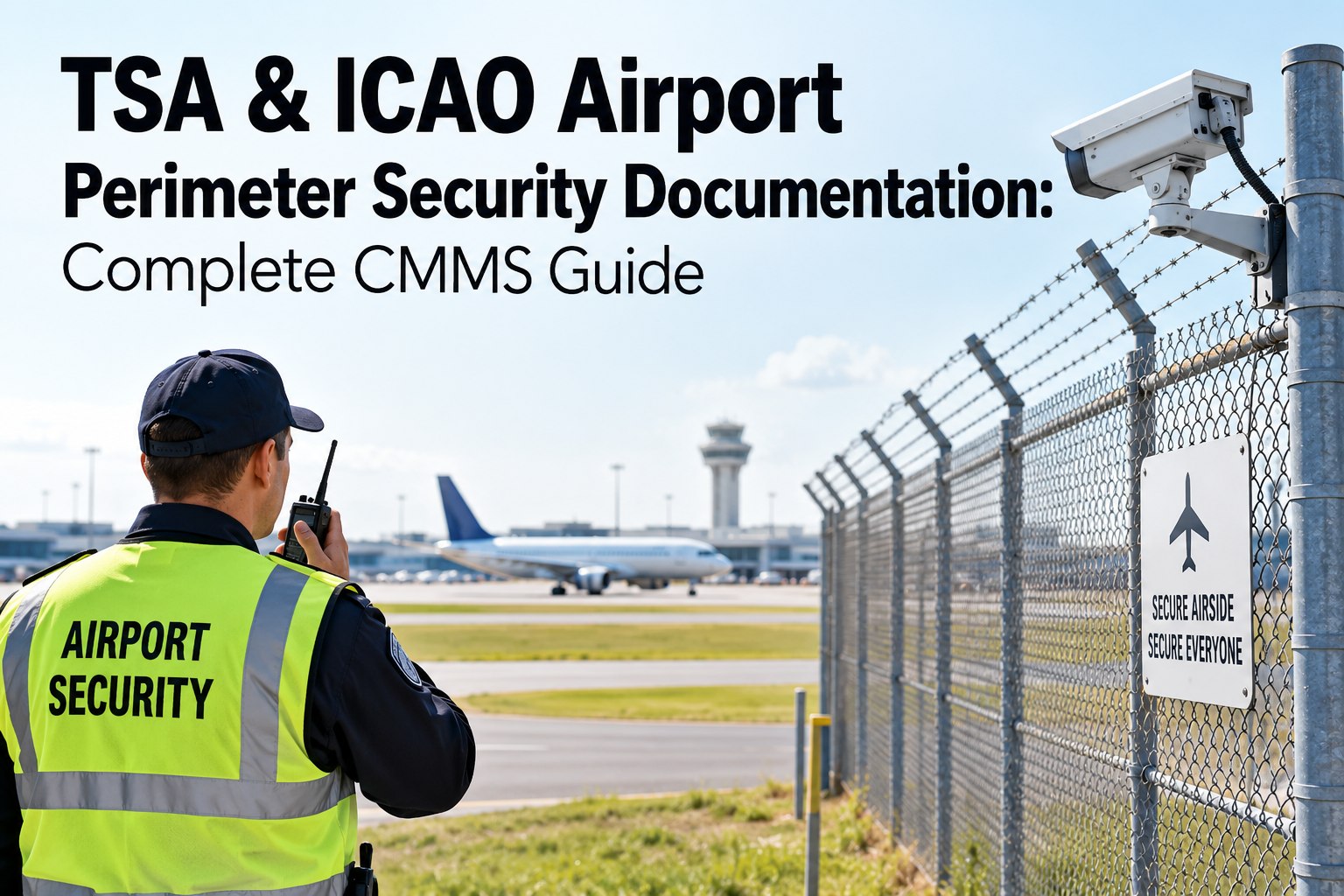
A security robot with a dead battery at 2 AM doesn't patrol the perimeter. It sits in a hallway, blind and useless, while the fence line it was supposed to monitor stays unwatched. Airports deploying autonomous patrol robots—K5 units, Secom X2s, Argus S5 platforms, drone perimeter systems—are discovering that the machines designed to eliminate security gaps can create new ones when their own maintenance falls through the cracks. The autonomous patrolling robot market is growing at 10.8% CAGR through 2033, with airports at the center of adoption. But deployment is the easy part. The hard part is keeping 24/7 surveillance truly 24/7—and that requires a maintenance discipline most security teams were never built to handle.
$71.8B
Security Robotics Market by 2027
Growing at 17.8% CAGR as airports accelerate deployment
24/7/365
Required Coverage Standard
TSA 49 CFR 1542 mandates continuous perimeter monitoring
3–8 hrs
Typical Robot Battery Cycle
Patrol duration before docking—maintenance windows are razor-thin
99.5%+
Target Uptime for Security Assets
Every percentage point below target is an unmonitored gap
Why Security Robots Are Different From Every Other Airport Asset
Terminal HVAC can run at 90% efficiency for a week before anyone notices. A baggage conveyor slowdown is annoying but manageable. But a security robot that goes offline creates an immediate compliance exposure. Under TSA regulation 49 CFR Part 1542, airports must maintain continuous access control and surveillance of secured areas. FAA Part 139 certification requires documented self-inspection programs. When a patrol robot is down, the zone it covers is unmonitored—and if that gap coincides with an incident or an audit, the consequences cascade from operational to regulatory to legal.
Trigger
Robot fails mid-patrol—sensor malfunction, battery degradation, software fault, or mechanical blockage
0–15 min
Patrol zone unmonitored. No thermal imaging, no anomaly detection, no license plate capture in that sector
15–60 min
Security ops must redeploy personnel to cover gap—pulling resources from other posts or leaving multiple zones thin
1–4 hrs
If no CMMS tracks the failure, maintenance response is ad-hoc. No root cause logged. No audit trail of the coverage gap
Audit Day
TSA/FAA inspector asks for documentation of continuous surveillance. Gaps without logged cause and resolution become findings
This is why security robot maintenance isn't a facilities task—it's a compliance function. And compliance functions need systems, not spreadsheets. Teams managing robotic patrol fleets can book a demo to see how CMMS automates security asset compliance before the next audit cycle.
The Maintenance Framework: Daily, Weekly, Monthly, Annual
Security robots operate in some of the harshest conditions at any airport—outdoor exposure to weather, dust, temperature swings, and constant vibration from movement across uneven surfaces. Their maintenance requirements span mechanical, electrical, software, and sensor systems simultaneously. The following framework covers every category on a cadence designed to prevent failures without pulling robots offline during peak patrol hours.
Every Shift / Daily
Power
Verify battery charge level, check docking station connection, confirm auto-charge cycle completed
Sensors
Clean camera lenses, LIDAR windows, and thermal imaging apertures. Confirm obstacle avoidance responds
Software
Review error logs from previous patrol cycle. Confirm firmware is current and comms link is stable
Physical
Visual inspection for debris lodged in wheels/tracks, exterior damage, loose panels, or fluid leaks
Weekly
Mechanical
Inspect wheel bearings, drive motors, and chassis mounting bolts. Check for abnormal vibration or noise during operation
Electrical
Test all cable connections and harnesses for secure termination. Verify grounding integrity and check for corrosion
Navigation
Verify GPS/SLAM accuracy by running reference route. Confirm patrol route waypoints match programmed coordinates
Security
Test emergency stop function, two-way audio, and alert transmission to SOC. Verify footage upload integrity
Monthly
Battery
Run full battery health diagnostic—cycle count, charge capacity degradation, internal resistance measurement
Calibration
Recalibrate thermal imaging, PTZ camera alignment, and LIDAR point cloud accuracy against reference targets
Software
Apply firmware updates, patch security vulnerabilities, backup all configuration data and patrol route maps
Lubrication
Grease drive joints and pivot points per manufacturer spec. Inspect weatherproofing seals on all access panels
Quarterly / Annual
Overhaul
Complete teardown inspection of drive system, replace wear components (wheels, belts, brushes), rebuild as needed
Battery
Replace batteries reaching 80% original capacity threshold. Test backup power systems and failover behavior
Compliance
Full audit of maintenance records vs. TSA/FAA requirements. Verify all findings linked to corrective work orders
Lifecycle
Review total cost of ownership. Evaluate repair-vs-replace decisions using actual maintenance history data
The Compliance Connection: Maintenance Records as Audit Evidence
Airport security audits don't just check whether your robots are working today. They check whether you can prove they've been working continuously—and that every failure was detected, documented, and resolved within an acceptable timeframe. TSA 49 CFR 1542 requires documented access control and surveillance programs. FAA Part 139 demands self-inspection records. The expanded SMS final rule now adds safety management documentation for Part 121, 135, and 91.147 operators. For airports using robotic surveillance, every one of these requirements translates into maintenance records that must be complete, searchable, and linkable from finding to resolution.
TSA 49 CFR Part 1542
Airport Security Programs
Requires documented, continuous surveillance of secured areas. Robot downtime without logged cause and resolution = finding.
FAA 14 CFR Part 139
Airport Certification
Self-inspection programs must include all safety-critical equipment. Security robots monitoring airside areas fall under this scope.
FAA SMS Final Rule
Safety Management Systems
Expanded mandate requires hazard identification and risk management documentation—including technology-dependent security systems.
TSA Cybersecurity EA
Emergency Amendment
Networked robots are IT/OT assets. Firmware updates, vulnerability patching, and incident reporting now fall under cybersecurity mandates.
Every regulation above requires records that a CMMS generates automatically—work orders, resolution timestamps, compliance trails. Manual tracking fails at the scale and speed these standards demand.
Uptime Architecture: Maintaining Coverage During Maintenance
The paradox of security robot maintenance is that the robots can't be maintained and patrol simultaneously. Every PM session, every battery swap, every firmware update creates a window where a zone is uncovered. Airports solving this problem use a combination of fleet redundancy, staggered scheduling, and CMMS-driven rotation planning to ensure that maintenance itself never creates the vulnerability the robots exist to prevent.
A
Fleet Redundancy with Rotation
Deploy N+1 units per zone—one always available as backup while the other undergoes scheduled PM. CMMS auto-assigns the standby unit to active patrol when the primary enters maintenance.
B
Off-Peak Maintenance Windows
Schedule PM tasks during lowest-traffic periods when security risk profile is reduced. CMMS triggers work orders based on both time intervals and operational tempo data.
C
Predictive Intervention
Use battery health trends, motor current analysis, and sensor drift data to schedule maintenance before failure—converting unplanned outages into planned, brief service windows.
Strategy C is where the real transformation happens—but it requires historical maintenance data that only exists if you've been capturing it in a structured system from day one. Security teams building their robotic fleet can sign up free and start tracking every patrol robot from deployment.
What Breaks Most Often—and How to Prevent It
After analyzing maintenance patterns across security robot deployments at airports and critical infrastructure facilities, five failure modes account for over 80% of unplanned downtime. Each is preventable with the right PM cadence and tracking discipline. The table below maps each failure mode to its root cause, its impact on security coverage, and the preventive action that eliminates it.
Failure Mode
Root Cause
Coverage Impact
Prevention
Battery Degradation
Charge cycle count exceeds threshold; no capacity monitoring in place
Patrol cuts short—zone unmonitored for hours until manual discovery
Monthly health diagnostics; CMMS alert at 80% capacity; scheduled replacement
Sensor Obstruction
Dust, moisture, insect debris on camera lenses, LIDAR, thermal apertures
Degraded detection—threats pass unrecognized even while robot is "active"
Daily lens cleaning in PM checklist; automated image quality self-test alerts
Navigation Drift
GPS/SLAM calibration degrades; environmental changes alter mapped routes
Robot patrols wrong zone or stops mid-route—coverage gaps and false readings
Weekly route verification against reference waypoints; post-construction recalibration
Comms Link Failure
Wi-Fi/cellular dead zones; firmware incompatibility after network upgrade
Robot operates but can't transmit alerts—SOC blind to detected threats
Weekly signal strength mapping; test alert transmission every shift; firmware version control
Drive System Wear
Wheel/track degradation from outdoor surfaces; motor bearing wear from continuous use
Robot immobilized on patrol route—physical obstacle and coverage gap simultaneously
Monthly drive inspection; lubrication per manufacturer spec; quarterly component replacement
The biggest misconception about security robots is that they reduce maintenance work. They don't—they redirect it. Instead of maintaining cameras bolted to walls, you're maintaining cameras mounted on machines that drive 15 miles a day through weather, dust, and jet blast. The maintenance burden is higher, but the security capability is exponentially better—if you have the systems to keep them running.
Airport Security Operations Manager, Tier-1 U.S. Hub
CMMS as the Security Operations Backbone
Manual maintenance tracking for security robots doesn't just create inefficiency—it creates liability. When an auditor asks for the maintenance history of Robot Unit 7 for the past 90 days and your answer involves opening three email threads, a shared spreadsheet, and a filing cabinet, the finding is already written. A CMMS transforms security robot maintenance from a scattered administrative task into a continuous, automated compliance engine that runs in the background of every patrol cycle.
Auto-Generated Work Orders
When a robot reports a sensor fault or battery threshold breach, the CMMS creates a prioritized work order, assigns it to the right technician, and stages the required parts—without a human initiating anything.
PM Schedule Automation
Daily, weekly, monthly, and annual tasks are triggered automatically based on calendar, operating hours, or patrol cycles. No missed inspections. No "we forgot to check" moments during audits.
Compliance Audit Trail
Every maintenance action is timestamped and linked: finding to work order, work order to technician, technician to verified resolution. TSA and FAA inspectors get answers in seconds, not weeks.
Fleet Uptime Dashboard
Real-time visibility into which robots are patrolling, which are charging, which are in maintenance, and which zones are at risk. Security operations and maintenance work from the same picture.
Predictive Maintenance Analytics
Historical failure data, battery degradation curves, and sensor drift patterns enable the CMMS to predict failures and schedule interventions before coverage gaps occur.
Cybersecurity Compliance
Track firmware versions, patch deployment dates, and vulnerability remediation across every networked robot—meeting TSA Emergency Amendment requirements for IT/OT asset management.
Airport operations teams managing security robot fleets of any size—from 3 units at a regional airport to 30+ at an international hub—can book a demo to see how OXmaint handles security asset PM scheduling, compliance documentation, and fleet uptime tracking.
Your Security Robots Are Only as Reliable as the System Maintaining Them
OXmaint gives airport security teams automated PM scheduling, real-time fleet uptime visibility, and audit-ready compliance trails for every robotic asset—from patrol bots to drone perimeter systems.
Frequently Asked Questions
How often should airport security patrol robots receive preventive maintenance?
Security robots require a layered PM schedule: daily shift checks covering battery, sensor cleanliness, and error log review; weekly inspections of mechanical systems, electrical connections, navigation accuracy, and emergency functions; monthly diagnostics including full battery health analysis, sensor recalibration, software updates, and lubrication; and quarterly-to-annual overhauls covering drive system teardowns, component replacements, and comprehensive compliance audits. The specific intervals should align with manufacturer recommendations—for example, some platforms recommend drive system inspection every 600 operating hours while others specify calendar-based intervals. The critical principle is that security robots operate 24/7 in outdoor environments, so their wear rate is significantly higher than industrial robots in controlled factory settings.
What compliance requirements affect airport security robot maintenance?
Four regulatory frameworks converge on security robot operations. TSA 49 CFR Part 1542 requires documented, continuous surveillance of airport secured areas—meaning robot downtime must be logged with cause, duration, and resolution. FAA 14 CFR Part 139 mandates self-inspection programs covering all safety-critical equipment, including robotic systems monitoring airside areas. The FAA's expanded SMS final rule requires hazard identification and risk management documentation that includes technology-dependent security systems. Additionally, the TSA Cybersecurity Emergency Amendment now classifies networked robots as IT/OT assets requiring firmware tracking, vulnerability management, and incident reporting. A CMMS that automates maintenance documentation addresses all four frameworks simultaneously by creating timestamped, searchable records linking every finding to its corrective action.
How do airports maintain surveillance coverage while robots are being serviced?
Leading airports use three complementary strategies. Fleet redundancy with N+1 deployment ensures a standby unit is always available when the primary robot enters maintenance. Off-peak scheduling concentrates PM tasks during lowest-traffic periods when the security risk profile is naturally reduced. Predictive maintenance uses historical data from a CMMS—battery degradation curves, motor wear patterns, sensor drift trends—to schedule interventions before failures occur, converting unplanned outages into brief, planned service windows. The most effective approach combines all three: redundant fleet managed by a CMMS that automatically rotates standby units into active patrol when a primary unit is scheduled for maintenance, ensuring zero-gap coverage documented for compliance purposes.
What are the most common security robot failure modes at airports?
Five failure modes account for the majority of unplanned security robot downtime. Battery degradation from charge cycle accumulation causes premature patrol termination. Sensor obstruction from dust, moisture, and debris degrades detection capability even while the robot appears operational. Navigation drift from GPS/SLAM calibration decay causes route deviation or mid-patrol stops. Communications link failures from Wi-Fi dead zones or firmware incompatibility prevent alert transmission to the security operations center. Drive system wear from continuous outdoor operation on uneven surfaces causes mechanical immobilization. All five are preventable through structured PM programs tracked in a CMMS, with daily sensor cleaning, weekly navigation verification, monthly battery diagnostics, and quarterly mechanical overhauls forming the core prevention cadence.