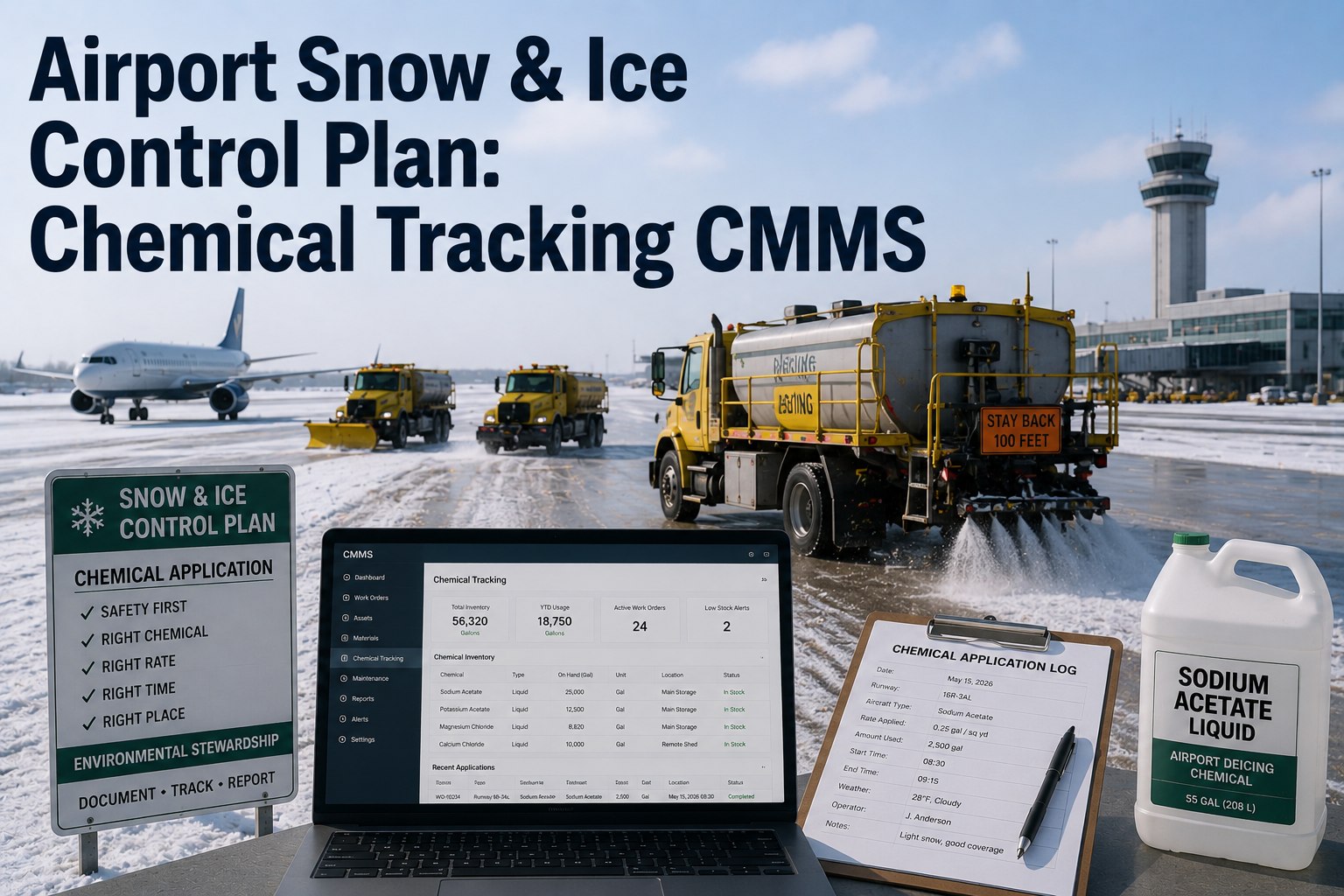
When winter hits, an airport's Snow and Ice Control Plan stops being a binder and becomes an operational contract — every plow pass, every runway condition assessment, every contaminant reading has to happen on schedule and be recorded. FAA AC 150/5200-30D frames the field condition assessments and winter operations that Part 139 airports run, built around the Runway Condition Assessment Matrix (RCAM) and the condition codes it produces. Come the annual plan review, the question isn't whether you cleared snow — it's whether you can prove how, when, and to what standard. This checklist walks the compliance and evidence a strong SICP needs, and how OXMAINT AI, the AI-powered CMMS, keeps every winter-ops record audit-ready.
Airport & Aviation · Winter Operations · FAA AC 150/5200-30D
Airport Snow & Ice Control Plan Compliance: FAA AC 150/5200-30 Checklist
A Snow and Ice Control Plan is only as strong as the records behind it — and reconstructing a season of plow logs and condition assessments before the annual review is a losing game. OXMAINT AI keeps the evidence as you go: equipment readiness, plow and treatment logs, runway condition assessments and training records, tied to assets and timestamped, so the plan you run is the plan you can prove.
AC 150/5200-30D
the FAA advisory for field condition & winter ops safety
RCAM
the matrix that turns contaminants into runway condition codes
RwyCC 0-6
the codes reported to pilots via a FICON NOTAM
Prove it
the annual review tests your records, not your intentions
Runway Condition Codes: The Heart of the Assessment
Modern winter reporting centers on the RCAM. An assessor observes the contaminant type, depth and coverage on each third of the runway, applies the matrix, and derives a Runway Condition Code from 6 (best) to 0 (worst) — the number that reaches the flight deck. Getting this right, and recording it, is the core of the plan. Start free and log runway condition assessments in OXMAINT AI.
6
Dry. Best condition — dry runway surface.
5
Good. Frost, or thin dry snow / wet conditions within limits.
4
Good to medium. Compacted snow at low temperatures.
3
Medium. Wet or slushy conditions, dry/wet snow over compacted snow.
2
Medium to poor. Deeper wet snow or slush, standing water.
0
Nil. Wet ice, water over compacted snow, dry/wet snow over ice — worst.
This is a simplified view of the RCAM for orientation — the actual matrix in AC 150/5200-30D governs the assessment, and codes are assigned by a trained assessor per runway third. Always work from the current FAA advisory and your approved SICP, not this summary.
From Assessment to NOTAM
A condition code only matters if it reaches pilots correctly and on time. The reporting chain runs from the field observation to a published field condition (FICON) NOTAM — and every step needs to be timely and recorded. Book a demo to see the assessment chain in OXMAINT AI.
Observe
Assess the surface — contaminant type, depth and percent coverage on each third of the runway.
Apply RCAM
Derive the RwyCC — the matrix converts the observed contaminants into a condition code per third.
Report
Issue the FICON NOTAM — the condition codes and contaminant details are published for flight crews.
Treat
Clear and treat — plow and apply approved products, then re-assess as conditions change.
Record
Log everything — assessment, NOTAM, plow and treatment actions timestamped as the season's evidence.
What Your SICP Has to Cover
A compliant Snow and Ice Control Plan documents how the airport prepares for and runs winter operations. These are the elements the plan — and the annual review — expect to see in place. Sign up free and structure your SICP elements in OXMAINT AI.
Priority Clearing Plan
Which surfaces are cleared first — runways, taxiways, aprons — and the sequence and standards for each.
Equipment & Readiness
Plows, brooms, blowers and spreaders inventoried, maintained and pre-season ready.
Condition Assessment
Who assesses, how, and how often — the RCAM-based procedure and reporting cadence.
Approved Materials
Deicing and anti-icing products approved for use, with application and storage procedures.
NAVAID Protection
Snow clearance and accumulation limits around navigational aids and critical areas.
Communication & NOTAM
How conditions are communicated to ATC, tenants and pilots, and who issues the FICON NOTAM.
Training
Assessor and operator training on the plan, the RCAM and equipment — recurrent and recorded.
Records & Review
Logs of actions, assessments and conditions, kept for the required period and reviewed annually.
The Plan Isn't Judged in a Storm. It's Judged in the Review.
A flawless winter still fails the annual review if the records can't prove it. OXMAINT AI captures plow logs, assessments and training as timestamped evidence tied to assets — so the review is an export, not a reconstruction.
The Winter-Ops Evidence Checklist
These are the records that turn "we ran the plan" into "here's the proof." Every one should be captured live during operations, not backfilled before the review. Book a demo to build this evidence set in OXMAINT AI.
1
Plow & treatment logs — what surface, when, by whom, and what product applied.
2
Runway condition assessments — contaminant, depth, coverage and RwyCC per third, timestamped.
3
FICON NOTAM record — the conditions reported and when they were issued and updated.
4
Equipment readiness & maintenance — pre-season checks and in-season repairs on the snow fleet.
5
NAVAID clearance records — snow cleared and accumulation kept within limits around critical areas.
6
Training records — who was trained on the SICP, RCAM and equipment, and when.
7
Any friction data used — where supplemental friction measurement informed decisions, recorded with context.
A Note on Mu / Friction Readings
Older winter programs leaned on Mu friction numbers as the primary basis for reporting. Current FAA guidance moved the standard to the RCAM — a trained assessment of contaminant type, depth and coverage — with friction measurement serving a supporting role rather than driving the condition code. If your team still records friction readings, capture them with their context, but assess and report against the RCAM. Start free and record assessments the RCAM way in OXMAINT AI.
Frequently Asked Questions
What does AC 150/5200-30D cover?
It's the FAA advisory circular for airport field condition assessments and winter operations safety, guiding the Snow and Ice Control Plan, the RCAM-based condition assessment, and FICON reporting at Part 139 airports. Work from the current version and your approved SICP.
Start free and align your records in OXMAINT AI.
What is the RCAM and RwyCC?
The Runway Condition Assessment Matrix translates observed contaminant type, depth and coverage into a Runway Condition Code from 6 (dry) down to 0 (nil), assessed per runway third and reported to pilots. It's the core of modern winter condition reporting.
Book a demo of RwyCC logging.
Is Mu friction measurement still used?
Friction readings now play a supporting role — current guidance bases the condition code on the RCAM assessment rather than on Mu as the primary measure. Record any friction data with its context, but assess and report against the RCAM.
Sign up free and record RCAM assessments in OXMAINT AI.
What records does the annual SICP review expect?
Plow and treatment logs, runway condition assessments, FICON records, equipment readiness and maintenance, NAVAID clearance and training records — captured during the season, kept for the required period, and retrievable on demand.
Book a demo of review-ready records.
Why manage winter ops in a CMMS?
Run the Plan — and Keep the Proof.
Capture equipment readiness, plow and treatment logs, RCAM assessments and training as timestamped, asset-linked evidence all season — with OXMAINT AI, so your Snow and Ice Control Plan holds up the day the annual review arrives.