For airports operating under FAA Part 139.313, a snow and ice control plan (SICP) is the operational and legal backbone of winter readiness. Every gallon of potassium acetate applied, every runway friction test logged, and every plow truck preventive maintenance record is subject to FAA inspection. When chemical usage goes untracked or run-off reports are incomplete, airports risk not only safety incidents but also operational closures, EPA fines, and compliance findings. This guide breaks down how a CMMS built for aviation winter operations keeps deicing chemical inventory, equipment PM, friction testing, and condition reporting audit-ready. Start your Start Free Trial to digitize your SICP records before the next freeze.
Is your airport's SICP audit-ready when the FAA inspector arrives mid-blizzard?
Every gallon of deicer, every friction reading, and every plow truck PM must be documented and retrievable in minutes. A CMMS digitizes chemical application tracking, runway condition reporting, and equipment readiness so you can prove compliance under pressure.
Why paper SICP records collapse under FAA scrutiny
A mid-size hub typically logs 2,500+ chemical application events per winter across runways, taxiways, and aprons. When those records live in spreadsheets and binder logs, reconstructing a single 24-hour operational window for an inspector can take a maintenance controller 6 to 10 hours. That gap is where findings are born.
The SICP winter execution timeline — where records get made or lost
A typical winter event at a Part 139 airport follows a four-phase cycle. Each phase generates documentation that the FAA expects to see linked, timestamped, and attributable. Here is where a CMMS captures each record at the point of action.
Inspect 40 to 60 plow trucks, sweepers, and chemical spreaders. CMMS auto-generates PM checklists, logs mechanic sign-off, and flags any unit below 80% readiness so it never leaves the barn with a bad hydraulic pump.
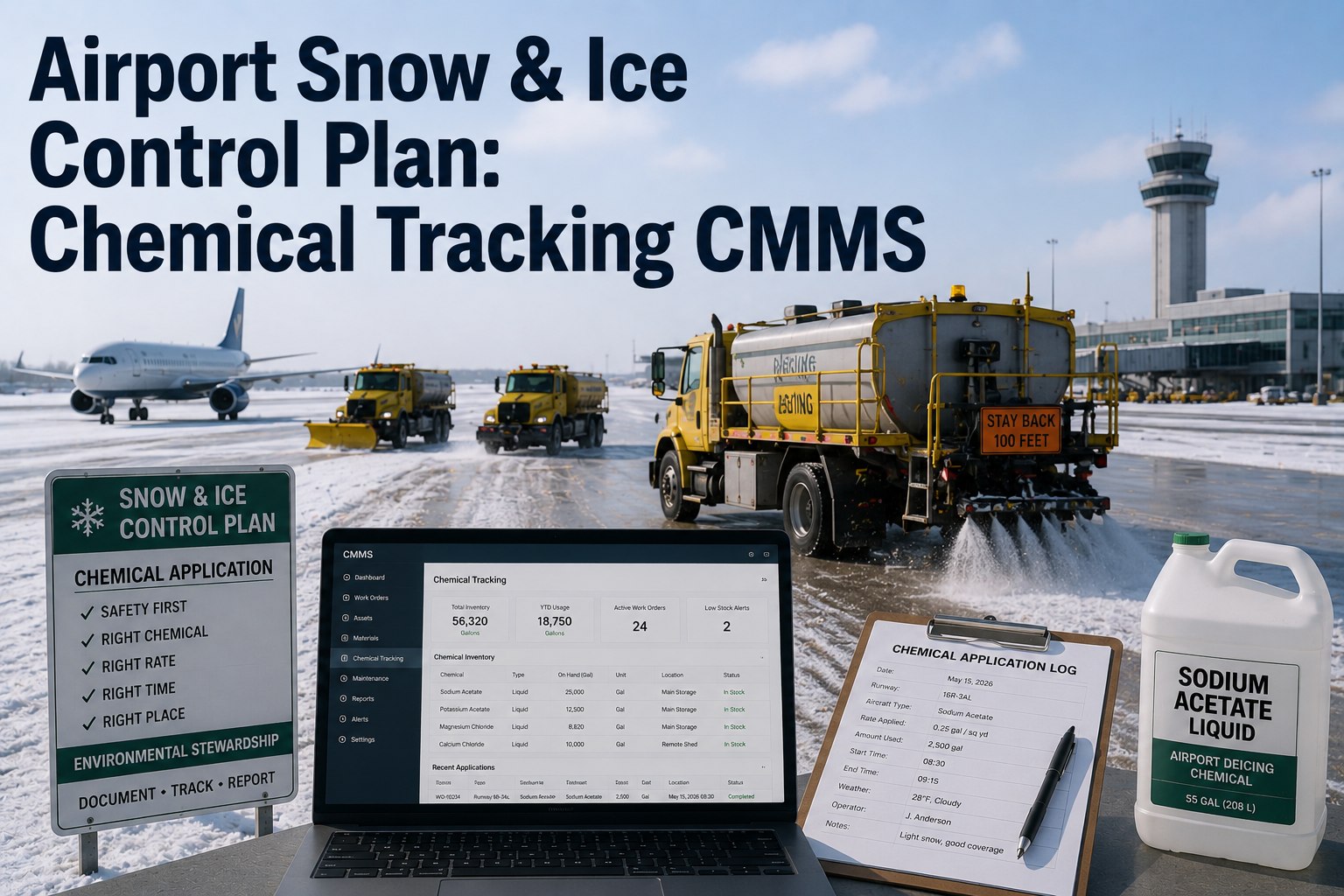
Operators log every pass: runway section, chemical type (potassium acetate, sodium formate, glycol), rate per 1,000 sq ft, and spreader calibration ID. The CMMS geotags each application and updates inventory in real time.
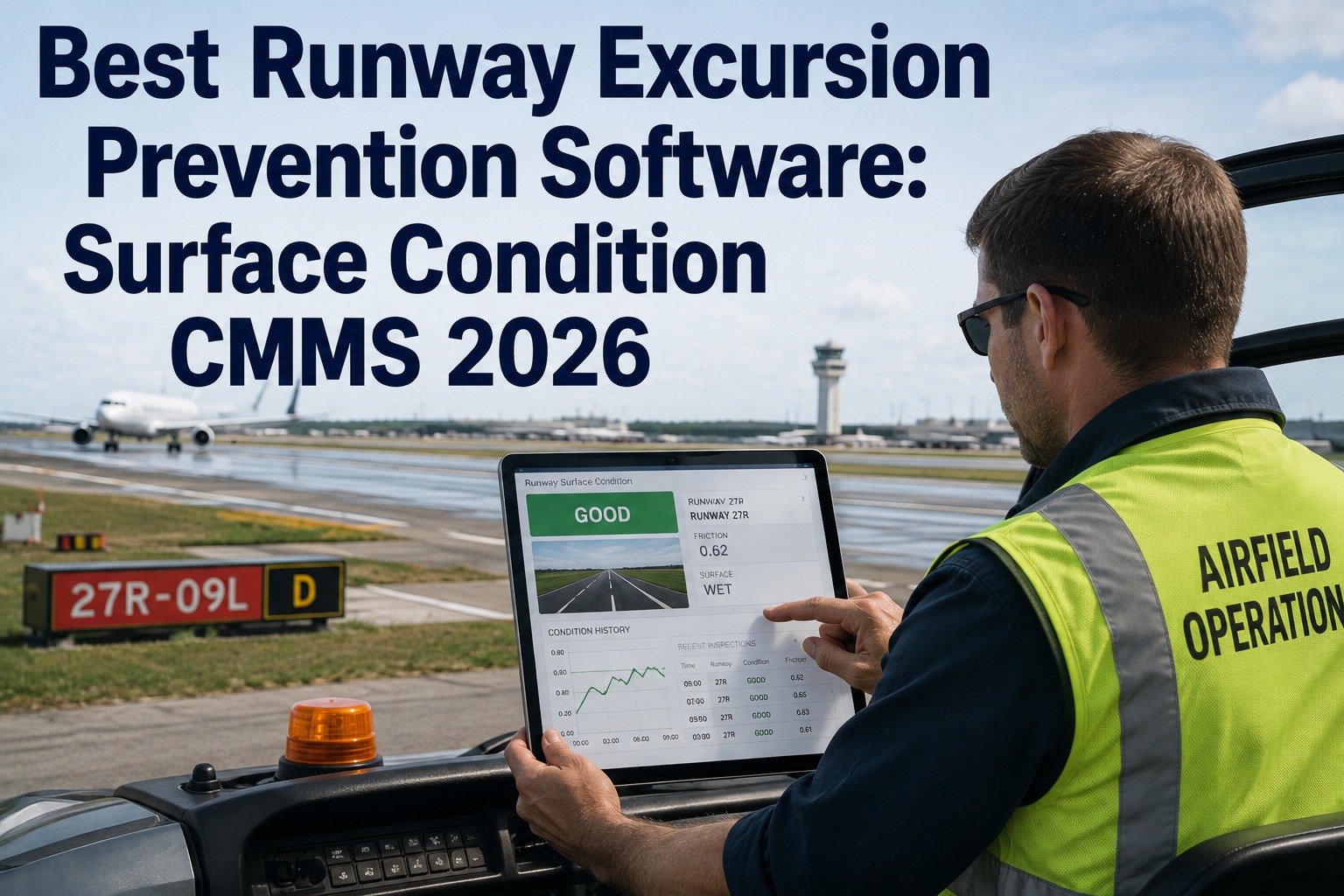
Continuous friction measuring equipment (CFME) runs log readings every 150 feet. The CMMS ingests mu values, cross-references against the Runway Condition Assessment Matrix, and auto-drafts the Field Condition Report (FICON).
Inventory reconciliation, equipment post-trip inspection, EPA run-off volume estimates, and the complete event packet are packaged into a single audit-ready record set. Inspector request? Export in under 10 minutes.
Real-world deicer inventory math at a 5-million-passenger hub
Consider a regional hub spending roughly $1.2M annually on potassium acetate and sodium formate across two parallel runways. Without CMMS tracking, inventory variance between purchased and applied chemical typically runs 18 to 25 percent — lost to uncalibrated spreaders, double-application on overlapping passes, and undocumented hand-application on hotspots.
| Tracking Method | Inventory Variance | Application Log Accuracy | FAA Retrieval Time | EPA Run-off Reporting |
|---|---|---|---|---|
| Paper logs & binders | 18–25% | ~65% (missing pass data) | 6–10 hours per event | Estimated, often contested |
| Spreadsheet tracking | 12–16% | ~80% | 2–4 hours per event | Partially automated |
| CMMS (oxmaint) | 3–5% | 99%+ (geotagged, timestamped) | < 10 minutes | Auto-calculated from application logs |
The SICP winter readiness checklist every maintenance controller should run
Before the first frost, a structured PM and inspection sweep across the winter fleet prevents the most common in-event failures: spreader calibration drift, plow cutting edge wear, and CFME sensor faults. A CMMS turns this list into assignable, trackable, sign-off-required work orders.
Chemical & Spread Equipment
- Calibrate every spreader to within ±5% of target application rate
- Verify tank level sensors against manual dipstick readings
- Inspect nozzles, booms, and pump pressure relief valves
- Confirm chemical storage temperature above potassium acetate freeze point (-59°F / -50°C)
- Log lot numbers and SDS sheets for every chemical delivery received
Mechanical Fleet PM
- Replace plow cutting edges worn below 2-inch minimum thickness
- Test hydraulic system pressure on all plow and broom circuits
- Inspect sweeper broom bristle pattern and replace if >15% missing
- Confirm engine block heaters and battery trickle chargers functional
- Validate LED light bars, beacon strobes, and radio interoperability
Friction & Reporting
- Run CFME self-test on dry pavement — baseline mu value must read 0.72+
- Calibrate surface temperature sensors against reference thermometer
- Verify weather feed integration updates every 5 minutes or less
- Test FICON auto-draft pipeline end-to-end with a mock event
- Confirm NOTAM distribution list current with ATC and airline ops
Stop burying your SICP records in binders.
Digitize chemical tracking, friction test logs, and equipment PM in one aviation-grade CMMS — and produce any inspector request in minutes, not hours.
What winter operations teams say after switching to CMMS tracking
"We cut our FAA record-retrieval time from a full shift to under 15 minutes. The inspector asked for two weeks of potassium acetate application logs and we had them exported before he finished his coffee."
"Spreadsheet variance on deicer was killing our budget. After the first winter on the CMMS, inventory variance dropped from 19% to 4% and we recovered over $140K in chemical spend. The payback was under three months."
"Equipment PM used to be reactive — we'd find a bad spreader mid-event. Now the CMMS flags calibration drift and wear thresholds before the season opens. Our in-event equipment failures dropped to near zero."
FAQ — Airport SICP and CMMS chemical tracking
What does FAA Part 139.313 require in a snow and ice control plan?
Part 139.313 requires a written SICP covering personnel responsibilities, equipment readiness, chemical storage and application procedures, runway condition reporting, and record retention. The plan must be executed and documented — meaning the FAA expects to see timestamped logs of every chemical application, friction test, and equipment inspection. A CMMS captures these records at the point of action, so they exist before an inspector asks. You can explore the full workflow with a Start Free Trial.
How does CMMS tracking reduce deicer chemical waste?
By geotagging every application pass and updating inventory in real time, a CMMS eliminates the double-passes and uncalibrated spreader drift that typically waste 18 to 25 percent of purchased chemical. Most airports see variance drop below 5 percent within the first full winter season, recovering $100K to $160K annually depending on fleet size and deicer volume.
Can the CMMS handle EPA run-off and environmental compliance reporting?
Yes. Because every chemical application is logged by volume, type, and location, the system auto-calculates run-off estimates for environmental reporting. This eliminates the manual reconciliation between application logs and EPA discharge monitoring reports, and provides defensible documentation if a state environmental agency audits your stormwater permits.
How quickly can we deploy a CMMS before winter operations begin?
A standard Part 139 airport deployment takes 4 to 6 weeks, covering fleet and chemical inventory import, PM template configuration, user onboarding for operators and mechanics, and integration with existing weather and friction-testing feeds. Most airports target a go-live 60 days before first frost. Schedule a scoping call via Book a Demo to map your timeline.
Does the system integrate with continuous friction measuring equipment?
Modern CFME devices export mu-value data via standard file formats or API endpoints. The CMMS ingests these readings, cross-references them against the Runway Condition Assessment Matrix, and auto-drafts the Field Condition Report. This removes manual transcription errors that have historically led to incorrect runway condition codes being transmitted via NOTAM.
Winter does not wait. Neither should your SICP digitization.
Deploy the CMMS that 139-certified airports trust for chemical tracking, equipment PM, and audit-ready records. Start before the first snowfall.
Free 14-day trial · No credit card