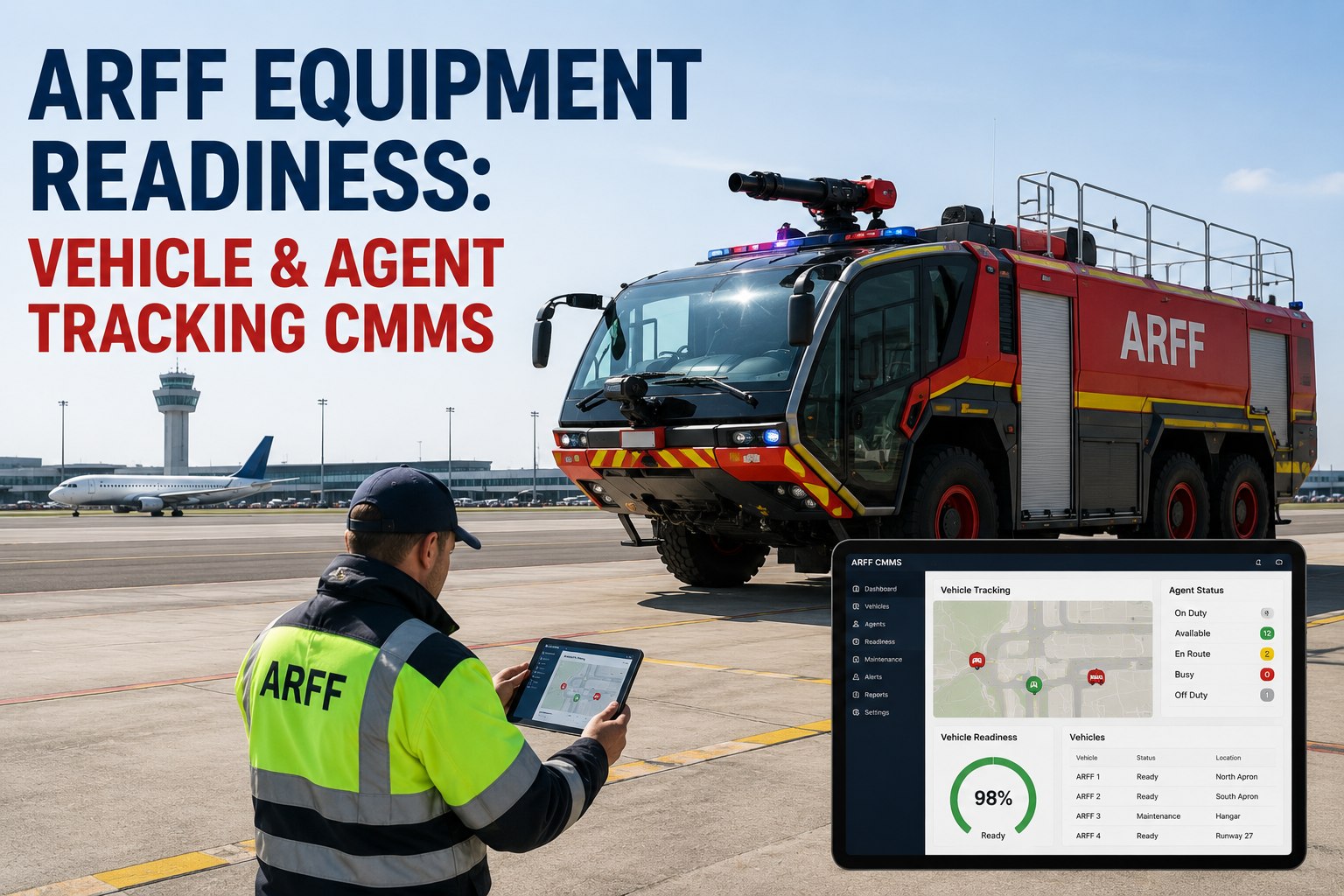
ARFF readiness documentation is the first thing FAA inspectors request during a Part 139 airport certification inspection — vehicle PM logs, agent inventory records, pump test results, and drill evidence. Gaps in aircraft rescue firefighting compliance records consistently rank among the top five Part 139 findings, and a single missing quarterly pump test or expired agent inventory log can trigger a Letter of Correction that puts your certificate at risk. This guide shows airport compliance officers exactly which ARFF records to maintain, how to keep them continuously audit-ready, and how digital ARFF documentation eliminates the scramble before every inspection. If your team is still chasing paper logs and spreadsheets, Start Free Trial and see how OxMaint keeps every ARFF record inspection-proof, automatically.
Is Your ARFF Documentation Ready for a Surprise FAA Inspection?
Inspectors give you minutes, not days. Every vehicle PM, agent inventory, pump test, and drill record must be retrievable on demand — or your airport faces a Letter of Correction, a compliance deadline, and potential certificate action.
What ARFF Records Does Part 139 Actually Require?
FAA Advisory Circular 150/5210 and Part 139.315–.319 define a specific, non-negotiable set of ARFF readiness documentation. Airports that fail inspections almost always fail on records — not on equipment. Here is the complete checklist inspectors work from.
Vehicle Maintenance Records
- Daily vehicle operational checks (engine, turrets, brakes, lights, communications)
- Preventive maintenance logs per manufacturer schedule
- Quarterly pump performance test results with flow and pressure data
- Corrective maintenance and repair history for each apparatus
- Vehicle out-of-service and return-to-service documentation
Agent & Inventory Records
- Firefighting agent quantity on hand vs. required minimum (Index-based)
- Agent type certification and compatibility documentation
- Dry chemical, foam concentrate, and clean agent stock levels
- Agent expiration dates and replacement schedules
- Reserve agent supply agreements and mutual aid agent provisions
Readiness & Response Records
- Response time drill results (3-minute requirement to midpoint of furthest runway)
- Personnel training records — initial and recurrent, per 139.319
- Live-fire drill documentation (at least one every 12 consecutive months)
- Mutual aid agreements and joint exercise records
- Emergency communication test logs
What Happens When ARFF Documentation Fails an Inspection
A Part 139 finding is not a slap on the wrist. It triggers a formal process that consumes weeks of staff time, invites heightened FAA scrutiny, and — in the worst case — can limit or suspend air carrier operations.
A mid-size Index B airport with 3 ARFF vehicles received a finding during its annual inspection because two quarterly pump tests were documented on paper forms that had been misfiled — the tests were done, but the records could not be produced on demand. The compliance officer spent 3 weeks reconstructing maintenance logs from technician notebooks, vendor invoices, and handwritten checklists. With OxMaint, every pump test, PM record, and agent inventory log would have been timestamped, searchable, and retrievable in under 60 seconds.
ARFF Vehicle Maintenance Documentation: What Inspectors Look For
Vehicle records are the single largest category of ARFF findings. Inspectors are not just checking that maintenance happened — they are verifying that your documentation proves a systematic, continuous program. Here is what separates audit-proof records from audit failures.
| Record Type | Frequency | What Inspectors Verify | Common Failure |
|---|---|---|---|
| Daily operational checks | Every shift / daily | Consistent completion, technician sign-off, deficiency follow-up | Gaps in dates, missing signatures, no corrective action trail |
| Preventive maintenance | Per manufacturer schedule | PM completed on time, parts used documented, next-due dates tracked | Overdue PMs, no evidence of parts replacement, ad-hoc scheduling |
| Pump performance tests | Quarterly (minimum) | Flow rate, pressure, and draft test data recorded and within spec | Missing quarters, incomplete data fields, no pass/fail determination |
| Agent inventory | Continuous / monthly reconciliation | Quantity on hand meets Index requirement, expiration dates tracked | Inventory below minimum, expired agent not flagged, no audit trail |
| Corrective maintenance | As needed | Deficiency identified, work order created, repair verified, vehicle returned to service | Verbal repairs with no work order, no return-to-service documentation |
| Out-of-service tracking | As occurs | Time-stamped out-of-service and return, interim coverage plan documented | No record of how ARFF coverage was maintained during downtime |
Why Paper ARFF Logs Fail — and What Audit-Proof Looks Like
The gap between airports that pass Part 139 inspections cleanly and those that receive findings almost always comes down to one thing: whether ARFF compliance documentation is systematic or scattered.
- Daily checklists filed in binders — retrieval takes hours or days
- Pump test data handwritten, sometimes illegible or incomplete
- Agent inventory tracked on a whiteboard or spreadsheet updated "when someone remembers"
- PM schedules in a calendar that depends on one person's memory
- No audit trail — cannot prove when a record was created or modified
- Inspection prep = 2–3 weeks of frantic document hunting
- Every record timestamped, searchable, and retrievable in under 60 seconds
- Pump test results captured digitally with pass/fail thresholds flagged automatically
- Agent inventory reconciled in real time with low-stock and expiration alerts
- PM schedules auto-generated per manufacturer intervals — nothing falls through
- Complete audit trail on every record — who, what, when, and what changed
- Inspection prep = open the dashboard, export the report, done
How OxMaint Keeps Your ARFF Records Continuously Audit-Ready
OxMaint is an AI-powered CMMS and EAM platform built for exactly this problem — turning scattered maintenance records into a systematic, inspection-proof compliance program. Here is how it maps to your ARFF readiness documentation requirements.
Automated PM Scheduling & Work Orders
Set manufacturer-recommended PM intervals for every ARFF vehicle once. OxMaint auto-generates work orders, assigns technicians, tracks completion, and escalates overdue items — so no quarterly pump test or daily check is ever missed or undocumented.
Agent & Spare Parts Inventory Tracking
Track foam concentrate, dry chemical, and clean agent quantities in real time against your Index requirement. Get automatic alerts when stock drops below minimum or approaches expiration — before it becomes a finding.
Timestamped Audit Trail on Every Record
Every work order, inspection, test result, and inventory adjustment carries a complete digital audit trail — who performed it, when, what was found, and what corrective action was taken. Inspectors see a systematic program, not a paper chase.
Compliance Dashboards & One-Click Reports
See ARFF readiness status across every vehicle, every agent type, and every required record from one dashboard. When the FAA arrives, export a complete compliance report in one click — organized exactly the way inspectors request it.
Stop Scrambling Before Every Part 139 Inspection
See how OxMaint keeps your ARFF vehicle records, agent inventories, and drill documentation continuously audit-ready — in a 30-minute personalized demo.
ARFF Documentation & Compliance FAQs
What ARFF records are required for Part 139 compliance?
Part 139 requires documented daily vehicle checks, preventive maintenance per manufacturer schedule, quarterly pump tests, agent inventory records meeting your airport's Index, personnel training records (initial and recurrent), live-fire drill evidence at least every 12 months, response time drill results, and mutual aid agreements. All records must be retrievable on demand during an inspection.
How long must airports retain ARFF maintenance records?
The FAA does not specify a single retention period for all ARFF records, but best practice — and what inspectors expect — is a minimum of 2 years for vehicle maintenance and pump test records, and longer for training documentation. Digital record-keeping through a platform like OxMaint makes indefinite retention practical and searchable.
What happens if ARFF documentation is missing during an FAA inspection?
Missing records typically result in a Letter of Correction requiring the airport to submit a corrective action plan within 30 days. The airport then faces heightened surveillance, and failure to correct can lead to civil penalties exceeding $250,000 per violation or, in extreme cases, suspension of the airport operating certificate — which halts air carrier operations.
Can digital ARFF records replace paper logs for FAA compliance?
Yes. The FAA accepts electronic records provided they are accurate, complete, and retrievable. Digital ARFF documentation is actually preferred by most inspectors because it includes timestamps, audit trails, and consistent formatting that paper cannot provide. Book a demo to see how OxMaint structures ARFF records for inspection-ready output.
How often should ARFF pump tests be documented?
NFPA 414 and FAA guidance require pump performance tests at least quarterly, with flow rate, pressure, and draft capability recorded. Each test must include a pass/fail determination against the vehicle's rated capacity. Missing even one quarter is a common Part 139 finding — automated scheduling ensures it never happens.
Make Your Next Part 139 Inspection the Easiest One Yet
Join airports using OxMaint to keep every ARFF vehicle log, agent inventory, pump test, and drill record audit-proof — automatically, every day.