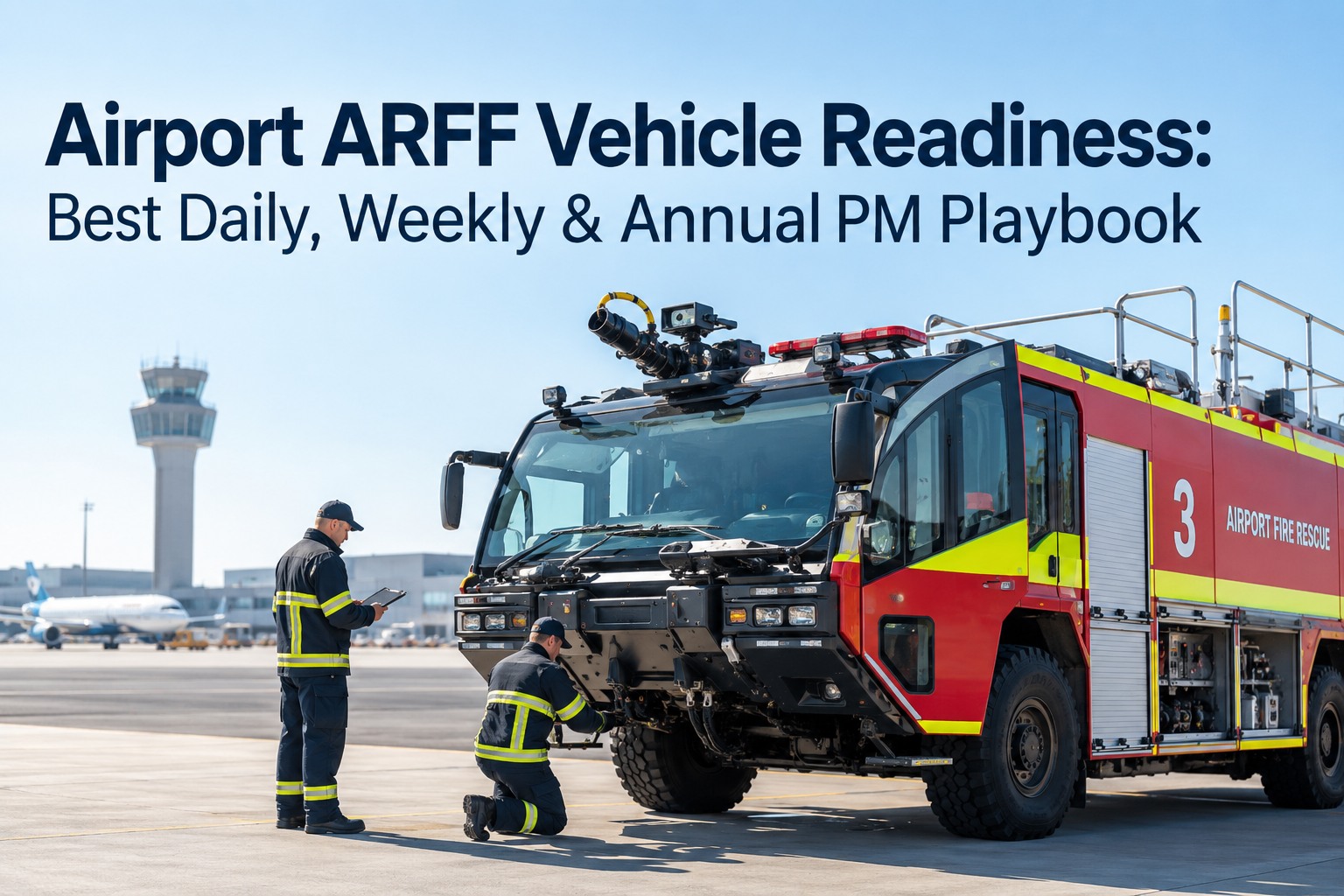
An ARFF vehicle that fails to start during an active runway emergency is not a maintenance issue — it is a potential mass casualty event. Aircraft Rescue and Fire Fighting vehicles operate under a uniquely unforgiving readiness standard: they must reach any point on an active runway within 3 minutes, discharge agent at full capacity, and sustain suppression operations until the incident is contained. There is no fallback plan when the primary response vehicle is grounded by a failed pump, a degraded foam proportioning system, or an engine that will not turn over because a coolant leak went undetected for weeks. FAA Part 139 does not merely recommend ARFF vehicle maintenance — it mandates operational readiness during all air carrier operations, with non-compliance triggering immediate index downgrades that can restrict commercial flight operations within 48 hours. For airport operations managers and fire chiefs responsible for ARFF fleet programs, the gap between "maintained" and "mission-ready" is measured in inspection rigor, documentation discipline, and the ability to detect degradation before it reaches failure — a gap that a modern CMMS platform is specifically designed to close. Want to see how leading airports manage ARFF readiness digitally? Start a free trial and explore the platform built for aviation maintenance teams.
Is Your ARFF Fleet Truly Mission-Ready?
Digitize daily inspections, automate PM scheduling, and maintain FAA Part 139 compliance documentation with OxMaint's aviation-grade CMMS.
What Is ARFF Vehicle Maintenance — And Why Does It Define Airport Certification?
ARFF vehicle maintenance encompasses every inspection, service action, component replacement, and documentation task required to keep Aircraft Rescue and Fire Fighting vehicles operationally capable at all times during air carrier operations. Unlike standard fleet maintenance programs where a vehicle can be rotated out of service without immediate operational consequence, ARFF maintenance operates under a binary readiness standard defined by 14 CFR Part 139: the vehicle is either fully operational and capable of meeting its assigned index requirements, or the airport's ARFF capability is degraded — triggering a mandatory notification chain that can result in restricted commercial operations within two days.
The scope of ARFF maintenance extends well beyond engine oil changes and tire rotations. These vehicles integrate complex foam proportioning systems, high-capacity water pumps delivering 500–1,200 gallons per minute through roof-mounted turrets, dry chemical delivery systems, communication equipment, and specialized drivetrain configurations designed for rapid acceleration across runway surfaces. Each of these subsystems has distinct inspection intervals, failure modes, and documentation requirements that must be tracked with precision — and that standard vehicle maintenance programs are not equipped to manage. Explore how OxMaint structures multi-system asset hierarchies for complex vehicles like ARFF apparatus — book a demo to see the platform configured for aviation fire rescue operations.
The Six Critical Subsystems of ARFF Vehicle Maintenance
Engine and Drivetrain
ARFF vehicles must accelerate from 0 to 50 mph in under 35 seconds. Diesel engine performance, transmission response, and all-wheel-drive system integrity directly determine whether the 3-minute response window is achievable. Coolant levels, oil analysis, belt tension, and exhaust system inspections form the daily and weekly maintenance baseline.
Foam Proportioning System
AFFF or fluorine-free foam (F3) must be mixed at precise ratios — typically 3% or 6% concentration — for effective fire suppression. Proportioner calibration drift, valve seal degradation, and concentrate contamination are the primary failure modes. Post-F3 transition, rinse protocols add additional maintenance complexity that must be tracked per FAA CertAlert 24-05 guidance.
Water Pump and Turret Assembly
Turret discharge rates of 500–1,200 GPM are required depending on vehicle water tank capacity. Pump seal integrity, impeller wear, turret rotation mechanisms, and nozzle condition must be verified through regular flow testing. A 10% drop in discharge rate can compromise suppression effectiveness on a large-frame aircraft fire.
Communication Systems
Part 139 mandates two-way voice radio capable of contacting ATC, fire stations, and common traffic advisory frequencies. Radio functionality testing, antenna integrity checks, and backup communication verification are non-negotiable daily inspection items — a communication failure during an active incident creates a coordination gap that compounds response risk.
Chassis, Tires, and Braking
ARFF vehicles weigh 35,000–65,000 lbs loaded. Tire condition, suspension integrity, and braking system performance directly affect high-speed runway traversal safety. Tire pressure monitoring, brake pad measurement, and suspension component inspection are critical given the stress these vehicles endure during rapid deployment and all-surface operation.
Dry Chemical and Clean Agent Systems
Supplementary agent systems — 450 lbs of potassium-based dry chemical or equivalent clean agent — require pressure vessel inspection, agent quality verification, discharge valve testing, and hose integrity checks. These systems are the first-attack capability deployed on arrival and must function without hesitation.
FAA Part 139 ARFF Compliance: What the Regulations Actually Require
The regulatory framework governing ARFF vehicle maintenance is not a set of suggestions — it is a legally binding certification requirement that directly determines an airport's authority to support commercial air carrier operations. Understanding the specific compliance obligations is essential for structuring a maintenance program that satisfies FAA inspectors while actually protecting operational readiness.
| Requirement Area | FAA Standard | Consequence of Non-Compliance | CMMS Tracking Capability |
|---|---|---|---|
| Vehicle Operational Readiness | 139.319(g)(1) — Operationally capable during all air carrier ops | Immediate replacement required; 48-hour index downgrade trigger | Real-time asset status dashboard with automated alerts |
| Agent Quantity Compliance | 139.317 — Minimum water, AFFF, dry chemical by Index | Index non-compliance; potential certificate action | Inventory level tracking with threshold-based reorder triggers |
| Response Time Capability | 139.319 — Must meet response time requirements | Operational restriction on air carrier service | Performance testing logs with trend analysis |
| Personnel Training Records | 139.319(h)(5) — 24-month training record retention | Certificate inspection findings; corrective action required | Digital training records with expiration tracking and alerts |
| Vehicle Marking and Lighting | 139.319(f) — Enhanced visibility marking and lighting | Inspection finding; must be corrected before next FAA visit | Inspection checklist items with photo documentation |
| Communication Equipment | 139.319(e) — Two-way voice radio with ATC and fire station | Vehicle deemed inoperative if comms fail | Daily inspection workflow with pass/fail radio check items |
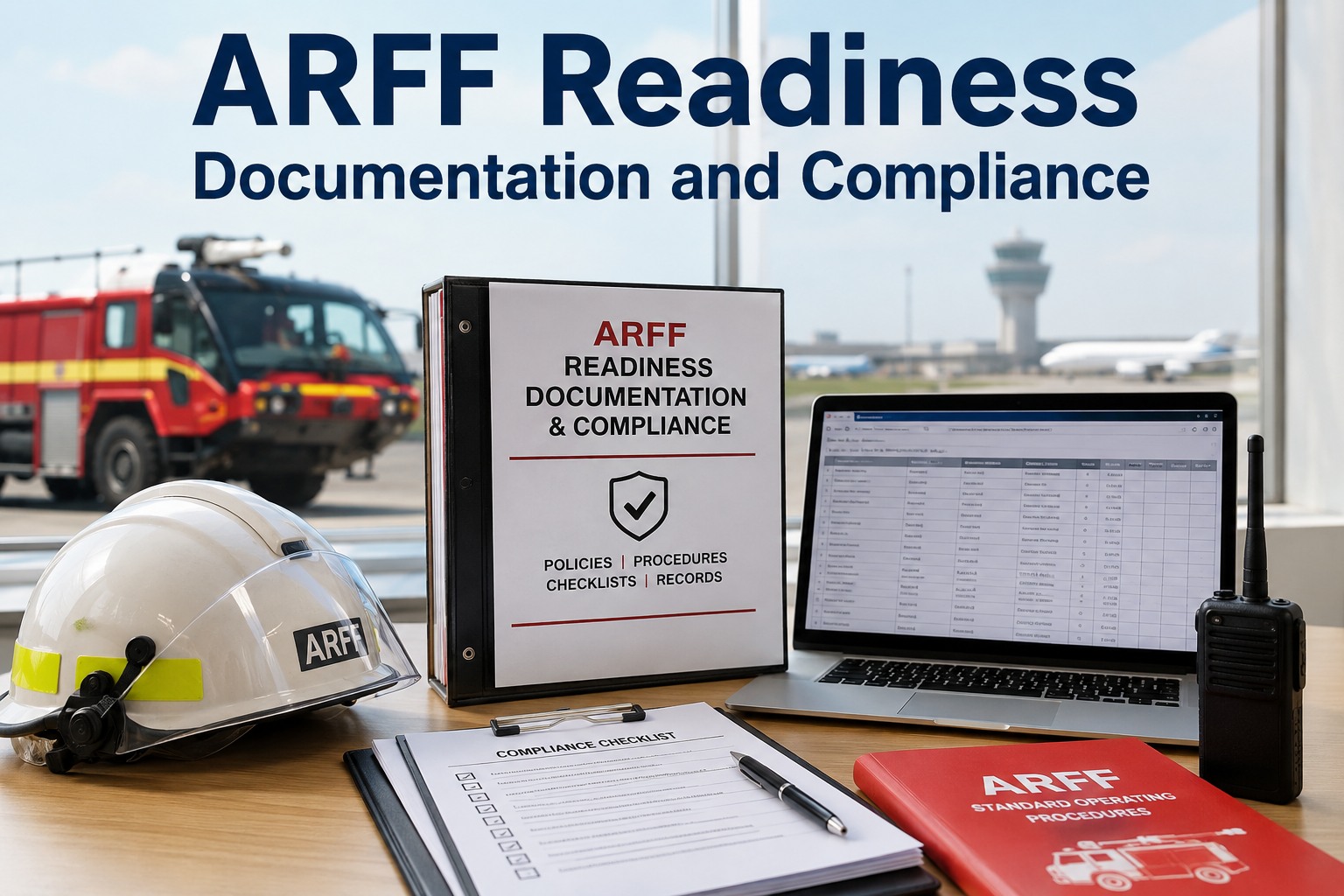
The critical takeaway: FAA inspectors evaluate not just whether maintenance is performed, but whether it is documented, traceable, and consistently executed. Paper-based maintenance logs — still used at many smaller Part 139 airports — create compliance risk through illegible records, missing entries, and the inability to demonstrate trend-based analysis during certification inspections. A CMMS purpose-built for aviation operations eliminates these documentation gaps entirely. Ready to see audit-ready ARFF documentation in action? Start a free trial and build your compliance-ready maintenance program today.
Paper Logs vs. Digital CMMS: The ARFF Maintenance Reality Check
- Daily inspection forms stored in binders — lost, damaged, or incomplete entries common
- PM schedules tracked on whiteboards or spreadsheets — no automated reminders
- Foam system test records filed separately from vehicle service history
- No trend analysis capability — failures appear sudden rather than predictable
- FAA inspector must review physical documents — time-consuming, error-prone
- Training expiration dates tracked manually — missed renewals create compliance gaps
- Digital daily inspections completed on mobile devices with photo evidence and timestamps
- Automated PM scheduling tied to calendar intervals, runtime hours, and condition triggers
- Unified asset record — every subsystem, inspection, and service event in one timeline
- Trend dashboards flag degradation patterns weeks before failure threshold
- Audit-ready digital reports generated on demand for FAA certification inspections
- Automated training expiration alerts with 30/60/90-day advance notifications
How OxMaint Structures ARFF Vehicle Maintenance Programs
OxMaint approaches ARFF fleet management through a hierarchical asset model that mirrors the actual operational structure of airport fire rescue programs — from the fleet level down to individual components within each vehicle. This architecture enables maintenance teams to manage complexity without losing visibility into any single subsystem's condition or compliance status.
Multi-Level Vehicle Hierarchy
Structure each ARFF vehicle as a parent asset with child components — engine, pump system, foam proportioner, turret, dry chemical system, communications, chassis — each with independent maintenance schedules, inspection histories, and condition scores. 100% of subsystem data rolls up to a single vehicle health dashboard.
Digital Daily Operator Checks
Mobile-first inspection forms covering all Part 139 daily check requirements — fluid levels, tire condition, brake systems, agent quantities, radio functionality, turret operation — with mandatory photo capture, GPS-stamped timestamps, and technician digital signatures that satisfy FAA documentation standards.
Multi-Trigger Preventive Maintenance
Schedule PMs by calendar interval, engine hours, mileage, or pump operation cycles — whichever threshold is reached first. OxMaint automatically generates work orders with pre-populated parts lists, labor estimates, and technician skill requirements for each ARFF-specific service task.
FAA Audit Documentation Engine
Generate comprehensive compliance reports covering vehicle operational readiness, agent inventory levels, training record currency, and inspection completion rates — formatted for FAA Part 139 certification inspection requirements. Produce 24-month training retention records with a single report pull.
Agent and Parts Tracking
Monitor AFFF/F3 foam concentrate levels, dry chemical quantities, and critical spare parts inventory with automatic reorder triggers when stock falls below minimum thresholds. Track lot numbers and expiration dates for foam concentrate to ensure agent quality compliance during flow testing.
Fleet Condition Scoring
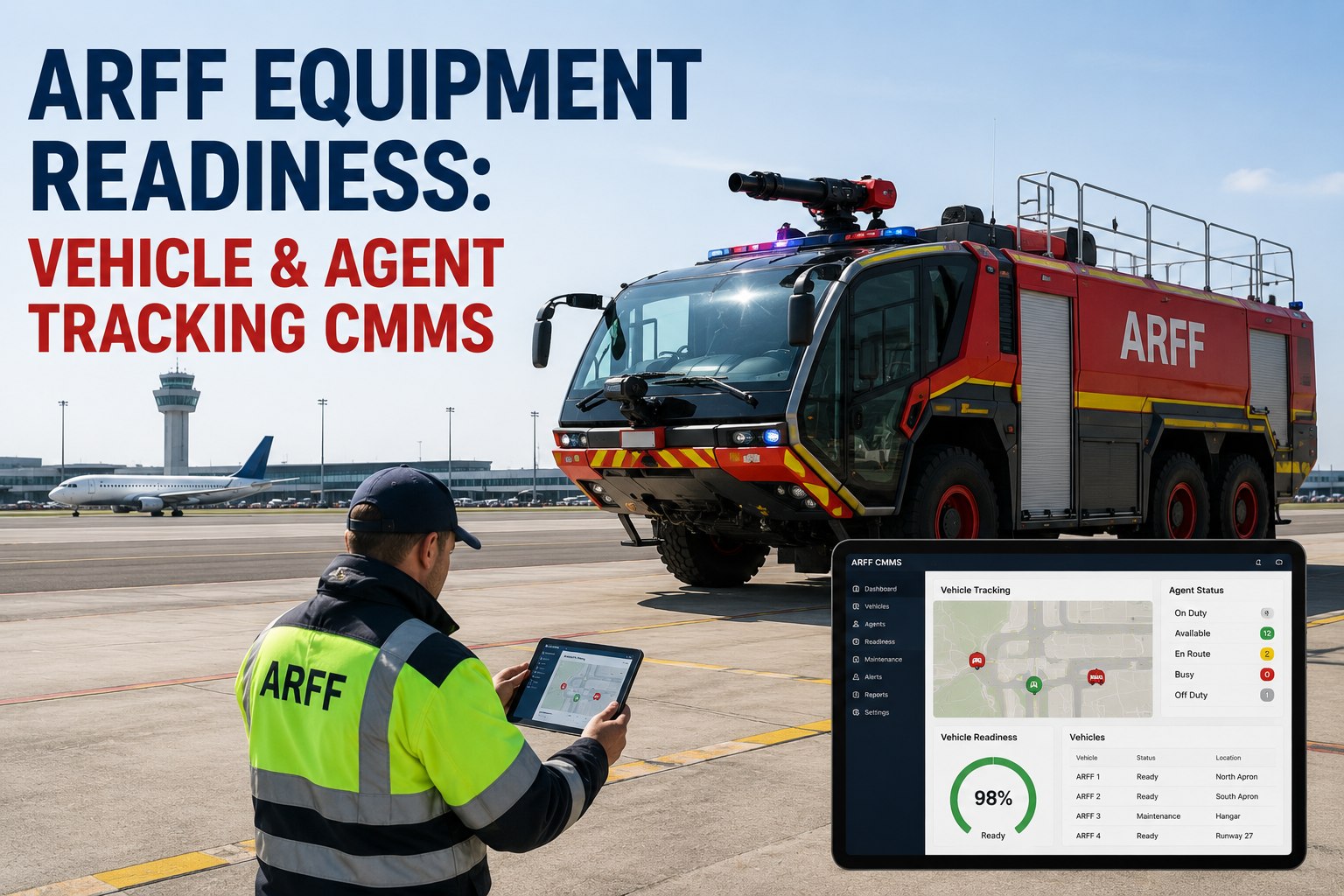
Real-time condition scores for every ARFF vehicle based on inspection results, open work orders, PM compliance rate, and component age data. Fleet-level dashboards give fire chiefs and airport operations directors instant visibility into readiness status across the entire ARFF program — critical when managing multi-vehicle index requirements.
ARFF Maintenance Frequency Matrix
ARFF maintenance intervals are driven by a combination of manufacturer specifications, FAA advisory circular guidance (AC 150/5220-10E), NFPA 414 standards, and airport-specific operational conditions. The following matrix represents the minimum recommended frequencies for core ARFF maintenance tasks — with the understanding that higher-activity airports or vehicles operating in extreme climate conditions may require compressed intervals.
| Maintenance Task | Daily | Weekly | Monthly | Quarterly | Annual |
|---|---|---|---|---|---|
| Engine fluid levels and visual inspection | Yes | — | — | — | — |
| Tire pressure and condition check | Yes | — | — | — | — |
| Radio communication functionality test | Yes | — | — | — | — |
| Foam system discharge test | — | Yes | — | — | — |
| Turret operation and rotation check | — | Yes | — | — | — |
| Brake system and suspension inspection | — | — | Yes | — | — |
| Foam proportioner calibration verification | — | — | Yes | — | — |
| Dry chemical system pressure vessel test | — | — | — | Yes | — |
| Full pump performance flow test | — | — | — | Yes | — |
| Comprehensive vehicle overhaul and certification | — | — | — | — | Yes |
The Real Cost of ARFF Maintenance Failure
The financial and operational consequences of ARFF maintenance failure extend far beyond the cost of an emergency repair. When an ARFF vehicle becomes inoperative, the cascading impact affects every airline operating at the airport — and the clock starts immediately.
The math is straightforward: an ARFF vehicle with a 10–12 year service life and a $540K+ acquisition cost that receives disciplined preventive maintenance will deliver 30–40% lower total cost of ownership than one managed reactively, where component failures cascade into emergency vendor dispatches, expedited parts procurement, and potential rental vehicle costs to maintain index compliance during extended downtime periods. The organizations achieving the lowest lifecycle costs are those running structured, digitally documented PM programs — not those spending the least on maintenance in any given year. Build a lifecycle cost model for your ARFF fleet with OxMaint's asset analytics — book a demo to see how CapEx forecasting works for aviation fire rescue assets.
Frequently Asked Questions
What daily inspections are required for ARFF vehicles under FAA Part 139?
FAA Part 139.319 requires that ARFF vehicles be maintained as operationally capable during all air carrier operations. In practice, this means daily operator inspections covering engine fluid levels, tire condition, brake systems, agent quantities (water, foam, dry chemical), turret and pump operation, radio communication functionality, lighting, and vehicle marking condition. All inspection results must be documented with sign-off records retained for FAA certification review.
How does a CMMS improve ARFF compliance documentation?
A CMMS replaces paper-based inspection logs, spreadsheet PM schedules, and manual training records with a centralized digital platform that auto-generates audit-ready compliance reports. Every inspection, work order, parts replacement, and training completion is timestamped, GPS-tagged, and linked to the specific asset — creating the unbroken documentation trail that FAA inspectors evaluate during Part 139 certification reviews. Digital records eliminate the legibility issues, missing entries, and filing errors that frequently generate inspection findings.
What happens if an ARFF vehicle becomes inoperative during air carrier operations?
Under 14 CFR 139.319(g)(3), an inoperative ARFF vehicle must be replaced immediately with equipment of equal capability. If replacement is not available, the airport must notify the Regional Airports Division Manager and all operating air carriers. If the required index level is not restored within 48 hours, the airport must restrict air carrier operations to match the capability of remaining operative ARFF equipment — a restriction that directly impacts airline scheduling and airport revenue.
How does the AFFF-to-F3 foam transition affect ARFF maintenance programs?
The transition from AFFF to fluorine-free foam (F3) agents requires comprehensive vehicle system rinsing to remove legacy PFAS-containing foam residue before new F3 agents are introduced. FAA CertAlert 24-05 provides guidance on this process, noting that vehicles will need to be temporarily taken out of service during transition — requiring airports to arrange backup ARFF capability to maintain index compliance. CMMS platforms track the entire transition workflow including rinse completion, agent changeover documentation, and recalibration of proportioning systems for the new foam type.
Stop Managing ARFF Readiness on Paper
OxMaint gives airport operations teams a single platform for daily inspections, PM scheduling, agent inventory, training compliance, and FAA audit documentation — purpose-built for the complexity of aviation fire rescue maintenance.