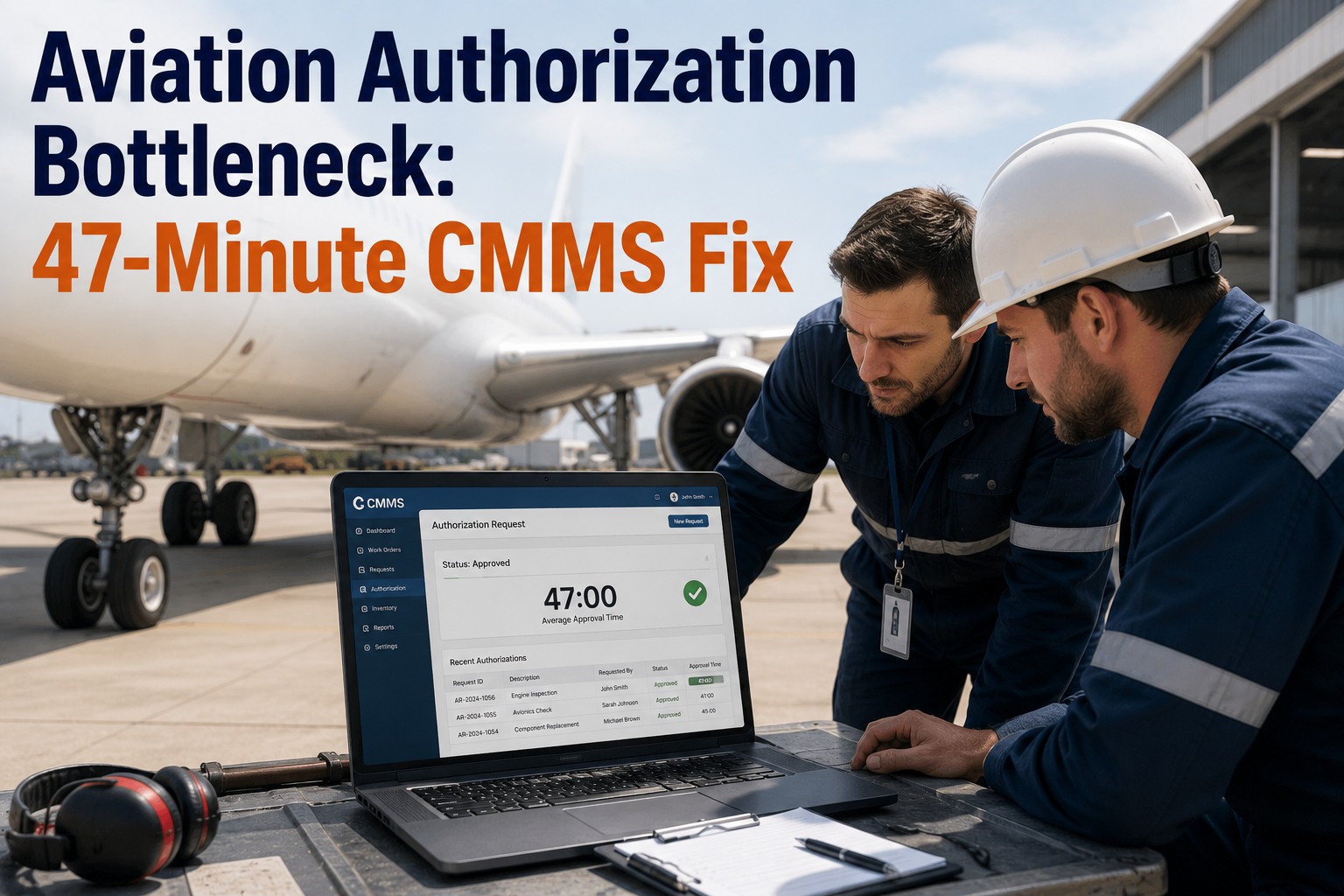
Across paper-based aviation maintenance shops, the single most underestimated source of labor waste is the authorization bottleneck — the cumulative minutes technicians spend idle while waiting for an inspector to physically sign off on a work order step. Industry observation puts that delay at roughly 47 minutes per work order in paper-driven MRO environments, which compounds into a full technician-shift every five tickets and quietly inflates aircraft ground time. A modern CMMS dissolves this bottleneck by routing sign-off requests digitally, surfacing inspector availability in real time, and escalating stalled authorizations automatically — without weakening the quality controls that AS9110 and Part 145 demand. If your shop is still chasing inspectors across hangar floors with paper travelers, the fastest way to recover that lost hour is to Start Free Trial on a CMMS built specifically for aviation MRO authorization workflows.
AVIATION MRO BOTTLENECK GUIDE · 2026
Is a paper signature really worth 47 minutes of aircraft ground time?
In paper-based MRO shops, every work order step that requires inspector sign-off stalls for an average of 47 minutes — while a licensed technician waits, the aircraft sits, and billable labor evaporates. A purpose-built aviation CMMS routes that same authorization in under three minutes.
47min
Avg. authorization wait
per work order (paper shops)
vs. under 3 min with
CMMS real-time routing
THE TRUE COST OF WAITING
Authorization delay is the silent labor sink in aviation MRO
Authorization delays do not show up as a line item on the P&L, which is exactly why they persist. But modeled against real shop throughput, the numbers are uncomfortable — and defensible.
60%
Reduction in authorization wait time after CMMS deployment
3 min
Median digital sign-off time with real-time inspector routing
22%
Of daily technician hours lost to authorization-related idle time in paper shops
1.8×
Throughput improvement on authorization-gated tasks post-CMMS
HOW CMMS ROUTING ELIMINATES THE BOTTLENECK
Four mechanisms that compress 47 minutes into three
Authorization speed is not about cutting corners on inspection rigor — it is about removing the communication friction between the technician who needs a sign-off and the inspector authorized to give it. A CMMS solves this through four layered mechanisms.
01
Digital sign-off routing
The moment a technician completes an inspection-gated task, the CMMS pushes a structured sign-off request — with task ID, relevant AD/SB references, photos, and measurement data — directly to the queue of every inspector holding the correct license and rating for that aircraft type and ATA chapter. No walking the hangar floor. No radio calls. The right request lands in front of the right inspector in under five seconds.
02
Inspector availability tracking
The CMMS maintains a live status board of every authorized inspector: current workload, active sign-offs in queue, location (hangar / line / break), and shift status. Routing logic weighs not just certification match but real-time capacity, so requests flow to the inspector who can actually respond — not the one buried under eight pending reviews on the other side of the airfield.
03
Escalation logic
If a sign-off request is not actioned within a configurable SLA window (default: 10 minutes for line maintenance, 25 for base maintenance), the CMMS automatically escalates to a secondary qualified inspector and notifies the shift supervisor. Stalled authorizations surface on a live dashboard instead of sitting undiscovered until end-of-shift review — the moment where 47-minute delays metastasize into multi-hour schedule slips.
04
Audit-grade digital trail
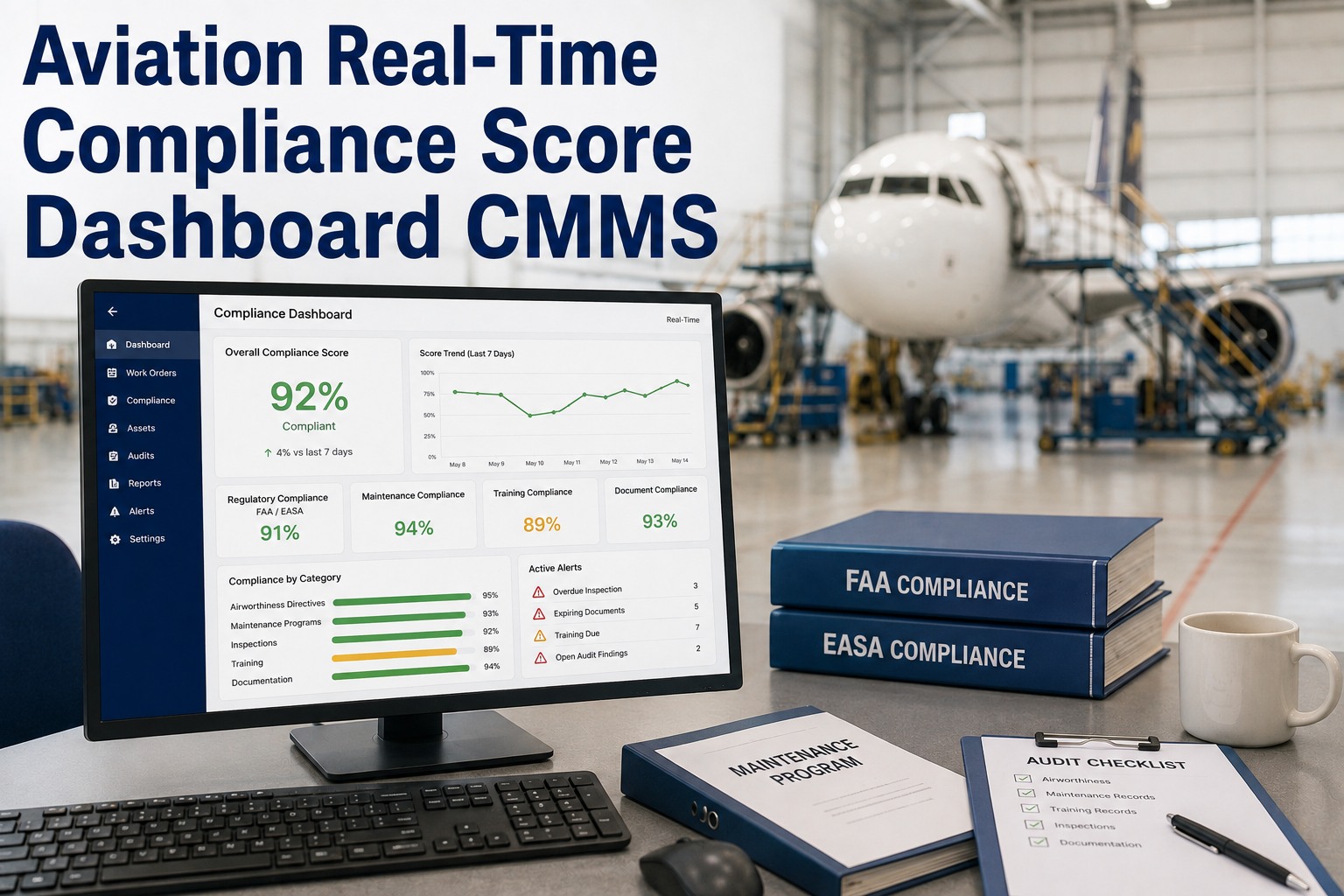
Every authorization event — request issued, inspector assigned, sign-off executed, exception flagged — is timestamped, geo-tagged, and written to an immutable log that satisfies AS9110 traceability and FAA Part 145 recordkeeping. What paper travelers lose to coffee stains and illegible signatures, the CMMS preserves as a queryable, audit-ready record with zero additional clerical effort.
PAPER VS. CMMS — WHERE THE MINUTES GO
A step-by-step breakdown of authorization time waste
The 47-minute figure is not one event — it is the sum of friction points scattered across the authorization workflow. The table below isolates each step, compares paper-based elapsed time against CMMS-routed time, and quantifies the recovered minutes per work order.
| Authorization step |
Paper-based MRO |
CMMS-routed |
Time recovered |
| Locate licensed inspector on hangar floor |
9 – 14 min |
0 min (auto-routed) |
11 min |
| Hand off paper traveler and task context |
4 – 6 min |
0 min (digital packet) |
5 min |
| Inspector reviews prior steps and references |
6 – 9 min |
2 – 3 min |
6 min |
| Physical walk-back for clarification / missing data |
5 – 12 min |
0 – 1 min (in-app comment) |
8 min |
| Sign-off execution and traveler update |
3 – 5 min |
30 sec – 1 min |
4 min |
| Escalation when inspector unavailable |
10 – 18 min |
2 – 4 min (auto-escalate) |
12 min |
| Total per work order |
~47 min |
~4.5 min |
42.5 min |
Recover 42 minutes of billable labor on every work order
A CMMS deployment that eliminates the authorization bottleneck typically pays for itself within the first quarter of operation — not through software savings, but through recovered technician hours that were already being paid for.
DEPLOYMENT TIMELINE
From paper bottleneck to CMMS-routed sign-offs in 90 days
Aviation MRO shops that move deliberately can dismantle the authorization bottleneck in a single quarter. The month-by-month timeline below reflects a typical Part 145 station with 35–60 technicians and 3–6 licensed inspectors.
MONTH 1
Audit & configuration
Map every authorization-gated task type, inspector licensing matrix, ATA chapter coverage, and current SLA expectations. Configure CMMS routing rules, escalation thresholds, and digital sign-off workflows to mirror — then tighten — existing paper procedures.
Baseline wait time established
MONTH 2
Pilot on line maintenance
Deploy CMMS authorization routing on line maintenance work orders first — lower complexity, faster cycle times, immediate feedback. Run paper and digital in parallel for two weeks, then cut over fully. Inspectors and technicians calibrate to the new queue-based workflow.
31% wait-time reduction measured
MONTH 3
Full deployment & base maintenance
Extend to base maintenance, heavy check, and modification work orders. Activate escalation logic and supervisor dashboards. Retire paper travelers for authorization-gated steps. Post-deployment audit confirms AS9110 and Part 145 traceability integrity.
62% wait-time reduction confirmed
“
We were burning a full technician-shift every day chasing inspector sign-offs across two hangars. After routing authorizations through the CMMS, our average wait dropped from close to an hour to under four minutes — and we recovered enough labor capacity to take on six additional line checks per month without adding headcount.
— Director of Maintenance, Regional Part 145 Station · 48 technicians
FREQUENTLY ASKED QUESTIONS
Authorization bottleneck, answered
The five questions below come directly from MRO managers evaluating CMMS-based authorization routing for the first time.
Does digital authorization routing weaken quality control or inspection rigor?
No. The CMMS enforces the same inspection gates as paper — it simply routes the request faster and records the sign-off with greater fidelity. Every authorization still requires a licensed inspector with the correct rating for the aircraft type and ATA chapter. What changes is the communication channel, not the control. In fact, traceability improves, because each sign-off is timestamped, geo-tagged, and tied to the specific task data the inspector reviewed.
How does the CMMS know which inspector is available and qualified?
Each inspector's profile carries their license ratings, aircraft type authorizations, ATA chapter coverage, and shift schedule. The CMMS updates real-time status — active queue depth, current location, break status — and routing logic matches the request to inspectors who hold both the qualification and the capacity to respond. You can see the full configuration in action when you
Book a Demo.
What happens if no qualified inspector responds within the SLA window?
The escalation engine triggers automatically. After the configurable SLA threshold (typically 10 minutes for line, 25 for base maintenance), the request is re-routed to the next qualified inspector and the shift supervisor receives a dashboard alert. If no secondary inspector is available, the supervisor can reassign across shifts or pull a qualified inspector from a adjacent station — all without the technician leaving the aircraft.
Can the digital sign-off trail satisfy AS9110 and FAA Part 145 audit requirements?
Yes. Every authorization event is written to an immutable log with inspector identity, timestamp, task references, attached evidence, and approval decision. The record is queryable by work order, aircraft tail number, inspector, date range, or task type — which is significantly faster to audit than pulling paper travelers from archive. Shops report audit preparation time dropping by 40–60% after cutover.
How long does it take to deploy CMMS authorization routing in an operating MRO?
A typical Part 145 station with 35–60 technicians deploys in 90 days: month one for audit and configuration, month two for a line-maintenance pilot, month three for full base-maintenance cutover and paper retirement. The CMMS can run in parallel with existing paper procedures during transition, so there is no operational gap. You can begin the configuration process today —
Start Free Trial takes under five minutes.
Stop paying technicians to wait for signatures
Every work order that stalls for 47 minutes is a technician-hour you have already paid for and will never recover. Deploy CMMS authorization routing and convert that idle time into billable capacity — typically within one quarter.
Free 14-day trial · No credit card