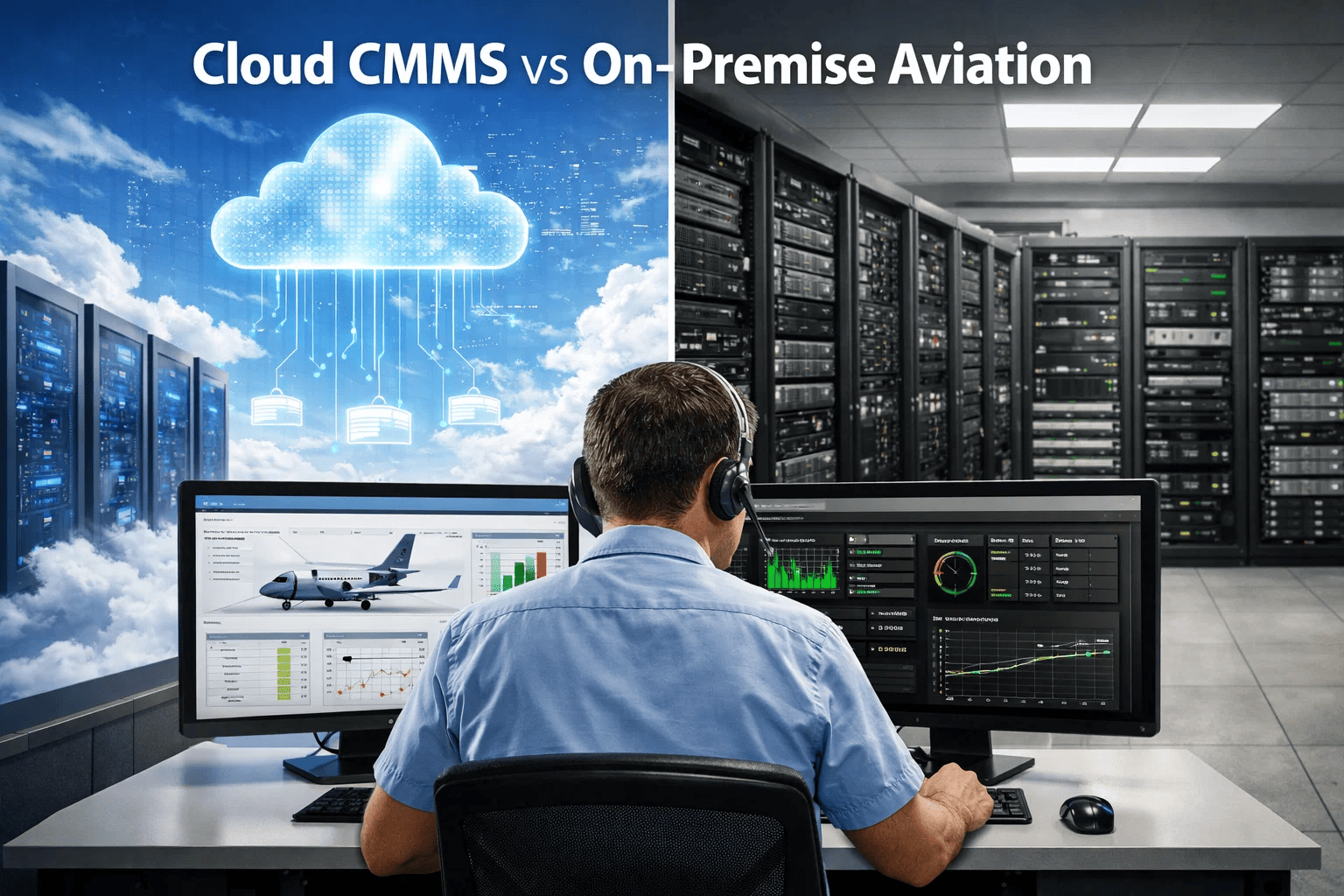
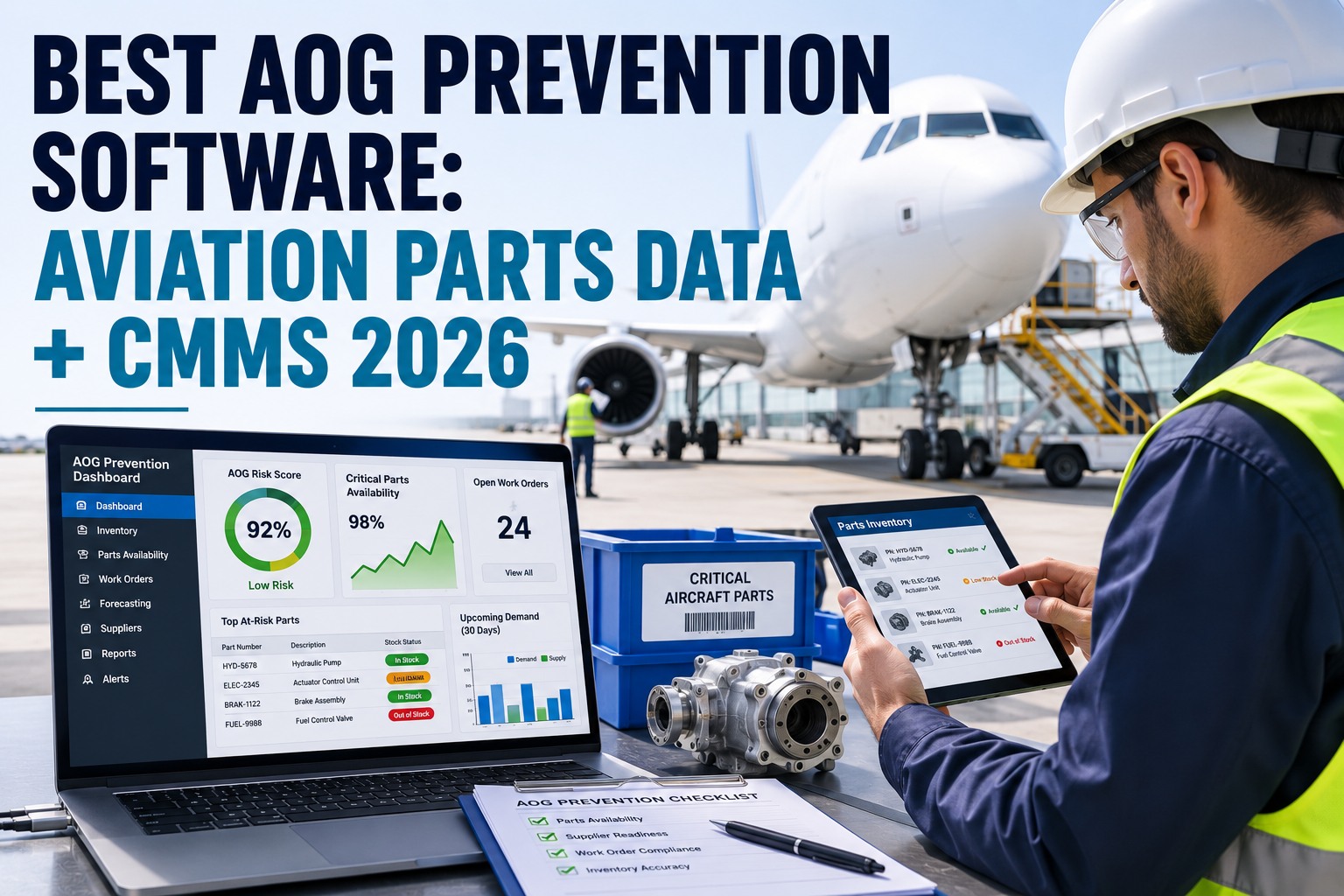
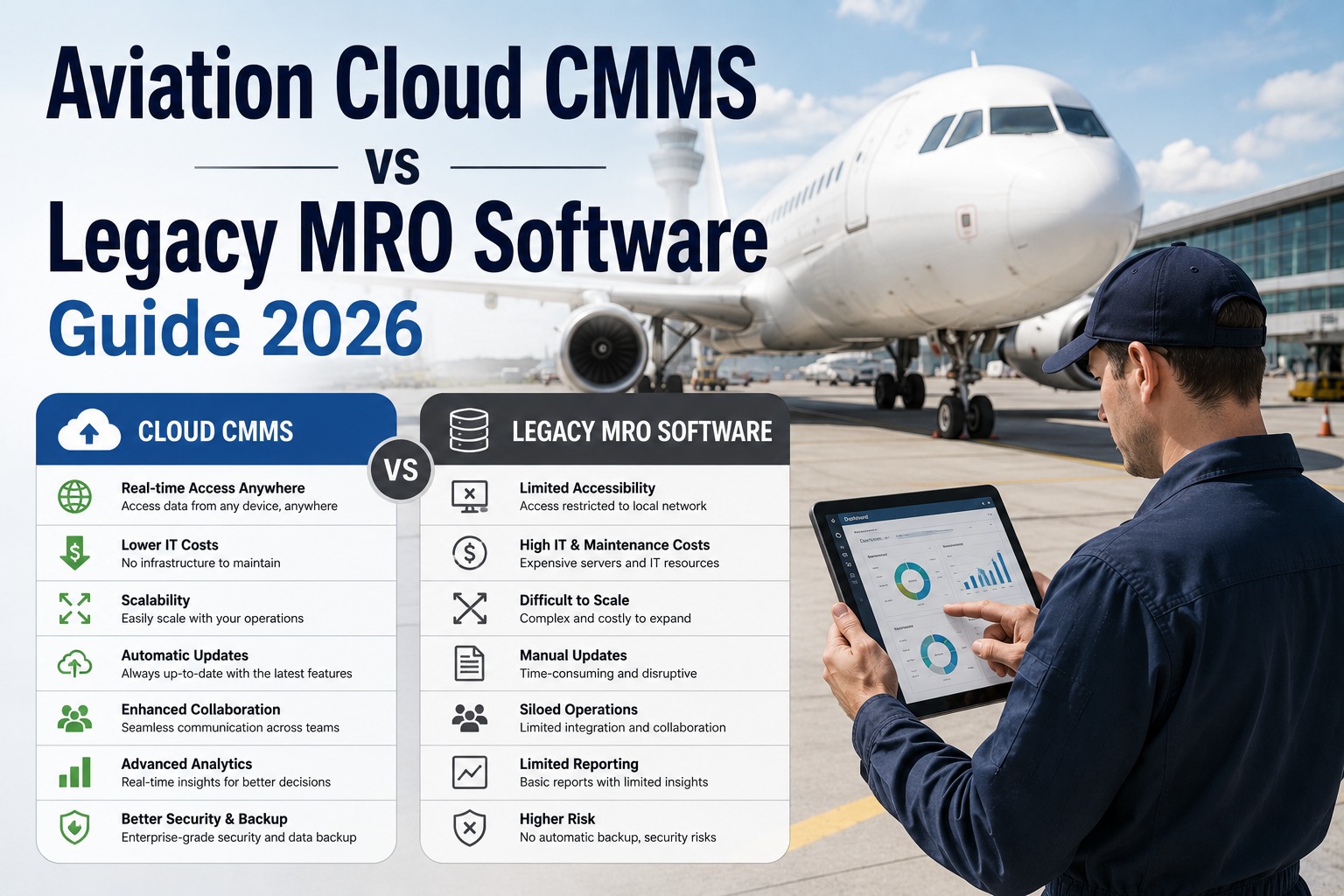
The decision your IT and operations teams are debating right now — cloud CMMS versus on-premise — will shape your MRO cost structure, compliance posture, and technician productivity for the next decade. In 2026, that decision carries more weight than ever: aviation maintenance software is no longer just a back-office tool. It is the real-time nervous system of your entire maintenance operation. Getting the architecture wrong means paying for it in AOG delays, audit failures, and infrastructure costs that compound annually. Getting it right means your maintenance team works faster, your regulators stay satisfied, and your CFO sees costs falling. Start a free trial for 30 days and experience Oxmaint's cloud-native aviation CMMS firsthand — or book a demo with our platform team today.
$13.5B
Global aviation MRO software market projected by 2030
72%
Of new MRO platform deployments in 2025 chose cloud-first architecture
40%
Lower 5-year TCO for cloud CMMS vs equivalent on-premise builds
6 weeks
Typical cloud CMMS deployment vs 9-18 months for on-premise
Your CMMS Architecture Decision Starts Here
Aviation maintenance leaders at airlines, MRO providers, and airport authorities across the USA, UK, UAE, Australia, and Germany are modernizing their maintenance platforms in 2026. The right architecture decision can reduce total maintenance costs by 25% and cut audit preparation time by 60%. Oxmaint's cloud-native CMMS is built specifically for multi-site aviation operations — no heavy implementation, no long onboarding. Ready to compare for your operation? Start a free trial and see the platform live — or book a demo for a guided walkthrough with our aviation team.
Definitions
Cloud CMMS vs On-Premise: What Each Model Actually Means
Before comparing cost tables and feature matrices, it helps to be precise about what you are actually choosing between. The two models differ not just in where software runs, but in who owns responsibility for uptime, security patching, scaling, and data access — decisions that have real operational consequences for aviation maintenance teams.
CLOUD (SaaS)
Cloud-Based CMMS
Software runs on vendor-managed infrastructure — typically AWS, Azure, or GCP data centers with 99.9%+ uptime SLAs. Your team accesses the platform via browser or mobile app. The vendor handles all server management, security patching, backups, and scaling. You pay a subscription fee. Deployment takes weeks, not months.
Subscription pricing
Vendor-managed infra
Anywhere access
Auto-updates
ON-PREMISE
On-Premise CMMS
Software runs on servers your organization owns and operates — either in your own data center or a colocation facility. Your IT team manages infrastructure, security, backups, and updates. You pay a one-time license fee plus ongoing infrastructure and support costs. Deployment typically takes 9-18 months including server procurement, configuration, and testing.
Capital expenditure
Internal IT burden
Full data control
Manual updates
Decision Factors
The Eight Dimensions That Determine the Right Choice
Aviation maintenance leaders evaluating CMMS architecture should assess eight dimensions in sequence — from cost and deployment speed to security and regulatory compliance. Each factor carries different weight depending on your organization's size, IT maturity, and operational footprint.
01
Total Cost of Ownership
Cloud CMMS carries a lower upfront cost — no server hardware, no OS licensing, no data center build. On-premise involves significant CapEx in year one (server hardware alone runs $50K-$500K for enterprise deployments) plus ongoing IT staff costs averaging $120K-$180K per year to maintain the infrastructure. Cloud 5-year TCO runs 40% lower on average.
02
Deployment Speed
Cloud CMMS platforms deploy in 4-8 weeks. On-premise builds require server procurement (12-16 weeks), OS configuration, network setup, software installation, and testing — totaling 9-18 months before a single technician logs in. In a market where MRO backlogs are measured in months, that timeline gap is a competitive disadvantage.
03
Scalability for Multi-Site Operations
Cloud platforms scale instantly — add a new MRO station in Singapore or a new airline customer without any infrastructure changes. On-premise scaling requires purchasing additional hardware, expanding data center capacity, and re-testing the environment. For aviation organizations operating across multiple bases and countries, cloud scalability is a decisive advantage.
04
Data Security and Sovereignty
On-premise gives you complete physical data control — critical for defense contractors, government-affiliated airports, and organizations under strict data residency mandates. Cloud platforms from enterprise vendors (AWS GovCloud, Azure Government) can satisfy most aviation data sovereignty requirements including ITAR, UK GDPR, and UAE Data Law, but require careful due diligence on data region selection.
05
Regulatory Compliance Support
FAA, EASA, CAAC, and CASA audits increasingly accept or prefer cloud-based records systems with digital signatures and immutable audit trails. Cloud vendors maintain compliance certifications (SOC 2 Type II, ISO 27001) that reduce your audit burden. On-premise systems require you to self-certify security controls — a significant compliance overhead for most aviation maintenance organizations.
06
Uptime and Disaster Recovery
Enterprise cloud platforms guarantee 99.9%+ uptime through geographically distributed data centers — equivalent to less than 9 hours downtime per year. On-premise systems depend entirely on your IT team's disaster recovery capabilities. Most aviation MRO on-premise builds achieve 99.5% uptime at best — translating to 43+ hours of potential annual downtime with no automatic failover.
07
Mobile and Field Technician Access
Cloud CMMS is natively mobile — technicians access work orders, aircraft records, and parts information from any device, on the ramp, in the hangar, or at a remote line station. On-premise systems typically require VPN access for field use, adding latency and complexity that frustrates technicians and reduces adoption rates by 30-40% compared to cloud alternatives.
08
Integration and IoT Capability
Cloud platforms integrate with IoT sensor networks, ACMS data feeds, ERP systems, and third-party MRO tools via standard APIs — enabling the real-time data flows that predictive maintenance requires. On-premise integration projects require custom development work that typically costs $100K-$500K per integration and takes 6-12 months to deliver.
Full Comparison
Cloud vs On-Premise CMMS: Aviation-Specific Comparison
| Evaluation Criteria |
Cloud CMMS (SaaS) |
On-Premise |
Advantage |
| Year 1 Cost |
Subscription — typically $15K-$80K/yr for mid-size MRO |
$150K-$600K+ CapEx (hardware, licenses, implementation) |
Cloud |
| 5-Year TCO |
40% lower than on-premise equivalent |
High — infrastructure, IT staff, upgrades compound annually |
Cloud |
| Deployment Time |
4-8 weeks to production |
9-18 months including hardware procurement |
Cloud |
| Uptime SLA |
99.9%+ (under 9 hours/year) |
Dependent on internal IT — typically 99.5% |
Cloud |
| Data Control |
Vendor-controlled with data residency options |
Complete physical ownership |
On-Premise |
| Security Management |
Vendor-certified (SOC 2, ISO 27001) — minimal IT burden |
Self-managed — requires dedicated security team |
Cloud |
| Software Updates |
Automatic — continuous delivery, no downtime windows |
Manual — planned maintenance windows, version lag risk |
Cloud |
| Mobile Access |
Native mobile — any device, no VPN required |
VPN-dependent — latency issues, poor UX for field teams |
Cloud |
| Multi-Site Scaling |
Instant — add sites with zero infrastructure change |
Requires hardware procurement and configuration per site |
Cloud |
| IoT / API Integration |
REST API, MQTT, OPC-UA — standard connectors available |
Custom integration projects — $100K-$500K, 6-12 months |
Cloud |
| Regulatory Audit Readiness |
Vendor-maintained compliance certifications, audit exports |
Self-certified — significant compliance overhead |
Cloud |
| Air-Gap / Offline Operations |
Limited — requires connectivity for full functionality |
Full offline capability — ideal for remote or restricted sites |
On-Premise |
Decision Guide
Which Architecture Fits Your Aviation Operation?
The right answer depends on four organization-specific variables. Use this framework to identify your optimal path before evaluating individual vendors.
You operate across multiple bases, countries, or airline customers and need unified visibility without per-site infrastructure
Your IT team has fewer than 5 dedicated infrastructure staff — on-premise maintenance will consume their capacity entirely
You need to go live within a quarter — a 9-18 month on-premise deployment timeline is operationally unacceptable
Your technicians work across multiple locations and need full mobile access without VPN complexity
You want IoT sensor integration, real-time dashboards, and predictive analytics without a major custom development project
You prefer OpEx subscription pricing that ties technology cost directly to operational usage and scales with your fleet
You handle classified defense maintenance contracts with ITAR restrictions that prohibit data touching commercial cloud infrastructure
Your operations include air-gapped environments — remote stations, military bases, or sites without reliable internet connectivity
National data sovereignty laws in your jurisdiction explicitly prohibit maintenance records from residing on foreign cloud servers
You have a mature, large IT organization with the capacity to manage server infrastructure without diverting from core responsibilities
Pain Points
Why Aviation Teams Are Moving Away From On-Premise
The majority of MRO organizations that evaluated on-premise in 2023-2025 and chose cloud instead cited the same set of operational frustrations. These are not theoretical concerns — they are recurring problems that maintenance directors report across the USA, UK, UAE, Australia, and Germany.
COST SPIRAL
Hidden Infrastructure Costs Exceed Projections by 60%+
Server hardware, SAN storage, OS licensing, database licensing, backup systems, disaster recovery hardware, and dedicated IT staff combine to push actual 5-year on-premise costs 60-80% above initial estimates. CapEx that looked manageable in year one compounds into a cost structure that rivals building a small data center.
ADOPTION FAILURE
VPN-Based Mobile Access Kills Field Team Adoption
On-premise CMMS systems accessed via VPN on the ramp or in the hangar experience connection drops, latency spikes, and authentication timeouts that frustrate technicians. Adoption rates for on-premise systems with VPN-based mobile access are typically 30-40% lower than cloud-native equivalents — meaning the investment in the platform never fully returns.
VERSION LAG
Update Cycles Leave Teams on Outdated Software for Years
On-premise software updates require planned maintenance windows, IT testing, and stakeholder coordination. Most aviation MRO organizations running on-premise CMMS are 2-4 major versions behind the current release — missing predictive analytics features, regulatory reporting improvements, and security patches that cloud users receive automatically.
SCALE LIMITS
Adding Sites or Customers Requires Infrastructure Projects
Every new maintenance station, airline customer, or geographic expansion triggers an infrastructure procurement and configuration project that takes months. MRO organizations that have won new contracts but cannot onboard customers quickly due to on-premise scaling limitations are losing revenue while their cloud-first competitors activate new customers in days.
Oxmaint Solution
How Oxmaint's Cloud-Native Architecture Solves Aviation MRO Challenges
Oxmaint is built cloud-first — not a legacy on-premise system ported to a browser. Every architectural decision in the platform was made assuming multi-site operations, mobile-first technician workflows, real-time IoT data ingestion, and regulatory-grade audit trails. The result is a CMMS that gives aviation maintenance teams enterprise capability without enterprise implementation timelines or costs.
ARCHITECTURE
Multi-Tenant Cloud with Data Isolation
Each organization's data is logically isolated and encrypted at rest and in transit — meeting aviation data security requirements without the cost of a dedicated single-tenant deployment.
MOBILE
Native Mobile for Ramp and Hangar Teams
iOS and Android apps with offline capability for low-connectivity environments. Technicians access work orders, aircraft records, parts data, and inspection checklists from the ramp with no VPN required.
INTEGRATION
IoT and SCADA Ready Out of the Box
REST API, MQTT, and OPC-UA connectors allow real-time sensor data from ground support equipment, HVAC systems, and aircraft gateways to flow directly into maintenance workflows without custom development.
COMPLIANCE
Audit-Ready Records with Digital Signatures
Every work order, inspection, and sign-off is time-stamped and digitally signed. FAA, EASA, and CAAC audit exports are generated in minutes — not the days of manual document retrieval that on-premise systems require.
FORECASTING
Rolling 5-10 Year CapEx Models
Asset condition scores feed automatically into CapEx forecasting models that give finance teams and ownership groups investor-grade reporting on maintenance spend and component replacement timelines — not spreadsheet guesswork.
SCALE
Portfolio-Level Multi-Site Management
Manage unlimited MRO stations, airline customers, and asset types under a single platform login. Oxmaint's hierarchy — Portfolio, Property, System, Asset, Component — maps directly to the structure of multi-base aviation operations.
Oxmaint deploys in 4-6 weeks with no heavy implementation fees. Aviation maintenance teams from regional operators to multi-continent MRO networks are live on the platform in weeks, not fiscal years. Start a free trial and configure Oxmaint for your fleet today — or book a demo with our team for a full walkthrough of the cloud architecture and compliance features.
What Aviation Teams Achieve With Cloud CMMS in 24 Months
40%
Reduction in unplanned maintenance events
Through condition-based monitoring and automated PM scheduling
25%
Lower total MRO cost over 5 years vs on-premise
Including elimination of infrastructure CapEx and IT overhead
60%
Faster regulatory audit preparation
Digital records and export tools replace days of manual document retrieval
6 weeks
Average deployment time vs 9-18 months on-premise
Your team is productive months before an on-premise build would go live
Hybrid Option
The Hybrid Model: When Neither Pure Cloud Nor Pure On-Premise Fits
Some aviation organizations — particularly defense MRO providers, government airport authorities, and operators with air-gapped remote stations — operate in a middle ground where pure cloud raises data sovereignty concerns but full on-premise would sacrifice too much agility. A hybrid architecture addresses this.
01
Edge Processing at Restricted Sites
Sensitive or air-gapped maintenance data is processed locally at restricted sites. Non-sensitive operational data and analytics sync to cloud when connectivity is available. Technicians work uninterrupted regardless of network status.
02
Private Cloud Deployment
The CMMS platform runs on dedicated cloud infrastructure in a specific geographic region — meeting data residency requirements while retaining the management benefits of cloud. AWS GovCloud, Azure Government, and region-specific deployments serve this use case.
03
Federated Multi-Region Architecture
Large MRO networks with operations across multiple jurisdictions — USA, UAE, Germany, UK — can run region-specific instances that federate for portfolio-level reporting while keeping local data within regulatory borders. Data crosses jurisdictions only in aggregated, anonymized form.
04
On-Premise Core, Cloud Analytics Layer
Organizations with existing on-premise CMMS investments can add a cloud-based analytics and reporting layer that ingests data from the on-premise system without migrating it. This delivers real-time dashboards and predictive analytics while preserving the existing infrastructure investment.
FAQ
Frequently Asked Questions
Is cloud CMMS secure enough for aviation maintenance records?
Yes, for the vast majority of commercial aviation maintenance operations. Enterprise cloud CMMS vendors maintain SOC 2 Type II, ISO 27001, and often ISO 27017 and ISO 27018 certifications — representing security postures that most MRO organizations could not afford to replicate internally. Encryption at rest (AES-256) and in transit (TLS 1.3), role-based access controls, multi-factor authentication, and immutable audit logs are standard features. The only aviation contexts where on-premise genuinely outperforms cloud on security are classified defense contracts with ITAR restrictions or operations in jurisdictions with explicit public cloud prohibitions. For commercial MRO, cloud is at least as secure as on-premise and typically more so.
What happens to our maintenance records if the cloud vendor goes out of business?
This is a legitimate due diligence question, and a well-drafted SaaS contract addresses it directly. Before signing any cloud CMMS agreement, verify: (1) you have a right to export all data in standard formats (CSV, XML, JSON) at any time and upon termination; (2) the vendor provides a data escrow arrangement or source code escrow in case of bankruptcy; (3) your SLA specifies a minimum data retention period post-termination (typically 90 days). Additionally, evaluate vendor financial stability — established cloud CMMS providers backed by institutional investors present far lower risk than on-premise software from vendors who may stop supporting their product without a public cloud shutdown event providing notice.
Can cloud CMMS work in environments with unreliable internet connectivity?
Modern cloud CMMS platforms including Oxmaint offer offline-capable mobile applications that allow technicians to access work orders, record maintenance actions, and complete inspection checklists without internet connectivity. Data syncs automatically when connectivity is restored. For fixed maintenance stations with unreliable WAN connectivity, a local caching layer can maintain full functionality during internet outages. The practical threshold where on-premise becomes technically superior to cloud is genuinely air-gapped environments — remote military bases, secure facilities, or maritime operations — where no internet connectivity exists at all. For everything else, including remote regional airports and developing-market operations, cloud with offline mobile capability is the correct choice.
How does migrating from on-premise CMMS to cloud affect existing maintenance records and workflows?
Cloud migration from an existing on-premise CMMS follows a structured process: data extraction from the legacy system in standard formats, data transformation and validation, import into the cloud platform, parallel operation during verification, and cutover. For aviation MRO specifically, the critical elements are preserving complete aircraft maintenance history with audit trail integrity, maintaining all work order references and part records, and ensuring regulatory documentation meets continuous airworthiness requirements during the transition period. Oxmaint's implementation team manages this process and has executed migrations from legacy systems including SAP PM, IFS, and AMOS. Typical migration timelines are 6-12 weeks depending on data volume and complexity, with zero loss of historical records.
Make the Right Call for 2026
Aviation-Grade CMMS That Deploys in Weeks, Not Months
Oxmaint's cloud-native maintenance platform gives aviation MRO teams real-time asset tracking, IoT-connected work orders, regulatory-ready audit documentation, and portfolio-level reporting — without the infrastructure cost, implementation timelines, or IT overhead that on-premise demands. Used by maintenance teams across the USA, UK, UAE, Australia, and Germany.